I. INTRODUCTION
The idea of fuzzy uncertainty as a major role occurs in all fields of science and engineering domains and it was initially developed by Zadeh [17]. Many scientists concentrated the fuzzy uncertainty to predict the fuzzified solution of the applications. The idea of fuzzification in group into uncertainty subgroup is introduced by Rosenfeld [14]. This is the first uncertainty filation of any quantity of algorithmic structures and newly expressed in another dimension in the different fields of science and engineering. The uncertainty is initially discussed through the n-ary systems by Kasner [7] and Dudek [2]. Furthermore, extension of this uncertainty on n-ary groups introduced by Dornte [6]. The uncertainty of n-ary groups as a generalization of uncertainty subgroup discussed by Davvz in [5]. Atanassov [1] introduced the axioms of set properties with notations in uncertainty sets. Dudek [3] has established the axioms of set properties along with basic notations using n-ary systems. Investigate of uncertainty n-ary subgroups introduced by [13]. The fermatean uncertainty sets was initially introduced by Senapathi and Yager [15]. D. Molodtsov's introduced the concept of soft sets in [11]. Followed by, the cubic fermatean uncertainty soft ideal structures, defining basic notions in soft sets along with suitable applications were presented in [9]. R.Nagarajan studied fermatean uncertainty multi-group over multi-homomorphism [12].
In this paper, an extension of the fermatean uncertainty soft subgroup structures under a norm. Also, the cubic fermatean uncertainty soft ideal structures and fermatean uncertainty multi-group over multi-homomorphism are discussed in detail.
The rest of the article is structured as follows: Section 2 explained the preliminaries related to the present study. Section 3 presented an extension fermatean uncertainty under normal subgroups such important theoretical proofs, corollaries and numerical examples related to these results. Conclusions and future research directions are presented in Section 4.
II. PRELIMINARIES
Let be a non-empty set. Define be an n-dimensional groupoid as a mapping , . Let be the sequence of elements in n-dimensional groupoids denoted by . The symbol is a set of symbols commonly denoted by . Mathematically, we write and .
Ref For any then n-dimensional groupoid is called -associative if it satisfies
For all , the above operation is associative then is said to be an n-dimensional semi group. Moreover, the n-dimensional groupoid satisfies associative condition if and only if it is called -associative for all . In binary case, the value of n = 2 is called usual semi group. Let with an integer , there exists an object z in G such that
The above Eqn. (1) is known as i-solvable or solvable at the place 'i'. If the solution is unique then Eqn. (1) is uniquely i-solvable.
For , an n-dimensional groupoid is uniquely solvable then it is called an n-dimensional quasigroup. An n-dimensional quasigroup satisfies the associative property then it is called n-dimensional group.
For , the element in an n-dimensional operation defines binary operation . If is an n-dimensional group the is a group. Followed by the nature of different groups were obtained based on the element . In all cases, these groups are isomorphic to each other [4]. So, we can consider only the groups of the form satisfies the operation . In this group, take e = c then .
Dudek and Michalski et. al [4] proved the result is as follows: For the elements in an n-dimensional group , there exists a group with automorphism satisfies
Senapati and Yager et. al [15]: Let X be a universe of discourse. The operation F in X is a fermatean uncertainty set (FUS) defined by with corresponding membership functions and satisfies . Herein, denotes the degree of membership and non-membership of an element .
Senapati and Yager et. al [16]: For any FUS, the elements the degree of an indeterminacy is given by . The ordered pair of the membership functions is the fermatean uncertainty number (FUN) denoted by .
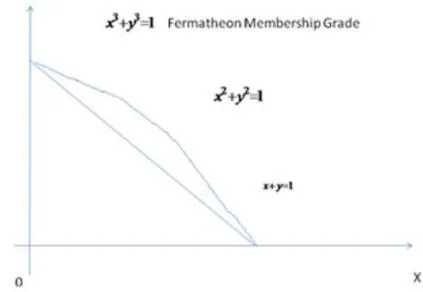
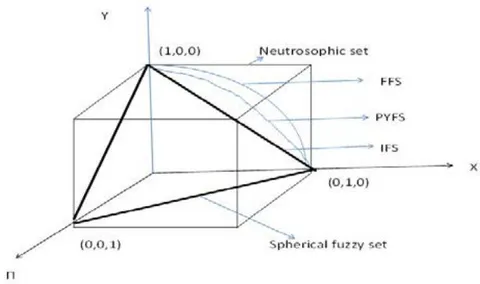
Senapati and Yager et. al [15]: The degree of the set of fuzzy membership functions are more than the degrees of both set of Pythagorean membership grades and bi-uncertainty membership grades. These membership grades are graphically plotted in Figure 2.2.
Davvaz and Dudek et. al [5]: An extension uncertainty subgroup (EUSG) in an n-dimensional group on satisfies following axioms
Put n=3 in the above condition (EUSG ) we get is
For every , there exists a natural number p such that where indicates the skew elements and . W.A. Dudek et. al: describes an uncertainty over n-dimensional subgroups satisfies .
Followed by the above backgrounds scope of the study, we discussed the theorems in Fermatean uncertainty of normal subgroups with suitable numerical examples.
Notes
III. EXTENSION FERMATEAN UNCERTAINTY OF NORMAL SUBGROUPS
In this section, an extension fermatean uncertainty (T, S) normal subgroup with related theorems, corollary with suitable examples are discussed in detail.
Definition 3.1: A collection of Fermatean uncertainty in is said to be an extension fermatean uncertainty (T, S) under normal subgroup of satisfies the following axioms:
Example 3.2: Let be an extension Fermatean uncertainty subgroup. Define a mapping defined by .
Consider, is a 4-dimensional additive subgroup of an integer modulo 4. Let be the fermatean uncertainty collection in given by
The above fermatean uncertainty collection satisfies an extension fermatean uncertainty subgroup of .
Theorem 3.3: If is an arbitrary family of an extension fermatean uncertainty subgroup of then is also an extension fermatean uncertainty subgroup of given by
Proof: According to Definition 3.1: the proof of this theorem obviously satisfied.
Theorem 3.4: Let be a collection of fermatean uncertainty in is an extension fermatean uncertainty subgroup of with operation satisfies .
Notes
Proof: From Definition 3.1: the membership function satisfies the axioms and .
Let then the membership function can be written as
And
Hence, the notion is an extension of fermatean uncertainty subgroup of .
Definition 3.5: Let be a fermatean uncertainty collection in . Let with the bounds of membership function on is defined by
Herein, the symbol and denotes the level k-cut in G.
The consequence of the following theorems to be proved based on the results discussed in [Dudek].
Theorem 3.6: Let A be the fermatean uncertainty collection in G with the image and is also an extension fermatean uncertainty subgroup of . If and only if the -level k-cut and -level k-cut of G are extension subgroups of for every such that , which are known as -level extension subgroups and -level extension subgroups respectively.
Proof: Let A be an extension fermatean uncertainty subgroup of . If and , then for all thus
this implies and and
Notes implies .
Moreover, for some and we have
implies and .
Thus, -level k-cut and -level k-cut are also an extension subgroup of . Conversely, assume that both -level k-cut and -level k-cut are extension subgroup of .
Define
For some then and ,
Consequently and .
Thus, .
Taking and then
Thus, and .
Since, by the assumption, and , Where and .
This completes the proof.
Theorem 3.7: Let A be the fermatean uncertainty collection in G is an extension fermatean uncertainty subgroup of if and only if and of G are also extension subgroup of . For each and satisfies the following conditions:
Notes (ii)
Proof: According to Theorem 3.6, for each non-empty level subsets both and are closed under operation in with and satisfies and .
For some and we have , where satisfies and . From the above conditions (iii) and (iv), we have and . Therefore, and is a solution of Eqn.(1). Conclude that both level k-cuts and is also an extension subgroups in G.
Conversely, assume that both level k-cuts and in G be an extension subgroups then the following conditions in (i) and (ii) are proved.
For we consider
then it satisfies and
According to Definition 3.1: then we obtained as and .
Thus, and satisfies the conditions (iii) and (iv).
Definition 3.8: The subgroups and are under fermatean extension and for any define a homomorphism map: defined by
The above homomorphism map is said to be a fermatean extension homomorphism. For any fermatean uncertainty collection , we define a pre image of A under is denoted by . Also, the fermatean uncertainty collection in G is defined by
Where, and .
For any , the symbol as the image of A under is also a fermatean uncertainty collection in defined by .
For all and then
Notes
Theorem 3.9: For all , an into map is defined by . If be an extension fermatean uncertainty subgroup of then is also an extension fermatean uncertainty subgroup under .
Proof:
Converse part is obviously true to be discussed in Theorem 3.10.
Theorem 3.10: Let be an extension homomorphism. If is an extension fermatean uncertainty subgroup of then is also an extension fermatean uncertainty group of .
Theorem 3.11: Let be a map. If is an extension fermatean uncertainty subgroup of then is also an extension fermatean uncertainty subgroup of .
Proof: Let be a map and for any then
Hence the Theorem is proved.
Corollary 3.12: A fermatean uncertainty collection on is a fermatean uncertainty subgroup iff it satisfies the following relations for any given by
Notes
Theorem 3.13: Let A be a collection of an extension fermatean uncertainty subgroup . For any , there exist such that and then A is an extension fermatean uncertainty subgroup of .
Proof: For each , we have the relation
Also, we write
In theorem 3.13, for that we have and .
This completes the proof. Followed by the numerical example is discussed here.
Example 3.14: Define a map: on defined by . Clearly, the ternary subgroup obtained from under this map. The fermatean uncertainty collection is given by
Hence, for that we have and .
Theorem 3.15: Let A be an extension fermatean uncertainty subgroup of . For any satisfies and then A is an extension fermatean uncertainty subgroup under .
In general, for any , then the relation is true.
Similarly,
In general, for any , then the relation is true.
For every , the following relations are obviously true. We have,
thus,
Notes
Finally, we have,
Thus
This result is derived.
Corollary 3.16: Let be a ternary group. For any fermatean uncertainty subgroup is also a fermatean uncertainty ternary subgroup under .
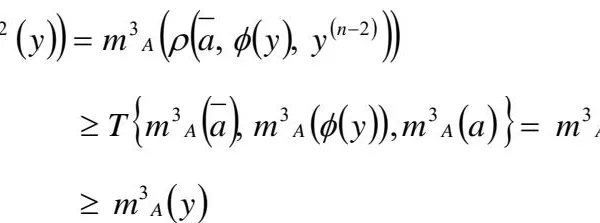
Proof: Let be an intermediate element of . For each , the following inequalities are and .
then we have and
Notes But in ternary group (involution operator). For any we have
So,
The above relations are satisfying the Theorem 3.15. Followed by the numerical example is discussed here.
Example 3.17: Define a map: under the additive group defined by . Let be a fermatean uncertainty subgroup of induced by subgroups , and .
Define the fermatean uncertainty collection A as follows
Then, is not greater than are equal to .
is not less than are equal to
Hence, the collection A is not a fermatean uncertainty ternary subgroup.
Remarks 3.18: From Example 3.17, the following results are true.
(i) The fermatean uncertainty subgroups of group are not an extension fermatean uncertainty subgroups.
(ii) In Theorem 3.15: the conditions and cannot be neglected. Also, in the Example 3.17: we have is not greater than are equal to and is not less than are equal to .
Notes (iii) The relations and cannot be replaced by and , where is an identity element of . In Example 3.17, for any , T = 11 then and .
Theorem 3.19: An extension subgroup of b-derived group . For any collection A in an extension fermatean uncertainty subgroup under such that and , is also an extension fermatean uncertainty subgroup under .
Proof: According to the extension principle rules (EFUSG ) and (EFUSG ) defined in Definition 3.1: to prove the extension principle rules (EFUSG ) and (EFUSG ) under the extension group , the b-exempted from an extension fermatean uncertainty subgroup gives
Followed by for each ,
This completes the proof of the result.
Corollary 3.20: For any fermatean uncertainty group of a group is an extension fermatean uncertainty subgroup of obtained by .
Proof: An extension group is obtained from by substituting an element b = e in Theorem 3.19 gives the relations , , . Therefore,
is not greater than are equal to
is not less than are equal to
Hence, the collection is not a fermatean uncertainty ternary subgroup of .
IV. CONCLUSIONS
Notes
We explained different aspects of cubic fermatean uncertainty soft ideal structures and fermatean uncertainty multi-group over multi-homomorphism. An extension of this fermatean uncertainty study using soft subgroup structures with norm. Moreover, we discussed the important mathematical proofs as Theorems, corollaries and suitable examples. In future, we extended this research into field of picture uncertainty collection and spherical uncertainty collections.