
Introduction
Warehouses that handle hazardous materials operate under strict conditions. Fires, explosions, or toxic releases can escalate quickly, harming people, assets, and reputation. International frameworks exist, yet day-to-day practices often falter without strong culture and disciplined systems. Organizations that treat process safety as a core value, demonstrated through clear expectations, visible leadership, and consistent learning, achieve consistent compliance and fewer incidents than those relying on periodic audits alone [1]. Leadership behaviours that make risk “talkable” on the shop floor, including walkthroughs, inquiry into weak signals, and consistent follow-through on actions, are repeatedly linked to better adherence and reporting quality [2].
This paper focuses on translation: turning recognized frameworks into daily discipline in warehouses. It proposes a practical, integrated program and shares evidence from a real world implementation that aligns leadership, people, procedures, and technology to reduce risk while improving efficiency [3].
Literature Review
Authoritative guidance converges on a lifecycle view of risk: identify hazards, evaluate and prioritize, implement engineered and administrative controls, verify performance, and learn systematically. Enterprises that embed these routines into business management, rather than treating them as an adjunct, sustain better results because barriers are actively maintained rather than intermittently checked [3]. Culture is the substrate. When safety is explicitly valued and resourced, reporting improves, weak signals surface earlier, and corrective actions are completed [1].
Human and organizational factors frequently precede technical failures in hazardous-chemical storage. Investigations and syntheses point to role ambiguity, training gaps, and supervision lapses as recurrent precursors to incidents. Programs that pair clear responsibilities with role specific competency frameworks see less procedural deviations and better emergency performance, especially when job aids and contractor integration are included from the outset [5]. Case histories underscore the point. Organizations tend to learn the same lessons repeatedly when they underinvest in knowledge capture and handover, or when procedures are complex but not usable under time pressure [9].
Digital tools help close visibility gaps that enable incidents. In warehouses, shelf-life dashboards, barcode and RFID tracking, and bilingual GHS labelling prevent the accumulation of expired or misidentified stock. Environmental sensing for Volatile Organic Compounds (vOCs) and temperature, combined with analytics, can detect abnormal conditions or risk trajectories earlier than manual rounds. Studies show that predictive or data-assisted approaches improve readiness, provided they are embedded in management routines and used by competent personnel rather than treated as standalone fixes [6].
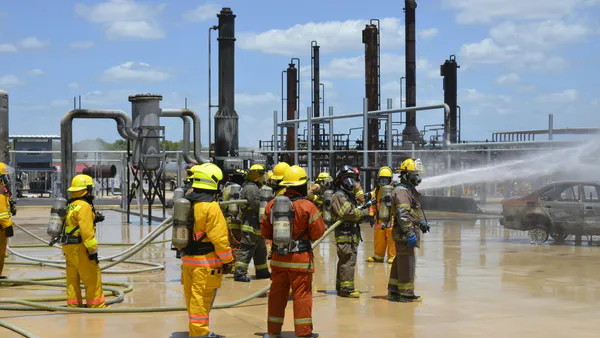
Operational discipline binds the system together. Warehousing requires compatibility-based segregation, secondary containment for liquids, controlled transfer, and accessible SDS and labelling. Emergency readiness should be exercised through drils, with findings feeding continuous improvement. Organizations that maintain process knowledge, including current procedures, change history, and lessons learned, are better at sustaining controls over time and through turnover [4,10]. Positive reinforcement also matters. Recognition tied to leading indicators such as inspection quality, near-miss reporting, and housekeeping helps make safe performance habitual when paired with a culture that protects openness [2,11]. At the governance level, broad stakeholder participation and clear risk-decision processes improve legitimacy and uptake of controls, complementing internal management systems in complex chemical contexts [12].
Method / Approach
We applied a designed science approach, with success factors informed by established research, best practices, and field insights from chemical warehousing. The resulting framework integrates six mutually reinforcing elements expressed in plain managerial terms rather than as a checklist: a cross-functional governance mechanism that assigns clear accountability, technology that provides real-time visibility into materials and conditions, role based competency with initial training, refreshers, and drills, leadership routines that make risk salient through walkthroughs, action tracking, and KPls, positive reinforcement that recognizes leading indicators without suppressing reporting, and operational controls across the full chemical lifecycle from receiving and segregation to transfer, waste handling, and emergency response [1,3].
Context and evaluation. The framework was implemented in a large industrial warehouse handling flammables, corrosives, and specialty chemicals. Pre-intervention issues included aging stock, variable labelling quality, and audit observations. Over approximately six months, the site established a chemical safety committee and a single-point owner; deployed electronic inventory with a shelf-life dashboard, bilingual labelling workflows, and environmental sensors;rolled out role-based training and drills; initiated monthly leadership walkthroughs and action logs; refreshed no-blame reporting; launched light-touch recognition for leading indicators; and revised SOPs and emergency plans to reflect current codes and best practice [4,14]. Performance was observed for another six months using leading and lagging indicators and staff safety-climate feedback [4].
Findings / Discussion
Proactive hazard mitigation improved markedly. The established shelf-life dashboard, combined with leadership reviews, supported early redeployment or safe and environmental disposal of at-risk stock before expiry. This overcomes challenges and emphasis on maintaining barriers rather than merely documenting them [3]. Direct-shipping of selected high-risk chemicals to end users reduced on-site volumes and simplified segregation, which lowered risk while improving space utilization [4].
Competency and culture strengthened in tandem. Role-based training and drills improved inspection quality, secondary labelling accuracy, and PPE discipline. Near-miss reporting rose and suggestions increased, which are healthy leading indicators of psychological safety and learning. This trajectory is consistent with human-factors guidance: when responsibilities are clear, tools are usable, and leaders are present and responsive, people follow procedures under real conditions rather than only in audits [5].
Compliance performance became more predictable. Consecutive internal audits closed timely, and an external regulatory inspection recorded no findings. The mechanism is straightforward. Technology creates visibility, leadership routines trigger timely action, competency enables correct execution, and operational controls provide the standard work. These elements reinforce one another in a manageable cadence [1].
Positive reinforcement supported attention and pride. A lightweight recognition approach tied to leading indicators, including near-miss reporting and closure of actions, helped sustain vigilance without distorting incentives. Evidence from controlled studies suggests such designs can improve safety behaviours when they reward improvement and transparency rather than raw “zero” counts [11].
Technology was fundamental in enabling visibility. Data streams for inventory status and sensor alerts mattered because leaders reviewed them on a schedule and supervisors translated them into field actions. This integration echoes findings that predictive or intelligent assessments only improve outcomes when they are embedded in routines and used by trained people who understand the hazards they are managing [6].
Limitations & Future Work
The evaluation is single-site and sector-specific. Generalizability would be improved by applying the framework in additional warehouses across different industries and regulatory contexts. Causal inference is constrained without a control site. Future work should use pre and post-statistical tests on incident rates and validated safety-climate scales, along with cost— benefit analysis of safety investment versus waste avoidance and insurance or downtime. A longer horizon of three to five years is needed to assess durability. At the component level, research should compare training modalities such as Virtual Reality (VR) simulation versus drills, refine incentive metrics to maximize learning, and test predictive analytics for early anomaly detection while avoiding alarm fatigue. These steps align with established risk analysis principles for maturing safety programs [13].
Conclusion
Warehouse chemical safety improves most when culture, competence, control, and technology operate as a system. The framework presented here, which combines governance with clear accountability, real-time visibility into stock and conditions, role-based competency and drills, leadership routines that keep risk front of mind, recognition for leading indicators within a just culture, and rigorous lifecycle Standard Operating Procedures SOPs, translated guidance into daily discipline. The results show that risk declines when leaders act on fresh information, people are trained and equipped to do the right thing under pressure, and operations are standardized and rehearsed. Managers seeking rapid and credible progress should institutionalize leadership walkthroughs, shelf-life and inventory dashboards with environmental sensing, competency matrices with drills, and recognition that rewards openness and improvement. Sustained measurement and learning will extend gains across sites and supply chains. The essential shift is from episodic compliance to everyday reliability, which is safer, steadier, and better aligned with contemporary operational excellence goals [1,4].