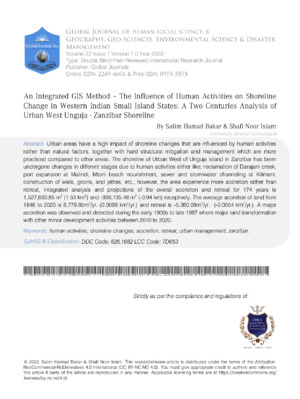
An Integrated GIS Method – The Influence of Human Activities on Shoreline Change in Western Indian Small Island States: A Two Centuries Analysis of Urban West Unguja – Zanzibar Shoreline

α
Salim Hamad Bakar
Salim Hamad Bakar
σ
Shafi Noor Islam
Shafi Noor Islam

Send Message

To: Author

An Integrated GIS Method – The Influence of Human Activities on Shoreline Change in Western Indian Small Island States: A Two Centuries Analysis of Urban West Unguja –  Zanzibar Shoreline

Article Fingerprint

ReserarchID

101ZR

An Integrated GIS Method – The Influence of Human Activities on Shoreline Change in Western Indian Small Island States: A Two Centuries Analysis of Urban West Unguja –  Zanzibar Shoreline Banner

AI TAKEAWAY

Connecting with the Eternal Ground
  • English
  • Afrikaans
  • Albanian
  • Amharic
  • Arabic
  • Armenian
  • Azerbaijani
  • Basque
  • Belarusian
  • Bengali
  • Bosnian
  • Bulgarian
  • Catalan
  • Cebuano
  • Chichewa
  • Chinese (Simplified)
  • Chinese (Traditional)
  • Corsican
  • Croatian
  • Czech
  • Danish
  • Dutch
  • Esperanto
  • Estonian
  • Filipino
  • Finnish
  • French
  • Frisian
  • Galician
  • Georgian
  • German
  • Greek
  • Gujarati
  • Haitian Creole
  • Hausa
  • Hawaiian
  • Hebrew
  • Hindi
  • Hmong
  • Hungarian
  • Icelandic
  • Igbo
  • Indonesian
  • Irish
  • Italian
  • Japanese
  • Javanese
  • Kannada
  • Kazakh
  • Khmer
  • Korean
  • Kurdish (Kurmanji)
  • Kyrgyz
  • Lao
  • Latin
  • Latvian
  • Lithuanian
  • Luxembourgish
  • Macedonian
  • Malagasy
  • Malay
  • Malayalam
  • Maltese
  • Maori
  • Marathi
  • Mongolian
  • Myanmar (Burmese)
  • Nepali
  • Norwegian
  • Pashto
  • Persian
  • Polish
  • Portuguese
  • Punjabi
  • Romanian
  • Russian
  • Samoan
  • Scots Gaelic
  • Serbian
  • Sesotho
  • Shona
  • Sindhi
  • Sinhala
  • Slovak
  • Slovenian
  • Somali
  • Spanish
  • Sundanese
  • Swahili
  • Swedish
  • Tajik
  • Tamil
  • Telugu
  • Thai
  • Turkish
  • Ukrainian
  • Urdu
  • Uzbek
  • Vietnamese
  • Welsh
  • Xhosa
  • Yiddish
  • Yoruba
  • Zulu

Abstract

Urban areas have a high impact of shoreline changes that are influenced by human activities rather than natural factors, together with hard structural mitigation and management which are more practiced compared to other areas. The shoreline of Urban West of Unguja Island in Zanzibar has been undergone changes in different stages due to human activities either like; reclamation of Darajani creek, port expansion at Malindi, Mtoni beach nourishment, sewer and stormwater channeling at Kilimani, construction of walls, groins, and jetties, etc., however, the area experience more accretion rather than retreat, integrated analysis and projections of the overall accretion and retreat for 174 years is 1,527,693.85 m 2 (1.53 km 2 ) and -936,135.48 m 2 (-0.94 km) receptively. The average accretion of land from 1846 to 2020 is 8,779.85m 2 /yr. (0.0088 km 2 /yr.) and retreat is -5,380.09m 2 /yr. (-0.0054 km 2 /yr.). A major accretion was observed and detected during the early 1900s to late 1987 where major land transformation with other minor development activities between 2010 to 2020.

References

28 Cites in Article
  1. Paul Watkiss,Alistair Hunt (2012). Assessing climate-resilient development options.
  2. David Obura (2017). Ocean Health in the Blue Economy.
  3. Unwto (2014). Tourism in Small Island Developing States (SIDS) – Building a more sustainable future for the people of Islands.
  4. E Ali,I El-Magd (2016). Impact of human interventions and coastal processes along the Nile Delta coast, Egypt during the past twenty-five years.
  5. N Kaneko,M Kobayashi,S Yoshiura (2015). Sustainable living with environmental risks.
  6. Khamis Kheir,Mayassa Ally,Bariki Juma,Ussi Kombo,Mohd Matano,Burhani Simai,Habibu Sharif,Farid Mpatani (2014). Ethnobotanical Survey of Medicinal Plants used by Traditional Healers of South Unguja Region in Zanzibar.
  7. Eivind Seland (2016). The Periplus of the Erythraean Sea : A Network Approach.
  8. M Chaibi,M Sedrati (2009). Coastal erosion induced by human activities: The case of two embayed beaches on the Moroccan coast.
  9. A Ngusaru (2000). Tanzania Coastal Management Partnership: The Present State of Knowledge of Marine Sciences in Tanzania -Synthesis Report.
  10. Albert Grases,Vicente Gracia,Manuel García-León,Jue Lin-Ye,Joan Sierra (2020). Coastal Flooding and Erosion under a Changing Climate: Implications at a Low-Lying Coast (Ebro Delta).
  11. Russell Arthurton (2003). The Fringing Reef Coasts of Eastern Africa—Present Processes in Their Long-term Context.
  12. S Mahongo,J Francis,S Osima (2011). The Changing Global Climate and its Implication on Sea Level Trends in Tanzania and the Western Indian Ocean Region.
  13. R Arthurton,A Brampton,C Kaaya,S Mohamed (1999). United Republic of Tanzania, Zanzibar, Indian Ocean Coast.
  14. N Nyandwi (2010). The Major Cause of Observed Erosion Surge on the Beaches North of Dar Es Salaam City.
  15. N Nyandwi (2015). The Major Cause of Observed Erosion Surge on the Beaches North of Dar Es Salaam City.
  16. Duvat (2009). Beach erosion management in Small Island Developing States: Indian Ocean case studies.
  17. J Mustelin (2009). Practical measures to tackle climate change: coastal forest buffer zones and shoreline change in Zanzibar.
  18. Oxana Sytnik,Laura Del Río,Nicolas Greggio,Jarbas Bonetti (2018). Historical shoreline trend analysis and drivers of coastal change along the Ravenna coast, NE Adriatic.
  19. Ocgs (2019). List of Tables, Figures and Photographs.
  20. Ocgs (2017). A STROLL THROUGH ZANZIBAR CITY.
  21. Clara Armaroli,Yann Balouin,Paolo Ciavola,Manuela Gardelli (2006). Bar Changes Due to Storm Events Using Argus: Lido di Dante, Italy.
  22. R Li,C Keong,E Ramcharan,B Kjerfve,D Willis (1998). A Coastal GIS for Shoreline Monitoring and Management -Case Study in Malaysia.
  23. Xiaoying Li,Lichen Liu,Xiaofeng Dong (2012). Quantitative Analysis of Urban Expansion Using RS and GIS, A Case Study in Lanzhou.
  24. A Belal,F Moghanm (2011). Detecting urban growth using remote sensing and GIS techniques in Al Gharbiya governorate, Egypt.
  25. Sailesh Samanta,Saikat Paul (2016). Geospatial analysis of shoreline and land use/land cover changes through remote sensing and GIS techniques.
  26. P Watkiss,M Bonjean (2012). Sea-Level Change in the Pacific Islands Region.
  27. David Obura (2017). Refilling the coral reef glass.
  28. Arjen Luijendijk,Gerben Hagenaars,Roshanka Ranasinghe,Fedor Baart,Gennadii Donchyts,Stefan Aarninkhof (2018). The State of the World’s Beaches.

Funding

No external funding was declared for this work.

Conflict of Interest

The authors declare no conflict of interest.

Ethical Approval

No ethics committee approval was required for this article type.

Data Availability

Not applicable for this article.

How to Cite This Article

Salim Hamad Bakar. 2026. \u201cAn Integrated GIS Method – The Influence of Human Activities on Shoreline Change in Western Indian Small Island States: A Two Centuries Analysis of Urban West Unguja – Zanzibar Shoreline\u201d. Global Journal of Human-Social Science - B: Geography, Environmental Science & Disaster Management GJHSS-B Volume 22 (GJHSS Volume 22 Issue B1): .

Download Citation

Enhanced shoreline change analysis techniques.
Issue Cover
GJHSS Volume 22 Issue B1
Pg. 11- 18
Journal Specifications

Crossref Journal DOI 10.17406/GJHSS

Print ISSN 0975-587X

e-ISSN 2249-460X

Keywords
Classification
GJHSS-B Classification: DDC Code: 628.1682 LCC Code: TD653
Version of record

v1.2

Issue date

March 26, 2022

Language
en
Experiance in AR

Explore published articles in an immersive Augmented Reality environment. Our platform converts research papers into interactive 3D books, allowing readers to view and interact with content using AR and VR compatible devices.

Read in 3D

Your published article is automatically converted into a realistic 3D book. Flip through pages and read research papers in a more engaging and interactive format.

Article Matrices
Total Views: 1823
Total Downloads: 42
2026 Trends
Related Research

Published Article

Urban areas have a high impact of shoreline changes that are influenced by human activities rather than natural factors, together with hard structural mitigation and management which are more practiced compared to other areas. The shoreline of Urban West of Unguja Island in Zanzibar has been undergone changes in different stages due to human activities either like; reclamation of Darajani creek, port expansion at Malindi, Mtoni beach nourishment, sewer and stormwater channeling at Kilimani, construction of walls, groins, and jetties, etc., however, the area experience more accretion rather than retreat, integrated analysis and projections of the overall accretion and retreat for 174 years is 1,527,693.85 m 2 (1.53 km 2 ) and -936,135.48 m 2 (-0.94 km) receptively. The average accretion of land from 1846 to 2020 is 8,779.85m 2 /yr. (0.0088 km 2 /yr.) and retreat is -5,380.09m 2 /yr. (-0.0054 km 2 /yr.). A major accretion was observed and detected during the early 1900s to late 1987 where major land transformation with other minor development activities between 2010 to 2020.

Our website is actively being updated, and changes may occur frequently. Please clear your browser cache if needed. For feedback or error reporting, please email [email protected]

Request Access

Please fill out the form below to request access to this research paper. Your request will be reviewed by the editorial or author team.
X

Quote and Order Details

Contact Person

Invoice Address

Notes or Comments

This is the heading

Lorem ipsum dolor sit amet, consectetur adipiscing elit. Ut elit tellus, luctus nec ullamcorper mattis, pulvinar dapibus leo.

High-quality academic research articles on global topics and journals.

An Integrated GIS Method – The Influence of Human Activities on Shoreline Change in Western Indian Small Island States: A Two Centuries Analysis of Urban West Unguja – Zanzibar Shoreline

Salim Hamad Bakar
Salim Hamad Bakar
Shafi Noor Islam
Shafi Noor Islam

Research Journals