An Investigation into Self-Regulated Learning in a Virtual Classroom: A Higher Education Perspective

1
Mensah, E.A
Mensah, E.A
2
Mensah
Mensah
3
E.A
E.A
4
Sachi
Sachi
5
P.J
P.J
6
Greene
Greene
7
R.A
R.A
8
Loglo
Loglo
9
F.S
F.S
10
Donkor
Donkor
11
D.O
D.O
12
Bempah
Bempah

Send Message

To: Author

GJHSS Volume 21 Issue G9

Article Fingerprint

ReserarchID

CF630

An Investigation into Self-Regulated Learning in a Virtual Classroom: A Higher  Education Perspective Banner
  • English
  • Afrikaans
  • Albanian
  • Amharic
  • Arabic
  • Armenian
  • Azerbaijani
  • Basque
  • Belarusian
  • Bengali
  • Bosnian
  • Bulgarian
  • Catalan
  • Cebuano
  • Chichewa
  • Chinese (Simplified)
  • Chinese (Traditional)
  • Corsican
  • Croatian
  • Czech
  • Danish
  • Dutch
  • Esperanto
  • Estonian
  • Filipino
  • Finnish
  • French
  • Frisian
  • Galician
  • Georgian
  • German
  • Greek
  • Gujarati
  • Haitian Creole
  • Hausa
  • Hawaiian
  • Hebrew
  • Hindi
  • Hmong
  • Hungarian
  • Icelandic
  • Igbo
  • Indonesian
  • Irish
  • Italian
  • Japanese
  • Javanese
  • Kannada
  • Kazakh
  • Khmer
  • Korean
  • Kurdish (Kurmanji)
  • Kyrgyz
  • Lao
  • Latin
  • Latvian
  • Lithuanian
  • Luxembourgish
  • Macedonian
  • Malagasy
  • Malay
  • Malayalam
  • Maltese
  • Maori
  • Marathi
  • Mongolian
  • Myanmar (Burmese)
  • Nepali
  • Norwegian
  • Pashto
  • Persian
  • Polish
  • Portuguese
  • Punjabi
  • Romanian
  • Russian
  • Samoan
  • Scots Gaelic
  • Serbian
  • Sesotho
  • Shona
  • Sindhi
  • Sinhala
  • Slovak
  • Slovenian
  • Somali
  • Spanish
  • Sundanese
  • Swahili
  • Swedish
  • Tajik
  • Tamil
  • Telugu
  • Thai
  • Turkish
  • Ukrainian
  • Urdu
  • Uzbek
  • Vietnamese
  • Welsh
  • Xhosa
  • Yiddish
  • Yoruba
  • Zulu

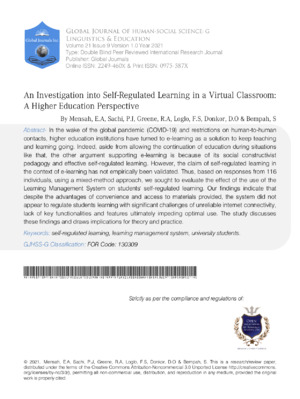
In the wake of the global pandemic and restrictions on human-to-human contacts, higher education institutions have turned to e-learning as a solution to keep teaching and learning going. Indeed, aside from allowing the continuation of education during situations like that, the other argument supporting e-learning is because of its social constructivist pedagogy and effective self-regulated learning. However, the claim of self-regulated learning in the context of e-learning has not empirically been validated. Thus, based on responses from 116 individuals, using a mixed-method approach, we sought to evaluate the effect of the use of the Learning Management System on students’ self-regulated learning. Our findings indicate that despite the advantages of convenience and access to materials provided, the system did not appear to regulate students learning with significant challenges of unreliable internet connectivity, lack of key functionalities and features ultimately impeding optimal use. The study discusses these findings and draws implications for theory and practice.


Funding

No external funding was declared for this work.

Conflict of Interest

The authors declare no conflict of interest.

Ethical Approval

No ethics committee approval was required for this article type.

Data Availability

Not applicable for this article.

Mensah, E.A. 2021. \u201cAn Investigation into Self-Regulated Learning in a Virtual Classroom: A Higher Education Perspective\u201d. Global Journal of Human-Social Science - G: Linguistics & Education GJHSS-G Volume 21 (GJHSS Volume 21 Issue G9): .

Download Citation

Alt: Innovative virtual classroom with digital tools for higher education research and learning.
Issue Cover
GJHSS Volume 21 Issue G9
Pg. 25- 37
Journal Specifications

Crossref Journal DOI 10.17406/GJHSS

Print ISSN 0975-587X

e-ISSN 2249-460X

Keywords
Classification
GJHSS-G Classification: FOR Code: 130309
Version of record

v1.2

Issue date

July 27, 2021

Language

English

Experiance in AR

The methods for personal identification and authentication are no exception.

Read in 3D

The methods for personal identification and authentication are no exception.

Article Matrices
Total Views: 2115
Total Downloads: 960
2026 Trends
Research Identity (RIN)
Related Research

Published Article

In the wake of the global pandemic and restrictions on human-to-human contacts, higher education institutions have turned to e-learning as a solution to keep teaching and learning going. Indeed, aside from allowing the continuation of education during situations like that, the other argument supporting e-learning is because of its social constructivist pedagogy and effective self-regulated learning. However, the claim of self-regulated learning in the context of e-learning has not empirically been validated. Thus, based on responses from 116 individuals, using a mixed-method approach, we sought to evaluate the effect of the use of the Learning Management System on students’ self-regulated learning. Our findings indicate that despite the advantages of convenience and access to materials provided, the system did not appear to regulate students learning with significant challenges of unreliable internet connectivity, lack of key functionalities and features ultimately impeding optimal use. The study discusses these findings and draws implications for theory and practice.

Our website is actively being updated, and changes may occur frequently. Please clear your browser cache if needed. For feedback or error reporting, please email [email protected]
×

This Page is Under Development

We are currently updating this article page for a better experience.

Request Access

Please fill out the form below to request access to this research paper. Your request will be reviewed by the editorial or author team.
X

Quote and Order Details

Contact Person

Invoice Address

Notes or Comments

This is the heading

Lorem ipsum dolor sit amet, consectetur adipiscing elit. Ut elit tellus, luctus nec ullamcorper mattis, pulvinar dapibus leo.

High-quality academic research articles on global topics and journals.

An Investigation into Self-Regulated Learning in a Virtual Classroom: A Higher Education Perspective

Mensah
Mensah
E.A
E.A
Sachi
Sachi
P.J
P.J
Greene
Greene
R.A
R.A
Loglo
Loglo
F.S
F.S
Donkor
Donkor
D.O
D.O
Bempah
Bempah
S
S

Research Journals