Loading menu…

An Unusual Cause of Stridor After Decannulation of a Tracheostomised Patient

Send Message

To: Author

An Unusual Cause of Stridor After Decannulation of a Tracheostomised Patient

Article Fingerprint

ReserarchID

566A7

An Unusual Cause of Stridor After Decannulation of a Tracheostomised Patient Banner

Key Research Insights

Synthesized scholarly intelligence & interactive research assistant
  • English
  • Afrikaans
  • Albanian
  • Amharic
  • Arabic
  • Armenian
  • Azerbaijani
  • Basque
  • Belarusian
  • Bengali
  • Bosnian
  • Bulgarian
  • Catalan
  • Cebuano
  • Chichewa
  • Chinese (Simplified)
  • Chinese (Traditional)
  • Corsican
  • Croatian
  • Czech
  • Danish
  • Dutch
  • Esperanto
  • Estonian
  • Filipino
  • Finnish
  • French
  • Frisian
  • Galician
  • Georgian
  • German
  • Greek
  • Gujarati
  • Haitian Creole
  • Hausa
  • Hawaiian
  • Hebrew
  • Hindi
  • Hmong
  • Hungarian
  • Icelandic
  • Igbo
  • Indonesian
  • Irish
  • Italian
  • Japanese
  • Javanese
  • Kannada
  • Kazakh
  • Khmer
  • Korean
  • Kurdish (Kurmanji)
  • Kyrgyz
  • Lao
  • Latin
  • Latvian
  • Lithuanian
  • Luxembourgish
  • Macedonian
  • Malagasy
  • Malay
  • Malayalam
  • Maltese
  • Maori
  • Marathi
  • Mongolian
  • Myanmar (Burmese)
  • Nepali
  • Norwegian
  • Pashto
  • Persian
  • Polish
  • Portuguese
  • Punjabi
  • Romanian
  • Russian
  • Samoan
  • Scots Gaelic
  • Serbian
  • Sesotho
  • Shona
  • Sindhi
  • Sinhala
  • Slovak
  • Slovenian
  • Somali
  • Spanish
  • Sundanese
  • Swahili
  • Swedish
  • Tajik
  • Tamil
  • Telugu
  • Thai
  • Turkish
  • Ukrainian
  • Urdu
  • Uzbek
  • Vietnamese
  • Welsh
  • Xhosa
  • Yiddish
  • Yoruba
  • Zulu
Reading Preferences
Font Size
Line Spacing
Background
This converted HTML version may contain rendering inconsistencies. Please refer to the PDF for the authoritative version, or click here to provide feedback.

Abstract

Stridor is commonly seen post decannulation in a tracheostomised patient. Usually it occurs due to airway obstruction secondary to tracheal stenosis, granulation tissue, tracheomalacia. We report a rare case of stridor due to dynamic pharyngeal collapse after decannulation. A 68-year -old male who presented with inferior wall MI and Complete Heart Block had to be put on a mechanical ventilator for hemodynamic instability and subsequently tracheostomised. Post decannulation he developed stridor and breathlessness. CT scan of neck revealed a supraglottic narrowing which on bronchoscopy showed a dynamic collapsibility of supraglottic area. This dynamic collapse was treated with non invasive positive pressure ventilation.

I. CASE REPORT

A 68-year-old male was admitted to the hospital for Inferior wall Myocardial Infarction and Complete Heart block. He was a current smoker with 80 pack-years history and a hypertensive and diabetic on treatment. As he was hemodynamic ally unstable he had to be intubated after being taken up for

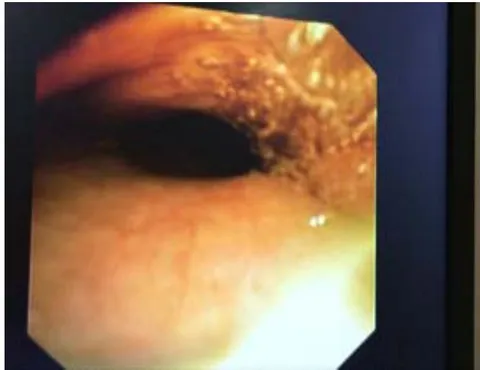
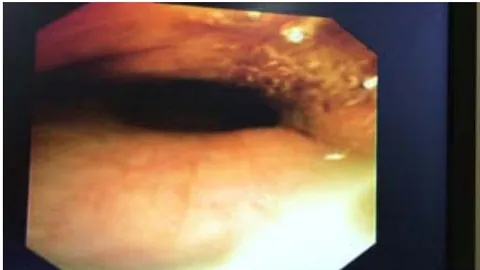
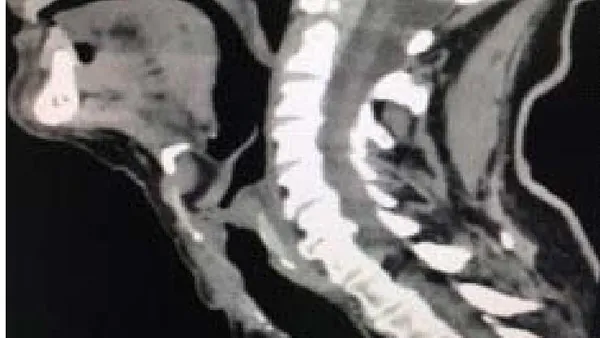
Percutaneous Coronary Angioplasty.As he had to be supported on the mechanical ventilator for a prolonged time with an endotracheal tube he had to be tracheostomised. In view of acute collapse of lung owing to thick tracheobronchial secretions, a good bronchial toileting was done. The patient was subsequently weaned off from the ventilator and then decannulated successfully. The follow-up visits in the OPD were uneventful clinically, but the patient was persistently complaining of progressive breathlessness and stridor. A CT scan of neck was advised and it showed supraglottic narrowing. Suspecting a laryngeal web, a video-assisted bronchoscopy was planned. Findings observed during bronchoscopy were dynamic collapsibility of the supraglottic area, with normal cords and no abnormality noted in the infraglottic area and tracheobronchial tree. The patient was advised nocturnal BIPAP. The patient's symptoms resolved completely and he returned to a normal lifestyle.
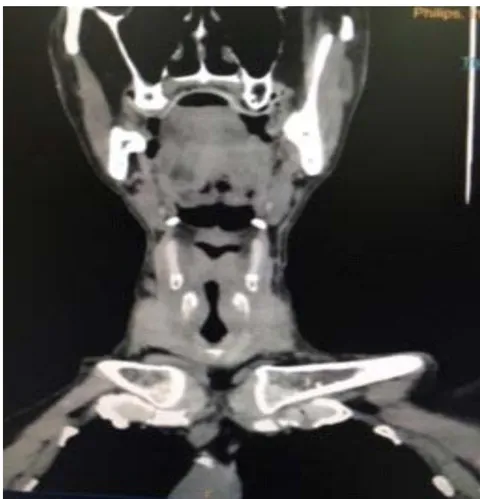
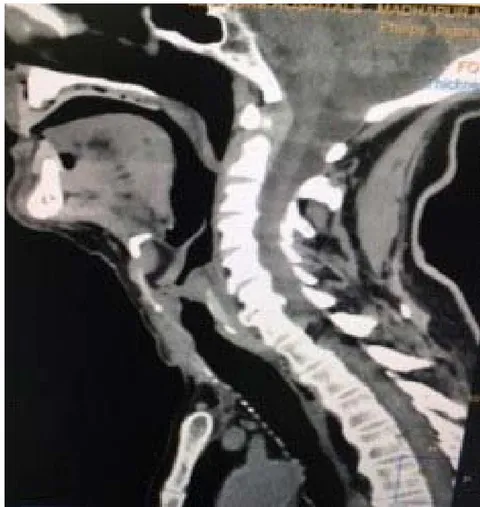
Figure 1: CT NECK coronal view showing supraglottic narrowing
Figure 2: CT NECK sagittal view showing supraglottic narrowing Figure 3: Bronchoscopy showing normal supraglottic airway
Figure 4: Bronchoscopy showing dynamic pharyngeal collapse

II. DISCUSSION

Stridor in a post decannulated patient usually occurs due to tracheal stenosis, tracheomalacia, granulation tissue, nodules, polyps. The incidence ranges from 20 to 67% in patients with long term tracheostomy tubes. But dynamic pharyngeal collapse may be an under recognized cause of stridor in post decannulated patient causing respiratory distress. Diagnosis is usually made by fiberoptic bronchoscopy. Treatment includes non invasive positive pressure ventilation.

III. CONCLUSION

Even though stridor post decannulation is commonly due to tracheal stenosis, tracheomalacia dynamic pharyngeal collapsibility should also be considered as a potential cause. A video-assisted bronchoscopy aids in the detection of the dynamic collapse.


References

4 Cites in Article
  1. 1. Scott Epstein (2005). Late Complications of Tracheostomy Scott K Epstein Respiratory Care Apr 2005. Respiratory Care, 50(4), 542-549.
  2. 2. J. Chew,R. Cantrell (1972). Chew J Y, Cantrell R W. Tracheostomy: Complications and Their Management. Arch Otolaryngol, 96(6), 538545.
  3. 3. Mc Clelland,R. (1965). Complications of tracheostomy. Br Med J, 2(5461), 567-569.
  4. 4. Scott Norwood,Van Vallina,Kevin Short,Makoto Saigusa,Luis Fernandez,Jerry McLarty (2000). Incidence of tracheal stenosis and other late complications after percutaneous tracheostomy Ann Surg. Annals of Surgery, 232(2), 233-241.

Funding

No external funding was declared for this work.

Conflict of Interest

The authors declare no conflict of interest.

Ethical Approval

No ethics committee approval was required for this article type.

Data Availability

Not applicable for this article.

How to Cite This Article

Sailaja Kambhampati, Meghana Yadav. 2020. "An Unusual Cause of Stridor After Decannulation of a Tracheostomised Patient". Global Journal of Medical Research - D: Diagnostic Radiology GJMR-D Volume 20 (GJMR Volume 20 Issue 10 (D1)).

More Citation Formats

Download Citation

Issue Cover
GJMR Volume 20 Issue 10 (D1)
Pg. 21-23
Journal Specifications

Crossref Journal DOI 10.17406/gjmra

Print ISSN 0975-5888

e-ISSN 2249-4618

Keywords
Classification
GJMR-D Classification NLMC Code: WN 1
Version of record
v1.2

Issue date
February 24, 2020

Language
English
Order Article Reprint
Experience in AR

Explore published articles in an immersive Augmented Reality environment. Our platform converts research papers into interactive 3D books, allowing readers to view and interact with content using AR and VR compatible devices.

Read in 3D

Your published article is automatically converted into a realistic 3D book. Flip through pages and read research papers in a more engaging and interactive format.

Article Matrices
Total Views: 713
Total Downloads: 62
All Trends

This is the heading

Lorem ipsum dolor sit amet, consectetur adipiscing elit. Ut elit tellus, luctus nec ullamcorper mattis, pulvinar dapibus leo.

High-quality academic research articles on global topics and journals.

An Unusual Cause of Stridor After Decannulation of a Tracheostomised Patient

Sailaja Kambhampati
Sailaja Kambhampati
Meghana Yadav
Meghana Yadav

Request Access

Please fill out the form below to request access to this research paper. Your request will be reviewed by the editorial or author team.
X