
I. INTRODUCTION
The resulting indicators of energy saving are the reduction in the specific consumption of energy resources per unit of industrial production. The complexity of the problem of energy conservation lies in the fact that this indicator is a function of many variables - quantitative and qualitative indicators of production. Considering this problem in terms of power consumption, it can be argued that, in addition to electrical factors, both technological and operational, as well as factors causing deviations from the norms of consumption of raw materials, intermediate products and auxiliary components, should be involved in the analysis and calculation of specific energy consumption, as well as in identifying reserves of savings. technological process (compressed air, oxygen, water, etc.). The latter, to one degree or another, are usually taken into account, but are not directly included in the calculation of standards. In many cases, this interferes with an objective assessment of energy performance. The increasing scale of electrification of enterprises requires continuous improvement of methods for analysis, assessment and calculation of energy consumption levels, especially in industry, which accounts for more than half of all electricity produced. Although at present there are a fairly large number of methods for predicting energy consumption, the results of their application do not always reflect the real situation. In this regard, we set the task of scientifically-based calculation, analysis and forecasting of power consumption for each production, taking into account its specific features .
Ferrous metallurgy has a number of specific production features that distinguish it from other industries. Existing methods for forecasting electricity do not take into account these features that characterize the production process, modes of power consumption of technological equipment, as well as the influence of technological and operational factors on energy performance. In addition, energy services are forced to normalize, evaluate and distribute energy resources based on experience and intuition, taking into account data on the actual and planned performance of individual enterprises, which leads to certain inaccuracies and errors. It should be noted that power consumption depends on the quality of the metal, on the technical perfection of technological equipment and the production process. Sometimes, to obtain 1 ton of finished products, it is necessary to process several tons of metal. And if the organization of production is not perfect, then there may be excess losses and, accordingly, energy overruns. Therefore, today it is relevant to improve the work on forecasting electricity .
II. THE MAIN PART
Assessment of the levels of absolute and specific energy consumption of integrated production, which includes a number of independent units, requires taking into account a large number of indicators.
The complexity of the analysis of power consumption modes and the calculation of energy indicators of ferrous metallurgy enterprises is caused by a number of reasons. Firstly, the range of finished products of the enterprise is very wide, has dozens of items and various energy intensity. At the same time, energy accounting, both for each production and the plant as a whole, is single. Secondly, a number of industries receive part of the intermediate production through internal and external production relations, while at the same time, they sell a certain amount of their products to the side. At the same time, depending on which production unit received the intermediate products from the outside, and what is the number of processing conversions, differences in energy consumption are produced .
Currently, due to the lack of developed methods for accounting for the above features, forecasting is carried out according to the general indicators of energy consumed from the network and the number of finished products. Naturally, the results of such forecasting calculations in some cases are inaccurate or erroneous and do not reflect the actual level of power consumption.
The task is to find ways to take into account the characteristics of production with a prerequisite for reflection in the calculations for predicting the energy intensity
Notes of processes. A technique is proposed for predicting energy indicators for a complex of industries as a whole, taking into account the above requirements.
To ensure reliable forecasting, it is necessary to study the patterns of change in the energy intensity of products and determine the conditions under which a change in time of energy consumption indicators can change significantly. In addition, the accuracy of forecasting is influenced by the development of new technologies, the improvement of equipment, the scale of modernization, which are different in each industry. The energy intensity of products and the level of energy consumption also depend on changes in the structure of energy consumption, and the latter depends on the need for such components of the process as: compressed air, oxygen, nitrogen, etc. [7,8,9].
Therefore, it is possible to formulate a set of tasks related to the above factors in order to increase the accuracy of forecasting. According to the proposed method, the projected total electric energy consumption of the enterprise is divided into the following components:
Energy consumption by enterprises where equipment does not change during the entire forecast period and traditional technologies are applied ;
Energy consumption by enterprises where it is planned to modernize technological equipment, switch to a new technology ( );
Energy consumption by new enterprises, with new equipment and technology ( ). The projected energy consumption will be:
or
where is the number of planned products; - the share of planned types of products attributable to the relevant enterprises; - respectively, the specific consumption of electricity.
The planned output for the forecast period and, accordingly, the shares of existing, modernized and new industries are determined in accordance with the plan for the future development of the industry.
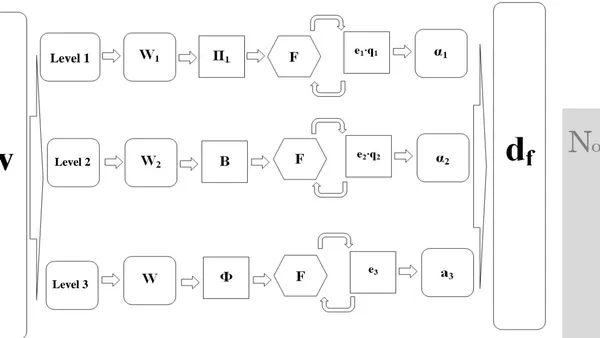
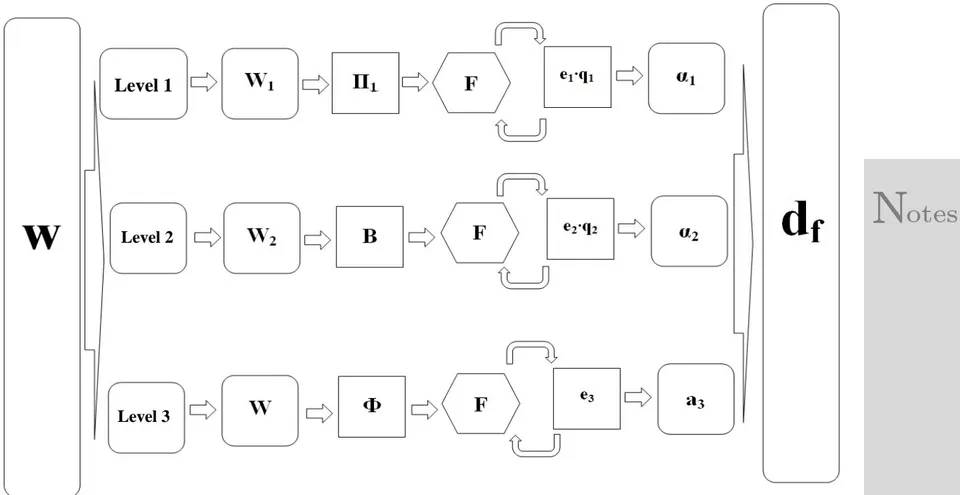
The I level of power consumption of the production unit for the production of intermediate product includes the specific consumption e1 of electricity for the production of products and the specific consumption of product per unit of final product F.
The II level of power consumption of the production unit for the production of process components and secondary energy resources B includes specific costs of electricity for product B and specific consumption of product B per unit of final product F.
The III level of other electricity costs for the production of final products includes the specific consumption of electric power per unit of final product F.
It should be noted that the above levels, in addition to indicators of energy consumption, also include indicators of the consumption of raw materials and technological components.
The predicted values of specific electricity consumption by levels are determined by the following expressions:
a) The specific energy consumption for the production of this workshop is calculated according to the following formulas:
for tier I
for tier II
for tier III
b) The specific consumption of intermediate production products, technology components per unit of final product can be calculated by the formulas: for tier I
for tier II
The specific energy consumption of the enterprise is determined by the components of each level, using the following expressions:
Ref
Therefore, the total specific energy consumption will be:
where n, are the number of levels of types I and II, respectively, which characterize the total value of the specific power consumption of the main and auxiliary industries.
The developed method for generating the predicted specific energy consumption by types of energy consumption and production processes (Fig. 1) can significantly simplify and improve the accuracy of calculations. This allows you to directly include in the calculation the component values of specific electricity consumption and indicators of individual energy-intensive facilities. The considered parameters are taken from the reporting data. In addition, they are considered, taken into account and controlled separately as in-plant indicators, without a direct link to the general production specific power consumption factors (for example, electric steel furnaces, compressors, etc.) [10,11].
The basis of the proposed method for forecasting energy consumption is, firstly, the division of the total value of this consumption into three categories:
- Electricity consumption by existing and newly commissioned enterprises, in which existing equipment is stored in the forecast period;
2) Energy consumption by modernized enterprises;
- Energy consumption by enterprises commissioned in the forecast period with new equipment and new technologies.
Secondly, differentiation is carried out within each category:
1) Electricity consumption by the main production units;
2) Energy consumption by type of energy-intensive auxiliary needs;
3) Other expenses.
As a result, all energy consumption by the industry and its units is differentiated and each calculation can be performed by levels, i.e. make it extremely easy. The calculation allows you to take into account the specifics of technological progress in each of the links in production.
As the basic (initial) data for metallurgical enterprises, the energy consumption indicators of the corresponding production facilities with operating equipment are taken.
As a result, the electricity demand for a given perspective in the industry can be determined based on the values of , Where
The proposed method for determining the predicted value of specific electricity consumption can be applied in industrial enterprises, as well as by type of product of the main divisions of the enterprise for short-term forecasting .
The reliability of the proposed method is demonstrated as an example by determining the energy indicators of the section rolling shop No1 equipped with traditional technology equipment for the main types of products.
Ref
The initial data for the calculation is the products of the section rolling shop No1, shown in table 1.
The value of the specific energy consumption for the production of a given technological cycle by production units is calculated according to formulas 2-4:
for block I:
for ball rolling
| No | Type of product | Output volume | Heat consumption | Power consumption | ||
| For technology kWh | For auxiliary needs kWh | For other needs kWh | ||||
| 1 | Ball rolling ∅ 100 | 3167 | 1254 | 111959,4 | 66782,8 | 17677,8 |
| 2 | Ball rolling ∅ 68 | 8573 | 3568 | 351861 | 209882 | 55557 |
| 3 | Ball rolling ∅ 40 | 431 | 568 | 36879 | 21998 | 5823 |
| the section rolling shop No1 | 12171 | 5390 | 500699 | 298663 | 79057,8 | |
for ball rolling
for ball rolling
The specific consumption of intermediate production products, technology components per unit of final product is calculated according to formulas 5-6:
for block I:
Ball rolling 68 - ;
Ball rolling 40 - .
The total specific energy consumption for the I block is determined by the formula (8):
Notes
According to the formula (4), we calculate the value of the specific energy consumption for the production of a given technological cycle by production units:
for block I:
for ball rolling 68 - ;
for ball rolling
By the formula (7), we calculate the specific heat energy consumption per unit of final product:
for block II:
The total specific energy consumption for block II is determined by the formula :
According to the formula (5), we calculate the value of the specific energy consumption by production units for block III:
for ball rolling
for ball rolling 68 - ;
for ball rolling 40 - .
The total specific energy consumption for block III will be:
According to the formula (10), we calculate the total specific energy consumption for the workshop:
According to formula (11), the need for electricity for a given perspective in the industry is determined:
According to the calculation indices db, it is possible to determine the predicted values of the specific and absolute energy consumption of the enterprises where modernization is planned , and for each level, in accordance with the scheme (Fig. 1), the following are calculated:
for tier I
for tier II
where m is the number of units or processes to be modernized; - energy saving due to modernization of technological equipment.
Using the formula (9), the predicted values of the consumed raw materials and the flow rate of the components of the technological process are determined.
For enterprises with new, more advanced technologies and equipment ( and ) for given , B, F, the calculation of electricity demand is performed by the same method as on the basis of design data.
Values of reliable data for individual indicators - projected products, consumption of process components, etc. can be determined by expert judgment.
Thus, according to the proposed method, for each industry, it is possible to obtain the necessary set of mathematical models that can improve the accuracy of forecasting power consumption, as well as flexibly and quickly carry out their correction for any technical and technological changes in individual links of each production.
III. CONCLUSIONS
A method for forecasting power consumption parameters has been developed, which allows one to study and optimize power consumption modes of both a separate production unit and the enterprise as a whole in conjunction with indicators of processed products and used components of the technological process.
It has been established that the method for determining the predicted specific energy consumption allows us to more fully investigate the trends and patterns of changes in the specific and total energy consumption, taking into account the complex influence of technological and production factors, and allows us to significantly simplify and improve the accuracy of calculations.