I. INTRODUCTION
The transition to digital technologies has been the main task of companies ' development for several decades. Even such conservative areas as rail freight are trying to keep up with the times and introduce technologies such as the digital twin. The object of the study is exactly such a large company that transports oil across Russia and border countries. The digital twin allows a company to create a digital copy of its assets containing all the necessary information to help make a decision[1].
However, despite the general awareness of the importance of digitalization, companies often find it difficult to understand the potential impact and benefits of digitalization. For successful implementation of the technology, it is necessary to analyze the potential impact of digitalization, a company must first analyze existing trends and their relevance to the company. Next, determine which drivers caused the desire for digitalization, what scenarios of changes are possible, and what goals the company pursues. Then to study the current state of the company and determine the gap between this state and the desired result, choose an approach that can cover this difference and then act .
For a qualitative assessment of the company's existing activities to avoid failure in the transition to new technologies, business process analysis is widely practiced in the world. Building diagrams that are understandable for businesses and developers helps reduce misunderstandings between the two groups, as well as identify bottlenecks in the company's activities [3].
That is why the subject of the work is the analysis of changes in the process of unplanned purchase of parts and components when implementing a digital twin in a transport company.
It is important to note that the automation of procurement is currently an actual direction, as this process improves not only the company's performance indicators, but also develops the circular economy, that is, increases sustainability [4].
This paper presents analysis of the company's activities through modelling the procurement process as it is and assesses the weaknesses of the existing model. Further, the analysis of technologies that can compensate for the existing shortcomings is carried out. After that, a model of the process is built, how it should be, and the positive effects of automation are highlighted. After that, conclusions on the work are made
II. METHODS
For this research it is important to consider the context, namely the specifics of the company in which the IoT implementation takes place. The idea of this paper is to understand the changes of processes that appear because of technology. Thus, a case study is used as a research method. A case study studies contemporary phenomena in their natural context, including people and their interaction with technology. As part of the research, the business processes are analyzed to understand how future system should affect the company's performance [5].
a) Analysis of the performance of the company
The company under discussion is a rail freight carrier. It operates on the territory of the former Soviet Union and transports oil and oil products. The main processes of the company are shown in Figure 1.
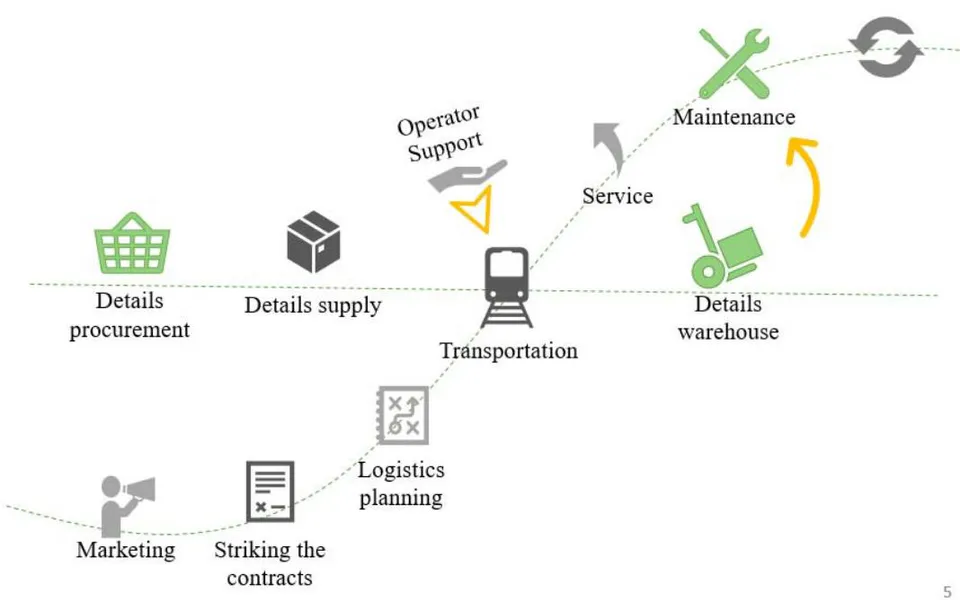
An important aspect of the transport company's activity is the repair of vehicles. Every day the depot receives cars and locomotives with malfunctions. Emergency stops lead to temporary and financial losses. Thus, the company decided to focus on the automation of this activity. The main processes in this area are maintenance, purchasing of parts and details and their warehousing. This article examines the impact of IoT implementation on the purchase of parts.
One of the tools for analyzing the company's activities is business process modeling. It allows to build a bridge between the views of the business and the vision of software developers. Models allow to look at the weaknesses in the company's activities and find solutions to overcome them [6].
One of the most understandable notations for business representatives is BPMN. The main objects in this notation are tasks, events, and gateways, which are flowchart hosted by actors executing the process [7].
To understand the impact of IoT on the purchase of parts and components, the process of purchasing unplanned parts was described and presented in Figure 2.
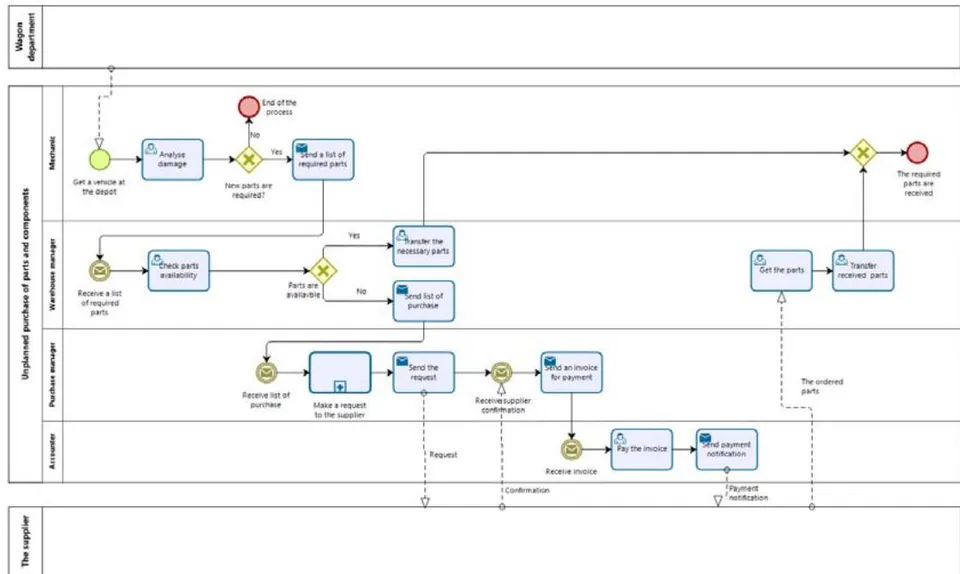
From this diagram, the broken vehicle is sent to the depot, where the mechanic determines the scale of the breakdown. Based on the results of the analysis, a list of necessary parts is compiled, which is sent to the warehouse manager. The availability of parts in the warehouse is checked and, if they are not available, a list of purchases is compiled. Next, the purchasing manager sends a request to the supplier, after which the accountant pays the invoice. After some time, the parts get to the warehouse and are transferred to the mechanic for repair. It is worth noting that to simplify the process, it has been accepted that the purchasing manager always receives confirmation from the supplier, since this does not affect the analysis of the process in this context.
For a more detailed analysis, consider the subprocess of creating a request to the supplier shown in Figure 3.
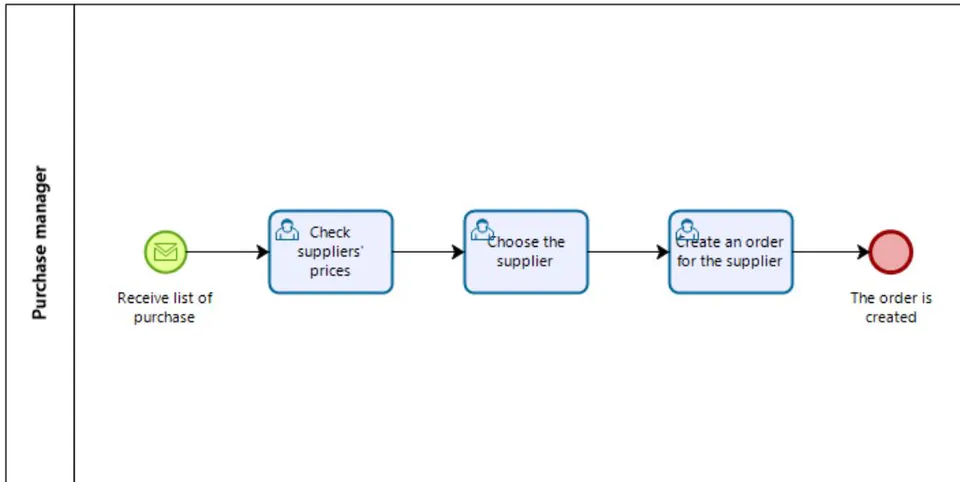
In this diagram, you can see that the purchasing manager checks the prices of suppliers, selects the appropriate one, and creates a request.
The first disadvantage of this model is that the damaged vehicle must be pre-diagnosed, which extends the time of repair.
Secondly, now the company does not have a specialized software product that provides inventory control in the warehouse. All information about parts and components is entered into the MS Excel program, which is why the process of checking the availability of parts in warehouse takes a long time.
Third, when analyzing the company's activities, it was revealed that there are no regular scheduled inspections of the quantity and quality of parts available in warehouse. In this regard, there is a frequent purchase of duplicate parts, which carries extra costs in the company. It is important to note that the company has several distributed warehouses, but there is no joint database of stored parts in different warehouses, which also makes it possible to purchase duplicate parts.
Finally, the company does not consider the quality of parts of specific suppliers, which leads to the continuation of the purchase of low-quality parts.
Summarizing the above conclusions, it could be said that that the company's processes are imperfect and lead to time and financial costs for long processing of requests, as well as possible purchase of low-quality and duplicate parts.
b) Description of technology
The processes of maintenance, part procurement and storage are closely linked and integrated under assets management. The main document regulating this activity is ISO 55000, which contains recommendations for managing the company's assets [8].
To automate this process, the market has long used Enterprise Asset Management systems that allow to implement the recommendations proposed by the standard. These systems provide automated operation of many processes, including the purchase of parts and components [9].
As well-know, now the world is in industry 4.0, the satellites of which are blockchain, big data and the Internet of Things [10]. Together, these technologies create an environment for creating a digital twin that allows you to take asset management to the next level. The digital double is a simulation of a real object, built based on data collected through sensors within the cyber-physical system (CPS) [11]. CPS is several sensors that monitor the condition, in this case, of parts and components of vehicles and transmit data via a wireless network. This data is then analyzed to help in decision-making process [12].
Such a system is built on the following stages: data collection, data processing, detection, diagnosis, prediction and decision-making. Data collection is carried out by a variety of sensors that transmit data wirelessly. Then, the collected raw data is cleaned up to perform analysis. Breakdowns are associated with many causes, so it is important that the system notices these triggers. Further, diagnostics are carried out, based on which forecasts are made and decisions are made on the replacement or repair of vehicles[13].
The digital twin allows to constantly monitor the state of assets and based on this, predict the future state of certain vehicles. Such analysis can significantly improve the procurement process, optimize the storage of parts in warehouses, and track the quality of purchased parts .
Thus, to ensure high efficiency of the process under consideration, the company needs to implement an asset management system supported by technologies such as IoT, data analysis, which allow to build a digital twin.
III. RESULTS
The introduction of an asset management system with Internet of Things technologies will lead to significant changes in the company's activities. First, this will affect the control of the technical condition of vehicles and will reduce the number of unexpected stops, as well as reduce the need for routine inspections [15].
Constant monitoring of the condition of parts will also reduce planned purchases, buying the necessary parts as they wear out. This will free up space in the warehouse and possibly reduce storage space. Also, the chance of parts falling into disrepair during storage is reduced, as parts are purchased as needed. The changes that will be made to the process of unplanned purchase of parts are shown in Figure 4. This diagram shows the process as it should be.
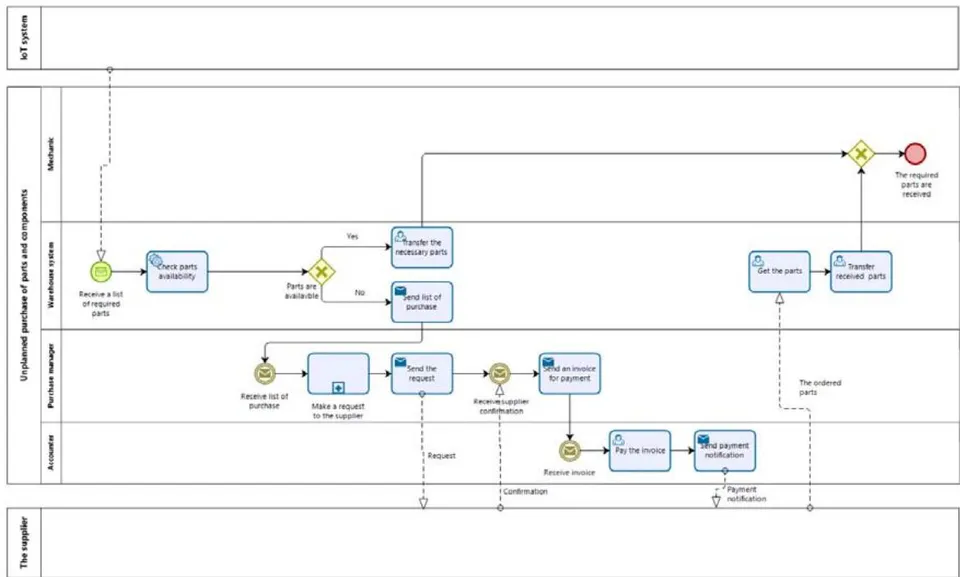
As could be seen in the diagram, data on broken parts are sent directly to the warehouse system, where they are checked for their presence. If they are not available, the list is sent to the purchase manager. In this case, the changes can be seen in the decomposition of the process of making a request to suppliers, shown in Figure 5.
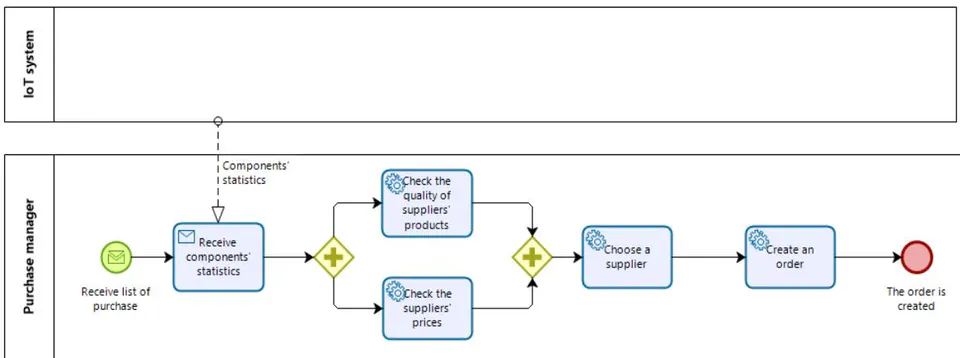
Based on the data collected by the sensors, the company can monitor the quality of parts, thus checking whether the supplied parts meet the requirements. Otherwise, the company may terminate contracts with unscrupulous suppliers. Moreover, the new information system will allow to automate tasks.
Such changes will lead to a significant reduction in the time of stops. Additionally, a timely response to deterioration, implemented by the digital twin, will reduce the number of emergency repairs to a minimum.
IV. Discussion
This paper examines the impact of the introduction of digital technologies on the procurement of a transport company. The creation of a digital twin introduces changes in various aspects of the business and the change in the procurement process is directly related to these changes.
The paper considers the workflow as it is and reveals that the process of emergency repairs, including unplanned purchase of parts, takes a long time. Such long stops lead to financial losses, as the company receives fines for delayed delivery.
As a result of the analysis of weak points in the activity, it was determined that the company needs an automated asset management system, whose data is backed up by a cyber-physical system that creates a digital twin of vehicles.
Under the constant monitoring of sensors, the process of checking the technical condition of objects is first reviewed. This makes it possible to predict breakdowns and restructure the processes of planned repairs, and what is important for this work, purchases. Sensors allow to predict a malfunction, which means that the company can purchase the necessary parts in advance. In this case, in case of failure, the parts necessary for repair will already be in warehouse. Moreover, the number of emergency stops will decrease, as managers will know about the impending failure in advance and act before they occur.
The process improvements are visible in the diagram as it should be, the diagram helps to understand what the company is striving for and serve as an instruction for the developers of the future system.
V. CONCLUSIONS
In this paper, the analysis of changes in the processes of unplanned purchase of parts and components was carried out.
In the built model, the long process life was noted, as well as low automation, which leads to poor quality accounting of available parts in the warehouse, the lack of quality control of products from various suppliers. By using modern technologies, such as the Internet of Things and Big data analysis, the company can build a digital twin of its vehicles, thereby enhancing the capabilities of its activities.
Based on the diagram as it should be, you can see that technologies allow you to speed up the process, automate tasks that were previously performed manually, and analyze statistics to select bona fide suppliers.