Analysis of Liver Disorder using Datamining Algorithm

§ Bharathiyar University

Send Message

To: Author

Analysis of Liver Disorder using Datamining Algorithm

Article Fingerprint

ReserarchID

CST027HC

Analysis of Liver Disorder using Datamining Algorithm Banner

AI TAKEAWAY

Connecting with the Eternal Ground
  • English
  • Afrikaans
  • Albanian
  • Amharic
  • Arabic
  • Armenian
  • Azerbaijani
  • Basque
  • Belarusian
  • Bengali
  • Bosnian
  • Bulgarian
  • Catalan
  • Cebuano
  • Chichewa
  • Chinese (Simplified)
  • Chinese (Traditional)
  • Corsican
  • Croatian
  • Czech
  • Danish
  • Dutch
  • Esperanto
  • Estonian
  • Filipino
  • Finnish
  • French
  • Frisian
  • Galician
  • Georgian
  • German
  • Greek
  • Gujarati
  • Haitian Creole
  • Hausa
  • Hawaiian
  • Hebrew
  • Hindi
  • Hmong
  • Hungarian
  • Icelandic
  • Igbo
  • Indonesian
  • Irish
  • Italian
  • Japanese
  • Javanese
  • Kannada
  • Kazakh
  • Khmer
  • Korean
  • Kurdish (Kurmanji)
  • Kyrgyz
  • Lao
  • Latin
  • Latvian
  • Lithuanian
  • Luxembourgish
  • Macedonian
  • Malagasy
  • Malay
  • Malayalam
  • Maltese
  • Maori
  • Marathi
  • Mongolian
  • Myanmar (Burmese)
  • Nepali
  • Norwegian
  • Pashto
  • Persian
  • Polish
  • Portuguese
  • Punjabi
  • Romanian
  • Russian
  • Samoan
  • Scots Gaelic
  • Serbian
  • Sesotho
  • Shona
  • Sindhi
  • Sinhala
  • Slovak
  • Slovenian
  • Somali
  • Spanish
  • Sundanese
  • Swahili
  • Swedish
  • Tajik
  • Tamil
  • Telugu
  • Thai
  • Turkish
  • Ukrainian
  • Urdu
  • Uzbek
  • Vietnamese
  • Welsh
  • Xhosa
  • Yiddish
  • Yoruba
  • Zulu
Font Type
Font Size
Font Size
Bedground

Abstract

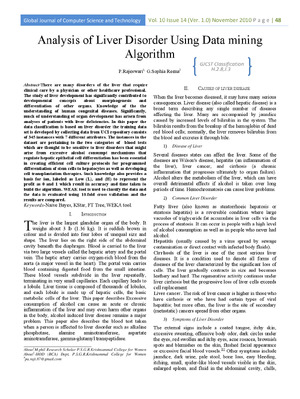
There are many disorders of the liver that require clinical care by a physician or other healthcare professional. The study of liver development has significantly contributed to developmental concepts about morphogenesis and differentiation of other organs. Knowledge of the the understanding of human congenital diseases. Significantly, much of understanding of organ development has arisen from analyses of patients with liver deficiencies. In this paper the data classification is based on liver disorder the training data set is developed by collecting data from UCI repository consists of 345 instances with 7 different attributes. The instances in the dataset are pertaining to the two categories of blood tests which are thought to be sensitive to liver disorders that might arise from excessive alcohol consumpt mechanisms that regulate hepatic epithelial cell differentiation has been essential in creating efficient cell culture protocols for programmed differentiation of stem cells to hepatocytes as well as developing cell transplantation therapies. Such knowledge also provides a basis for ion, labeled as Low (L), and (H) to represent the profit as 0 and 1 which result in accuracy and time taken to build the algorithm. WEAK tool is used to classify the data and the data is evaluated using 10-fold cross validation and the results are compared.

References

9 Cites in Article
  1. J Duggan,A Duggan (2005). Systematic review: The liver in celiac disease.
  2. M Cassagnou,A Boruchowicz,F Guillemot (1996). Hepatic steatosis revealing celiac disease: a case complicated by transitory liver failure.
  3. A Austin,E Campbell,P Lane,E Elias (2004). Nodular regenerative hyperplasia of the liver and coeliac disease: potential role of IgA anti-cardiolipin antibody.
  4. B Hagander,N Berg,L Brandt,A Nordén,K Sjölund,M Stenstam (1977). HEPATIC INJURY IN ADULT CŒLIAC DISEASE.
  5. M Bonamico,G Pitzalis,F Culasso (1986). Il danno epatico nella malattia celiaca del bambino.
  6. Salvatore Leonardi,Gaetano Bottaro,Rosario Patané,Salvatore Musumeci (1990). Hypertransaminasemia as the First Symptom in Infant Celiac Disease.
  7. G Maggiore,De Giacomo,C Scotta,M Sessa,F (1986). Celiac disease presenting as chronic hepatitis in girl.
  8. P Vajro,A Fontanella,M Mayer (1993). Elevated Serum minotransferases activity as an early manifestation of glutensensitive enteropathy.
  9. Umberto Volta,Lucia Franceschi,Federico Lari,Nicolino Molinaro,Marco Zoli,Francesco Bianchi (1998). Coeliac disease hidden by cryptogenic hypertransaminasaemia.

Funding

No external funding was declared for this work.

Conflict of Interest

The authors declare no conflict of interest.

Ethical Approval

No ethics committee approval was required for this article type.

Data Availability

Not applicable for this article.

How to Cite This Article

Dr.P.Rajeswari, G.Sophia Reena. 1970. "Analysis of Liver Disorder using Datamining Algorithm". Global Journal of Computer Science and Technology GJCST Volume 10 (GJCST Volume 10 Issue 14).

Download Citation

Journal Specifications

Crossref Journal DOI 10.17406/gjcst

Print ISSN 0975-4350

e-ISSN 0975-4172

Keywords
Version of record

v1.2

Issue date
October 14, 2010

Language
English
Experiance in AR

Explore published articles in an immersive Augmented Reality environment. Our platform converts research papers into interactive 3D books, allowing readers to view and interact with content using AR and VR compatible devices.

Read in 3D

Your published article is automatically converted into a realistic 3D book. Flip through pages and read research papers in a more engaging and interactive format.

Article Matrices
Total Views: 5.5K
Total Downloads: 301
All Trends

Request Access

Please fill out the form below to request access to this research paper. Your request will be reviewed by the editorial or author team.
X

This is the heading

Lorem ipsum dolor sit amet, consectetur adipiscing elit. Ut elit tellus, luctus nec ullamcorper mattis, pulvinar dapibus leo.


High-quality academic research articles on global topics and journals.

Analysis of Liver Disorder using Datamining Algorithm

Dr.P.Rajeswari
Dr.P.Rajeswari Bharathiyar University
G.Sophia Reena
G.Sophia Reena