
1. Introduction
Traditional technologies of transverse electromagnetic field (TEMF) for treating cardiovascular and cerebrovascular diseases primarily focus on the regulatory effects of physical therapies or bioactive substances (e.g., endothelin-1, nitric oxide) on vascular endothelial cells and blood circulation, with underlying mechanisms encompassing techniques such as TEMF stimulation, biofeedback, and microcurrent modulation [1, 2, 3, 4, 5]. EMF technology can act on vascular endothelial cells to promote nitric oxide release, thereby facilitating peripheral vasodilation and reducing blood flow resistance. The biofeedback module enables real-time monitoring of users’ heart rate variability, balancing sympathetic and parasympathetic neural activities by modulating autonomic nervous function. Microcurrent stimulation can influence local tissue metabolism, accelerate lactic acid clearance, and enhance cell membrane stability.
Typically, the amplitude of electromagnetic longitudinal waves (scalar waves, SWs) is considerably smaller than that of the source transverse electromagnetic waves (TEM waves) generating them [6], thus they are often neglected. However, in certain scenarios, such as the near-field region, existing Maxwell’s equations fail to fully characterize their electromagnetic properties, necessitating the consideration of SWs [7, 8]. Substantial SWs can be generated when two coherent, out-of-phase TEM waves interfere [9, 10]. The vortex electromagnetic field of SWs gives rise to a unique force field known as the torsion field [11, 12, 13, 14, 15, 16]. While the static torsion field exhibits extremely weak intensity (approximately times weaker than gravitational force), its dynamic intensity is substantially enhanced [17]. Torsion fields possess properties including superluminal propagation, non-shielding, zero-point vacuum energy extraction, and memory effects [18], and their potential and practical applications in medicine have gained widespread recognition and attention [19, 20, 21, 22, 23].
Nevertheless, due to the absence of rigorous wave equations and particle propagation model [24], applied researches of torsion fields generated by SWs on energy medicine has encountered technical bottlenecks, such as optimizing energy intensity and therapeutic frequencies. Consequently, many scholars have questioned the efficacy and reliability of scalar wave and torsion field therapy [25]. Additionally, conventional perspectives maintain that generating pure torsion fields generated by SWs is highly challenging, requiring precise control of the phase difference between two source waves to the picosecond level, stable interference point spatial conditions, and mitigating environmental noise, metal reflections, and geomagnetic disturbances. Even minimal phase drift can cause SWs to collapse into ordinary TEM waves, resulting in the loss of all unique properties.
As a result, current researches on torsion fields generated by SWs remain within the realm of fringe science, and no clear consensus has been established in authoritative medical literature regarding their medical functions and physicochemical mechanisms in treating cardiovascular and cerebrovascular diseases. By constructing accurate models of the vacuum scalar wave equation and particle propagation, we aim to derive a theoretical framework for torsion fields generated by SWs and elucidate their intrinsic connections to mass and gravitational field. The development of these novel theoretical models may provide new tools and methodological approaches for analyzing the medical efficacy and physicochemical mechanisms of torsion fields generated by SWs in cardiovascular and cerebrovascular disease treatment.
2. The essence of electromagnetic fields
Both torsion field and SW wave are associated with spin effects. The torsion field stems from spacetime distortion [11], whereas SW waves originate from vortex electromagnetic fields [6]. Thus, torsion fields are closely related to SW waves, and investigating torsion fields necessitates a prior clarification of the essence of electromagnetic fields.
From the law of total current [26], the electromagnetic field / in a conductor can be expressed as
Thus, it follows from Eq. (1) that
By synthesizing Eqs. (1) and (2), it is evident that the law of total current embodies a fundamental implication of the electromagnetic field: the relativistic effect of the propagation velocity of the electric field through positive charges (holes) in the conductor (specifically, the moving velocity of the electric field, ) is converted into the magnetic field within the conductor, which aligns with the principle that a moving electric field generates a magnetic field [27].
Employing the same analytical approach, Faraday’s Law of Electromagnetic Induction [26] yields that
Then, according to Eq. (3), we have
By synthesizing Eqs. (3) and (4), it is evident that Faraday’s law of electromagnetic induction embodies another fundamental implication of the electromagnetic field: the magnetic field within the conductor is converted into an electric field in the conductor via the relativistic effect of the magnetic field’s velocity vector , specifically, a moving magnetic field generates an electric field [28].
In Eq. (4), serves as both the wave velocity of electromagnetic transverse waves [26] and the velocity of magnetic field motion [28]. According to the principle of duality, the component of along the electromagnetic field propagation direction is not only the velocity at which positive charges propagate the electric field (or the velocity of the electric field itself) [10], but should also correspond to the wave velocity of some form of wave. It is hypothesized that while the TEM waves / propagate along the -direction within the conductor, there exists a type of electromagnetic longitudinal waves, i.e. SWs / that propagates along the same -direction with frequency and wave velocity [29].
Eq. (4), which is associated with Faraday’s law of electromagnetic induction for the TEM waves /, can be expressed in terms of the electromagnetic scalar potential and magnetic vector potential as follows [26]
which gives that
In accordance with the Lorenz gauge condition applicable to metallic conductors [26], we can obtain
Thus, it follows that
Eq. (6) reveals a constraint relation between (the propagation velocity of the electric field of TEM waves in the conductor medium, i.e., the wave speed of SW waves) and (the velocity of magnetic field motion, i.e., the wave speed of TEM waves): the product of the two quantities does not exceed the square of the speed of light in the conductor. For typical metallic conductors [30], we can obtain that
which implies that the wave velocity of the SW propagating within the conductor could be superluminal.
3. The particle propagation mode for SWs
When two coherent light waves (termed "source light waves") with identical frequency, equal amplitude, opposite propagation directions, and a phase difference of are superposed in a vacuum, a pair of vacuum scalar waves are generated [6]. Upon superposition, the resultant TEM fields vanish, creating the illusion of energy disappearance. However, according to the Aharonov-Bohm effect [31], this process merely corresponds to the extinction of the TEM waves; the magnetic vector potential and electromagnetic scalar potential in the vacuum do not cease to exist, but instead transform into the SWs [6].
By analogy with the electromagnetic fields in conductive media, the electromagnetic fields of vacuum SWs should also satisfy electromagnetic conversion formulas shown as Eqs. (2) and (4). We thus hypothesize
Here, denotes the propagation velocity of the electromagnetic field associated with the vacuum SW, and should also correspond to the velocity at which a charge or particle propagates the electromagnetic fields [10]. Given the absence of charges in a vacuum, must therefore represent the magnitude of the absolute velocity of the propagation particle of the SWs relative to the vacuum medium.
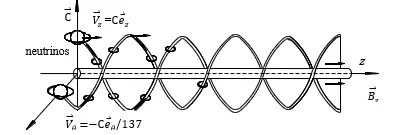
The particle propagation mode for the vacuum SWs is illustrated in Fig. 1 [18]. To uphold the conservation of angular momentum within this model, it is hypothesized that the propagating particles of the SWs consist of two left-handed neutrinos undergoing counter-rotating large-helical revolution, with a phase difference of . The spin velocity of the left-handed neutrinos equals the speed of light, and both follow left-handed large-helical trajectories along the forward axis, with their axial velocity also matching the speed of light. Since neutrinos possess mass, their tangential rotational velocity cannot exceed the speed of light [32]. By assuming that the mechanism of neutrinos rotating around the SWs’ core is analogous to that of a ground-state electron orbiting the hydrogen nucleus [33], we can derive
From Ref. [10], the frequency of the helical motion of scalar wave neutrinos, denoted as , corresponds to the frequency of the vacuum SWs and can be expressed as
Accordingly, the step length of the helical motion of their propagation particle (neutrino) can be expressed as
Herein, denotes the vortex decay period of the vortex electric field , represents the frequency of the source light waves that generate the SWs, and and are the vacuum conductivity and vacuum permittivity, respectively.
Consequently, the energy ratio of to the source light waves can be expressed as
which implies that, in addition to the energy contribution , the SWs must acquire a substantial amount of additional free energy from the zero-point vacuum field [10, 16]. The free energy acquisition mechanism of is associated with the local spatial vortex motions of the SW-propagating particles (neutrinos), where the vortex motion acts as the fundamental unit of energy and a bridge linking visible matter to invisible energy [18]. This vortex motion enables the extraction of zero-point vacuum energy via the coherent resonance effect between the torsion field they induce and the zero-point vacuum energy field [13, 14].
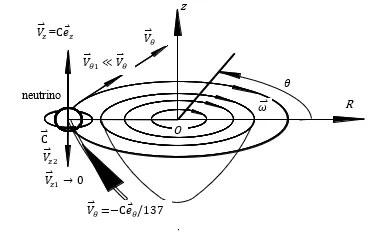
Given that SWs absorb a significant quantity of vacuum free energy, this energy, analogous to the local spatial curvature effect induced by massive objects and the gravitational field generated by spatial curvature, gives rise to a distinct spatial distortion effect within the helical interior of the SWs. This distortion manifests as a tangential distortion motion and a -directional bending motion in the local space (see Fig. 2).
To simplify the model, we assume the bending effect of the Earth in this local space corresponds to a -directional bending motion , while neglecting the influence of macroscopic -directional spatial expansion. Accordingly, the absolute equation of motion for the vacuum SW-propagating particle (neutrino) relative to the vacuum is expressed as
Herein, denotes the linear motion of the SW neutrino at the speed of light along the -direction, while corresponds to its tangential rotational motion. refers to the local spatial distortion motion induced by the scalar wave after it has absorbed a substantial amount of vacuum free energy, and represents the -direction bending motion of the Earth within this local space. Notably, and are the active motions of the scalar-wave neutrino, whereas and are the passive motions of the SW neutrino that arise as a consequence of its following the spatial deformation.
4. The wave equations for SWs
As illustrated in Fig. 3, within the vacuum space, we establish a region of the field point P centered at point O on the Earth’s surface. In the source region (centered at the fixed source point O’ adjacent to field region ), there exist certain continuous, non-moving, and time-varying charges and a time-varying vortex current source that is excited by external electromagnetic fields. These sources generate the SWs within the region .
Furthermore, a cylindrical coordinate system is established with an observer as the origin on the Earth’s surface. This coordinate system is employed to describe the propagation of the neutrino motion of . When approaches zero and coincides with O’, the position vector satisfies
and
Subsequently, in accordance with the relational formula between the scalar waves and [6], within region P, when the radial dimension and :
From Eqs. (16) and (17), the fundamental equations for in a vacuum are derived as follows [6]:
whose plane wave solutions are presented as Eqs. (20) and (20.1):
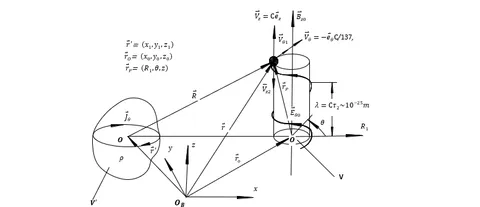
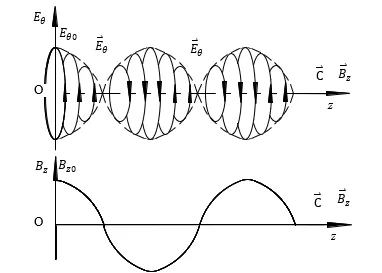
Fig. 4 depicts the wave patterns of and , showing that and share the same phase angle and propagate along the positive -axis at the phase velocity . Eqs. (20) and (20.1) unveil the electromagnetic induction law governing the vacuum SWs and , specifically, the scalar magnetic field and the vortex electric field are mutually convertible and propagate forward in a vacuum.
Within the vacuum, the local spatial vortex motion induced by interacts with the zero-point vacuum energy field, forming a torsion field coherence (resonance) state. This state generates high-energy rays, neutrons, and high-energy particles at the vortex center of the scalar wave, while extracting zero-point vacuum free energy, accompanied by highly directional cold nuclear fusion [13]. This process embodies the mechanism by which SWs harness free energy from the zero-point vacuum energy field.
5. Torsion fields induced by vacuum SWs
Upon differentiating the left-hand side of Eq. (17), we obtain
while upon differentiating the right-hand side of Eq. (17), we obtain
In Eq. (22), corresponds to the strong interaction scale. strong nuclear force field generated by the -directional linear motion of the SW particle at the speed of light , undoubtedly represents the electromagnetic fields induced by its tangential subluminal rotational motion , equaling denotes the acceleration field of the spatial tangential distortion motion induced by the vacuum SWs within their helical structure, namely the torsion field, and denotes the gravitational field acting on the SW neutrino. Eq. (22) appears to formally unify nuclear force, electromagnetic force, torsion field force, and gravitational force [34, 35]. An analysis of Eq. (22) reveals that, under ideal conditions, SWs can generate a torsion field with a magnitude comparable to that of the strong nuclear force. However, in the field of medical therapy, SW torsion fields do not require such enormous energy; only the torsion field corresponding to the local spatial tangential distortion motion , induced by the vortex motion of SW particles, is necessary.
Based on Eqs. (21) and (22), when magnetism generates electricity, the electromagnetic fields adhere to the left-hand helix rule. The radial and tangential acceleration fields (i.e., the torsion fields and ) of the spatial tangential distortion motion , induced by the vacuum SWs , can be expressed as
Meanwhile, based on Eq. (17), the electromagnetic conversion relation of the torsion-field-inducing SWs can be expressed as
Projecting Eq. (25) onto the -direction as shown in Fig. 3 yields
which indicates that the torsion-field-inducing SWs have a phase difference of 180°, i.e., .
By combining Eqs. (23), (24), and (26), the torsion fields and generated by the vacuum SWs can be expressed as
Similarly, based on the relational Eqs. (16) and (17) between and , when electricity generates magnetism, the electromagnetic conversion relation of the torsion-field-inducing SWs can also be expressed as .
Employing the same analytical approach, it is found that when electricity generates magnetism, the electromagnetic fields follow the right-hand helix rule. The -directional acceleration field of the local spatial curvature motion induced by , namely, the -directional torsion field, can be expressed as
6. Dynamic analysis of thrombus removal induced by torsion fields
6.1. Negative mass induced by radial torsion field
According to the wave pattern of the vacuum SWs illustrated in Fig. 4, when magnetism induces electricity, the electromagnetic field follows the left-hand screw rule, and , meaning the vortex electric field decreases with time. Accordingly, the radial torsion field associated with the spatial tangential distortion motion induced by can be expressed as
when electricity induces magnetism, the electromagnetic field obeys the right-hand screw rule, and , meaning the vortex electric field increases with time. Accordingly, the radial torsion field associated with the spatial tangential distortion motion induced by can be expressed as
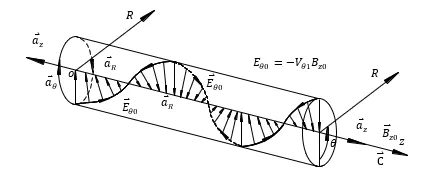
It is evident that regardless of whether electricity induces magnetism or magnetism induces electricity, the direction of the radial torsion field generated by is as illustrated in Fig. 5: the radial torsion field is an intense spiral centripetal acceleration field.
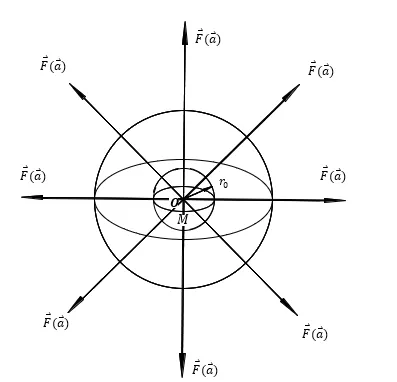
With reference to the definitions of relevant physical quantities in electrostatic fields [36], within a stationary spherical space , we define the gravitational field , gravitational potential , gravitational displacement vector , and global gravitational flux induced by a spherical object of mass located at the space center (with radius , density , surface area , and volume , respectively) as follows (see Fig. 6):
Herein, denotes the gravitational constant, and is the radial distance from the center of the spherical space . Eq. (31.4) implies that the essence of mass lies in the total surface integral of the gravitational field induced by it (i.e., the gravitational flux). Taking the cylindrical surface formed by the helical motion of SW neutrinos in Fig. 5 as the Gaussian surface, and assuming that the lateral surface area of this Gaussian surface is much larger than the area of its two end faces, the total Gaussian surface integral of the torsion field induced by can be expressed as
Herein, denotes the thrombus length and denotes its radius. When the SW torsion fields target cardiovascular or cerebrovascular thrombi, the radial torsion field is responsible for the mass reduction of the thrombus. Once the thrombus mass is reduced to zero, it enters a wave state and exits the human body at the speed of light. Concurrently, as the thrombus transitions into the wave state, the medical treatment mechanisms and approaches for cardiovascular and cerebrovascular thrombosis may undergo qualitative changes.
6.2. Coagulation motion of thrombus induced by tangential torsion field
It is evident that regardless of electromagnetic induction (whether electric fields generate magnetic fields or vice versa), the direction of the tangential torsion field induced by is illustrated in Fig. 5: the tangential torsion field causes local space to rotate clockwise (when viewed from the positive to the negative direction of ). Analogous to centrifugation techniques, promotes the aggregation of thrombogenic factors derived from positively charged dysfunctional red blood cells in human blood, forming helical filamentous thrombus clusters. This process reduces thrombus volume and mitigates the challenges associated with thrombus management.
6.3. Directional guidance of thrombus removal by -axis torsion field
According to Eq. (29), the -directional bending acceleration field induced by the local spatial distortion motion triggered by , namely the -directional torsion field , can be expressed as
As electricity induces magnetism, , meaning the vortex electric field increases with time,
while as magnetism induces electricity, , meaning the vortex electric field decreases with time,
It is evident that the expression of the -directional torsion field induced by SWs still adheres to Newton’s laws of motion. Its direction is either consistent with or opposite to the propagation direction of the scalar magnetic field of the scalar wave, depending on the rate of change of the vortex electromagnetic field . When the SW torsion fields target cardiovascular and cerebrovascular thrombi, the dominant motion of the thrombus driven by the -directional torsion field governs the direction of thrombus removal.
7. The interaction between vacuum SWs and red blood cells
The primary component of blood consists of red blood cells, and thrombus formation essentially arises from the adhesion of red blood cells. The surface of each healthy red blood cell carries a negative charge. With aging and the occurrence of metabolic abnormalities, the surface of pathological red blood cells becomes enveloped by a lipid membrane, which diminishes or abolishes their negative surface charge while augmenting the positive charge. This leads to electrostatic attraction between pathological and healthy red blood cells, culminating in the formation of what is known as a thrombus.
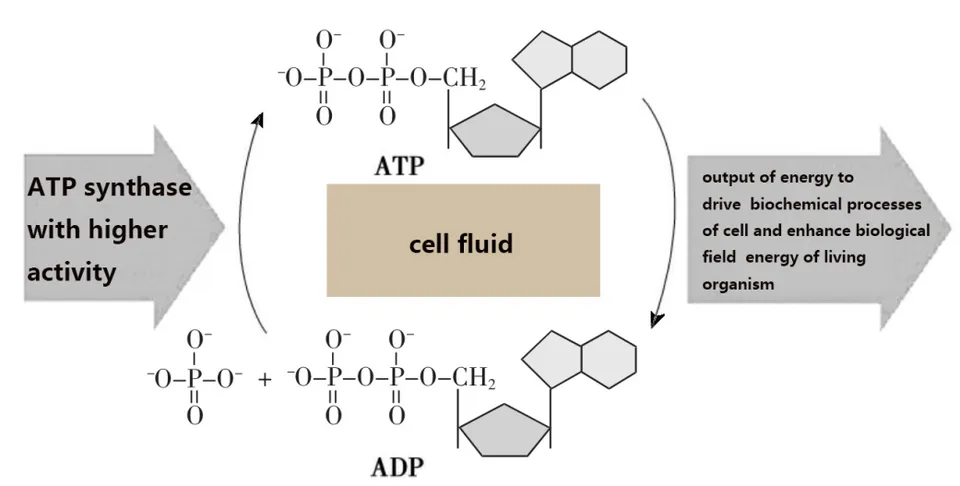
Mature red blood cells shed their nuclei and mitochondria to maximize the spatial capacity for hemoglobin, thereby optimizing their oxygen-transport function. They rely on anaerobic glycolysis to generate adenosine triphosphate (ATP) for energy supply. ATP is indispensable for all life processes. Fluctuations in the ATP/adenosine diphosphate (ADP) ratio are intricately linked to numerous pathways, including apoptosis, autophagy, and energy metabolism, and thus ATP/ADP ratio is frequently employed as one of the indicators for assessing cell viability[38]. When ATP is hydrolyzed into ADP and inorganic phosphate, energy is released to drive a multitude of intracellular biochemical processes, which in turn stimulates, balances, and enhances the energy of the organism’s biological field, facilitating the restoration of health.
In the process of blood circulation, the most fundamental chemical reaction is electron transfer, which is mediated by hemoglobin. Hemoglobin molecules are, in fact, long chains formed by the linkage of amino acid molecules, each exhibiting identical left-handed chirality.
When a living organism receives the left-handed SW (carrying drug/nutrient information and zero-point vacuum energy) emitted by a SW generator, the scalar magnetic field of the left-handed SW induces a left-handed eddy potential channel along hemoglobin molecular chain (see Fig. 7) while delivering information and energy to cells. This left-handed attracts left-spinning free electrons in the cell fluid to move left-handedly along hemoglobin chains, accelerating the dissociation of intracellular water molecules into and (the source of free electrons). This disrupts the intracellular ATP/ADP concentration balance, thereby accelerating the synthesis of ATP from ADP and inorganic phosphate, and decelerating ATP hydrolysis. The release of free electrons also stimulates the antioxidant activity of cells, increasing the ATP/ADP concentration ratio in red blood cells, promoting blood circulation, and maintaining the organism in a high-energy state (see Fig. 7).
When cells interact with the scalar magnetic field of right-handed SWs, the organism generates at the center of hemoglobin chains. The device regulates to induce a right-handed channel, which repels free electrons in the cell fluid. This accelerates the recombination of and into water molecules, thereby accelerating ATP hydrolysis into ADP and inorganic phosphate in red blood cells, while decelerating ATP synthesis. The ATP/ADP ratio in red blood cells decreases, blood circulation slows, and the organism enters a low-energy state.
The energy required for ATP synthesis is derived from three sources: food oxidation (in animal cells, fungi, and some bacteria), light energy capture (in plant cells and some bacteria), and zero-point vacuum energy supplied by scalar waves (applicable to both animal and plant cells).
From the above analysis, SWs are closely associated with normal blood circulation and thrombus formation. The quantity of free electrons provided by SWs not only directly determines thrombus size and concentration but also regulates the ATP/ADP ratio in red blood cells. Left-handed SWs supply free electrons to red blood cells, increasing their ATP/ADP ratio, accelerating blood circulation, and sustaining the organism in a high-energy state.
8. Conclusion
Based on the rigorous vacuum SW equations and particle propagation mode, we propose a theoretical model for the torsion fields generated by vacuum SWs, revealing their intrinsic connections to mass and gravitational field. The establishment of these novel torsion field theoretical models provides feasible solutions to bottleneck issues in the research on medical applications of torsion fields (such as the optimization of torsion field energy intensity and SW therapeutic frequency), while offering new tools and implementation approaches for analyzing the medical functions and physicochemical mechanisms of torsion fields generated by vacuum SWs in the treatment of cardiovascular and cerebrovascular diseases. Finally, we conduct a detailed analysis of the dynamic characteristics of thrombus removal by the torsion fields and the interaction between SWs and red blood cells.
The magnitude of the torsion field generated by vacuum SWs is correlated with the variation frequency and electromagnetic conversion efficiency of the SW electromagnetic field, i.e., the velocity of local spatial distortion motion induced by SWs within the helix. The theoretical expression of the torsion field generated by SWs still adheres to Newton’s laws of motion: the direction of the -axis torsion field is either parallel or antiparallel to the propagation direction of the SW, depending on the rate of change of the scalar electric field , which dictates the direction of thrombus removal; the radial torsion field is a strong helical centripetal acceleration field that induces the mass-reduction process of thrombi; the tangential torsion field drives the rotation of local space inside the SW helix, leading to thrombus aggregation. The three torsion fields act as a precise micro-surgical scalpel, enabling non-invasive aggregation and removal of intravascular thrombi while delivering energy and information to living organisms and enhancing their bioenergetic fields.
Acknowledgements
I would like to thank my wife, Ms. Xue Jingwen for her hard family work and support for my creation of this thesis.
Competing Interests
The authors declare no competing interests.
Data and Materials Availability
All data are available in the main text or the supplementary materials.
Ethics Declarations
The study did not require ethical approval.
Approval for Animal Experiments
Confirms that all experiments were performed in accordance with relevant named guidelines and regulations.
Approval for Human Experiments
Confirms that all experiments were performed in accordance with relevant named guidelines and regulations.