
I. INTRODUCTION
Knowledge-based industries, particularly related to information technology have been recognized as the top priority sector by countries making transition from agro-industrial economy to information economy. Hi-Tech/Software Technology parks are being developed in different countries, both developed and developing, to provide a range of infrastructure and administrative support services to create an efficient work environment for development of IT/ITES enabled industry [1,2].
Considering the world trends, Bangladesh has also recognized that new directions must be set for the future prosperity of the country. Information technology has been identified as a "thrust sector" for the economy of Bangladesh. Strategic plans have been prepared to enable Bangladesh to embrace the information age and to become an important player in the global market in information and other high technology sectors. The Government of Bangladesh has declared Vision 2021 with a target to transform Bangladesh into Digital
Bangladesh [3]. Government has taken initiative to established Hi-Tech/Software Technology Parks around the country to ensure knowledge-based industry.
II. ELEMENTS OF TECHNOLOGY PARKS
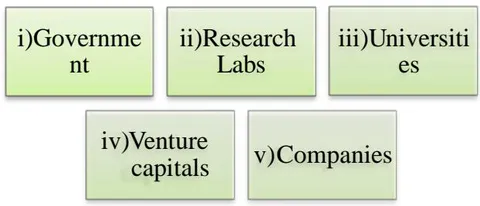
Technology parks need to provide wide ranges of services to the company or investors. As a result, it requires a mixed eco system to operate efficiently and effectively for the client in the park. It depends on a close linkage with knowledge-based partners to ensure technology transfer, commercialization, education, and training. Study suggests the following elements are very important for technology parks.
III. STUDY OF TECHNOLOGY PARKS
Nations around the globe realized that innovation targets and transition economics requires appropriate technological infrastructures. Infrastructures that can add value to the society, can create employment, promote knowledge-based product with commercialization, transfer technology and ensure high return on investment. Technology Park is such an ecosystem. Nations understood the importance of knowledge industry for sustainable economic growth and commence for the establishment of technology park of different geographical scale. Many researchers studied the concept of technology park, its development history, working process, focus area, role & responsivity towards economic development, policy, R&D institution requirement and common services. Several models have been developed for technology park. However, technology park in developed country and developing country varies. Sometimes, it is seen that anchor tenants plays a vital role in developing country technology park [4].
Around the globe technology parks operates in various mode, i.e., Private, Government, Public-Private partnership model, Mixed model (university, government, industry). Whatever the model is, research and development play a vital role for sustainability.
IV. TECHNOLOGY PARK BEST PRACTICES
During the last couple of decades, technology parks practices different firework for success. The success or failure varies region to region. Based on technology parks case study and various research available shows that for long term success, high quality infrastructure is important. Specialized business infrastructure for targeted group; knowledge intensive work force; collaboration with university and research institution; R&D; Technology Transfer Support; Incubation facilities; Innovation & Patent support; Product Commercialization; Marketing Assessment; Financial Incentives are the vital player for the success. It requires a mixed eco-system.
V. RESEARCH DESIGN
To achieve the objectives of the thesis work, four steps are followed. Initially related literature reviewed from journals, book, thesis etc. Then ongoing project site and completed project site were visited. After that survey questioner used to collect the data.
Various type of tools used to analyses the collected data and finally a frame work is developed. Tools and fetchiness are very essential to analyses values, attitudes, opinions, feelings, and behaviors of individuals and understand how these affect the overall research outcome. In this study few tools are used to analyses the data to draw the result. These tools are described in the following sections.
a) Analytical Hierarchy Process (AHP)
The mathematical formulation of the AHP has been well presented by Saaty in 1978. The AHP provides a means of decomposing the problem into a hierarchy of sub-problems which can more easily be comprehended and subjectively evaluated. The subjective evaluations are converted into numerical values and processed to rank each alternative on a numerical scale. The AHP uses hierarchical decision models, and it has a sound mathematical basis. A model is a representation of a phenomenon. It can be manipulated the model, either physically if it is a physical model, or mathematically in the case of hierarchical model, to discover the important influences. The methodology of the AHP can be explained in following in figure 2.
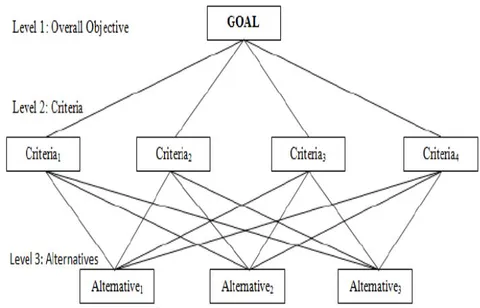
This method used for both tangible and intangible factors analysis. for real world problems. again, mutual agreement can also be provided among decision makers prior to their final decision. Firstly, the alternatives, main and sub-criteria -if there is any- must be determined. In the next step the decision problem is modelled hierarchically by considering previously selected criteria. The decision-makers' judgments are collected through pairwise comparisons in the third step. In this step, the importance rankings of alternatives and criteria will be determined by analyzing these data which are obtained from these comparisons. Hence comparisons must be performed among these criteria and alternatives [5-7].
b) Questionnaires
Questionnaires is developed to collect expert's opinion for AHP analysis. The AHP technique is a widely used and accepted method for gathering data from respondents within their domain of expertise. The technique is designed as a group communication process which aims to achieve a convergence of opinion on a specific real-world issue. It has been used in various fields of study such as program planning, needs assessment, policy determination, and resource utilization to develop a full range of alternatives, explore or expose underlying assumptions, as well as correlate judgments on a topic spanning a wide range of disciplines. In this study seven experts are chosen for selecting the criteria and sub criteria. The personal profile of expert panel is shown in table below. Based on the interviews and interaction of relevant experts, observation and literature review, modalities, criteria,
and sub-criteria are included in this study. Sample questionnaires for the criteria are shown below and details questionnaires are included in the annexure.
| SN | Designation | Overall Exp. (Years) | Relevant Exp. (Good, Better, Best) | Education Qualification | Organization |
| 1 | Expert-1 | 25+ | Best | Masters | Government Officer |
| 2 | Expert-2 | 25+ | Best | B.Sc. Engr. | |
| 3 | Expert-3 | 20+ | Best | B.Sc. Engr. | |
| 4 | Expert-4 | 20+ | Better | PhD | |
| 5 | Expert-5 | 20+ | Better | PhD | Professor |
| 6 | Expert-6 | 30+ | Best | Masters | Senior Consultant, Asian Development Bank |
| 7 | Expert-7 | 40+ | Best | Masters | ICT Industry |
| 8 | Expert-8 | 20+ | Best | PhD | Professor |
| 9 | Expert-9 | 8+ | Good | PhD | Assistant Professor |
| 10 | Expert-10 | 30+ | Best | Masters | Senior Consultant, Asian Development Bank |
| 11 | Expert-11 | 40+ | Best | Masters | ICT Industry |
| 12 | Expert-12 | 30+ | Good | Masters | ICT Industry |
i. Questionnaires for Criteria
Let given the frequency selection options, what is more important to you: Infrastructure (F1) or Governance (F2)?
Let given the frequency selection options, what is more important to you: Infrastructure (F1) or Strategic & Business Facility (F3)?
Let given the frequency selection options, what is more important to you: Governance (F2) or Strategic & Business Facility (F3)?
c) Main Attributes and their Sub-attributes
i. Infrastructure (main attributes)
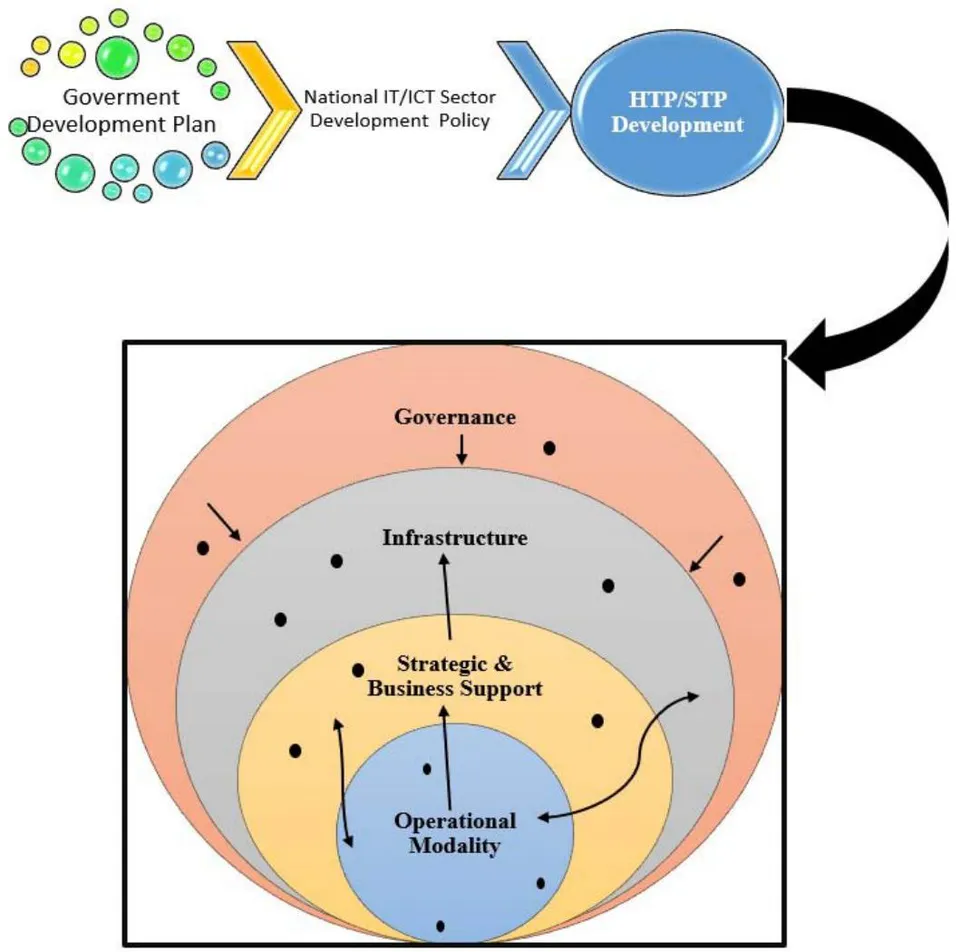
Infrastructure is one of the most important parts for the development of HTTP/STP. It is considered that within 2025 Bangladesh may require 20 million square feet buildup space for IT/ITEs sector. For HTTP/STP infrastructures are considered in three ways which are assumed as sub attributes i.e.,
a. Basic Facility (sub-attributes)
Land, working space, meeting room, auditorium/conference room, cafeteria; utility like generator, sub-station, HVAC, fire safety, 24/7 working environment, good connectivity etc.,
b. Digital Facility
Networking, security surveillance, lab facilities/lab equipment for rent, videoconference room, software-based utility billing system and paperless management etc.
c. Social Facility (sub-attributes)
Dormitory, banking services, shopping facility, gymnasium, recreation zone, health care, library, day care facility etc.
ii. Strategic and Business Support (main attributes)
Strategic and business support is required to create the eco-system. This is the major forces shaping the initial investment to success.
a. Industrial Chain and Enterprise Development (sub-attributes)
- R&D facilities, industrial co-operation, international collaboration, university linkage, technology transfer center/ support etc. b. Innovation and Strategic Facility (sub-attributes)
- Incubation/start up development facilities, innovation & patent support service, product commercialization, marketing assessment, financial incentives, business development/mentorship etc. c. Capacity and Market Development (sub-attributes)
Entrepreneurship development training, project and financial management, venture capital, co/shared workplace/workforce facility, seminar/symposium, professional membership, internship support, global standard certification support, need based on job training support, cyber security/latest technology support etc.
iii. Governance (main attributes)
a. Policy Support (sub-attributes) b. Operational Modality (sub-attributes)
Government
Private
Mixed Model
- University-Industry
- University-Govt.-Industry mixed type
- Government- Industry
c. Park Management (sub-attributes)
- Administrative capability and employee structure
- Legal Service
- Social Service
- Innovation Culture development etc.
VI. RESULT
To build the pair-wise comparison matrices for the main attributes and sub-attributes, opinion of academic experts and professional experts are collected. The purposive sampling method is used. It is one where the sample is selected on need basis according to the specialization. The matrix of pair-wise comparisons depicts the intensities of expert's preference/importance. Geo metrics mean of the value of each pair wise comparison determined and then matrix is formed with respect to the goal [8-10].
| Main Attributes | Weightage | Position |
| Infrastructure (F1) | 0.469 | 1st |
| Strategic & Business Support (F2) | 0.433 | 2nd |
| Governance (F3) | 0.097 | 3rd |
| Main Attributes | Sub-Attributes | Weightage | Position |
| Infrastructure (F1) | Basic Facility (F1A1) | 0.422 | |
| Digital Facility (F1A2) | 0.501 | ||
| Social Facility (F1A3) | 0.076 | ||
| Strategic & Business Support (F2) | Research & Strategic Facility (F2B1) | 0.656 | |
| Industrial Chain & Innovation Facility (F2B2) | 0.253 | ||
| Capacity Development (F2B3) | 0.089 | ||
| Governance (F3) | Policy Support (F3C1) | 0.279 | |
| Operational Modality (F3C2) | 0.658 | ||
| Park Management (F3C3) | 0.062 |
VII. CONCLUSION
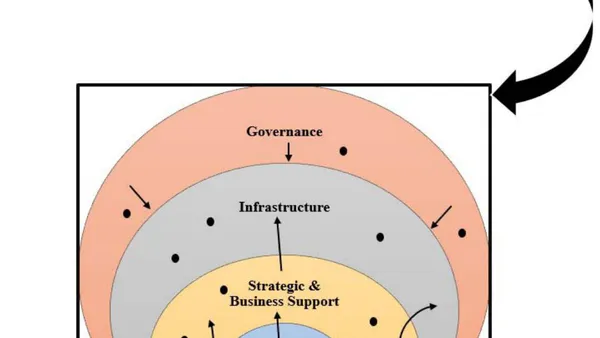
It been seen that, most of the initiatives are infrastructure focused rather than strategy based. After infrastructural initiatives, government is taking strong actions to establish business strategy. Many initiatives are seen around the country to support innovation and entrepreneurship. Government also trying to support new idea and products. But to make these steps and HTP/STP successful targeting successful institutionalization, operation modality shall be the most important variable. From the study the following process is proposed for the development of HTP/STP in Bangladesh [11].