The trade of agricultural products between China and Thailand is thriving, especially China’s import trade of agricultural products from Thailand. Even in the period of significant external environmental disruptions to trade, it has shown a vibrant and rapid growth. China has already become Thailand’s largest trading partner and export market for agricultural products. This research is based on HS classification data from 2013 to 2022, studies the trade scale, product structure, and market share of China’s import trade of agricultural products from Thailand. It also analyzes the influencing factors from the perspectives of import demand, export supply, and opportunities for the further development. It concludes that China’s import of agricultural products from Thailand are growing rapidly, the product structure has undergone significant changes and there is still great potential for further development in the future.
## I. INTRODUCTION
China and Thailand are important and friendly economic and trade partners. During $40+$ years of China's reform and opening up, the scale and level of trade and investment cooperation between the two countries are continuously developing. In 2010, China-ASEAN Free Trade Area was officially launched, and economic and trade cooperation between the two countries entered a fast lane of development. In 2022, the Regional Comprehensive Economic Partnership Agreement (RCEP) officially came into effect, and the level of openness in various fields such as trade in goods, trade in services, and economic cooperation has significantly improved compared to the commitments made in WTO. The further development of economic and trade cooperation between the two countries has ushered in new opportunities.
China and Thailand are both important producers of agricultural goods. The differences in climate and natural resources give each country its own endowment advantages in agricultural products. And at the same time, the two countries are near in geography and close in economic and trade cooperation, therefore, agricultural trade between the two countries has a very good foundation for development. In recent years, the bilateral trade of agricultural products between the two countries has developed rapidly, especially the significant rapid growth of China's import of agricultural products from Thailand. In 2022, China's import of agricultural products from Thailand reached 12.59 billion US dollars, an increase of $6.02\%$. Thailand's well-known agricultural products such as durian, mango, and fragrant rice have become common delicacies on the dining table for Chinese consumers. In fact $90\%$ of Thailand's export of fresh durian and manioc are shipped to China. The gradual integration of high-quality agricultural products from Thailand with the huge market demand in China has led to sustained and stable development of agricultural trade between the two countries.
The scope of agricultural products in this article is based on the basic agricultural product scope in the WTO Agreement on Agriculture, but not less fish and fish products, which means it includes all products listed in HS codes 1-24, plus other products listed in ANNEX 1 of the WTO Agreement on Agriculture, such as mannitol, sorbitol, essential oils, wool, raw cotton, and etc. The data used in the analysis is classified according to HS codes in the UN Comtrade database. Considering the research needs and data availability, the sample space is mainly from 2013 to 2022.
## II. CURRENT SITUATION OF CHINA'S IMPORT OF AGRICULTURAL PRODUCTS FROM THAILAND
The bilateral trade of agricultural products between China and Thailand has developed rapidly. In 2022, the import and export value of agricultural products between China and Thailand reached 17.48 billion US dollars, an increase of $5.9\%$. Among them, China imported agricultural products of 12.59 billion US dollars from Thailand and export value is 4.89 billion US dollars. China has a 7.7 billion US Dollars deficit in agricultural product trade with Thailand, and the deficit increased $6.27\%$ compared to year 2021. As to the share of import from Thailand in China's import of agricultural products from world, the figure is $3.64\%$ in 2013 and $5.34\%$ in 2022. Thailand has become an important source of China's agricultural product imports.
Agricultural products are an important component of Thailand's export to China. Trade goods between China and Thailand are diverse, including agricultural products, mechanical and electrical products, services and etc. With the increasingly close trade cooperation between China and Thailand, the bilateral trade between the two countries continues to grow. Among them, the growth rate of China's import of agricultural products from Thailand is significant higher than its export. As shown in Figure 1, in 2013 China imported 4.3 billion US dollars of agricultural products from Thailand, accounting for $11.16\%$ of China's total imports of goods from Thailand. In 2022, China imported 12.59 billion US dollars of agricultural products from Thailand, accounting for $22.28\%$ of China's total imports of goods from Thailand. Over the past decade, China's import of agricultural products from Thailand has increased by 1.93 times, now accounting for nearly a quarter of China's import of goods from Thailand.
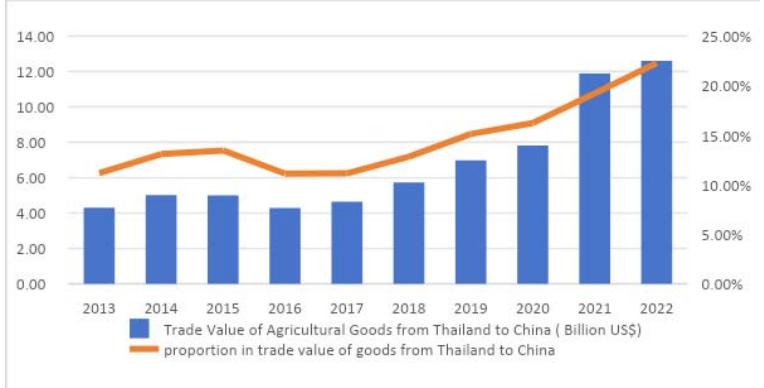 Data source: Calculated based on UN Comtrade Database (China as the Reporter) Figure 1: 2013-2022 Trade Value of Agricultural Goods from Thailand to China and its Proportion
The proportion of fruit products in China's import of agricultural products from Thailand is increasing rapidly. Agriculture is a traditional industry in Thailand, the world's largest exporter of rice and a major producer and exporter of rubber, manioc, sugarcane, and aquatic products. At present, the trade value of cereal products in China's import of agricultural products from Thailand is far less than that of fruits, vegetables and roots. From 2013 to 2017, the trade value of vegetables and roots (commodity code HS07) imported from Thailand by China was the highest, accounting for over a quarter of the total. But after 2018, as shown in Figure 2, the import of fruit and nuts (commodity code HS08) began to increase and surpassed the vegetables and roots. China's import value of fruit and nuts from Thailand has increased from 1.45 Billion US dollars in 2013 to 6.28 Billion US dollars in 2022, an increase of 2.33 times. Since 2021, fruit and nuts accounts for about $50\%$ of China's import of agricultural products from Thailand.
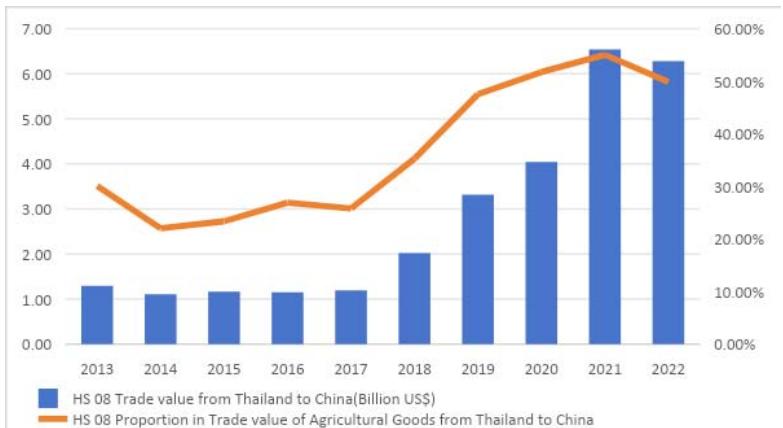 Data source: Calculated based on UN Comtrade Database (China as the reporter) Figure 2: 2013-2022 Trade Value of Fruit and Nuts (HS08) from Thailand to China and its Proportion
Fresh durian, manioc, manioc starch, guava mango and mangosteen are the top four agricultural products imported by China from Thailand. As shown in Figure 3, the total import value of the four products has increased from 2.75 billion US dollars in 2013 to 7.53 billion US dollars in 2022, which has similar growth rate with China's import of agricultural products from Thailand. Therefore, the proportion of the above four products in China's import of agricultural products from Thailand has not changed much, basically ranging from $50\%$ to $60\%$, in 2022 the figure is $59.79\%$. Further analysis shows that before 2018, the import value of manioc was greater than that of the other three products, after 2018 the import value of fresh durian has grown at an astonishing rate and surpassed the import value of manioc. In 2022, the import value of fresh durian from Thailand to China was 3.85 billion US dollars, accounting for $30.54\%$ of China's import of agricultural products from Thailand. This means that fresh durian alone accounts for nearly one-third of China's import of agricultural products from Thailand. Fresh durian, a popular and unique tropical fruit, has become a star product. In addition, the import value of manioc starch, guava mango and mangosteen has grown rapidly as well, ranking just after fresh durian and manioc.
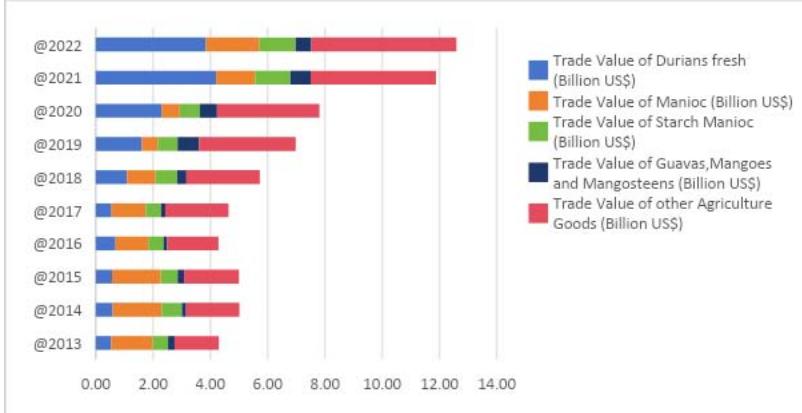 Data Source: Calculated based on UN Comtrade Database (China as the Reporter) Figure 3: 2013-2022 Trade Value of Selected Products from Thailand to China
China is the largest export market for Thai agricultural products. The main export markets of Thai agricultural products are China, Japan, the United States. In recent years, there have been slight adjustments in exports to the Japanese and American markets, and exports to the Chinese market have increased significantly. Now China has become the largest export market for Thai agricultural products for years. As shown in Table 1, according to UN Comtrade Database (Thailand as the reporter), China has the largest share in Thailand's agricultural product export market, rising from $15.55\%$ in 2019 to $25.48\%$ in 2021 which means that about a quarter of Thailand's agricultural product exports are sold to the Chinese market. In addition, several agricultural product exports rely heavily on the Chinese market. As shown in Table 2, from 2019 to 2021 the Chinese market share in Thailand's fresh durian, manioc, and manioc starch exports was high and increasing. In 2021, the Chinese market share in these three product exports was $90.04\%$, $99.48\%$, and $71.84\%$ respectively.
Table 1: 2019-2021 Market Structure of Thai Agricultural Products Export
<table><tr><td>Period</td><td>Market Share of China</td><td>Market Share of Japan</td><td>Market Share of USA</td><td>Market Share of others</td></tr><tr><td>2019</td><td>15.55%</td><td>13.00%</td><td>10.39%</td><td>61.06%</td></tr><tr><td>2020</td><td>18.70%</td><td>12.52%</td><td>12.02%</td><td>56.77%</td></tr><tr><td>2021</td><td>25.48%</td><td>11.29%</td><td>10.63%</td><td>52.60%</td></tr></table>
Table 2: 2019-2021 Chinese Market Share of Thai Durian Fresh, Manioc, and Starch Manioc Export
<table><tr><td>Period</td><td>Durian fresh: Market Share of China</td><td>Manioc: Market Share of China</td><td>Starch Manioc: Market Share of China</td></tr><tr><td>2019</td><td>58.01%</td><td>98.99%</td><td>53.24%</td></tr><tr><td>2020</td><td>72.79%</td><td>99.41%</td><td>62.70%</td></tr><tr><td>2021</td><td>90.04%</td><td>99.48%</td><td>71.84%</td></tr></table>
## III. FACTORS INFLUENCING CHINA'S IMPORT OF AGRICULTURAL PRODUCTS FROM THAILAND
With the increase of GNI, the demand for imported goods by Chinese consumers grows rapidly. According to the World Bank Data, GNI per capital PPP of China is 11,780 current international dollars in 2013 and 21,250 current international dollars in 2022. Considering the increase of GNI per capita and China's population, the change in market demand is a huge volume. The impact of increased income on demand is also influenced by the income elasticity of demand. Some agricultural products such as oil seeds, animal or vegetable fats and oil have a relatively low income elasticity of demand, so the market's demand for these products is less affected by income changes. However, other agricultural products such as meat and edible meat offal, fruit and nuts edible have a relatively high income elasticity of demand. As consumer income increases, the quantity of demand for such products will significantly increase as well. China imported from world meat and edible meat offal of 5.93 billion US dollars in 2013 and 30.88 billion US dollars in 2022, an increase of 4.2 times, and fruit and nuts edible of 4.10 billion US dollars in 2013 and 16.64 billion US dollars in 2022, an increase of 3.06 times. The tropical fruits and other agricultural products from Thailand matches the demand of the Chinese market just in time. Taking fresh durian as an example, Thailand exported fresh durian of 3.41 billion US dollars in 2021, of which the largest demand came from China.
Thailand is a major producer and exporter of rice, natural rubber and tropical fruits in the world, and has its own unique natural endowment advantages in the production and export of these agricultural products. During the five years from 2017 to 2021, Thailand's main agricultural product export markets were China (export value 30.99 billion US dollars, export market share $17.05\%$ ), Japan (export value 22.91 billion US dollars, export market share $12.61\%$ ), and the United States (19.52 billion US dollars, export market share $10.75\%$ ). The export value continued to grow, and China has become the largest market. The distance between China and Thailand is relatively close, and the transportation of goods is well developed, which increases the timeliness and convenience of agricultural products, especially fresh fruit transportation. The continuous development of cold chain transportation for fruit has improved efficiency and reduced costs, 6-hour rapid customs clearance facilitates trade of perishable goods, as well as trade tariff reduced further, all of these helps to provide new impetus for Sino-Thai agricultural product trade. However, the production and export of agricultural products are susceptible to natural factors such as climate. And the inspection and quarantine issues caused by pests cannot be underestimated. In addition, Thailand's competitors in Southeast Asia have also begun to compete for global market share in agricultural exports. For example, China has officially allowed the import of fresh durian from Vietnam since 2022, and Vietnam is reducing costs through land border transportation. Vietnam's fresh durian exports to China are showing a rapid growth trend, which may challenge dominant position of Thailand's fresh durian in the Chinese market.
In addition, regional economic cooperation is also an important influencing factor in the trade of agricultural products between China and Thailand. After the establishment of the China-ASEAN Free Trade Area and the launch of the RCEP negotiations, bilateral trade between China and Thailand has continued to expand and cooperation has become closer. RCEP is the world's largest free trade agreement, consisting of 10 ASEAN member countries and 5 trading partners (China, Japan, South Korea, Australia, and New Zealand). After its implementation in the Philippines in June this year, this agreement will enter into force for all 15 members. According to the RCEP agreement, $65\%$ of the tariffs and quotas on trade of goods between member countries will be abolished, and this proportion will increase to $90\%$ over time. For example, China will maintain zero tariffs or immediately reduce tariffs on agricultural products under 960 categories, accounting for $65.3\%$ of all agricultural products. Partly tax reductions and exceptions only accounts for $7.2\%$. RCEP also includes simplifying customs procedures, investment and e-commerce regulations, and introducing more free trade measures, all of which are favorable factors for the sustained and rapid development of China's import of agricultural products from Thailand.
## IV. CONCLUSION
In recent years, China's import of agricultural products from Thailand have grown rapidly. China's import of agricultural products from Thailand is much greater than its export, the trade deficit is large and still increasing. The growth rate of China's import of agricultural products from Thailand is greater than the growth rate of China's total imports of goods from Thailand. Therefore, the proportion of agricultural products in China's total imports of goods from Thailand has significantly increased, reaching nearly a quarter.
Since 2018, the product structure of China's import of agricultural products from Thailand has undergone significant changes. Before 2018, vegetables and roots accounted for the largest proportion, with manioc being the most prominent. After 2018, the import of fruit and nuts has grown rapidly, with fresh durian being the most prominent. Now fruit and nuts accounts for about $50\%$ of China's import of agricultural products from Thailand, significantly surpassing vegetables and roots. Among fruit and nuts, fresh durian is really a star product.
China has become the largest market for Thai agricultural exports for years. Thailand's main agricultural product export markets are China, Japan, the United States. In recent years, exports to the Chinese market have grown rapidly. In 2021, about a quarter of Thailand's agricultural product exports were to China. Fresh durian and other agricultural products have a high dependence on the Chinese market.
China's import of agricultural products from Thailand still has great potential for development. Thailand's abundant tropical fruit and other agricultural products have unique natural endowment advantages and are widely popular in the international market. The income elasticity of demand of these products is relatively high. As long as they can meet the huge market demand of the Chinese market and continuously improve the timeliness and convenience of delivery, there is still great development potential. In addition, the comprehensive launch of the RCEP agreement, which includes measures such as canceling tariffs, simplifying customs procedures and etc., is also a favorable factor for promoting the further development of China's import of agricultural products from Thailand.
Generating HTML Viewer...
References
10 Cites in Article
Zheng Guofu (2016). Analysis and Policy Suggestions on the Complementarity and Competitiveness of Bilateral Trade between China and Thailand.
Liu Xu Peiyuan,Yafang (2017). Research on the Current Situation, Problems, and Countermeasures of China Thailand Economic Relations.
Chen Yanwu,Xie Xiaobing (2013). Structural Characteristics and Prospects of Sino Thai Trade.
Zhang Yu'e,Cao Lijuan (2016). Definition and classification of the scope of agricultural products in agricultural trade research.
He Min,Zhang Ningning,Huang Zequn (2016). Analysis on the Competitiveness and Complementarity of Agricultural Products Trade between China and the "the Belt and Road" Countries.
Zhan Miaohua (2018). Competitiveness and complementarity of agricultural products trade of countries along the "the Belt and Road" -based on social network analysis method.
Fu Minghui,Qi Chunjie (2016). Analysis on the Current Situation and Comparative Advantage of Agricultural Products Trade between China and the "the Belt and Road" Countries and Regions.
Ding Yibing,Feng Zixuan (2022). Analysis of the Evolution Trends and Influencing Factors of Agricultural Product Trade between China and Other RCEP Member States.
Cheng Rong,Cheng Huifang (2011). III. BILATERAL TRADE RELATIONS BETWEEN CHINA AND ASEAN.
Sun Lifang,Chen Zhao (2018). How does economic openness affect the international competitiveness of agricultural products in the context of the the Belt and Road Initiative: evidence from RCEP member countries.
No ethics committee approval was required for this article type.
Data Availability
Not applicable for this article.
How to Cite This Article
Wan Ning. 2026. \u201cAnalysis on Chinas Import Trade of Agricultural Products from Thailand\u201d. Global Journal of Management and Business Research - B: Economic & Commerce GJMBR-B Volume 23 (GJMBR Volume 23 Issue B6): .
Explore published articles in an immersive Augmented Reality environment. Our platform converts research papers into interactive 3D books, allowing readers to view and interact with content using AR and VR compatible devices.
Your published article is automatically converted into a realistic 3D book. Flip through pages and read research papers in a more engaging and interactive format.
The trade of agricultural products between China and Thailand is thriving, especially China’s import trade of agricultural products from Thailand. Even in the period of significant external environmental disruptions to trade, it has shown a vibrant and rapid growth. China has already become Thailand’s largest trading partner and export market for agricultural products. This research is based on HS classification data from 2013 to 2022, studies the trade scale, product structure, and market share of China’s import trade of agricultural products from Thailand. It also analyzes the influencing factors from the perspectives of import demand, export supply, and opportunities for the further development. It concludes that China’s import of agricultural products from Thailand are growing rapidly, the product structure has undergone significant changes and there is still great potential for further development in the future.
Our website is actively being updated, and changes may occur frequently. Please clear your browser cache if needed. For feedback or error reporting, please email [email protected]
Thank you for connecting with us. We will respond to you shortly.