I. INTRODUCTION
The independent solutions of this equation are Bessel functions are the solutions of the differential equation of the wave equation of Helmholtz in cylindrical coordinates [1]:
where is a constant and is an integer.
The independent solutions of this equation are the first and the second kind of Bessel functions, and , respectively. The second kind of Bessel functions are also called Weber or Neumann functions. Then, the generic solution of the differential equation is a linear combination of the Bessel functions:
where and are arbitrary constants, whose value can be obtained by applying boundary conditions.
This differential equation appears in many fields of physics involving electromagnetic fields, vibrations, heat conduction diffraction, scattering, etc. We are going to focus on the electromagnetic applications in this work, but all the results obtained here can be used in other fields as well.
Bessel functions must be integrated in many electromagnetic problems such as scattering and resonators problems. A lot of papers and treatises provide analytical solution of some integrals that involves Bessel functions, like Luke [2], Watson [3], Manring[4] and Kajfez [5]. Nevertheless, it is difficult to find the analytical solution of the most important integrals in electromagnetics grouped together and there are not works that provide the analytical solution of all these integrals since they only provide the integrals involved in its particular problem.
In this paper, the most important integrals that have analytical solution and involves Bessel functions in electromagnetics are provided. Some solutions of these integrals have been obtained from the literature, but others have been obtained for the first time in this paper with an interesting method shown in [6].
II. ANALYTICAL INTEGRALS
From now on, we define functions and as linear combination of Bessel functions; and are arbitrary constants which are included in the argument of Bessel functions; and are integer numbers starting in 0 that indicate the order of the Bessel functions; and is the independent variable. Derivatives of Bessel functions are defined in this paper as follow [7]:
The first integrals shown in this paper are the most common in electromagnetics, they appear very often in many problems and have been studied deeply in literature, so we are going to provide the analytical solution and the reference where can be found.
From [1]:
From [3]:
From [2]:
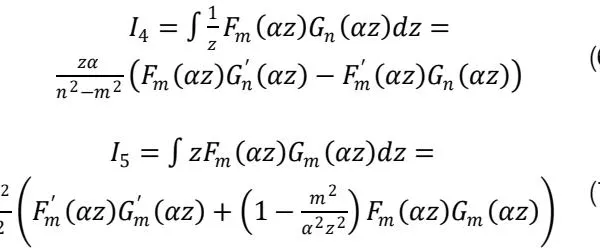
I_{4} = \int_{z}^{1} F_{m} (\alpha z) G_{n} (\alpha z) \, dz = \frac{z \alpha}{n^{2} - m^{2}} \left(F_{m} (\alpha z) G_{n}^{\'} (\alpha z) - F_{m}^{\'} (\alpha z) G_{n} (\alpha z)\right) (6) \quad I_{5} = \int z F_{m} (\alpha z) G_{m} (\alpha z) \, dz = \frac{z^{2}}{2} \left(F_{m}^{\'} (\alpha z) G_{m}^{\'} (\alpha z) + \left(1 - \frac{m^{2}}{\alpha^{2} z^{2}}\right) F_{m} (\alpha z) G_{m} (\alpha z)\right) (7)The following integrals are more complex and they appear in specific electromagnetic problems when orthogonality between transversal electric fields (TE) and transversal magnetic fields (TM) is applied in circular waveguides. These integrals are not provided in the classical treatises of Bessel functions like Korenev [1], Watson [3] or Luke [2], but if you look forward deeply in literature, the analytical solution of these integrals can be found as well in specific works. From [4]:
From [5]:
Finally, in the following lines, we provide the analytical solution of two integrals that are not given in any treatise of Bessel functions nor literature about the topic and they appear in electromagnetic problems.
The first one appears in cylindrical structures when the mutual influence between TE and TM modes are considered to give place to hybrid modes. This integral can be solved immediately applying the definition of the derivate of the product of two functions and finding the primitive of the integral. This integral that looks very simple to solve analytically is calculated by numerical methods in someworks, loosing accuracy and computational time for their simulations. In this work the analytical solution is provided:
The second integral is also not given in classical treatises and it is more complex to solve. It appears when the stored electromagnetic energy of circular waveguides is calculated. The analytical solution can be obtained with an interesting method described in [6], which get analytical solutions of some integrals starting from the initial differential equation in cylindrical coordinates. The procedure described in [6] is not the main objective of this paper but can be interesting for the reader knows the source to check the procedure and the steps that we have follow to solve this integral. Then, this integral is obtained applying this method and the solution is:
III. CHECKING INTEGRALS
In this section, the provided analytical solutions of the integrals shown above are verified comparing the result with numerical methods.
We have chosen a general linear combination of Bessel functions for and Gas follows:
In addition, we have chosen arbitrary numbers for the constants involved, concretely: ; ; ; ; ; ; ; . The integrals have been evaluated from to .
| Integral | Relative Error (%) |Num. solution - Analytic solution| Analytic solution · 100 | Time variation tnumerical tanalytic |
| I1 | 2·10-14 | 2,07 |
| I2 | 8·10-14 | 2,61 |
| I3 | 2·10-12 | 2,21 |
| I4 | 1,2·10-12 | 2,18 |
| I5 | 2·10-13 | 2,27 |
| I6 | 2·10-12 | 3,33 |
| I7 | 1,4·10-11 | 2,27 |
| I8 | 2·10-12 | 6,8 |
| I9 | 3·10-15 | 3,34 |
Table I shows that the accuracy of the integrals provided above is very good and the computational time to calculate the integrals is much longer in numerical methods than directly applying the expressions of analytical solutions provided in this paper.
IV. CONCLUSIONS
In this paper the most important integrals that involves Bessel functions in electromagnetics and have analytical solution have been provided. Especially useful can be the analytical integrals shown in this paper for first time and in addition to the review of the other integrals developed in different works to and difficult to find all of them together.
The accuracy of the analytical integral solutions has been verified with numerical methods, obtaining excellent results as well as the computational time. This work shows that evaluating the analytical solution is much better in terms of computational time and accuracy than computing the integral numerically. These results can be especially useful to improve the accuracy and optimize the computational time of tough iterative electromagnetic simulations, which involve thousands of integrals at each step.