Antibacterial Efficacy of Pap Slurry Liquor on Some Diarrhogenic Organisms

1
Yusuf, Lamidi
Yusuf, Lamidi
2
Yusuf
Yusuf
3
Lamidi
Lamidi

Send Message

To: Author

GJMR Volume 21 Issue C3

Article Fingerprint

ReserarchID

B9I2N

Antibacterial Efficacy of Pap Slurry Liquor on Some Diarrhogenic Organisms Banner
  • English
  • Afrikaans
  • Albanian
  • Amharic
  • Arabic
  • Armenian
  • Azerbaijani
  • Basque
  • Belarusian
  • Bengali
  • Bosnian
  • Bulgarian
  • Catalan
  • Cebuano
  • Chichewa
  • Chinese (Simplified)
  • Chinese (Traditional)
  • Corsican
  • Croatian
  • Czech
  • Danish
  • Dutch
  • Esperanto
  • Estonian
  • Filipino
  • Finnish
  • French
  • Frisian
  • Galician
  • Georgian
  • German
  • Greek
  • Gujarati
  • Haitian Creole
  • Hausa
  • Hawaiian
  • Hebrew
  • Hindi
  • Hmong
  • Hungarian
  • Icelandic
  • Igbo
  • Indonesian
  • Irish
  • Italian
  • Japanese
  • Javanese
  • Kannada
  • Kazakh
  • Khmer
  • Korean
  • Kurdish (Kurmanji)
  • Kyrgyz
  • Lao
  • Latin
  • Latvian
  • Lithuanian
  • Luxembourgish
  • Macedonian
  • Malagasy
  • Malay
  • Malayalam
  • Maltese
  • Maori
  • Marathi
  • Mongolian
  • Myanmar (Burmese)
  • Nepali
  • Norwegian
  • Pashto
  • Persian
  • Polish
  • Portuguese
  • Punjabi
  • Romanian
  • Russian
  • Samoan
  • Scots Gaelic
  • Serbian
  • Sesotho
  • Shona
  • Sindhi
  • Sinhala
  • Slovak
  • Slovenian
  • Somali
  • Spanish
  • Sundanese
  • Swahili
  • Swedish
  • Tajik
  • Tamil
  • Telugu
  • Thai
  • Turkish
  • Ukrainian
  • Urdu
  • Uzbek
  • Vietnamese
  • Welsh
  • Xhosa
  • Yiddish
  • Yoruba
  • Zulu

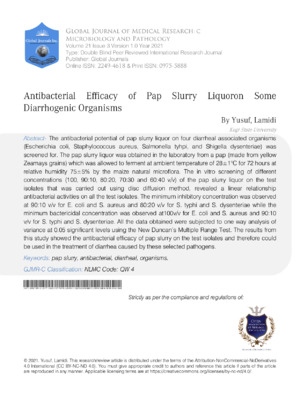
The antibacterial potential of pap slurry liquor on four diarrheal associated organisms (Escherichia coli, Staphylococcus aureus, Salmonella tyhpi, and Shigella dysenteriae) was screened for. The pap slurry liquor was obtained in the laboratory from a pap (made from yellow Zeamays grains) which was allowed to ferment at ambient temperature of 28±1 o C for 72 hours at relative humidity 75±5% by the maize natural microflora. The in vitro screening of different concentrations (100, 90:10, 80:20, 70:30 and 60:40 v/v) of the pap slurry liquor on the test isolates that was carried out using disc diffusion method, revealed a linear relationship antibacterial activities on all the test isolates. The minimum inhibitory concentration was observed at 90:10 v/v for E. coli and S. aureus and 80:20 v/v for S. typhi and S. dysenteriae while the minimum bactericidal concentration was observed at100v/v for E. coli and S. aureus and 90:10 v/v for S. typhi and S. dysenteriae. All the data obtained were subjected to one way analysis of variance at 0.05 significant levels using the New Duncan’s Multiple Range Test. The results from this study showed the antibacterial efficacy of pap slurry on the test isolates and therefore could be used in the treatment of diarrhea caused by these selected pathogens.

Funding

No external funding was declared for this work.

Conflict of Interest

The authors declare no conflict of interest.

Ethical Approval

No ethics committee approval was required for this article type.

Data Availability

Not applicable for this article.

Yusuf, Lamidi. 2021. \u201cAntibacterial Efficacy of Pap Slurry Liquor on Some Diarrhogenic Organisms\u201d. Global Journal of Medical Research - C: Microbiology & Pathology GJMR-C Volume 21 (GJMR Volume 21 Issue C3): .

Download Citation

Anti-bacterial effectiveness of pap slurry in diarrhogenic organisms.
Journal Specifications

Crossref Journal DOI 10.17406/gjmra

Print ISSN 0975-5888

e-ISSN 2249-4618

Keywords
Classification
GJMR-C Classification: NLMC Code: QW 4
Version of record

v1.2

Issue date

November 24, 2021

Language

English

Experiance in AR

The methods for personal identification and authentication are no exception.

Read in 3D

The methods for personal identification and authentication are no exception.

Article Matrices
Total Views: 1950
Total Downloads: 946
2026 Trends
Research Identity (RIN)
Related Research

Published Article

The antibacterial potential of pap slurry liquor on four diarrheal associated organisms (Escherichia coli, Staphylococcus aureus, Salmonella tyhpi, and Shigella dysenteriae) was screened for. The pap slurry liquor was obtained in the laboratory from a pap (made from yellow Zeamays grains) which was allowed to ferment at ambient temperature of 28±1 o C for 72 hours at relative humidity 75±5% by the maize natural microflora. The in vitro screening of different concentrations (100, 90:10, 80:20, 70:30 and 60:40 v/v) of the pap slurry liquor on the test isolates that was carried out using disc diffusion method, revealed a linear relationship antibacterial activities on all the test isolates. The minimum inhibitory concentration was observed at 90:10 v/v for E. coli and S. aureus and 80:20 v/v for S. typhi and S. dysenteriae while the minimum bactericidal concentration was observed at100v/v for E. coli and S. aureus and 90:10 v/v for S. typhi and S. dysenteriae. All the data obtained were subjected to one way analysis of variance at 0.05 significant levels using the New Duncan’s Multiple Range Test. The results from this study showed the antibacterial efficacy of pap slurry on the test isolates and therefore could be used in the treatment of diarrhea caused by these selected pathogens.

Our website is actively being updated, and changes may occur frequently. Please clear your browser cache if needed. For feedback or error reporting, please email [email protected]
×

This Page is Under Development

We are currently updating this article page for a better experience.

Request Access

Please fill out the form below to request access to this research paper. Your request will be reviewed by the editorial or author team.
X

Quote and Order Details

Contact Person

Invoice Address

Notes or Comments

This is the heading

Lorem ipsum dolor sit amet, consectetur adipiscing elit. Ut elit tellus, luctus nec ullamcorper mattis, pulvinar dapibus leo.

High-quality academic research articles on global topics and journals.

Antibacterial Efficacy of Pap Slurry Liquor on Some Diarrhogenic Organisms

Yusuf
Yusuf
Lamidi
Lamidi
Lamidi
Lamidi

Research Journals