
Antiepileptic Drugs and the Relationship with the Intestinal Microbiota

1
Matheus Amorim Grigorio
Matheus Amorim Grigorio Reviewer
2
Henrique Hollanda Larangeira
3
Luciane Alves de Oliveira
4
Renata Gomes Ramalho dos Santos
5
Cínthia Pereira Jacomini
6
Tamires Santos Pinheiro
7
Lucca Cardoso Damasceno
8
Nilcele Freire de oliveira

Send Message

To: Author

GJMR Volume 23 Issue B3

Article Fingerprint

ReserarchID

PDDTMUGELA

Antiepileptic Drugs and the Relationship  with the Intestinal Microbiota Banner
  • English
  • Afrikaans
  • Albanian
  • Amharic
  • Arabic
  • Armenian
  • Azerbaijani
  • Basque
  • Belarusian
  • Bengali
  • Bosnian
  • Bulgarian
  • Catalan
  • Cebuano
  • Chichewa
  • Chinese (Simplified)
  • Chinese (Traditional)
  • Corsican
  • Croatian
  • Czech
  • Danish
  • Dutch
  • Esperanto
  • Estonian
  • Filipino
  • Finnish
  • French
  • Frisian
  • Galician
  • Georgian
  • German
  • Greek
  • Gujarati
  • Haitian Creole
  • Hausa
  • Hawaiian
  • Hebrew
  • Hindi
  • Hmong
  • Hungarian
  • Icelandic
  • Igbo
  • Indonesian
  • Irish
  • Italian
  • Japanese
  • Javanese
  • Kannada
  • Kazakh
  • Khmer
  • Korean
  • Kurdish (Kurmanji)
  • Kyrgyz
  • Lao
  • Latin
  • Latvian
  • Lithuanian
  • Luxembourgish
  • Macedonian
  • Malagasy
  • Malay
  • Malayalam
  • Maltese
  • Maori
  • Marathi
  • Mongolian
  • Myanmar (Burmese)
  • Nepali
  • Norwegian
  • Pashto
  • Persian
  • Polish
  • Portuguese
  • Punjabi
  • Romanian
  • Russian
  • Samoan
  • Scots Gaelic
  • Serbian
  • Sesotho
  • Shona
  • Sindhi
  • Sinhala
  • Slovak
  • Slovenian
  • Somali
  • Spanish
  • Sundanese
  • Swahili
  • Swedish
  • Tajik
  • Tamil
  • Telugu
  • Thai
  • Turkish
  • Ukrainian
  • Urdu
  • Uzbek
  • Vietnamese
  • Welsh
  • Xhosa
  • Yiddish
  • Yoruba
  • Zulu

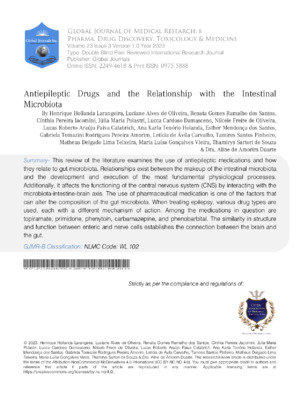
This review of the literature examines the use of antiepileptic medications and how they relate to gut microbiota. Relationships exist between the makeup of the intestinal microbiota and the development and execution of the most fundamental physiological processes. Additionally, it affects the functioning of the central nervous system (CNS) by interacting with the microbiota-intestine-brain axis. The use of pharmaceutical medication is one of the factors that can alter the composition of the gut microbiota. When treating epilepsy, various drug types are used, each with a different mechanism of action. Among the medications in question are topiramate, primidone, phenytoin, carbamazepine, and phenobarbital. The similarity in structure and function between enteric and nerve cells establishes the connection between the brain and the gut.

Funding

No external funding was declared for this work.

Conflict of Interest

The authors declare no conflict of interest.

Ethical Approval

No ethics committee approval was required for this article type.

Data Availability

Not applicable for this article.

Matheus Amorim Grigorio. 2026. \u201cAntiepileptic Drugs and the Relationship with the Intestinal Microbiota\u201d. Global Journal of Medical Research - B: Pharma, Drug Discovery, Toxicology & Medicine GJMR-B Volume 23 (GJMR Volume 23 Issue B3): .

Download Citation

Enhanced understanding of antiepileptic drugs and gut microbiota relationships.
Journal Specifications

Crossref Journal DOI 10.17406/gjmra

Print ISSN 0975-5888

e-ISSN 2249-4618

Keywords
Classification
GJMR-B Classification: NLMC Code: WL 102
Version of record

v1.2

Issue date

January 2, 2024

Language

English

Experiance in AR

The methods for personal identification and authentication are no exception.

Read in 3D

The methods for personal identification and authentication are no exception.

Article Matrices
Total Views: 1109
Total Downloads: 27
2026 Trends
Research Identity (RIN)
Related Research

Published Article

This review of the literature examines the use of antiepileptic medications and how they relate to gut microbiota. Relationships exist between the makeup of the intestinal microbiota and the development and execution of the most fundamental physiological processes. Additionally, it affects the functioning of the central nervous system (CNS) by interacting with the microbiota-intestine-brain axis. The use of pharmaceutical medication is one of the factors that can alter the composition of the gut microbiota. When treating epilepsy, various drug types are used, each with a different mechanism of action. Among the medications in question are topiramate, primidone, phenytoin, carbamazepine, and phenobarbital. The similarity in structure and function between enteric and nerve cells establishes the connection between the brain and the gut.

Our website is actively being updated, and changes may occur frequently. Please clear your browser cache if needed. For feedback or error reporting, please email [email protected]
×

This Page is Under Development

We are currently updating this article page for a better experience.

Request Access

Please fill out the form below to request access to this research paper. Your request will be reviewed by the editorial or author team.
X

Quote and Order Details

Contact Person

Invoice Address

Notes or Comments

This is the heading

Lorem ipsum dolor sit amet, consectetur adipiscing elit. Ut elit tellus, luctus nec ullamcorper mattis, pulvinar dapibus leo.


High-quality academic research articles on global topics and journals.

Antiepileptic Drugs and the Relationship with the Intestinal Microbiota

Henrique Hollanda Larangeira
Luciane Alves de Oliveira
Renata Gomes Ramalho dos Santos
Cínthia Pereira Jacomini
Tamires Santos Pinheiro
Lucca Cardoso Damasceno
Nilcele Freire de oliveira

Research Journals





























































