


Application of Ammonium Carbonate Solutions in Electrochemical Technology of Heavy Alloy Waste Processing

Application of Ammonium Carbonate Solutions in Electrochemical Technology of Heavy Alloy Waste Processing

Article Fingerprint

ReserarchID

SFR4K6D1

Application of Ammonium Carbonate Solutions in Electrochemical Technology of Heavy Alloy Waste Processing Banner

Key Research Insights

Synthesized scholarly intelligence & interactive research assistant
  • English
  • Afrikaans
  • Albanian
  • Amharic
  • Arabic
  • Armenian
  • Azerbaijani
  • Basque
  • Belarusian
  • Bengali
  • Bosnian
  • Bulgarian
  • Catalan
  • Cebuano
  • Chichewa
  • Chinese (Simplified)
  • Chinese (Traditional)
  • Corsican
  • Croatian
  • Czech
  • Danish
  • Dutch
  • Esperanto
  • Estonian
  • Filipino
  • Finnish
  • French
  • Frisian
  • Galician
  • Georgian
  • German
  • Greek
  • Gujarati
  • Haitian Creole
  • Hausa
  • Hawaiian
  • Hebrew
  • Hindi
  • Hmong
  • Hungarian
  • Icelandic
  • Igbo
  • Indonesian
  • Irish
  • Italian
  • Japanese
  • Javanese
  • Kannada
  • Kazakh
  • Khmer
  • Korean
  • Kurdish (Kurmanji)
  • Kyrgyz
  • Lao
  • Latin
  • Latvian
  • Lithuanian
  • Luxembourgish
  • Macedonian
  • Malagasy
  • Malay
  • Malayalam
  • Maltese
  • Maori
  • Marathi
  • Mongolian
  • Myanmar (Burmese)
  • Nepali
  • Norwegian
  • Pashto
  • Persian
  • Polish
  • Portuguese
  • Punjabi
  • Romanian
  • Russian
  • Samoan
  • Scots Gaelic
  • Serbian
  • Sesotho
  • Shona
  • Sindhi
  • Sinhala
  • Slovak
  • Slovenian
  • Somali
  • Spanish
  • Sundanese
  • Swahili
  • Swedish
  • Tajik
  • Tamil
  • Telugu
  • Thai
  • Turkish
  • Ukrainian
  • Urdu
  • Uzbek
  • Vietnamese
  • Welsh
  • Xhosa
  • Yiddish
  • Yoruba
  • Zulu
Reading Preferences
Font Size
Line Spacing
Background
This converted HTML version may contain rendering inconsistencies. Please refer to the PDF for the authoritative version, or click here to provide feedback.

Abstract

The electrochemical behavior of the VNZhK alloy waste (wt.%: W 90, Ni 7,2, Fe 1,8, Co 1) in a solution of (NH 4 ) 2 CO 3 1M was investigated by using the methods of cyclic voltammetry in the potentiodynamic mode, potentiostatic electrolysis and electrolysis under the action of alternating current (industrial frequency 50 Hz). It was found, that the highest oxidation rate of VNZhK alloy waste (1700 mg /cm 2 •h) is achieved by using alternating current, and the highest current efficiency (about 100%) -by using direct current. A technological scheme was proposed for recovery of tungsten from the heavy tungsten alloy waste in the form of ammonium paratungstate.

I. INTRODUCTION

Research in the field of tungsten-containing secondary raw materials processing is now widespread [ 1 10 ] . Electrochemical technologies for recycling tungsten from waste of metalized tungsten-containing raw materials, including heavy tungsten alloys (WHAs), are often based on the use of alkaline solutions [ 11 15 ] . Despite the fact, that alkaline electrolytes have a higher electrical conductivity compared to ammonium carbonate solutions [ 16 , 17 ] , the use of the latter in the electrochemical processing of WHAs can significantly simplify the production of a commercial product - ammonium paratungstate (APM). The extraction of tungsten from traditional alkaline solutions, as well as ammonium alkaline tungsten-containing solutions, is based on their neutralization with acids and precipitation of tungstic acid. Tungstic acid is further purified to achieve the necessary requirements. In this work, we propose the use of an ammonium carbonate solution as an electrolyte for processing of WHAs waste of the VNZhK type. It will simplify the separation of tungsten from the rest of the alloy components (metals of the iron subgroup), and at the same time, the use of significant volumes of acids will be excluded from the technological process. Also there will be no need to dispose of concentrated salt solutions. The proposed approach prevents a decrease in the purity of the APM by impurities from the electrolyte. The use of ammonium carbonate solutions in the WHAs electrochemical processing contributes to an increase in the environmental safety of production and also reduces the number of technological operations when obtaining the final product - APM.

II. EXPERIMENTAL PART

The anodic behavior of the VNZhK alloy waste (wt.%: W 90, Ni 7,2, Fe 1,8, Co 1) was studied by linear voltammetry in a potentiodynamic mode using an IPC-Pro potentiostat. The VNZhK alloy waste was applied as a working electrode. The measurements were carried out relative to a saturated chlorine-silver reference electrode with an auxiliary glassy-carbon electrode. The potential sweep speed was 1 mV/s. The samples were preliminarily washed with hydrochloric acid (4M) and distilled water. All studies were carried out in a ammonium carbonate solution 1M. This is due, on the one hand, to sufficient electrical conductivity of the electrolyte, and on the other hand, to the possibility of achieving a high concentration of tungsten in the electrolyte [17]. The solution temperature 20°C was maintained using a thermostat TW2-02. Potentiostatic dissolution of VNZhK alloy waste under the action of direct current (DC) in a solution of ammonium carbonate 1M was carried out at a potential of +0,25 V, using an auxiliary glassy-carbon electrode at a temperature of 20°C. Dissolution of the VNZhK alloy waste under the influence of alternating current (AC) was carried out at the industrial frequency 50 Hz, using two electrodes made of the processed material at a temperature of 20 °C. The completeness of the tungsten leaching from the VNZhK alloy surface during its electrochemical processing under the action of DC in a potentiostatic mode was determined using X-ray spectral analysis (ISM-6380LV equipped with an Energy 250 analyser and X-ray diffractometry (ARL X'TRA). The content of tungsten oxide in ammonium paratungstate was determined by the gravimetric method [18].

The anodic polarization of the VNZhK alloy in the ( NH 4 ) 2 CO 3 1M solution is shown in Figure 1. Curves 1 - 3 in Figure 1 represent three cycles of volt-ampere curves of the VNZhK alloy waste in the potential range from -0,25 to +1,25 V, scanned sequentially one after the other. Curve 4 in Figure 1 is the last cycle of the volt-ampere curve, after which its appearance practically does not change. It is associated with the complete leaching of tungsten from the surface of the alloy. Figure 1 shows that the polarization curves have a shape, which is typical for materials, that tend to passivation. The initial part of the polarization curves (in the potential range from -0.25 to +0.25 V) is associated with the oxidation of tungsten and its transition into solution. It can be seen, that with each subsequent cycle the value of the maximum anodic current density decreases during alloy dissolution. It drops from 170 mA/cm 2 for a fresh alloy surface to 40 mA/cm 2 for alloy surface completely leached with tungsten and enriched with iron, nickel and cobalt.
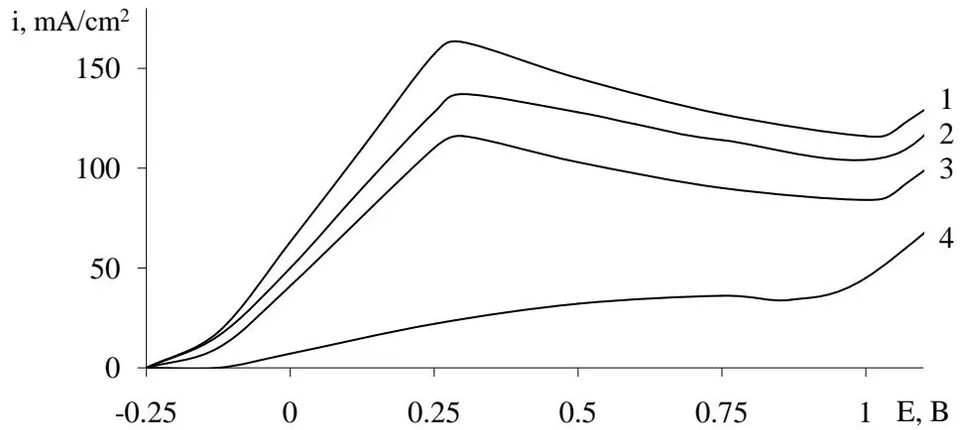
Figure 1: Anode polarization curves of VNZhK alloy waste in solution (\mathrm{NH}_{4})_{2}\mathrm{CO}_{3} 1M. 1 - the first cycle, 2 - the second cycle, 3 - the last cycle after complete leaching of tungsten from the surface of the alloy
Figure 1: Anode polarization curves of VNZhK alloy waste in solution ( NH 4 ) 2 CO 3 1M. 1 - the first cycle, 2 - the second cycle, 3 - the last cycle after complete leaching of tungsten from the surface of the alloy

Electrochemical dissolution of VNZhK alloy waste under the action of a DC was carried out in a potentiostatic mode at a potential of +0,25 V, which corresponds to the maximum anodic current density of the investigated alloy in electrolyte ( NH 4 ) 2 CO 3 1M. It was found, that the dissolution of the VNZhK alloy waste is carried out at a rate of 150   m g / c m 2 h and current efficiency close to 100% (based on the ionization of tungsten in the oxidation state +6) with a degree of tungsten extraction into the solution - 99,5%. At the same time, it was found that, the use of ammonium carbonate electrolytes, as well as alkaline and ammonium alkaline solutions, leads to decrease in the dissolution rate of investigated alloy in the process of electrochemical leaching of tungsten from the surface of the WHAs under the action of DC [19]. The use of AC makes it possible to overcome this obstacle [14].

Figure 2 shows the dependence of the oxidation rate of the VNZhK alloy waste and its current efficiency on the alternating current density in the ( NH 4 ) 2 CO 3 1M solution. It can be seen, that current density growth from 1 to 7 A/cm 2 leads to a manifold increase in the oxidation rate of the alloy from 100 to 1700 mg/cm 2 ·h. The process is accompanied by an increase in the current efficiency only from 3 to 33%. It is important to note the similarity of the electrochemical behavior of the VNZhK alloy in ammonium carbonate and ammonium alkaline solutions under the action of AC [14, 20]. In both cases, the transition of tungsten into solution is accompanied by the concentration of the iron subgroup metals in the finely dispersed electrolysis residue.
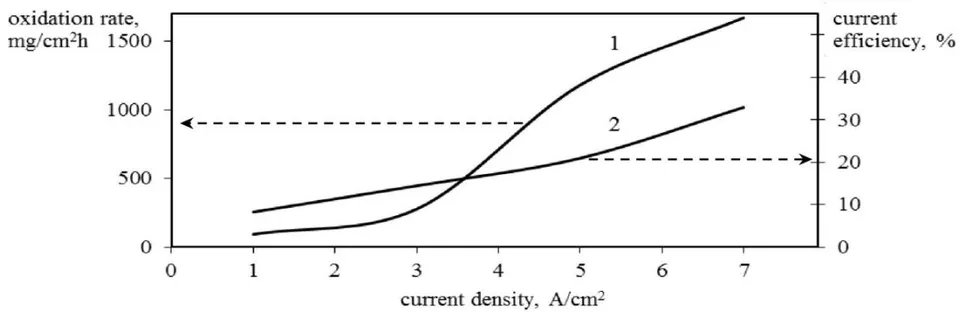
Figure 2: Dependences of oxidation rate (1) of VNZhK alloy waste and its current efficiency (2) on the alternating current density in solution (\mathrm{NH}_{4})_{2}\mathrm{CO}_{3} 1M.
Figure 2: Dependences of oxidation rate (1) of VNZhK alloy waste and its current efficiency (2) on the alternating current density in solution ( NH 4 ) 2 CO 3 1M.

In order to optimize the electrolysis energy parameters, it is advisable to carry out the processing of WHAs by using both DC and AC. In this case, DC is most effective in cases, where the surface of the processed alloy is enriched with tungsten, and AC - when tungsten is already leached from the alloy surface and it needs to be renewed through the formation of a residue of the iron subgroup metals oxides in the form micro-dispersed powder [ 14 , 20 ] .

When the concentration of tungsten in the electrolyte reached 50 g/l, the latter was evaporated at a temperature of 70-80°C until the odor of ammonia was removed in order to obtain APM. The precipitated APM was washed and dried at 90°C. The content of W O 3 in the obtained APM was 87,4 wt.%.

A schematic diagram for the processing of tungsten alloy waste of the VNZhK type under the action of DC and AC in ammonium carbonate solutions is shown in Figure 3. Tungsten passes from the alloy into the electrolyte as a result of the electrochemical dissolution of the alloy under the action of AC and DC.

The electrolyte is evaporated, and excess of ammonium carbonate decomposes into ammonia and carbon dioxide, released in the form of gases. The process is accompanied by crystallization of APM. Nickel, iron and cobalt are concentrated in the oxide form as micro-dispersed electrolysis residue, which is filtered before the electrolyte evaporation stage. Traces of tungsten oxides in micro-dispersed residue are leached with an ammonium carbonate solution and returned to the stage of electrochemical dissolution of VNZhK alloy waste.

III. CONCLUSIONS

The electrochemical behavior of heavy tungsten alloy waste of the VNZhK type in a 1 M ammonium carbonate solution was investigated. It was found, that the optimal value of the alloy dissolution potential was +0.25 V in the investigated electrolyte. It was shown, that the dissolution rate of the alloy was 150 m g / c m 2 h at its current efficiency of 100 % in the process of potentiostatic electrolysis.
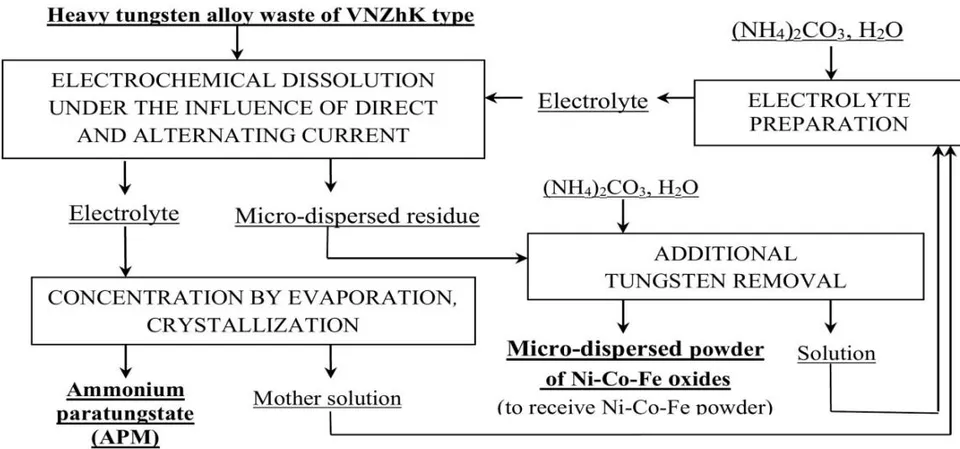
Figure 3: Schematic diagram for the recycling of heavy tungsten alloys of VNZhK type in ammonium carbonate solutions

The change in the oxidation rate of heavy tungsten alloy waste of the VNZhK type and its current efficiency depending on the alternating current density of the industrial frequency in the range from 1 to 7 A / cm 2 was investigated. It was revealed, that the oxidation rate of alloy increased to 1700 mg / cm 2 h at a current density of 7 A / cm 2 but its current efficiency was about 30 % .

A technological scheme for processing heavy tungsten alloy waste of the VNZhK type in ammonium carbonate solutions using direct and alternating electric current was proposed.
References

20 Cites in Article
  1. 1. Zhengdong Han,Artem Golev,Mansour Edraki (2021). A Review of Tungsten Resources and Potential Extraction from Mine Waste. Minerals, 11(7), 701.
  2. 2. Burghard Zeiler,Andreas Bartl,Wolf-Dieter Schubert (2021). Recycling of tungsten: Current share, economic limitations, technologies and future potential. International Journal of Refractory Metals and Hard Materials, 98, 105546.
  3. 3. L Shen,X Li,D Linberg,P Taskinen (2019). Tungsten extractive metallurgy: A review of processes and their challenges for sustainability. Minerals Engineering, 142, 105934.
  4. 4. S S Kamal,P Sahoo,J Vimala,B Shanker,P Ghosal,L Durai (2016). Synthesis of high purity tungsten nanoparticles from tungsten heavy alloy scrap by selective precipitation and reduction route. Journal of Alloys and Compounds, 678, 403-409.
  5. 5. A Shemi,A Magumise,S Ndlovu,N Sacks (2018). Recycling of tungsten carbide scrap metal: A review of recycling methods and future prospects. Minerals Engineering, 122, 195-205.
  6. 6. L Ye,Z Ouyang,Y Chen,S Liu (2020). Recovery of rhenium from tungsten-rhenium wire by alkali fusion in KOH-K 2 CO 3 binary molten salt electrolysis. Int Journal of Refractory Metals and Hard Materials, 87, 1-7.
  7. 7. Ming Li,Xiaoli Xi,Zuoren Nie,Liwen Ma,Qingqing Liu (2019). Recovery of tungsten from WC–Co hard metal scraps using molten salts electrolysis. Journal of Materials Research and Technology, 8(1), 1440-1450.
  8. 8. E Ageeva,A Ageeva (2020). Tungsten-free hard alloys based on powders obtained by processing TN20 alloy waste by electric discharge dispersion in alcohol. Metallurgist, 68(12), 1934-1940.
  9. 9. Vadym Kovalenko,Valerii Kotok (2020). Investigation of the anodic behavior of w-based superalloy for electrochemical selective treatment. Eastern-European Journal of Enterprise Technologies, 6(12 (108)), 55-60.
  10. 10. Vadym Кovalenko,Valerii Kotok (2017). Selective anodic treatment of W(WC)-based superalloy scrap. Eastern-European Journal of Enterprise Technologies, 1(5 (85)), 53-58.
  11. 11. V Parshutin (2008). Corrosive and electrochemical behavior of pseudoalloys on the basis of tungsten and their components. Surface Engineering and Applied Electrochemistry, 44(6), 446-461.
  12. 12. A Palant,A M Levin,O Levchuk,V Bryukvin (2013). Electrochemical processing of the metallic wastes of ZhS32 nickel superalloys. Russian Metallurgy (Metally), 2013(7), 497-500.
  13. 13. S Hairunnisha,G Sendil,J Rethinaraj,G Srinivasan,P Adaikkalam,S Kulandaisamy (2007). Studies on the preparation of pure ammonium para tungstate from tungsten alloy scrap. Hydrometallurgy, 85(2-4), 67-71.
  14. 14. O Kuznetsova,A Levin,M Sevost’yanov,O Tsybin,A Bol’shikh (2021). Electrochemical Processing of a Heavy W–Ni–Fe Alloy by Direct and Alternating Currents in Ammonia–Alkali Solutions. Russian Metallurgy (Metally), 2021(5), 586-593.
  15. 15. Lin Luo,Liu Kejun,Atsushi Shibayama,Wantai Yen,Toyohisa Fujita,Osamu Shindo,Akira Katai (2004). Recovery of tungsten and vanadium from tungsten alloy scrap. Hydrometallurgy, 72(1-2), 1-8.
  16. 16. O Kuznetsova,A Levin,M Sevost’yanov,O Tsybin,A Bol’shikh (2020). Electrical Conductivity of Tungsten-Containing Ammonium Hydroxide Solutions. Russian Metallurgy (Metally), 2020(9), 971-975.
  17. 17. O Kuznetsova,Levin,M Sevastyanov,M (2021). Specific electrical conductivity of tungstencontaining aqueous solutions of ammonium carbonate Conf "Theory and practice of scientific activity modernization in the context of digitalization. Specific electrical conductivity of tungstencontaining aqueous solutions of ammonium carbonate Conf "Theory and practice of scientific activity modernization in the context of digitalization, 25-28.
  18. 18. Molybdenum Tungsten (1991). General requirements for methods of chemical and spectral analysis GOST 29103-91. General requirements for methods of chemical and spectral analysis GOST 29103-91
  19. 19. O Kuznetsova,A Levin,M Sevast’yanov,O Tsybin,A Bol’shikh (2019). Electrochemical Oxidation of a Heavy Tungsten-Containing VNZh-Type Alloy and Its Components in Ammonia–Alkali Electrolytes. Russian Metallurgy (Metally), 2019(5), 507-510.
  20. 20. O Kuznetsova,A Levin,M Sevostyanov,O Tsybin,A Bolshikh (1942). Electrochemical processing of heavy tungsten alloy wastes for obtaining a microdispersed iron-nickel base powder by using alternating current. Journal of Physics: Conference Series, 1942(1), 012056.

Funding

No external funding was declared for this work.

Conflict of Interest

The authors declare no conflict of interest.

Ethical Approval

No ethics committee approval was required for this article type.

Data Availability

Not applicable for this article.

How to Cite This Article

O G Kuznetsova, A M Levin, M A Sevostyanov, O I Tsybin, A O Bolshikh. 2021. "Application of Ammonium Carbonate Solutions in Electrochemical Technology of Heavy Alloy Waste Processing". Global Journal of Science Frontier Research - A: Physics & Space Science GJSFR-A Volume 21 (GJSFR Volume 21 Issue A4).

Download Citation

High-quality image of research on ammonium carbonate solutions for electrochemical applications.
Journal Specifications

Crossref Journal DOI 10.17406/GJSFR

Print ISSN 0975-5896

e-ISSN 2249-4626

Keywords
Classification
GJSFR-A Classification FOR Code: 091499
Version of record

v1.2

Issue date
December 6, 2021

Language
English
Order Article Reprint
Experiance in AR

Explore published articles in an immersive Augmented Reality environment. Our platform converts research papers into interactive 3D books, allowing readers to view and interact with content using AR and VR compatible devices.

Read in 3D

Your published article is automatically converted into a realistic 3D book. Flip through pages and read research papers in a more engaging and interactive format.

Article Matrices
Total Views: 847
Total Downloads: 50
All Trends

Request Access

Please fill out the form below to request access to this research paper. Your request will be reviewed by the editorial or author team.
X

This is the heading

Lorem ipsum dolor sit amet, consectetur adipiscing elit. Ut elit tellus, luctus nec ullamcorper mattis, pulvinar dapibus leo.

High-quality academic research articles on global topics and journals.

Application of Ammonium Carbonate Solutions in Electrochemical Technology of Heavy Alloy Waste Processing

O Kuznetsova
O Kuznetsova
A Levin
A Levin
M Sevostyanov
M Sevostyanov
O Tsybin
O Tsybin
A Bolshikh
A Bolshikh

