
I. INTRODUCTION
Intestinal parasite infections produced by protozoan and helminths still constitute one of the main global causes of infant morbidity and mortality (1). The prevalence of such infections affects several countries and territories in the world because despite being cosmopolitan, the transmission of parasites is dependent on the conditions of the host, parasite, and environment (2).
Currently, around 3.5 million people worldwide are affected by one or more species of parasites, representing a relevant public health problem (3). In an analysis of the incidence of intestinal parasite infections of different age groups in children, between 5 and 12 years old, were identified as one of the most affected groups (4). Children are also more likely to generate symptoms and clinical manifestations of parasite infections (cognitive impairment, decreased growth, irritability, and susceptible increase in other pathogen infections), reducing their quality of life (3,5).
One of the biggest causes of children's susceptibility to parasites is due to their immature immune system combined with the precariousness of maintaining personal hygiene (6). Frequent contact with soil and water during recreational activities without guidance can determine the transmission and prevalence of enteroparasitosis in homes and schools (7,8).
In Brazil, the prevalence of parasitic diseases in schoolchildren is directly associated with a low Human Development Index (HDI), ranging from to , reaching in more alarming cases (9). The North and Northeast regions of the country have high prevalence and polyparasitism in several communities, with a high diversity of species involved (10,11). Among the intestinal parasitoses that affect children, the most frequent are those whose means of transmission is the oral-fecal route. Since they are associated with the ingestion of contaminated water or food, as is the case of Ascaris lumbricoides, Entamoeba histolytica, Enterobius vermicularis, Trichuris trichiura, and Giardia lamblia (12,13).
Prevention is still the best way to avoid enteroparasitosis. In this sense, health education practices in schools and communities improve the knowledge of the population about the risk factors that lead the individual to be infected (14). Because although many individuals assure knowledge about intestinal parasitic diseases, studies reveal that, they have misunderstandings regarding the preventive and curative measures of worms (9).
Lack of knowledge about preventive measures, the basic principles of personal hygiene, and care in food handling can contribute to the spread of the disease, facilitate infections and precipitate reinfection in areas considered endemic (15,16,17). Thus, it is necessary to include parents/guardians, teachers, and students in educational activities to make them trained in educational actions (9). The partnership of family and school minimizes the difficulties encountered in the school environment, adding knowledge about the realities experienced (19,20).
This study aimed to evaluate the frequency of intestinal parasites observed in school-age children in the city of Recife, Pernambuco and to determine their main species and intervene in the school environment through playful educational practices to make students, parents, and employees aware of the preventive measures that were took to avoid the contamination of these parasites.
Thus, the present work aimed to identify intestinal parasites, as well as evaluate your frequency in school-age children in the city of Recife, Pernambuco. And intervene in the school environment through educational practices to make students, parents, and employees aware of the preventive measures to avoid the contamination of these parasites.
II. MATERIAL AND METHODS
a) Study population
A total of 705 fecal samples did collect from children aged 12 years or less from different public schools or daycare centers located in the city of Recife, PE, between the years 2008 and 2018.
The followed inclusion criteria did consider were the age of the children (aged 12 years or less), public schools and the Informed Consent Form (ICFs) accepted by the parents/guardians.
Regarding the exclusion criteria, children over the age of 12 did not participate in the analysis; private schools and daycare and the absence of parents/guardians that do not agree with their children's participation.
b) Ethical aspects
The study was approved by the Ethics Committee of the Health Sciences Center (CCS) of the Federal University of Pernambuco (UFPE), presenting the CAAE number: 19640213.0.1001.5208. All children enrolled in this study had the ICF signed by their parents/guardians.
c) Sample collection
All children or their participating guardians received the ICF and the plastic collecting jars, without preservatives, and received instructions about how to collect the fecal sample correctly. Two days after, we received the signed ICF and identified collecting pots. All fecal samples were processed and analyzed by expertise personal at the Parasitology Laboratory of the Medical Sciences Center (LP/CCM) by the Federal University of Pernambuco (UFPE).
d) Analysis and processing of parasitological samples
In the laboratory, fecal material was stored under refrigeration between and until analysis. First, a macroscopic evaluation of the fecal material was carried out to observe the presence of larvae or helminth proglottids. Samples were processed by the Hoffman/Lutz methods (spontaneous sedimentation) for protozoan cysts, helminth eggs or larvae detections (21) and the modified Kinyoun technique using fuchsiacarbolic, to search for Cryptosporidium spp. (22). For each stool collector, two slides were arranged per technique. Enteroparasites were identified by optical microscope under , , and/or objectives. All results were confirmed by a supervisor.
e) Health education
Awareness about health education was carried out after each stool collection cycle, in schools or daycare centers that are suitable for research, in the year of the study. Through educational activities previously planned by undergraduate students in the health field, together with teachers associated with the LP/CCM/UFPE, parents, guardians, and employees of the Schools were directed to lectures of the type expository-dialog. To bring basic knowledge about parasites, how to identify and the prevention and treatment measures to be taken.
While for children, theatrical plays, competitive and musical games were carried out, to bring knowledge and information playfully about the risks of parasitic infections. Discussing aspects such as signs and symptoms of the disease, modes of transmission, biological cycle of the parasites and reinforcement of prophylaxis measures, both individual and collective. About educational practices aimed at enteroparasitosis, undergraduate students in the health area were mobilized, along with professors from UFPE. Each year, a different school received an interactive lecture with parents or guardians and school staff.
The results of the exams were made available simply and lucidly to the students' guardians. Positive cases of parasite infection sent to treatment at a local Health Center.
f) Data analysis
This study comprehends qualitative and quantitative methods (23). A descriptive analysis was performed, using data obtained from coproparasitological exams. Based on the reports, a spreadsheet survey was performed in Office Excel 365, addressing the number of participating children, the number of samples of fecal material collected, and their respective positivity or negativity.
III. RESULTS
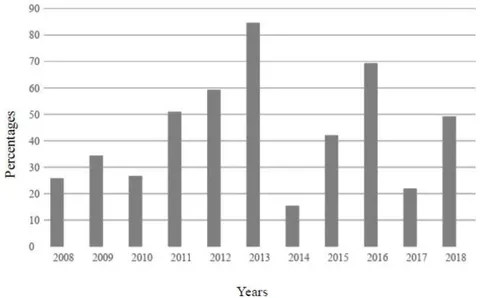
Between the period of 2008 to 2018, 730 coproparasitological exams were performed on children under 12 years old. These total, 421 samples were negatives, representing , and 309 were positive for one or more enteroparasites, with a percentage rate of .
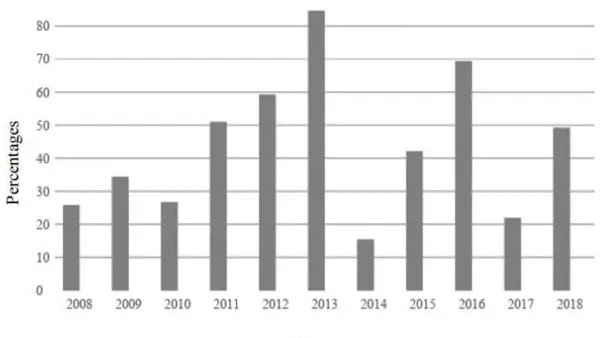
Figure 1 shows the relatives frequencies of positivity, over the ten years of parasitological analysis of the Daycare and Schools studied. Higher numbers of positive diagnoses for enteroparasitosis were observed in the years 2013 and 2016, with percentage rates of (22/26) and (68/98), respectively. However, the lowest number of positive parasite reports were observed in 2014 and 2017, with (10/65) and (16/73), respectively.
Regarding the main species of parasites found in microscopic evaluations, were identified 12 different species of protozoa and helminths between 2008 and 2018 (Table 1). Related to all identified enteroparasitoses, a higher positivity rate of protozoa, like as Giardia lamblia , Endolimax nana , Cryptosporidium spp and Entamoeba coli when compared to helminths: Ascaris lumbricoides , Ascilostoma spp and Trichuris trichiura .
In accordance to Table 1, the highest frequency of Cryptosporidium spp (75.5%), G. lamblia (54.8%), and E. nana (40%) occurred in the years 2015, 2017, and 2014, respectively. Whereas no parasite of the species Blastocystis hominis, Ancilostoma sp, lodameba butschlii, Balantidium coli, and Taenia sp were detected in the same years.
Among the analyzed years, the largest absolute frequency of positive cases was seen in 2016, highlighting the species Cryptosporidium spp 39/68 (57.35%), Endolimax nana 11/68 (16.17%), and Ascaris lumbricoides 10/68 (14.7%). In the second-highest frequency of enteroparasites, the year 2012 also showed high positivity for Endolimax nana 12/48 (25%). Despite the high case number showed in the same year, the relative frequency was no higher due to the total number of samples.
However, unlike in 2016, the species Giardia lamblia and Entamoeba histolytica/E. dispar were the most present species in the stool samples collected in
2012, being responsible for and of infections.
Another year with a high absolute frequency of parasites was 2015 (N=37). The parasite specie Cryptosporidium spp reached 28/37 (75.5%) of students parasitized. While others parasites identified were E. nana 9/37 (24.3%), G. lamblia 5/37 (13.5%), E. histolytica/E. dispar 3/37 (8%), A. lumbricoides 3/37 (8%), and E. coli 1/37 (2.7%).
Specifically in 2014 occurred the lowest number of parasite positivity , with nana , Giardia lamblia and Ascaris lumbricoides . Others years, like 2009, 2010 and 2017 presented also a low number of positive samples, showed positivity to lamblia, varying between ,
31.3%, and 54.6%, E. coli 18.2%, 18.5% and 12.5%, respectively.
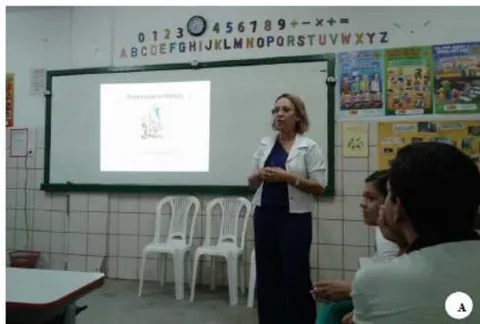
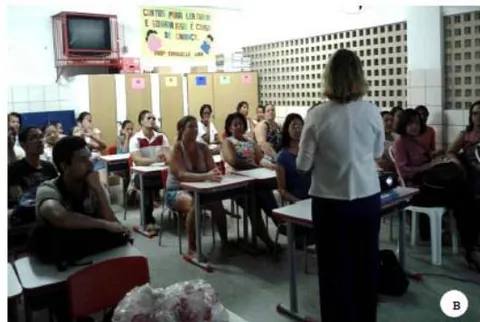
In regards to the educational practices, the employees and parents/guardians of the Schools were given lectures focused on parasitic endemics, the signs, and symptoms of enteroparasitosis; how to identify when children are under such infections, and how to prevent their biological cycle (Figure 2A and B). In this practice, limited knowledge on the subject was noted, both by those responsible for the children and school staff. However, throughout the lectures, a great familiarity with the theme was seen when the public stated that friends, relatives, or the parents/guardians themselves had such symptoms or were diagnosed.
Children's guardians, however, expressed doubts about some home treatments, passed down through generations. In one of the reports, it was reported that sitting in a basin containing warm water eliminates Strangyloides stercoralis and reduces the itching caused by the parasite. Thus, employees intervened in the knowledge of practices like these, demystifying and reporting the best way to follow palliative and curative practices.
About the children, playfully, theaters, competitive games, musicals, and/or more interactive conversations about parasites were made to attract attention and build knowledge. As a result, great mobilization and interaction were seen, showing interest in the subject and confirming the knowledge received during questioning (Figure 3A and B). When reported on popular names of enteroparasitoses and hygiene habits, a certain prior understanding was evidenced. However, many said they were not adept at such habits that protect from parasitic diseases.


IV. DISCUSSION
This work is the first in the State of Pernambuco to use educative strategies to combat enteroparasitosis in public school and daycare through the fecal parasitological examination of the schoolchildren and adoption of health educative measures to aim children and their parents to combat parasite infections. An expanded view of the permanence of parasites in the school environment and the importance of educative practices were able to transform life habits.
All the evaluated daycare and schools showed children with parasite contamination. In this study, between the years 2008 and 2018, were observed high frequencies of commensal protozoa, Endolimax. nana, and agents capable of generating human morbidity, as is the case of Giardia lamblia and Cryptosporidium spp. These three parasites are frequently found in Brazilian children's coproparasitological exams (24-26).
The high frequency of nana in schoolchildren can be an indicator of hygiene lacking, as demonstrated in the study conducted in Caxias do Sul, with nana cysts identified in of the analyzed samples (27). Another study in Paracatu (MG) also associates the lack of hygienic care with the occurrence of commensal parasites in nine public schools, with a prevalence of for nana (28). In João Pessoa, Paraíba, a study in children also suggested the same justification for the prevalence of nana in of fecal samples from children (29).
The infection by nana does not give major symptomatological effects, but promote a greater susceptibility to other parasite infections (30). The major problem of polyparasitism is the clinical manifestations caused for combination by commensal parasites and pathogenic (31). However, it's common a high incidence of polyparasitism like as seen in the study carried out by (32) showed nana associated in of the cases with Entamoeba coli, and with the species Ascaris lumbricoides and lodamoeba butschlii. Similar results were seen in public daycare and preschools from São Sebastião da Grama, São Paulo State, the nana and Blastocystis spp were combined with the species duodenalis, coli, Entamoeba. histolytic/dispar, Strongyloides. stercoralis, Taenia sp., and I. Butschlii (33).
The present study also showed a high number of sample positives for lamblia, an important parasite species responsible for giardiasis that presents diarrhea, abdominal pain, nausea, vomiting, flatulence, anorexia, and fever as symptoms (34). In many cases, diarrheal disease is short-lived and self-limiting. However, some individuals have persistent diarrhea with malabsorption of nutrients, interfering with the quality of life (35).
Similar to our results there are other studies showed enteroparasites contamination of children inside daycare and school environments (36,37). Giardia lamblia was the most common species found in many of these Brazilian studies. In Ribeirão Preto, São Paulo, of children infected with parasites obtained positive results for G. lamblia (36). In a public school in Cariaca, Espirito Santo revealed a positivity for G. lamblia (37). In a philanthropic institution, the habits of hygiene and contact with soil were suggested as one of the causes of the prevalence of Giardia spp. , as well as Cryptosporidium spp. (38).
For a long time, it believes that cryptosporidiosis affects only immunodeficient individuals. But in recent years, was detected Cryptosporidium spp. in immunocompetent people that exhibit watery diarrhea, vomiting, nausea, loss of appetite, weight loss, fatigue, and other symptoms (39). Children under eight years of age were the most affected (38). Despite this, in Brazil, the detection of Cryptosporidium spp. and other coccids are not included in routine parasitological examinations, being only investigated with a medical request (40). Thus, the presence of Cryptosporidium spp in schools and daycare centers is not properly investigated in the country.
The incidence of infectious and parasitic diseases in preschool children have a relationship with efficient sanitation (41). Also, the lack or low adherence of parents or guardians can underreport the presence of parasites and interfere with the development of parasitological work in schoolchildren (42). This difficulty in adhering to parasitological research is reported by Reuter and collaborators (2015), who received a low number of samples from a daycare center in the Rio Grande do Sul (43). Vargas and Amaral (2016) associate the absence of parental attention to this type of research with the rush of everyday life, which makes it difficult to interact with educational activities (42).
In the present study, the years most affected by low interaction between parents/guardians were 2014 and 2017, with lower absolute and relative frequencies due to the number of stools received. However, these years dispelled parasites such as G. lamblia, E. nana, E. histolytica/disparate, E. coli, and Ascaris lumbricoides, agents capable of generating morbidity to those infected and being disseminated among children in the school environment (44).
Some strategies to reduce the parasite contamination of schoolchildren can be useful to educate and stimulate the children to repass information about the prevention of parasite diseases to their families and friends. Recreational activities, theatre, musical, and games are educative tolls to transmit knowledge about health and hygiene (14,45). Though these tools like theater, musicals, and games duly adapted to the reality of that parasite affect the children can influence their creativity, motor activity, provide relaxation, and develop socio-cultural abilities, providing more dynamic and active learning. The construction of children's knowledge about parasites has a positive impact on the change in hygiene behavior, as well as reflected in the rates of geohelmintic infections and other parasites in homes and schools (46).
Educative activities aimed at raising awareness and preventing intestinal parasites are efficient alternatives to fill the process, the gaps found in the content covered in schools (9). Thus, it is essential to plan health education actions to reduce the high rates of morbidity and mortality; and increase health information in the search for the best health status and quality of life (47).
The combination of theory with practice is complementary because the previous knowledge students there are better consolidation of learning during moments of experience (48). Thus, the role of educators and health professionals is to provide knowledge and encourage both parents and students to acquire healthy habits. These actions become essential for the prevention of intestinal parasites (49).
Punctual educative practice will not change the actual situation of high parasite contamination of schoolchildren. However, these actions must be continuous with the insertion and collaboration of parents, which are essential for the change of their children's behavior. Different studies claim that collaboration between the family and the school is important to reduce the difficulties encountered in the school environment since knowledge is constantly experienced (19,20).
Throughout these 10 years of study, the coproparasitological analysis in schoolchildren showed the need for greater attention to enteroparasitosis inside school and daycare environments, since there was parasite positivity in all children evaluated. Thus, some educative actions applied in this study were crucial for building knowledge in the children about forms to detect and prevent parasite contaminations, change bad hygiene and health habits and disseminate learning to other children, their teachers, and members of the family.