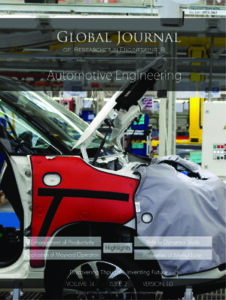
Application of Maynard Operation Sequence Technique (M.O.S.T) at Tata Motors and Adithya Automotive Application Pvt Ltd. Lucknow for Enhancement of Productivity-A Case Study
There are millions of jobs and everyone feels that his/her job is unique to them, their product and finally to their organization. But the fact remains that all the jobs are just combinations of 19 basic motions that are used to perform any task. The productivity is key to survival of any organizations and hence profitability. The productivity is defined as “Optimum Utilization of Available Resources”. To achieve productivity of the highest order, The consumption of all the resources viz Men, Material, Machine, Money and Methodology” have to be optimized. There are primarily three methods of determining the “Standard Time” in which a worker should perform a task: i) Maynard Operation Sequence Technique (M.O.S.T) is a predetermined motion time system that is used primarily in industrial settings to get the standard time in which a worker should perform a task. ii) Time Study is a traditional Work Measurement technique which is involved to calculate the time of the operation in an assembly line with the help of instrument (Stopwatch). iii) Taylorism, System of scientific management advocated by Fred W. Taylor. In Taylor’s view, the task of factory management was to determine the best way for the worker to do the job, to provide the proper tools and training, and to provide incentives for good performance. He broke each job down into its individual motions, analyzed these to determine which were essential, and timed the workers with a stopwatch. With unnecessary motion eliminated, the worker, following a machinelike routine, became far more productive.
Funding
No external funding was declared for this work.
Conflict of Interest
The authors declare no conflict of interest.
Ethical Approval
No ethics committee approval was required for this article type.
Data Availability
Not applicable for this article.
How to Cite This Article
Prof. D.V.Mahindru. 2014. \u201cApplication of Maynard Operation Sequence Technique (M.O.S.T) at Tata Motors and Adithya Automotive Application Pvt Ltd. Lucknow for Enhancement of Productivity-A Case Study\u201d. Global Journal of Research in Engineering - B: Automotive Engineering GJRE-B Volume 14 (GJRE Volume 14 Issue B2): .
Explore published articles in an immersive Augmented Reality environment. Our platform converts research papers into interactive 3D books, allowing readers to view and interact with content using AR and VR compatible devices.
Your published article is automatically converted into a realistic 3D book. Flip through pages and read research papers in a more engaging and interactive format.
There are millions of jobs and everyone feels that his/her job is unique to them, their product and finally to their organization. But the fact remains that all the jobs are just combinations of 19 basic motions that are used to perform any task. The productivity is key to survival of any organizations and hence profitability. The productivity is defined as “Optimum Utilization of Available Resources”. To achieve productivity of the highest order, The consumption of all the resources viz Men, Material, Machine, Money and Methodology” have to be optimized. There are primarily three methods of determining the “Standard Time” in which a worker should perform a task: i) Maynard Operation Sequence Technique (M.O.S.T) is a predetermined motion time system that is used primarily in industrial settings to get the standard time in which a worker should perform a task. ii) Time Study is a traditional Work Measurement technique which is involved to calculate the time of the operation in an assembly line with the help of instrument (Stopwatch). iii) Taylorism, System of scientific management advocated by Fred W. Taylor. In Taylor’s view, the task of factory management was to determine the best way for the worker to do the job, to provide the proper tools and training, and to provide incentives for good performance. He broke each job down into its individual motions, analyzed these to determine which were essential, and timed the workers with a stopwatch. With unnecessary motion eliminated, the worker, following a machinelike routine, became far more productive.
Our website is actively being updated, and changes may occur frequently. Please clear your browser cache if needed. For feedback or error reporting, please email [email protected]
Thank you for connecting with us. We will respond to you shortly.
Lorem ipsum dolor sit amet, consectetur adipiscing elit. Ut elit tellus, luctus nec ullamcorper mattis, pulvinar dapibus leo.
Application of Maynard Operation Sequence Technique (M.O.S.T) at Tata Motors and Adithya Automotive Application Pvt Ltd. Lucknow for Enhancement of Productivity-A Case Study
Mr. Ankit Mishra
Mr. Vivek AgnihotriDr. A.P.J. Abdul Kalam Technical University
Prof. D.V.MahindruDr. A.P.J. Abdul Kalam Technical University