The people’s livelihood is largely dependent upon forests and related resources which comprises the tangible and intangible ones. Tangible resourcesare in the form of Timber, Non-Timber Forest Products (NTFPs) such as mushroom, fruits etc. while intangible services include a wide range of vital environmental services by the floras and faunas which includes erosion control, carbon sequestration among others. Assessing these tangible resources was always through active physical involvements by the actors in the management of the forests. Unexpectedly, the outbreak of COVID-19 pandemic which was earlier endemic to China have created a barrier to man in the management and utilization of these forest resources. Imposed lockdowns, curfews, social distances meant less team work, access and utilization of forest resources globally. The unavoidable reliance on forest resources especially by rural dwellers in developing nations like Nigeria was observed to spike up.
## I. INTRODUCTION
### a) Pandemic and Covid 19 Coronavirus Disease-2019
Forests provide clean water, air, timber for wood products, wildlife habitats, stable soil, and recreational opportunities, and beautifies the environment. Furthermore, they also are important economic resources producing marketable timber and non-timber resources like fruits and fiber. By virtue of their importance as territories, forests are integral to conserving biological diversity and the ecosystems and also provides sources of livelihoods (UNEP, 2001; Agrawala et al., 2003; Magreth and peter, 2016). Sustainable consumption refers to the use of products, materials, and energy according to sustainable development principles. The conservation of natural resources and energy ensures that minimal impact on environment occurs through man's activities. It also entails minimizing the use of toxic substances and materials for production. Amidst the struggle to entrenched sustainable utilization of resources and improve food security, especially in developing countries like Nigeria the COVID-19 Pandemic hit the world. Subsequently, a new normal entails minimal contact through social distancing and even lockdown. This affects livelihoods of African population that are usually 'daily food hunters'that do not have reserve of food. Thus, the pandemic changed everything and caused a break in the food value system and the overall livelihood of especially the populace. Importantly, it was observed that the felling of trees for firewood increased within the lockdown period. Reconnaissancesurvey revealed that for traders that could no longer engage in their usual marketing and travelling practices engaged in felling off trees for sell as firewood within rural communities where the lockdown was not as seriously enforced.
Pandemics are hazards related to large-scale outbreaks of infectious diseases that can greatly increase morbidity and mortality over a wide geographic area and cause significant economic, social, and political disruption (Madhav et al., 2017). The consequences of a pandemic, affecting people on a worldwide scale, with expected long-term impacts and consequences on the coupled socio-ecological system, can be described as a disaster. The wide-spread of coronavirus (Covid-19) was confirmed on the 27 February, 2020 in Lagos, Nigeria's commercial capital with a population of 21 million. The COVID-19 that started out as an epidemic in Wuhan, China in December 2019 and ended up as a pandemic (affecting the whole world) has thrown the world into a war-like situation. Many cases of deaths have been recorded cumulatively for all countries from across the world.
The Coronavirus Disease-2019 (COVID-19) is caused by a novel Coronavirus, called the Severe Acute Respiratory Syndrome Coronavirus-2 (SARS-CoV-2). It is an enveloped non-segmented positive sense single-stranded RNA virus in the family Coronaviridae. In appearance, the virus looks like a crown under the electron microscope (Figure 1), hence the name, "Corona". Like other coronaviruses, the COVID-19 virus genome is about 400-500nm in size and encodes structural proteins (e.g. spike glycoprotein and accessory proteins), as well as non-structural proteins such as RNA dependent RNA polymerase, helicase, papain-like protease and 3 chymotrypsin-like protease.
The virus is believed to be more infectious than its counterparts: SARS and MERS (Enitan et al., 2020; Ibeh et al., 2020; Guamer, 2020).
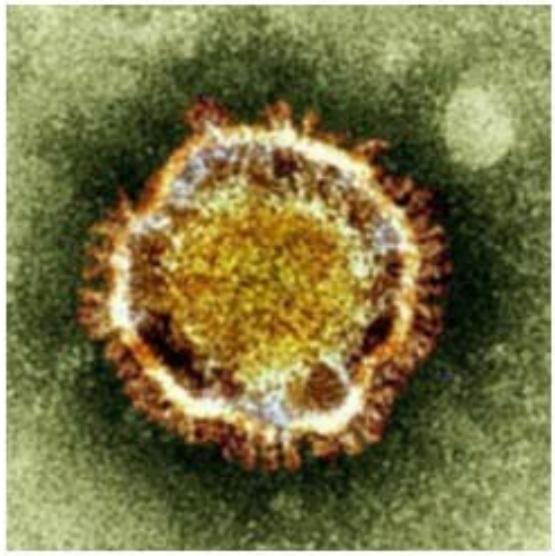
Credit: Pasieka/Science Photo Library Figure 1: Coronavirus as seen under the electron microscope As of May 16, 2020, the COVID-19 virus has spread to 188 countries and territories, with 4,614,135 total confirmed cases and 310,520 total deaths globally (JHU-CSSE, 2020). The top 14 most hit countries as indicated by Johns Hopkins University Center for Systems Science and Engineering are: US (1,463,350), Russia (272,043), United Kingdom (241,455), Spain (230,698), Italy (224,760), Brazil (222,877), France (179,630), Germany (175,752), Turkey (148,067), Iran (118,392), India (90,648), Peru (88,541) and China (84,038) and Canada (77,082).
It is evident that there was really no preparation to arrest the earliest cases of importation of Covid-19 into the country which could have been done at the points of entry into the country, especially at the international airports. Effective quarantine of travelers coming into the country, since the Chinese outbreak became news in January could have been done. It was not until much later, by 18 March 2020, that Nigeria eventually placed a travel ban on 13 countries with high incidence of the disease namely the United States, United Kingdom, South Korea, Switzerland, Germany, France, Italy, China, Spain, Netherlands, Norway, Japan and Iran. It was later that the banof all international flights into and out of Nigeria took effect on 23 March 2020. This uncoordinated approach came rather late as many returnees had already melted into the communities.
A number of the measures adopted to contain the virus in the country embrace restriction of movements, airports and land borders closure, patients transfer and isolation, diagnosis, tracing and follow-up of potential contacts, sustaining scaling of laboratories, upgrading and creation of treatment centers and public health funding, provision of palliatives to the vulnerable population, etcetera. However, the above measures are constrained by poor health care infrastructure and alternative COVID-19 pre-existing fragilities like poverty weak institutional framework, and falling oil costs.
Corona Virus Disease (COVID-19) pandemic has hit all sectors of economy, where the impact was projected to be quite immense in the agriculture, industry, tourism, and remittances (ADB 2020(FAO, 2020). This means there is need for serious sensitization on the Pandemic as well as on the importance of forest products for a sustainable ecosystem. The understanding of people's dependence on forest products can assist and support the activities of conservation and development policy interventions as sustainable forest management (McShane and Wells, 2004). On the other hand, recent literature highlighted the positive side of the COVID-19 or lockdown, such as strict quarantine benefits environment (Wang and Su, 2020) or ecosystems are being greatly recovered (Chakraborty and Maiti, 2020).
To attain this objective, the paper is split into 5 sections. Section one is the introduction. Section 2impact of COVID 19 on forest and Ecosystem, Section 3 highlights the means through which forest products can mitigate COVID-19 and sustain livelihood; section 4 to enumerate the impact of extension services on COVID-19 and to recommend policies for sustainability of biodiversity. This paper is a review of the impact of the non-timber forest product and extension services as


means of mitigating the effect of COVID 19 pandemic for sustainability.
## i. Non-Timber Forest Product as a Forest Resource
Non-Timber Forest Products (NTFPs) are useful substances, materials or commodity obtained from forest that do not require the harvesting of trees (Saka, et al., 2020; FAO, 2018, FOSA, 2001). The term Non-Timber Forest Products (NTFPs) emerged as an umbrella to recognize the products derived from various forest resources as a group. Non-timber forest products are plants and/or forest products that are valued for other purposes beside timber. They have been described as all biological materials of plant and animal origin other than wood that are extracted from the forest for human use and are mainly technological processing (Ibrahim et al., 2016). It comprises such diverse product as game, starchy foods, nut, spices, leaves, for wrapping food, medicinal herbs, essentials oils, latex for rubber and rattan (Ros-Tonen, 1999). Although some authors (Sizer, 1996) tend to include ecotourism among NTFPs.
The COVID-19 pandemic has underscored the significance of Non-Timber Forest Products (NTFPs) in African countries, where they are widely used as food, medicine, and a source of income for local communities. The use of NTFPs, particularly medicinal plants, has been reported to be on the rise during the pandemic, with many believing they can drive away flu-related ailments and boost immunity. In Kenya, Uganda, and Tanzania, for instance, stakeholders, including local community representatives, reported an increased interest in NTFPs, with trees and shrubs with medicinal values gaining popularity on social media. The Intergovernmental Panel on Biodiversity and Ecosystem Services (IPBES) estimates that $75\%$ of approved antimicrobial drugs are derived from natural or naturally derived compounds, highlighting the importance of NTFPs in primary health care services, particularly in remote rural areas. However, the lack of data and information on NTFPs, despite their increasing demand and use, poses a significant challenge to understanding their contribution to livelihoods and economies. Furthermore, the effectiveness of NTFPs in treating diseases is often not scientifically established, providing an opportunity for future research to gather evidence on their efficacy. Overall, the COVID-19 pandemic has brought to the fore the need to develop methodologies to document the contribution of NTFPs to livelihoods and economies, and to conduct research on their effectiveness in treating diseases, in order to promote their sustainable use and conservation.
## ii. NTFPS: A Means to Sustainable Rural Livelihoods
The need to promote sustainable development of non-timber forest products in Nigeria has become imperative. While these set of resources have contributed to income generation and livelihood in rural economies, their roles as a foreign exchange earner and as raw materials in the nation's industrial sector are yet to be reaped to full potentials.
Alongside stabilizing ecosystem, resuscitating the environment one other virtue of the NTFP resources is the potentials it holds in sustaining rural livelihoods. The rural dwellers are most often poor, impoverished and marginalized where the basics amenities like health care are not provided.
In this regard, (Saka et al., 2019) posited that NTFPs extends opportunities for the people of Gujba LGA in Yobe State Nigeria through providing fruits, gums and wildlife for income generation. For the poor rural dwellers, the main source of energy is firewood and charcoal. This means continued exploitation of the forest resources. Other sources of income and of great importance to NTFPs sustainability are the bees that provides honey and beeswax. They also are the major vectors of pollination of the plants thus responsible for the sustenance of biodiversity and development (Hertz, 2002; Reinhard and Admasu, 1994).
Honey and beeswax are two important NTFP that are major sources of nectar and pollen. Examples of trees that provide good nectar/pollen in Nigeria include Anacadium occidentale, Citrus spp, Cocos nucifera, Mangifera indica and Talinium triangulare. Bees are responsible for the pollination of many flavouring plants and are therefore important in sustaining biodiversity (Hertz, 2002). According to beekeeping has significant role in forest conservation and development.
NTFP plants employed as food products include wild fruits, vegetables, nuts, edible roots, bush meat, edible insects, honey, oil, saps and food additives such as spices, flavourings, food colourants and fermentation agents. Okafor (1975) classified the dietary importance and consumption of NTFP's into five.These include those taken as main food such as Treculia africana, food supplements such as Dacryodes edulis; condiments such as Irvingia gabonensis, Mucuna sloana, Parkia clappertoniana and Prosopis africana; and leafy vegetables such as Vitex doniana. Berries, herbs and mushrooms are among the most valuable of NTFP plants being harvested and sold to established markets across the globe (Barfoot, 2006).
A number of NTFP are used as fodders for grazing animals. Examples of these are species such as Asystacia gigantica, Gossandra nilotica, Commiphora africana, Bombax buonopozense, B. costatum, Tecoma capensis, Combretum aculeatum and Polycarphaea corymbosa. (Jimoh, 2005). Likewise, Shea butter, is now becoming one of the best-selling and highly recommended beauty skin products. It generated US$61 million in 2004. While these can be considered right steps in the right direction, the processing of these products locally before their and exportation will generate far higher foreign exchange in addition to providing employment locally.
Table 1: List of Non-Wood Forest Products removals and value of removals
<table><tr><td>SN</td><td>Plant products</td><td>Animal Products</td></tr><tr><td>1.</td><td>Food</td><td>Living animals</td></tr><tr><td>2.</td><td>Fodder</td><td>Hides, skin and trophies</td></tr><tr><td>3.</td><td>Raw material for medicine and aromatic products</td><td>Wild honey and bee-wax</td></tr><tr><td>4.</td><td>Raw materials for colorants and dyes</td><td>Wild meat</td></tr><tr><td>5.</td><td>Raw materials for utensil, handicraft and construction</td><td>Raw material for medicine</td></tr><tr><td>6.</td><td>Ornamental plants</td><td>Wild meat</td></tr><tr><td>7.</td><td>Exudates</td><td>Raw materials for colorants</td></tr><tr><td>8.</td><td></td><td>Raw material for medicine</td></tr><tr><td>9.</td><td></td><td>Other edible animal products</td></tr><tr><td>10.</td><td></td><td>Other edible non animal products</td></tr></table>
Table 2: Forest Region by Area
<table><tr><td>Region / Subregion</td><td colspan="4">Forst area(1000ha)</td></tr><tr><td></td><td>1990</td><td>2000</td><td>2010</td><td>2020</td></tr><tr><td>Eastern and southern Africa</td><td>346034</td><td>322580</td><td>314849</td><td>295778</td></tr><tr><td>Northern Africa</td><td>39926</td><td>38104</td><td>36833</td><td>35151</td></tr><tr><td>Western and central Africa</td><td>356842</td><td>339365</td><td>324333</td><td>305710</td></tr><tr><td>Total Africa</td><td>742801</td><td>710049</td><td>676015</td><td>636639</td></tr><tr><td>East Asia</td><td>29906</td><td>229071</td><td>252390</td><td>271403</td></tr><tr><td>South and southeast Asia</td><td>326511</td><td>308077</td><td>305461</td><td>296047</td></tr><tr><td>Western and central Asia</td><td>48976</td><td>50262</td><td>53109</td><td>55237</td></tr><tr><td>Total Asia</td><td>585393</td><td>587410</td><td>610960</td><td>622687</td></tr><tr><td>Europe excl. Russian federation</td><td>185369</td><td>193000</td><td>198847</td><td>202150</td></tr><tr><td>Total Europe</td><td>994319</td><td>1002268</td><td>1013982</td><td>1017461</td></tr><tr><td>Caribbean</td><td>5961</td><td>6808</td><td>7497</td><td>7889</td></tr><tr><td>Central America</td><td>28002</td><td>25819</td><td>33706</td><td>22404</td></tr><tr><td>North America</td><td>721317</td><td>719721</td><td>722987</td><td>722417</td></tr><tr><td>Total north and central America</td><td>755279</td><td>752349</td><td>754190</td><td>752710</td></tr><tr><td>Total Oceania</td><td>184974</td><td>183328</td><td>181015</td><td>185248</td></tr><tr><td>Total South America</td><td>973666</td><td>922645</td><td>870154</td><td>844186</td></tr><tr><td>World</td><td>4236433</td><td>4158050</td><td>4106137</td><td>4058931</td></tr></table>
Table 3: Rate of Forest Loss
<table><tr><td rowspan="2">Region /Subregion</td><td colspan="2">1990-2000</td><td colspan="2">2000 - 2010</td><td colspan="2">2010-2020</td></tr><tr><td>\(1000\text{hayr}^{-1}\)</td><td>%</td><td>\(1000\text{hayr}^{-1}\)</td><td>%</td><td>\(1000\text{hayr}^{-1}\)</td><td>%</td></tr><tr><td>Eastern and southern Africa</td><td>-1345</td><td>-0.40</td><td>-1773</td><td>-0.55</td><td>-1907</td><td>-062</td></tr><tr><td>Northern Africa</td><td>-182</td><td>-0.47</td><td>-127</td><td>-0.34</td><td>-168</td><td>-0.47</td></tr><tr><td>Western and central Africa</td><td>-1748</td><td>-0.50</td><td>-1503</td><td>-0.45</td><td>-1862</td><td>-0.59</td></tr><tr><td>Total Africa</td><td>-3275</td><td>-0.45</td><td>-3403</td><td>-0.49</td><td>-3938</td><td>-0.60</td></tr><tr><td>East Asia</td><td>1917</td><td>0.88</td><td>2332</td><td>0.97</td><td>1901</td><td>0.73</td></tr><tr><td>South and southeast Asia</td><td>-1843</td><td>-0.58</td><td>-262</td><td>-0.09</td><td>-941</td><td>-0.31</td></tr><tr><td>Western and central Asia</td><td>129</td><td>0.26</td><td>285</td><td>0.55</td><td>213</td><td>0.39</td></tr><tr><td>Total Asia</td><td>202</td><td>0.03</td><td>2355</td><td>0.39</td><td>1173</td><td>0.19</td></tr><tr><td>Europe excl. Russian federation</td><td>763</td><td>0.40</td><td>585</td><td>0.30</td><td>330</td><td>0.16</td></tr><tr><td>Total Europe</td><td>795</td><td>0.08</td><td>1171</td><td>0.12</td><td>348</td><td>0.03</td></tr><tr><td>Caribbean</td><td>85</td><td>1.34</td><td>69</td><td>0.97</td><td>39</td><td>0.51</td></tr><tr><td>Central America</td><td>-218</td><td>-0.81</td><td>-211</td><td>-0.85</td><td>-130</td><td>-0.56</td></tr><tr><td>North America</td><td>-160</td><td>-0.02</td><td>327</td><td>0.05</td><td>-57</td><td>-0.01</td></tr><tr><td>Total north and central America</td><td>-193</td><td>-0.04</td><td>184</td><td>0.02</td><td>-148</td><td>-0.02</td></tr><tr><td>Total Oceania</td><td>-165</td><td>-0.09</td><td>-231</td><td>-0.13</td><td>423</td><td>0.23</td></tr><tr><td>Total south America</td><td>-5102</td><td>-0.54</td><td>-5249</td><td>-0.58</td><td>-2597</td><td>-0.30</td></tr><tr><td>World</td><td>-7838</td><td>-0.19</td><td>-5173</td><td>-0.13</td><td>-4739</td><td>-0.12</td></tr></table>
Trends in forest area (1990 -2020) and net annual change in forest cover for the different regions in Africa as shown in Table 2 reflect a decline in the forest areas in the region between 1990 and 2020. However, trends in forest cover are usually over longer time frames and the full impact of COVID-19 on forest areas of Africa may take a longer period to be experienced.
## iii. Militating Factors Against NTFPS Sustainable Development
Despite their wide applications, a number of problems are militating against optimal development and utilization of NTFP plants in Nigeria. These have made it difficult to obtain adequate benefits from their harvesting and sales locally and on global basis. Some of the major constraints are subsequently discussed. Among the problems militating against the sustainable development of the resources are neglect by policy makers, planners and forest managers, lack of detailed inventory on NTFP plants which makes categorization and send use classification difficult. The methods of harvesting, overgrazing and overdependence on them by local communities also constitute major problems militating against the use of the resources.
The current local and global policy initiatives most especially, the need to achieve Millennium Development Goals of poverty alleviation, extreme hunger, women empowerment, quest for permanent cure for HIV/ AIDS, malaria coupled with increased local drive for foreign exchange earnings from green sources in the face of increasing climate change problems associated with power generation from crude oil and development of improved technology are likely to drive the sustainability of NTFP plants in Nigeria.
Other factors that limit the potential of NTFPs to forest dwellers incomes are related to marketing problems. Among these are lack of information on potential markets and marketing channels, fragmented nature of NTFP markets, the lack of sufficient volume and the unpredictability of the production cycle, resulting in irregular supplies (Panayotou, 1991). The perishable nature of many products combined with the poor infrastructure and high transportation cost in the tropical rainforest areas also hinder the successful marketing of NTFPs, together with the lack of organization among harvesters and lack of access to credit and storage facilities (Verhey and Reinder, 1997).
In general, the potential contribution of commercial NTFP exploitation to improved livelihoods for forest dwelling people is limited for NTFPs from natural forests, because of the low densities at which they occur and their irregular distribution (Van Dijk,
1999). Also, the sum of marketing of NTFPs from natural cannot simply be expected to function as a vehicle for improved livelihoods. It is inherent in NTFP-based livelihoods that they tend to disappear.
### b) Challenges and Opportunities for Sustainable Rural Livelihoods
The COVID-19 pandemic has brought unprecedented challenges to forest resource management and rural livelihoods worldwide. Studies have shown that the pandemic has accelerated deforestation and forest degradation, particularly in tropical regions, due to increased demand for land, timber, and non-timber forest products (NTFPs) (WWF, 2020). The closure of national parks and protected areas during lockdowns has also led to an increase in poaching and wildlife trafficking, further threatening biodiversity (IUCN, 2020). Moreover, the pandemic has disrupted global supply chains, affecting the livelihoods of forest-dependent communities, particularly those relying on NTFPs, such as medicinal plants, fruits, and nuts (Kusters et al., 2020). However, the pandemic has also created opportunities for sustainable forest management and rural livelihoods. For instance, the shift towards online platforms and digital technologies has enabled forest-dependent communities to access new markets and customers, increasing their income and livelihood resilience (FAO, 2020). Additionally, the pandemic has highlighted the importance of sustainable forest management and conservation for human wellbeing, particularly in terms of providing ecosystem services, such as clean air and water, and regulating climate change (IPBES, 2020). Therefore, it is essential to adopt innovative and inclusive approaches to forest resource management, such as community-led forest management, agroforestry, and sustainable forest certification, to promote sustainable rural livelihoods and conserve forest ecosystems for future generations (Chomba et al., 2020; Sunderland et al., 2020). Overall, the COVID-19 pandemic has underscored the need for a more sustainable and equitable approach to forest resource management, one that balances human well-being with environmental conservation and promotes resilient rural livelihoods.
### c) Impact of Covid-19 on Forests and Ecosystem Around the World
The COVID-19 pandemic has severely impacted Africa's forest sector, affecting forest management, conservation, and livelihoods. Movement restrictions and social distancing measures have led to reduced revenues, decreased funding, and increased deforestation and illegal harvesting of timber and nontimber forest products. The pandemic has also disrupted conservation efforts, leading to increased poaching and illegal trade in endangered species. The economic impacts have been significant, with declines in production, international trade, and investment in the forest sector. Furthermore, the pandemic has highlighted the importance of non-timber forest products, such as medicinal plants, which have seen increased demand. Generally, the pandemic has exacerbated existing challenges in Africa's forest sector, emphasizing the need for sustainable forest management and conservation practices to ensure the long-term health of Africa's forests and the livelihoods of forest-dependent communities (United Nations, 2021).
The instability caused by the pandemic is characterized by variables that have sudden and multiple impacts on both the natural environment and on society and could push the system into three different potential states. Furthermore, one of the more striking ecological consequences of the COVID-19 pandemic that has swept the world was the response of wildlife to the sudden absence of humanity. From a popular media perspective, habitat all around us was seemingly restored overnight (Wright, 2020). News reports in early 2020 were filled with images of wildlife in unorthodox settings: wild boar foraging in the center of Barcelona, Spain; nesting sea turtles on deserted sunbathing beaches in Brazil; and even a typically nocturnal small Indian civet filmed in broad daylight on a crosswalk in Kerala, India. There have also been dramatic environmental changes—for example, a marked and sustained reduction in global anthropogenic seismic noise (Lecocq et al., 2020), and improved air quality and reduced $\mathrm{NO}_2$ levels, with clearer skies above many major cities (NASA, 2020). Forest landscape fragmentation also may facilitate human contact with wild animals, increasing the likelihood of transmission risk of animal-to-human viruses (Weerasinghe, 2018; Barrett and Bouley, 2015).
A study released during the COVID-19 pandemic estimates that spending of USD 260 billion per year over ten years on measures such as combating deforestation, improving management of global wildlife trade, ending the wild meat trade in China and improving disease surveillance in wild and domestic animals, would substantially reduce the risk of another pandemic. This investment is equivalent to $2\%$ of the authors' estimated cost of the COVID-19 pandemic Dobson (2020).
Land-use change and wildlife exploitation (capture, hunting and trade) increase disease risk by bringing people and domestic animal populations in close proximity to pathogen-carrying wildlife. Human pressure on ecosystems can also alter infectious disease dynamics by disrupting the species composition, Function and structure of ecosystems (Karesh et al., 2012); Keesing et al., (2010); Halliday and Rohr, 2019)(Table 1 and 3). For example, when an ecosystem is disturbed its species diversity may decline while the abundance of "generalist" or "opportunistic" species increases. The pandemic has also had an impact on ecological research, field work and experiments. In many cases, this research activity has been diminished or halted, with important consequences on conservation of species and habitats.
During the COVID-19 epidemic, there is a misconception that nature is "getting a break" from people. Instead, illegal mining, deforestation, wildlife poaching, and land grabbing are putting more strain on many tropical rural regions. People who lost their jobs in the metropolis are going back to their rural homes, which puts more strain on natural resources and raises the possibility that COVID-19 will spread to rural areas. Increased deforestation has been reported in Latin America, Africa, and Asia in the meantime. Remote indigenous groups may be exposed to the virus as a result of illegal miners and loggers encroaching on their lands. Because tourism has stopped, areas that rely on it for their economic survival have fewer resources, which has led to an increase in the eating of bushmeat, or wild meat. There is also a possible economic impact on conservation programs around the globe as a result of pandemic and different programs are assessing their long-term viability (such as the Global Environmental Fund) (OECD, 2020). Even after the pandemic ends, a danger exist that both research and conservation programs will be diminished mainly due to miscommunication between decision makers and scientists. However, perhaps the most important impact of the pandemic on the ecological transition focuses on sustainability and the still possible choices that the society could make to ensure its long-term survivability.
The world is facing its sixth mass extinction event, with one million plant and animal species now threatened with extinction due to changes in land and sea-use, overexploitation, climate change, pollution and invasive alien species (Diaz et al., 2019). Since 1970, populations of mammals, birds, reptiles, amphibians and fish have declined on average by $68\%$ and vast areas of ecosystems have been degraded (WWF, 2020). Human destruction of biodiversity is one of the leading drivers of infectious disease outbreaks (Loh, 2015). It also poses a significant risk to supply chains, businesses and the global economy. Investing in activities that protect and restore biodiversity would provide immediate jobs, while also reducing the risk of
future crises and improving the resilience and long-term viability of businesses and the economy.
Potential workforce shortage in this period could impact the forest cycle activities (management, planting, harvesting) and reflect along the value chain. Current evidence does not necessarily predict a workforce deficit; however, the arrival of foreign workforce could be disturbed by applied travel restrictions. Some activities where potential workforce shortage could present a challenge are for example tree planting, which is around the corner in the Nordic countries, cork extraction in Southern Europe taking place from June to August and treatment of forest calamities. Some countries are exploring how to replace the potential lack of foreign workforce with a domestic one.
Covid-19's impact on forest-based industries will have immediate consequences for the forest owners, arising primarily from the continued decline in wood runoff and sales, mainly due to currently interrupted wood supply chain. Prices and volumes are linked to the general situation, which in the industry sector, shows different intensity, depending on the sector. Generally speaking, if the packaging, wood pallets (retail) and pulp for tissue and toilet paper see stability or some increase, others such as graphic paper, wood energy, construction, furniture and panel see a decrease in activities. As a result, sawmills have been largely impacted and some forest-based enterprises adapted their production chain to produce fibre protective material for sanitary use.
Table 4: Projected Impacts of COVID 19 on Tropical Forest Recovery and Restoration
<table><tr><td></td><td>Predicted impact</td></tr><tr><td></td><td>Ephemeral expansion of species ranges in natural and urban settings</td></tr><tr><td rowspan="8">Immediate and shorter term consequence</td><td>Increased gene flow and colonization events across normally fragmented anthropogenic landscapes through zoonotic disease transmission.</td></tr><tr><td>Increased pressure on forest resource, including deforestation</td></tr><tr><td>Reduction in sources populations of some species due to spike in illegal harvest.</td></tr><tr><td>Reduction in group and volunteer restoration efforts (tree planting events)</td></tr><tr><td>Reduction in site maintenance and monitoring of restored sites</td></tr><tr><td>Lost opportunities for field research and training and disseminating results at national and international meetings</td></tr><tr><td>Fewer opportunities for international collaborations</td></tr><tr><td>UN CBD 2020 and UN COP 26 postponed</td></tr><tr><td rowspan="7">Long term consequences</td><td>Loss of restoration funding from ecotourism and funding from non -profits and private donors</td></tr><tr><td>Suspended payments for ecosystem services</td></tr><tr><td>Reduced restoration through voluntary carbon offsets (e.g airline)</td></tr><tr><td>Strain on native plant supplier due to reduced demand</td></tr><tr><td>Variable indirect impacts of economic shock (e.g loss of remittance, internal migration in developing nations to the country side, decreased research funding)</td></tr><tr><td>Increase in interest in less expensive and more accessible protected areas due to increased poverty</td></tr><tr><td>Reduction in wildlife trade due to lower demand and increase in illegal restrictions for species and habitat protection</td></tr></table>
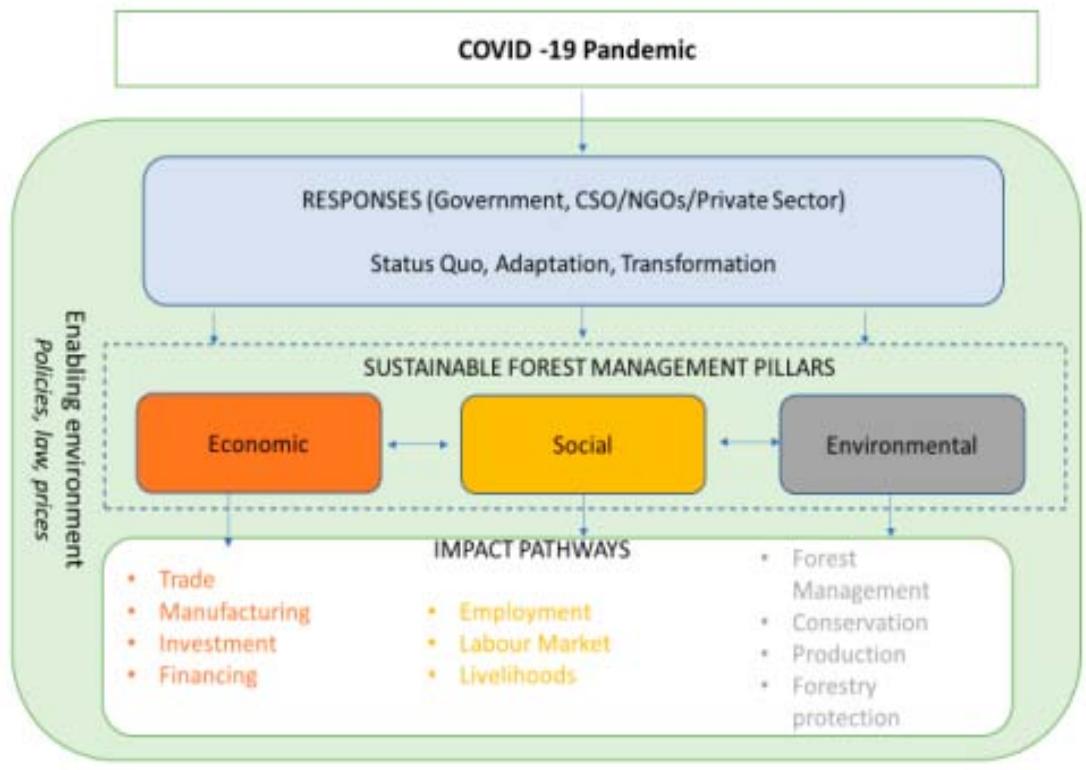
Figure 1: Assessment Frame
Source: United Nations, 2021
## i. Practical Approaches to other Impacts of Covid-19 on the Forest Sector
a. Carry out an analysis of the impact of COVID 19 on various forest products markets and responses to the pandemic by regions.
b. Provide policy guidance to promote approaches to developing and transitioning towards a sustainable bio-economy, and meeting the climate goals of the Paris Agreement taking into account low prices for fossil resources and fossil resource-based materials.
c. In collaboration with the Advisory Committee on Sustainable Forest-based Industries and other related stakeholders identify effective, innovative responses to the impacts that COVID-19 might have on global forest-based industries in the short, medium and long term.
d. Maximize the use of available forest data as part of ongoing efforts to identify risks to local wild food sources and opportunities for developing local supply chains based on forest products.
## ii. Minimize the Impact on Global Trade and Supply Chains of Forest Products
a. Strengthen national and regional markets for forest products, in order to maintain access to legally harvested wood and technology (technical assistance, training, equipment), and create channels of commercialization.
b. Coordinate strategies with ministries of economy, industry and trade to deliver targeted programmes based on public-private partnerships.
c. Maintain demand for legal timber and work with governments to enforce internationally agreed regulations on legally harvested timber. This is critical to enable timber-producing countries to implement national legislation that promotes sustainable forest management.
d. Amid disrupted international markets, boost the interest of governments and private sector actors in legal domestic timber production and processing, by providing more opportunities for smallholders and other local timber producers.
e. Formalize and facilitate domestic timber production to supply local export-oriented industries. Over the years, these industries have increasingly relied on lower risk and better documented timber supplies imported from developed countries (with a high carbon footprint).
iii. Present and Post- Mitigation of Covid-19 and Other Pandemics for Better Biodiversity
1. Biodiversity attracts current and future human health, well-being and economic prosperity. Still, it is being destroyed at an unprecedented and accelerating rate, with $25\%$ of all plant and animal species now threatened with extinction. It is
therefore critical that countries integrate biodiversity considerations into their COVID-19 response and economic recovery plans.
2. Protecting biodiversity is important for avoiding the next pandemic. Close to three-quarters of emerging infectious diseases in humans come from other animals. Land-use change and wildlife exploitation increase infectious disease risk by bringing people and domestic animals in close proximity to pathogen-carrying wildlife, and by disrupting the ecological processes that keep diseases in check.
3. The economy and human well-being also depend on biodiversity for food, clean water, flood protection, erosion control, inspiration for innovation and much more. Over half the world's global domestic product is moderately or highly dependent on biodiversity. The ongoing decline of biodiversity therefore poses important risks to society. Investing in biodiversity as part of the COVID-19 policy response can help to minimize these risks, while providing immediate jobs and economic stimulus.
4. While government and business leaders have acknowledged the importance of a "green recovery", the focus has been predominantly on climate change. Yet biodiversity loss and climate change are challenges of a similar magnitude and urgency, and are fundamentally interlinked. They must be addressed together as part of a broader green and inclusive recovery.
5. A number of countries have integrated biodiversity measures in their COVID-19 policy response. Examples of biodiversity measures include changes to regulation on wildlife trade to protect human health, and job programmes focused on ecosystem restoration, sustainable forest management and invasive species control.
6. Despite some good practice examples, many countries have weakened environmental regulations or introduced stimulus measures that threaten to drive further biodiversity loss. Analysts suggest that the volume of potentially harmful spending committed as part of the economic recovery from the COVID-19 crisis outweighs the volume of spending beneficial to biodiversity.
7. Governments can take the following steps to integrate biodiversity considerations into the COVID-19 recovery plans, and drive the transformative changes needed to halt and then reverse biodiversity loss:
- Ensure that COVID-19 economic recovery measures do not compromise biodiversity
- Maintain and strengthen regulations on land-use, wildlife trade and pollution
- $\diamond$ Attach environmental conditionality to bailouts to drive sustainability improvements
- Screen (ex ante) and monitor (ex post) stimulus measures for their biodiversity impacts
8. Scale up investment in biodiversity conservation, sustainable use and restoration
- Set biodiversity spending targets for COVID-19 stimulus measures and recovery plans
- Promote jobs in biodiversity conservation, sustainable use and restoration
- Engage businesses and the finance sector for a biodiversity-positive recovery
### 9. Put a price on biodiversity loss
- Reform subsidies harmful to biodiversity
- Scale up economic incentives for biodiversity
#### 10. Foster cross-sectoral and international collaboration
- $\diamond$ Adopt and strengthen the One Health approach
- Support developing countries to safeguard their biodiversity
- Develop, adopt and implement an ambitious post-2020 global biodiversity framework
## iv. Protection of Forest-Dependent Communities
- Support governments to connect forest beneficiaries with compensation measures adopted for other sectors, in particular through the use of producer associations as delivery partners.
- Design programmes combining poverty alleviation and environmental protection such as employment in forest restoration and monitoring, expand cash transfer programmes through a combination of payments for ecosystem services, and facilitate improved access and use of wild/indigenous/local foods that are readily available.
- Partner with the International Labour Organization, the World Bank and other relevant agencies to create targeted instruments to allow producer associations to increase the provision of microcredit and social protection services, fostering the adoption of resilient, integrated and sustainable production practices for agricultural and forest products.
- Maintain a focus on legal and sustainable production for national industry incentive packages and ensure that sustainable production is economically viable (i.e. requirements are not so costly that MSMEs are forced into illegal practices).
d) Weathering the Storm: Covid-19, Forest Resources, and Innovative Extension Approaches for Resilient Rural Livelihoods
The COVID-19 pandemic has brought unprecedented challenges to forest resource management and rural livelihoods, necessitating innovative extension approaches to promote resilience. Research has shown that the pandemic has accelerated deforestation and forest degradation, particularly in tropical regions, due to increased demand for land, timber, and non-timber forest products (NTFPs) (WWF, 2020). The closure of national parks and protected areas during lockdowns has also led to an increase in poaching and wildlife trafficking, further threatening biodiversity (IUCN, 2020). Moreover, the pandemic has disrupted global supply chains, affecting the livelihoods of forest-dependent communities, particularly those relying on NTFPs, such as medicinal plants, fruits, and nuts (Kusters et al., 2020). However, the pandemic has also created opportunities for innovative extension approaches, such as digital extension services, to promote sustainable forest management and resilient rural livelihoods. For instance, the use of mobile apps and online platforms has enabled forest-dependent communities to access new markets and customers, increasing their income and livelihood resilience (FAO, 2020). Additionally, the pandemic has highlighted the importance of agroforestry and sustainable forest management practices, such as community-led forest management and sustainable forest certification, to promote ecosystem services, biodiversity conservation, and human well-being (Chomba et al., 2020; Sunderland et al., 2020). Therefore, it is essential to adopt innovative extension approaches that integrate digital technologies, agroforestry practices, and community-led forest management to promote resilient rural livelihoods and conserve forest ecosystems for future generations (Tacoli et al., 2020). Overall, the COVID-19 pandemic has underscored the need for a more innovative and inclusive approach to forest resource management, one that balances human wellbeing with environmental conservation and promotes resilient rural livelihoods.
## II. CONCLUSION
In conclusion, the COVID-19 pandemic has had far-reaching impacts on tropical forests and ecosystems, exacerbating existing environmental challenges and threatening biodiversity. The pandemic has disrupted global supply chains, led to increased deforestation and wildlife poaching, and strained the livelihoods of forest-dependent communities. However, the pandemic also presents opportunities for sustainable forest management, biodiversity conservation, and ecosystem restoration. To mitigate the impacts of COVID-19 on tropical forests, it is essential to adopt a multifaceted approach that prioritizes sustainable forest management, biodiversity conservation, and the well-being of forest-dependent communities. This can be achieved through policy interventions, technological innovations, and behavioral change. Additionally, investing in biodiversity conservation, sustainable use, and restoration can provide immediate jobs and economic stimulus while minimizing the risks associated with biodiversity loss. Ultimately, protecting tropical forests and ecosystems requires a collaborative effort from governments, businesses, civil society, and individuals to ensure the long-term health and resilience of these critical ecosystems.
### a) Policy Recommendations for Integrating Biodiversity Into the Covid-19 Recovery
Governments must stop rolling back legal protections for the world's protected areas, as this can accelerate the pace of climate change, eliminate an important source of sustainable livelihoods, and contribute to biodiversity loss and deforestation: two significant drivers of disease outbreaks. Instead of scaling back protected areas, government should seize the opportunity to scale them up.
Governments in countries experiencing a rise in deforestation, illegal mining and poaching urgently need to maintain enforcement efforts, even during the COVID-19 pandemic. Equally important, countries must start planning for rebuilding their economies in a way that fosters green structural transformation, including through long-term commitments to public spending and pricing reforms. After restrictions are lifted, governments and development financing institutions should prioritize stimulus efforts that have high economic multiplier effects and reduce carbon emissions. Such investments would have additional benefits for biodiversity and reduce the risk of zoonotic disease outbreaks, too, thereby addressing an important root cause of the current pandemic. It is equally important that climate and biodiversity stay at the top of the agenda in 2020 and beyond, and that leaders leverage every opportunity to maintain the momentum.
Generating HTML Viewer...
References
48 Cites in Article
A (2020). Nepal Development Update, July 2020.
Shardul Agrawala,Maarten Van Aalst (2003). Adapting development cooperation to adapt to climate change.
J Bafoot (2006). A Study to Investigate the Potential for Development of Non-Timber Forest Products and Values from Boreal Forests of Newfoundland Botanical Garden.
Meredith Barrett,Timothy Bouley (2015). Need for Enhanced Environmental Representation in the Implementation of One Health.
I Chakraborty,P Maity (2020). COVID-19 outbreak: Migration, effects on society, global environment and prevention.
S Chomba (2020). Community-led forest management: A review of the evidence.
S Diaz (2019). Summary for policymakers of the global assessment report on biodiversity and ecosystem services of the Intergovernmental Science-Policy Platform on Biodiversity and Ecosystem Services.
A Dobson (2020). Ecology and economics for pandemic prevention.
(1991). Non wood forest products: the way ahead.
(2021). No. 1313. United Nations and Economic Community of West African States.
(2020). The impact of COVID-19 on agriculture and food security.
(2020). The impact of COVID-19 on agriculture and food security.
(2018). Non-Timber Forest Products from Restoration to Income Generation.
Fosa (2001). Natural Resources in Africa.
Fra (2010). Country Report.
Fletcher Halliday,Jason Rohr (2019). Measuring the shape of the biodiversity-disease relationship across systems reveals new findings and key gaps.
O Hertz (2002). The Use of Traditional Knowledge in Beekeeping Projects.
Johnson Rukundo (2016). Productivity and Informality in Rwanda:.
(2020). Global Assessment Report on Biodiversity and Ecosystem Services.
(2020). Conflits et conservation.
S Jimoh (2005). Non-Timber Forest Products in Phytomedicine and Culinary Uses.
William Karesh,Andy Dobson,James Lloyd-Smith,Juan Lubroth,Matthew Dixon,Malcolm Bennett,Stephen Aldrich,Todd Harrington,Pierre Formenty,Elizabeth Loh,Catherine Machalaba,Mathew Thomas,David Heymann (2012). Ecology of zoonoses: natural and unnatural histories.
Felicia Keesing,Lisa Belden,Peter Daszak,Andrew Dobson,C Harvell,Robert Holt,Peter Hudson,Anna Jolles,Kate Jones,Charles Mitchell,Samuel Myers,Tiffany Bogich,Richard Ostfeld (2010). Impacts of biodiversity on the emergence and transmission of infectious diseases.
K Kusters (2020). The impact of COVID-19 on non-timber forest products and their contribution to livelihoods.
T Lecocq,S Hicks,K Van Noten,K Van Wijk,P Koelemeijer,R De Plaen,H Xiao (2020). Global quieting of high-frequency seismic noise due to COVID-19 pandemic lockdown measures.
E Loh (2015). Targeting Transmission Pathways for Emerging Zoonotic Disease Surveillance and Control.
N Madhav,B Oppenheim,M Gallivan,P Mulembakani,E Rubin,N Wolfe,Pandemics (2017). Disease Control Priorities: Improving Health and Reducing Poverty.
S Magreth,M Peter (2016). Potentials of the Forest Resources in Adaptation to Climate Variability and Change in the North Nguu Mountain Block.
T Mcshane,M Wells (2004). Getting Biodiversity Projects toWork.
J Okafor (1975). Varietal Delimination in Irvingia gabonensis (Irvingiacea).
T Panayotous (1991). The role of non-timber products in sustaining natural rain forest: what we need to know.
Profor (2019). Colombia : Bank Financing to Small- and Medium-Sized Enterprises (SMEs) in Colombia.
Reinhard,F Admasu,A (1994). Honey Bee Flora of Ethiopia.
Ros-Tonen,Maf (1999). Introduction: NTFP research in the Tropipenbos Programme.
M Saka,Y Aujara,K Ilu,K Salami,Yakubu Mustapha (2020). Composition and Diversity of Non-Timber Forest Products (NTFPS) in Baturiya WetlandGame Reserve, Jigawa State.
M Saka,A Gujja,U Alkali,M Yau,Y Mairo,M Babagana (2019). Assessment of The Roles of Non-Timber Forest Products in The Livelihood Sustainance in Gujba Local Government Area Inhabitant of Yobe State, Nigeria.
N Sizer (1996). Profit without plunder: reaping revenue from Guyana tropical forest without destroying them.
T Sunderland (2020). Agroforestry and sustainable forest management: A review of the evidence.
C Tacoli (2020). Innovative extension approaches for sustainable agriculture and rural development.
(2001). United nations environment programme (unep).
B Verhheji,M Reinder (1997). The status of the extraction and marketing timber and non timber forest product s by Amerindians in the Guyanese context.
Q Wang,M Su (2020). A preliminary assessment of the impact of COVID-19 on the environment-A case study of China.
G Weerasinghe (2016). One Health case studies: addressing complex problems in a changing world.
L Wright (2020). How pandemics wreak havocand open minds.
(2020). COVID-19 and the environment: A review of the impacts and implications.
Wwf (2020). Living Planet Report 2020 -Bending the curve of biodiversity loss.
No ethics committee approval was required for this article type.
Data Availability
Not applicable for this article.
How to Cite This Article
Dr. Salami, K. D.. 2026. \u201cAppraisal of Covid-19 on Forest Resources and Extension Approaches Towards Sustainable Rural Livelihood\u201d. Global Journal of Science Frontier Research - H: Environment & Environmental geology GJSFR-H Volume 25 (GJSFR Volume 25 Issue H2): .
Explore published articles in an immersive Augmented Reality environment. Our platform converts research papers into interactive 3D books, allowing readers to view and interact with content using AR and VR compatible devices.
Your published article is automatically converted into a realistic 3D book. Flip through pages and read research papers in a more engaging and interactive format.
The people’s livelihood is largely dependent upon forests and related resources which comprises the tangible and intangible ones. Tangible resourcesare in the form of Timber, Non-Timber Forest Products (NTFPs) such as mushroom, fruits etc. while intangible services include a wide range of vital environmental services by the floras and faunas which includes erosion control, carbon sequestration among others. Assessing these tangible resources was always through active physical involvements by the actors in the management of the forests. Unexpectedly, the outbreak of COVID-19 pandemic which was earlier endemic to China have created a barrier to man in the management and utilization of these forest resources. Imposed lockdowns, curfews, social distances meant less team work, access and utilization of forest resources globally. The unavoidable reliance on forest resources especially by rural dwellers in developing nations like Nigeria was observed to spike up.
Our website is actively being updated, and changes may occur frequently. Please clear your browser cache if needed. For feedback or error reporting, please email [email protected]
Thank you for connecting with us. We will respond to you shortly.