
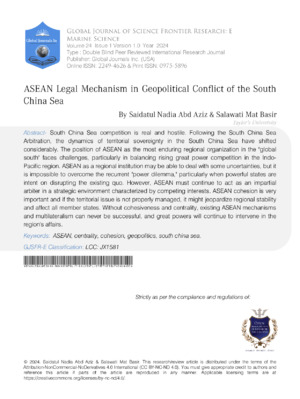

ASEAN Legal Mechanism in Geopolitical Conflict of the South China Sea

Article ID

N8538

Legal framework addressing disputes in South China Sea geopolitics.

ASEAN Legal Mechanism in Geopolitical Conflict of the South China Sea

Saidatul Nadia Abd Aziz
Salawati Mat Basir
Salawati Mat Basir
DOI

Abstract

South China Sea competition is real and hostile. Following the South China Sea Arbitration, the dynamics of territorial sovereignty in the South China Sea have shifted considerably. The position of ASEAN as the most enduring regional organization in the “global south” faces challenges, particularly in balancing rising great power competition in the Indo-Pacific region. ASEAN as a regional institution may be able to deal with some uncertainties, but it is impossible to overcome the recurrent “power dilemma,” particularly when powerful states are intent on disrupting the existing quo. However, ASEAN must continue to act as an impartial arbiter in a strategic environment characterized by competing interests. ASEAN cohesion is very important and if the territorial issue is not properly managed, it might jeopardize regional stability and affect all member states. Without cohesiveness and centrality, existing ASEAN mechanisms and multilateralism can never be successful, and great powers will continue to intervene in the region’s affairs.

ASEAN Legal Mechanism in Geopolitical Conflict of the South China Sea

South China Sea competition is real and hostile. Following the South China Sea Arbitration, the dynamics of territorial sovereignty in the South China Sea have shifted considerably. The position of ASEAN as the most enduring regional organization in the “global south” faces challenges, particularly in balancing rising great power competition in the Indo-Pacific region. ASEAN as a regional institution may be able to deal with some uncertainties, but it is impossible to overcome the recurrent “power dilemma,” particularly when powerful states are intent on disrupting the existing quo. However, ASEAN must continue to act as an impartial arbiter in a strategic environment characterized by competing interests. ASEAN cohesion is very important and if the territorial issue is not properly managed, it might jeopardize regional stability and affect all member states. Without cohesiveness and centrality, existing ASEAN mechanisms and multilateralism can never be successful, and great powers will continue to intervene in the region’s affairs.

Saidatul Nadia Abd Aziz
Salawati Mat Basir
Salawati Mat Basir

No Figures found in article.

Saidatul Nadia Abd Aziz. 2026. “. Global Journal of Science Frontier Research – E: Marine Science GJSFR-E Volume 24 (GJSFR Volume 24 Issue E1): .

Download Citation

Journal Specifications

Crossref Journal DOI 10.17406/GJSFR

Print ISSN 0975-5896

e-ISSN 2249-4626

Classification
Not Found
Keywords
Article Matrices
Total Views: 753
Total Downloads: 10
2026 Trends
Research Identity (RIN)
Related Research
Our website is actively being updated, and changes may occur frequently. Please clear your browser cache if needed. For feedback or error reporting, please email [email protected]

Request Access

Please fill out the form below to request access to this research paper. Your request will be reviewed by the editorial or author team.
X

Quote and Order Details

Contact Person

Invoice Address

Notes or Comments

This is the heading

Lorem ipsum dolor sit amet, consectetur adipiscing elit. Ut elit tellus, luctus nec ullamcorper mattis, pulvinar dapibus leo.


High-quality academic research articles on global topics and journals.

ASEAN Legal Mechanism in Geopolitical Conflict of the South China Sea

Saidatul Nadia Abd Aziz
Salawati Mat Basir
Salawati Mat Basir

Research Journals






























































