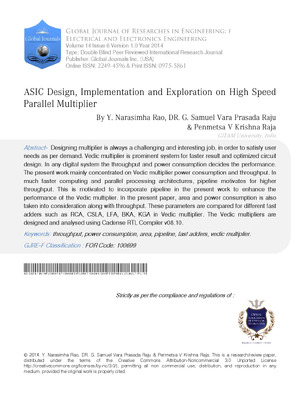
ASIC Design, Implementation and Exploration on High Speed Parallel Multiplier

§ GITAM University GITAM University

Send Message

To: Author

ASIC Design, Implementation and Exploration on High Speed Parallel Multiplier

Article Fingerprint

ReserarchID

RED62NF

ASIC Design, Implementation and Exploration on High Speed Parallel Multiplier Banner

Key Research Insights

Synthesized scholarly intelligence & interactive research assistant
  • English
  • Afrikaans
  • Albanian
  • Amharic
  • Arabic
  • Armenian
  • Azerbaijani
  • Basque
  • Belarusian
  • Bengali
  • Bosnian
  • Bulgarian
  • Catalan
  • Cebuano
  • Chichewa
  • Chinese (Simplified)
  • Chinese (Traditional)
  • Corsican
  • Croatian
  • Czech
  • Danish
  • Dutch
  • Esperanto
  • Estonian
  • Filipino
  • Finnish
  • French
  • Frisian
  • Galician
  • Georgian
  • German
  • Greek
  • Gujarati
  • Haitian Creole
  • Hausa
  • Hawaiian
  • Hebrew
  • Hindi
  • Hmong
  • Hungarian
  • Icelandic
  • Igbo
  • Indonesian
  • Irish
  • Italian
  • Japanese
  • Javanese
  • Kannada
  • Kazakh
  • Khmer
  • Korean
  • Kurdish (Kurmanji)
  • Kyrgyz
  • Lao
  • Latin
  • Latvian
  • Lithuanian
  • Luxembourgish
  • Macedonian
  • Malagasy
  • Malay
  • Malayalam
  • Maltese
  • Maori
  • Marathi
  • Mongolian
  • Myanmar (Burmese)
  • Nepali
  • Norwegian
  • Pashto
  • Persian
  • Polish
  • Portuguese
  • Punjabi
  • Romanian
  • Russian
  • Samoan
  • Scots Gaelic
  • Serbian
  • Sesotho
  • Shona
  • Sindhi
  • Sinhala
  • Slovak
  • Slovenian
  • Somali
  • Spanish
  • Sundanese
  • Swahili
  • Swedish
  • Tajik
  • Tamil
  • Telugu
  • Thai
  • Turkish
  • Ukrainian
  • Urdu
  • Uzbek
  • Vietnamese
  • Welsh
  • Xhosa
  • Yiddish
  • Yoruba
  • Zulu
Reading Preferences
Font Size
Line Spacing
Background
This converted HTML version may contain rendering inconsistencies. Please refer to the PDF for the authoritative version, or click here to provide feedback.

Abstract

Designing multiplier is always a challenging and interesting job, in order to satisfy user needs as per demand. Vedic multiplier is prominent system for faster result and optimized circuit design. In any digital system the throughput and power consumption decides the performance. The present work mainly concentrated on Vedic multiplier power consumption and throughput. In much faster computing and parallel processing architectures, pipeline motivates for higher throughput. This is motivated to incorporate pipeline in the present work to enhance the performance of the Vedic multiplier. In the present paper, area and power consumption is also taken into consideration along with throughput. These parameters are compared for different fast adders such as RCA, CSLA, LFA, BKA, KGA in Vedic multiplier. The Vedic multipliers are designed and analysed using Cadense RTL Compiler v08.10.

References

10 Cites in Article
  1. 1. Rakshith Saligram (2013). Optimized Reversible Vedic Multipliers for High Speed Low Power Operations. Proceedings of 2013 IEEE Conference on Information and Communication Technologies, 809-814.
  2. 2. Jagadguru Swami,Sri Bharath,Krsna Tirathji (1986). Vedic Mathematics or Sixteen Simple Sutras From The Vedas. Vedic Mathematics or Sixteen Simple Sutras From The Vedas
  3. 3. G Kumar (2012). Design of High Speed Vedic Multiplier using Vedic Mathematics Techniques. International Journal of Scientific and Research Publications, 2(3), 1-5.
  4. 4. Y Narasimharao (2014). Area Efficient High Speed Vedic Multiplier. International Journal of Innovative Technology and Exploring Engineering, 8(9S), 302-306.
  5. 5. Y Narasimharao (2014). Studies and Performance Evaluation of Vedic Multiplier using Fast Adders. IJCET, 4(3), 1908-1912.
  6. 6. D Hoe (2011). Design and characterization of parallel prefix adders using FPGAs. IEEE, 43rd Southeastern Symposium on System
  7. 7. J Desiree (2013). Fast and Area Efficient RSA Cryptosystem Design Using Modified Montgomery Multiplication for FPGA Applications. IJSER, 4(7)
  8. 8. Unknown Title.
  9. 9. G Jyoshna (2011). Parallel-Prefix Adder Architecture With Efficient Timing-Area Characteristic. UACEE International journal of Advances in Electronics Engineering, 1(1)
  10. 10. K Sreenath (2012). Reconfigurable VLSI architecture for FFT computation. IJSER, 3(6)

Funding

No external funding was declared for this work.

Conflict of Interest

The authors declare no conflict of interest.

Ethical Approval

No ethics committee approval was required for this article type.

Data Availability

Not applicable for this article.

How to Cite This Article

Y. Narasimha Rao. 2014. "ASIC Design, Implementation and Exploration on High Speed Parallel Multiplier". Global Journal of Research in Engineering - F: Electrical & Electronic GJRE-F Volume 14 (GJRE Volume 14 Issue F6).
Download Citation

Journal Specifications

Crossref Journal DOI 10.17406/gjre

Print ISSN 0975-5861

e-ISSN 2249-4596

Keywords
Classification
GJRE-F Classification FOR Code: 100699
Version of record

v1.2

Issue date
August 16, 2014

Language
German
Order Article Reprint
Experiance in AR

Explore published articles in an immersive Augmented Reality environment. Our platform converts research papers into interactive 3D books, allowing readers to view and interact with content using AR and VR compatible devices.

Read in 3D

Your published article is automatically converted into a realistic 3D book. Flip through pages and read research papers in a more engaging and interactive format.

Article Matrices
Total Views: 950
Total Downloads: 81
All Trends

Request Access

Please fill out the form below to request access to this research paper. Your request will be reviewed by the editorial or author team.
X

This is the heading

Lorem ipsum dolor sit amet, consectetur adipiscing elit. Ut elit tellus, luctus nec ullamcorper mattis, pulvinar dapibus leo.


High-quality academic research articles on global topics and journals.

ASIC Design, Implementation and Exploration on High Speed Parallel Multiplier

Y. Rao
Y. Rao GITAM University