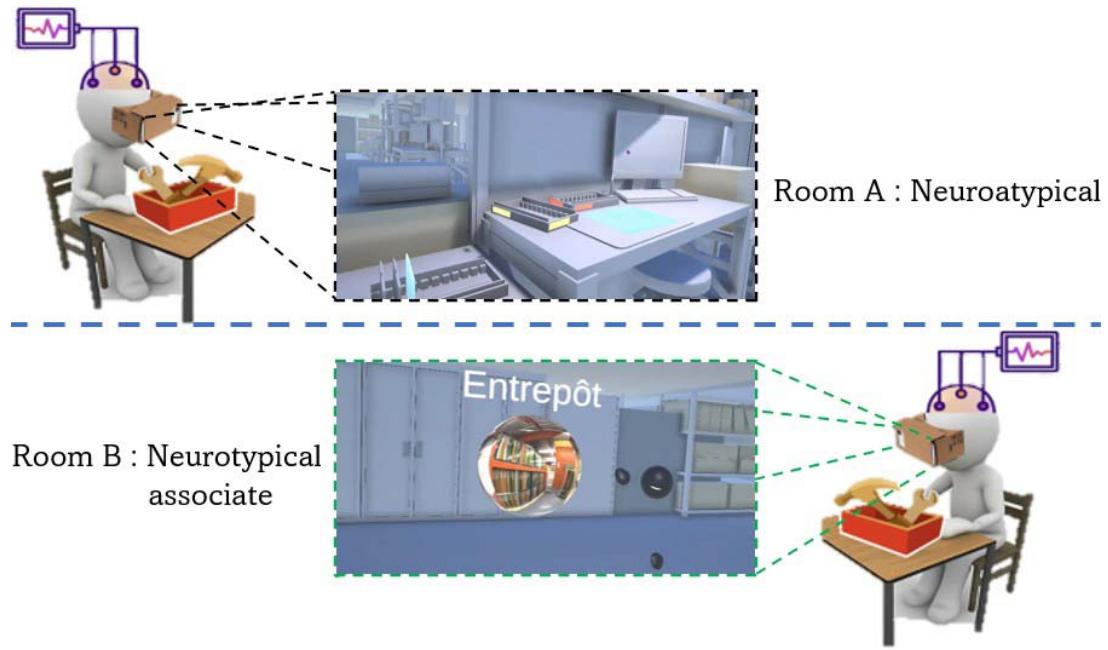
The study focuses on enhancing workplace experiences for autistic people by addressing professional burnout risks. Acknowledging the benefits of sensory adjustments for autistic employees, previous interactions with autistic participants associations and inclusive organizations highlighted challenges in gauging emotional well-being during workplace social dynamics and tasks. This study delves into real-time evaluations centered on collaborative task-based social interactions. The methodological design consists of a Collaborative Virtual Simulation (CVS) specifically crafted for vocational training targeting autistic people. We have implemented a feedback system for real-time monitoring of cognitive stress, mental workload, and emotional self-regulation within the CVS. The assessment of our approach involved analyzing cognitive stress, mental workload, and physiological synchronization of respiratory sinus arrhythmia (RSA), amidst neuroatypical and neurotypical pairs within the CVS.
Gregory Drew H Abney,Bennett Lewis,Bertenthal (2021). A method for measuring dynamic respiratory sinus arrhythmia (RSA) in infants and mothers.
Neelu Jyothi Ahuja,Sarthika Dutt,Shailee Lohmor Choudhary,Manoj Kumar (2022). Intelligent tutoring system in education for disabled learners using human-computer interaction and augmented reality.
Goudarz Alibakhshi,Akram Labbafi,Hoora Polouei (2023). Teachers and educators’ experiences and perceptions of Artificial -powered interventions for Autism groups.
Deeksha Ashwaq Z Amat,Mahrukh Adiani,Michael Tauseef,Spencer Breen,Amy Hunt,Amy Swanson,Zachary Weitlauf,Nilanjan Warren,Sarkar (2023). Design of a Desktop Virtual Reality-based Collaborative Activities Simulator (ViRCAS) to Support Teamwork in Workplace Settings for Autistic Adults.
Julianne Samuel Rc Arnold,Janelle Higgins,Aishani Weise,Elizabeth Desai,Julian Pellicano,Trollor (2023). Confirming the nature of autistic burnout.
Julianne Samuel Rc Arnold,Janelle Higgins,Aishani Weise,Elizabeth Desai,Julian Pellicano,Trollor (2023). Towards the measurement of autistic burnout.
Mary Baker-Ericzén,Roxanne Elshamy,Rebecca Kammes (2022). Current status of evidence-based practices to enhance employment outcomes for transition age youth and adults on the autism spectrum.
Eran Bar-Kalifa,Jessica Prinz,Dana Atzil-Slonim,Julian Rubel,Wolfgang Lutz,Eshkol Rafaeli (2019). Physiological synchrony and therapeutic alliance in an imagery-based treatment.
Nirit Bauminger,Cory Shulman,Galit Agam (2004). The Link Between Perceptions of Self and of Social Relationships in High-Functioning Children with Autism.
Lal Bozgeyikli,Evren Bozgeyikli,Matthew Clevenger,Shangdong Gong,Andrew Raij,Redwan Alqasemi,Stephen Sundarrao,Rajiv Dubey (2014). VR4VR: Towards vocational rehabilitation of individuals with disabilities in immersive virtual reality environments.
Vasiliki Bravou,Despoina Oikonomidou,Athanasios Drigas (2022). Applications of Virtual Reality for Autism Inclusion. A review (Aplicaciones de la realidad virtual para la inclusión del autism. Una revisión).
Giuliana Galli Carminati,Fabienne Gerber,Marc Baud,Olivier Baud (2007). Evaluating the effects of a structured program for adults with autism spectrum disorders and intellectual disabilities.
Amarie Carnett,Leslie Neely,Siobhan Gardiner,Marie Kirkpatrick,John Quarles,Kameron Christopher (2022). Systematic Review of Virtual Reality in Behavioral Interventions for Individuals with Autism.
Erik Carter,Michelle Harvey,Julie Taylor,Katherine Gotham (2013). CONNECTING YOUTH AND YOUNG ADULTS WITH AUTISM SPECTRUM DISORDERS TO COMMUNITY LIFE.
Ying-Chih Cheng,Yu-Chen Huang,Wei-Lieh Huang (2020). Heart rate variability in individuals with autism spectrum disorders: A meta-analysis.
Helen Ira L Cohen,Matthew Yoo,Lauren Goodwin,Moskowitz (2011). Assessing challenging behaviors in Autism Spectrum Disorders: Prevalence, rating scales, and autonomic indicators.
Joana Coutinho,Patrícia Oliveira-Silva,Eugénia Fernandes,Oscar Gonçalves,Diogo Correia,Kristin Perrone Mc-Govern,Wolfgang Tschacher (2019). Psychophysiological synchrony during verbal interaction in romantic relationships.
Paula Matthew R Cribbet,Heather Williams,Holly Gunn,Rau (2011). Effects of tonic and phasic respiratory sinus arrhythmia on affective stress responses.
Molly Davis,Kara West,Joanie Bilms,Diana Morelen,Cynthia Suveg (2018). A systematic review of parent–child synchrony: It is more than skin deep.
Anders Dechsling,Stian Orm,Tamara Kalandadze,Stefan Sütterlin,Roald Øien,Frederick Shic,Anders Nordahl-Hansen (2021). Virtual and Augmented Reality in Social Skills Interventions for Individuals with Autism Spectrum Disorder: A Scoping Review.
John Denver,Shawn Reed,Stephen Porges (2007). Methodological issues in the quantification of respiratory sinus arrhythmia.
Muhterem Dindar,Sanna Järvelä,Eetu Haataja (2020). What does physiological synchrony reveal about metacognitive experiences and group performance.
Jessica Dreaver,Craig Thompson,Sonya Girdler,Margareta Adolfsson,Melissa Black,Marita Falkmer (2020). Success factors enabling employment for adults on the autism spectrum from employers' perspective.
Hadeel Faras,Nahed Al Ateeqi,Lee Tidmarsh (2010). Autism spectrum disorders.
Jonathan Proulx Guimond,Jocelyn Kiss,Reyes Consuelo,Miguel Alejandro,Dominique Michaud,Rency Inson Michel,Alexandre Ménard,Isabelle Feillou,Geoffreyjen Edwards,James Hutson (2023). Enhancing Employability for Autistic Graduates: Using TRIZ Theory to Design Virtual Reality Solutions for Fostering Inclusive Communications in Workplace Environments.
Lisa Guy,Margaret Souders,Lauren Bradstreet,Christine Delussey,John Herrington (2014). Brief Report: Emotion Regulation and Respiratory Sinus Arrhythmia in Autism Spectrum Disorder.
Darren Hedley,Mirko Uljarević,David Hedley (2017). Employment and Living with Autism: Personal, Social and Economic Impact.
Jonathan Helm,Jonas Miller,Sarah Kahle,Natalie Troxel,Paul Hastings (2018). On Measuring and Modeling Physiological Synchrony in Dyads.
Jonathan Helm,David Sbarra,Emilio Ferrer (2014). Coregulation of respiratory sinus arrhythmia in adult romantic partners.
Julianne Higgins,Samuel Arnold,Janelle Weise,Elizabeth Pellicano,Julian Trollor (2021). Defining autistic burnout through experts by lived experience: Grounded Delphi method investigating #AutisticBurnout.
Julie Hofheimer,Brian Wood,Stephen Porges,Ellyn Pearson,Edward Lawson (1995). Respiratory sinus arrhythmia and social interaction patterns in preterm newborns.
David Johnson,Roger Johnson (2008). Social Interdependence Theory and Cooperative Learning: The Teacher's Role.
Demetria Karen R Johnson,Matthew Ennis-Cole,Bonhamgregory (2020). Workplace success strategies for employees with autism spectrum disorder: A new frontier for human resource development.
Kate Kidwell,Rebecca Clancy,Gwenith G Fisher (2023). The devil you know versus the devil you don't: Disclosure versus masking in the workplace.
Emma Kinnaird,Catherine Stewart,Kate Tchanturia (2019). Investigating alexithymia in autism: A systematic review and meta-analysis.
Johann Kleinbub,Fabian Ramseyer (2021). rMEA: An R package to assess nonverbal synchronization in motion energy analysis time-series.
Marsha Perry Lattimore,Dennis Parsons,Reid (2002). A prework assessment of task preferences among adults with autism beginning a supported job.
Wenn B Lawson (2020). Adaptive morphing and coping with social threat in autism: An autistic perspective.
Justin Leaf,Julia Joseph H Cihon,Peter Ferguson,Gerhardt (2022). Handbook of Quality of Life for Individuals with Autism Spectrum Disorder: An Introduction.
Chen Li,Meike Belter,Jing Liu,Heide Lukosch (2023). Immersive Virtual Reality Enabled Interventions for Autism Spectrum Disorder: A Systematic Review and Meta-Analysis.
E Daniel,Stewart Lidstone,Mostofsky (2021). Moving toward understanding autism: Visual-motor integration, imitation, and social skill development.
Miriam Liss,Jennifer Mailloux,Mindy Erchull (2008). The relationships between sensory processing sensitivity, alexithymia, autism, depression, and anxiety.
Lucy Livingston,Punit Shah,Victoria Milner,Francesca Happé (2020). Quantifying compensatory strategies in adults with and without diagnosed autism.
Theo Lorenc,Mark Rodgers,David Marshall,Hollie Melton,Rebecca Rees,Kath Wright,Amanda Sowden (2018). Support for adults with autism spectrum disorder without intellectual impairment: Systematic review.
Gonzalo Lorenzo,Nigel Newbutt,Alejandro Lorenzo-Lledó (2023). Designing virtual reality tools for students with Autism Spectrum Disorder: A systematic review.
Beatriz López,Liz Keenan (2014). Barriers to employment in autism: Future challenges to implementing the Adult Autism Strategy.
Grace Mak,Lea Zhao (2023). A systematic review: the application of virtual reality on the skill-specific performance in people with ASD.
Jane Mantzalas,Amanda Richdale,Achini Adikari,Jennifer Lowe,Cheryl Dissanayake (2022). What Is Autistic Burnout? A Thematic Analysis of Posts on Two Online Platforms.
Andreas Marougkas,Christos Troussas,Akrivi Krouska,Cleo Sgouropoulou (2023). How personalized and effective is immersive virtual reality in education? A systematic literature review for the last decade.
Analia Marzoratti,Tanya Evans (2022). Measurement of interpersonal physiological synchrony in dyads: A review of timing parameters used in the literature.
Oded Mayo,Ilanit Gordon (2020). In and out of synchrony—Behavioral and physiological dynamics of dyadic interpersonal coordination.
Oded Mayo,Michal Lavidor,Ilanit Gordon (2021). Interpersonal autonomic nervous system synchrony and its association to relationship and performance-a systematic review and metaanalysis.
Patricia Mesa-Gresa,Hermenegildo Gil-Gómez,José-Antonio Lozano-Quilis,José-Antonio Gil-Gómez (2018). Effectiveness of virtual reality for children and adolescents with autism spectrum disorder: an evidence-based systematic review.
Cassandra Moiser (2023). Integration of a Neurodivergent Workforce in a Company.
Jewoong Moon,Gi Choi,Joo Seo (2023). Revisiting multimedia learning design principles in virtual reality-based learning environments for autistic individuals.
Daniel Judith K Morgan,Erika Shaw,Forbes (2013). Physiological and behavioral engagement in social contexts as predictors of adolescent depressive symptoms.
Steven Robert G Moulder,Fabian Boker,Wolfgang Ramseyer,Tschacher (2018). Determining synchrony between behavioral time series: An application of surrogate data generation for establishing falsifiable null-hypotheses.
Tom Muskett (2016). Examining language and communication in autism spectrum disorder-in context. Re-thinking autism: Diagnosis, identity and equality.
Emily Neuhaus,Raphael Bernier,Theodore Beauchaine (2014). Brief report: social skills, internalizing and externalizing symptoms, and respiratory sinus arrhythmia in autism.
N Marlena,Novack,Dennis R Dixon (2019). Predictors of burnout, job satisfaction, and turnover in behavior technicians working with individuals with autism spectrum disorder.
Michelle Patriquin,Jill Lorenzi,Angela Scarpa,Martha Bell (2014). Developmental trajectories of respiratory sinus arrhythmia: Associations with social responsiveness.
Michelle Patriquin,Angela Scarpa,Bruce Friedman,Stephen Porges (2013). Respiratory sinus arrhythmia: A marker for positive social functioning and receptive language skills in children with autism spectrum disorders.
Stephen W Porges (2009). The polyvagal theory: New insights into adaptive reactions of the autonomic nervous system.
W Stephen,Robert Porges,Bohrer (1990). The analysis of periodic processes in psychophysiological research.
Valéry Psyché,Ben Daniel,Jacqueline Bourdeau (2019). Adaptive Learning Spaces with Context-Awareness.
Fabian Ramseyer,Wolfgang Tschacher (2011). Nonverbal synchrony in psychotherapy: Coordinated body movement reflects relationship quality and outcome..
Alan Dora M Raymaker,Nicole Teo,Brandy Steckler,Mirah Lentz,Austin Scharer,Steven Santos,Morrigan Kapp,Andee Hunter,Christina Joyce,Nicolaidis (2020). Having all of your internal resources exhausted beyond measure and being left with no clean-up crew": Defining autistic burnout.
Veerle Ross,Daniel Cox,Ron Reeve,Timothy Brown,Matthew Moncrief,Rose Schmitt,Gary Gaffney (2018). Measuring the attitudes of novice drivers with autism spectrum disorder as an indication of apprehensive driving: Going beyond basic abilities.
Mario Saiano,Eleonora Garbarino,Simonetta Lumachi,Silvano Solari,Vittorio Sanguineti (2015). Effect of interface type in the VR-based acquisition of pedestrian skills in persons with ASD.
Mario Saiano,Laura Pellegrino,Maura Casadio,Susanna Summa,Eleonora Garbarino,Valentina Rossi,Daniela Dall’agata,Vittorio Sanguineti (2015). Natural interfaces and virtual environments for the acquisition of street crossing and path following skills in adults with Autism Spectrum Disorders: a feasibility study.
Désirée Schoenherr,Jane Paulick,Susanne Worrack,Bernhard Strauss,Julian Rubel,Brian Schwartz,Anne-Katharina Deisenhofer,Wolfgang Lutz,Ulrich Stangier,Uwe Altmann (2019). Quantification of nonverbal synchrony using linear time series analysis methods: Lack of convergent validity and evidence for facets of synchrony.
Jonathan Shalom,Haggar Israeli,Omer Markovitzky,Joshua Lipsitz (2015). Social anxiety and physiological arousal during computer mediated vs. face to face communication.
Yung-Ji Sher,En-Tzu Lin,Jon-Chao Hong,Ting-Fang Wu,Kai-Hsin Tai (2022). Effects of Virtual Reality on Training in Food Preparation Curriculum for Vocational High School Students with Autism Spectrum Disorder.
Marco Simões,Miguel Bernardes,Fernando Barros,Miguel Castelo-Branco (2018). Virtual Travel Training for Autism Spectrum Disorder: Proof-of-Concept Interventional Study.
J Matthew,Emily Smith,Katherine Ginger,Michael Wright,Julie Wright,Laura Taylor,Dale Humm,Morris Olsen,Michael Bell,Fleming (2014). Virtual reality job interview training in adults with autism spectrum disorder.
Nattapong Ivo V Stuldreher,Jan Bf Thammasan,Anne-Marie Van Erp,Brouwer (2020). Physiological synchrony in EEG, electrodermal activity and heart rate detects attentionally relevant events in time.
(2010). R: A language and environment for statistical computing.
Wolfgang Tschacher,Hermann Haken (2019). The Process of Psychotherapy.
Wolfgang Tschacher,Deborah Meier (2020). Physiological synchrony in psychotherapy sessions.
Wolfgang Tschacher,Georg Rees,Fabian Ramseyer (2014). Nonverbal synchrony and affect in dyadic interactions.
Pauli Virtanen,Ralf Gommers,Travis Oliphant,Matt Haberland,Tyler Reddy,David Cournapeau,Evgeni Burovski,Pearu Peterson,Warren Weckesser,Jonathan Bright,Stéfan Van Der Walt,Matthew Brett,Joshua Wilson,K Millman,Nikolay Mayorov,Andrew Nelson,Eric Jones,Robert Kern,Eric Larson,C Carey,İlhan Polat,Yu Feng,Eric Moore,Jake Vanderplas,Denis Laxalde,Josef Perktold,Robert Cimrman,Ian Henriksen,E Quintero,Charles Harris,Anne Archibald,Antônio Ribeiro,Fabian Pedregosa,Paul Van Mulbregt (2020). Author Correction: SciPy 1.0: fundamental algorithms for scientific computing in Python.
Hui Wang,Cynthia Suveg,B Kara,West,Xutong Zhuo R Han,Xiaoyi Zhang,Li Hu,Yi (2021). Synchrony of respiratory sinus arrhythmia in parents and children with autism spectrum disorder: moderation by interaction quality and child behavior problems.
Tingting Wang,Shan Li,Xiaoshan Huang,Zexuan Pan,Susanne Lajoie (2023). Examining students’ cognitive load in the context of self-regulated learning with an intelligent tutoring system.
Susan White,Carla Mazefsky,Pearl Gabriel S Dichter,John Chiu,Thomas Richey,Ollendick (2014). Social-cognitive, physiological, and neural mechanisms underlying emotion regulation impairments: Understanding anxiety in autism spectrum disorder.
Lorna Wing (1993). The definition and prevalence of autism: A review.
Saima Zia,Muhammad Ahmad,Anum Tariq (2023). How Job Burnout Impacts the Goal-Focused Leader Behavior with the Mediating Role of Supervisor's Bottom-line Mentality.
No ethics committee approval was required for this article type.
Data Availability
Not applicable for this article.
How to Cite This Article
Jocelyne Kiss. 2026. \u201cAssessing Remote Social Interaction for Autistic People Using Physiological Signals in a Collaborative Virtual Reality Workplace\u201d. Global Journal of Human-Social Science - H: Interdisciplinary GJHSS-H Volume 24 (GJHSS Volume 24 Issue H3): .
Explore published articles in an immersive Augmented Reality environment. Our platform converts research papers into interactive 3D books, allowing readers to view and interact with content using AR and VR compatible devices.
Your published article is automatically converted into a realistic 3D book. Flip through pages and read research papers in a more engaging and interactive format.
The study focuses on enhancing workplace experiences for autistic people by addressing professional burnout risks. Acknowledging the benefits of sensory adjustments for autistic employees, previous interactions with autistic participants associations and inclusive organizations highlighted challenges in gauging emotional well-being during workplace social dynamics and tasks. This study delves into real-time evaluations centered on collaborative task-based social interactions. The methodological design consists of a Collaborative Virtual Simulation (CVS) specifically crafted for vocational training targeting autistic people. We have implemented a feedback system for real-time monitoring of cognitive stress, mental workload, and emotional self-regulation within the CVS. The assessment of our approach involved analyzing cognitive stress, mental workload, and physiological synchronization of respiratory sinus arrhythmia (RSA), amidst neuroatypical and neurotypical pairs within the CVS.
Our website is actively being updated, and changes may occur frequently. Please clear your browser cache if needed. For feedback or error reporting, please email [email protected]
Thank you for connecting with us. We will respond to you shortly.