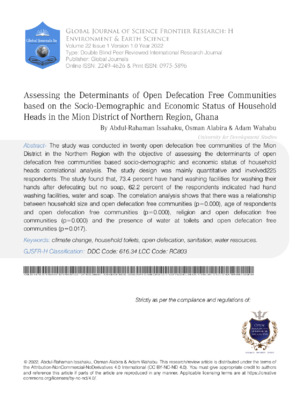
Assessing the Determinants of Open Defecation Free Communities Based on the Socio-demographic and Economic Status of Household Heads in the Mion District of Northern Region, Ghana

Abdul-Rahaman Issahaku
Osman Alabira
Osman Alabira
Adam Wahabu
Adam Wahabu
University for Development Studies University for Development Studies

Send Message

To: Author

Assessing the Determinants of Open Defecation Free Communities Based on the Socio-demographic and Economic Status of Household Heads in the Mion District of Northern Region, Ghana

Article Fingerprint

ReserarchID

RI8GT

Assessing the Determinants of Open Defecation Free Communities Based on the Socio-demographic and Economic Status of Household Heads in the Mion District of Northern Region, Ghana Banner

AI TAKEAWAY

Connecting with the Eternal Ground
  • English
  • Afrikaans
  • Albanian
  • Amharic
  • Arabic
  • Armenian
  • Azerbaijani
  • Basque
  • Belarusian
  • Bengali
  • Bosnian
  • Bulgarian
  • Catalan
  • Cebuano
  • Chichewa
  • Chinese (Simplified)
  • Chinese (Traditional)
  • Corsican
  • Croatian
  • Czech
  • Danish
  • Dutch
  • Esperanto
  • Estonian
  • Filipino
  • Finnish
  • French
  • Frisian
  • Galician
  • Georgian
  • German
  • Greek
  • Gujarati
  • Haitian Creole
  • Hausa
  • Hawaiian
  • Hebrew
  • Hindi
  • Hmong
  • Hungarian
  • Icelandic
  • Igbo
  • Indonesian
  • Irish
  • Italian
  • Japanese
  • Javanese
  • Kannada
  • Kazakh
  • Khmer
  • Korean
  • Kurdish (Kurmanji)
  • Kyrgyz
  • Lao
  • Latin
  • Latvian
  • Lithuanian
  • Luxembourgish
  • Macedonian
  • Malagasy
  • Malay
  • Malayalam
  • Maltese
  • Maori
  • Marathi
  • Mongolian
  • Myanmar (Burmese)
  • Nepali
  • Norwegian
  • Pashto
  • Persian
  • Polish
  • Portuguese
  • Punjabi
  • Romanian
  • Russian
  • Samoan
  • Scots Gaelic
  • Serbian
  • Sesotho
  • Shona
  • Sindhi
  • Sinhala
  • Slovak
  • Slovenian
  • Somali
  • Spanish
  • Sundanese
  • Swahili
  • Swedish
  • Tajik
  • Tamil
  • Telugu
  • Thai
  • Turkish
  • Ukrainian
  • Urdu
  • Uzbek
  • Vietnamese
  • Welsh
  • Xhosa
  • Yiddish
  • Yoruba
  • Zulu
Font Type
Font Size
Font Size
Bedground

Abstract

The study was conducted in twenty open defecation free communities of the Mion District in the Northern Region with the objective of assessing the determinants of open defecation free communities based socio-demographic and economic status of household heads correlational analysis. The study design was mainly quantitative and involved225 respondents. The study found that, 73.4 percent have hand washing facilities for washing their hands after defecating but no soap, 62.2 percent of the respondents indicated had hand washing facilities, water and soap. The correlation analysis shows that there was a relationship between household size and open defecation free communities (p=0.000), age of respondents and open defecation free communities (p=0.000), religion and open defecation free communities (p=0.000) and the presence of water at toilets and open defecation free communities (p=0.017).


References

43 Cites in Article
  1. L Abramovsky,B Augsburg,E Flynn,F Oteiza (2016). Improving CLTS Targeting: Evidence from Nigeria.
  2. Nana Anokye,Joyeeta Gupta (2012). Reconciling IWRM and water delivery in Ghana – The potential and the challenges.
  3. S Asumadu-Sarkodie,P Owusu (2016). The relationship between carbon dioxide and agriculture in Ghana, a comparison of VECM and ARDL model.
  4. Anne-Wil Harzing,Satu Alakangas (2015). Google Scholar, Scopus and the Web of Science: a longitudinal and cross-disciplinary comparison.
  5. Samuel Asumadu-Sarkodie,Phebe Owusu (2015). The Causal-Effect between Carbon Dioxide Emissions and Forestry Production and Trade: A Case Study in Ghana<strong></strong>.
  6. S Asumadu-Sarkodie,P Owusu,P Rufangura (2015). Impact analysis of flood in Accra, Ghana.
  7. S Barnard,P Routray,F Majorin,R Peletz,S Boisson,A Sinha,T Clasen (2013). Impact of Indian Total Sanitation Campaign on Latrine Coverage and Use: A Cross-Sectional Study in Orissa Three Years following Programme Implementation.
  8. Lisa Cameron,Susan Olivia,Manisha Shah (2015). Initial Conditions Matter: Social Capital and Participatory Development.
  9. S Cavill,R Chambers,N Vernon (2014). Frontiers of CLTS: Innovations and Insights.
  10. Jonny Crocker,Darren Saywell,Katherine Shields,Pete Kolsky,Jamie Bartram (2015). The true costs of participatory sanitation: Evidence from community-led total sanitation studies in Ghana and Ethiopia.
  11. J Crocker,E Abodoo,D Asamani,W Domapielle,B Gyapong,J Bartram (2016). Impact evaluation of training natural leaders during a community-led total sanitation intervention: a cluster-randomized field trial in Ghana.
  12. V Curtis (1998). The Dangers of Dirt: Household hygiene and health.
  13. Joshua Garn,Gloria Sclar,Matthew Freeman,Gauthami Penakalapati,Kelly Alexander,Patrick Brooks,Eva Rehfuess,Sophie Boisson,Kate Medlicott,Thomas Clasen (2016). The impact of sanitation interventions on latrine coverage and latrine use: A systematic review and meta-analysis.
  14. A Tonsuglo,P Aglobitse,N Kuunibe (2014). Choice of Malaria Care Services in Sissala West District in the Upper West Region of Ghana.
  15. Ama Owusu-Darko (2012). rGhanaCensus: 2021 Ghana Population and Housing Census Results as Data Frames.
  16. R Guiteras,J Levinsohn,A Mobarak (2015). Encouraging sanitation investment in the developing . world: a cluster-randomized trial.
  17. Suzanne Hanchett,Laurie Krieger,Mohidul Kahn,Craig Kullmann,Rokeya Ahmed (2011). Long-Term Sustainability of Improved Sanitation in Rural Bangladesh.
  18. Rober Chambers (2016). Sharing and Co-Generating Knowledges: Reflections on Experiences with PRA and CLTS.
  19. Marion Jenkins,Beth Scott (2007). Behavioral indicators of household decision-making and demand for sanitation and potential gains from social marketing in Ghana.
  20. (2012). Improving Urban Water Supply and Sanitation Services : Advisory Note.
  21. Kamal Kar,R Chambers (2008). Finding a Sustainable Sanitation Solution: Scaling Up Community-Led Total Sanitation.
  22. A Karikari,O Ansa-Asare (2006). Physico-Chemical and microbial water quality assessment of Densu River of Ghana.
  23. Robert Krejcie,Daryle Morgan (1970). Determining Sample Size for Research Activities.
  24. S Lonergan,D Brooks (1994). Watershed: The role of fresh water in the Israeli-Palestinian conflict.
  25. N Mukherjee,A Robiarto,S Wartono,E Wartono,D (2012). Achieving and Sustaining Open Defecation Free Communities: Learning from East Java.
  26. E Ojomo,M Elliott,L Goodyear,M Forson,J (2015). Sustainability and scale-up of household water treatment and safe storage practices: enablers and barriers to effective implementation.
  27. Taikan Oki,Shinjiro Kanae (2006). Global Hydrological Cycles and World Water Resources.
  28. I Osumanu,A Kosoe,F Dapilah (2016). Residential housing in Ghana's low-income urban areas: an analysis of households living conditions in the Wa Municipality.
  29. I Osumanu,E Kosoe (2013). Where do I answer nature's call? An assessment of accessibility and utilization of toilet facilities in Wa, Ghana.
  30. Amy Pickering,Habiba Djebbari,Carolina Lopez,Massa Coulibaly,Maria Alzua (2015). Effect of a community-led sanitation intervention on child diarrhoea and child growth in rural Mali: a cluster-randomised controlled trial.
  31. Lasse Møller-Jensen,Lene Madsen (2015). Becoming and Being an African Scholar: A 15-Year Perspective on Capacity-Building Projects in Ghana.
  32. (2013). Impact Evaluation of Training Natural Leaders during a Community-Led Total Sanitation Intervention: A Cluster-Randomized Field Trial in Ghana.
  33. W Pickut (2003). Definition of safe drinking water.
  34. P Tyndale-Biscoe,M Bond,R Kidd (2013). The Missionary and the Maharajas.
  35. (2015). United Nations sustainable development goals (UN SDGs).
  36. (2013). Schistosoma: background document for the WHO guidelines for drinking-water quality and the WHO guidelines on sanitation and health.
  37. (2011). Table 1: Retrieved and candidate papers from Google Scholar..
  38. Hugh Waddington,Birte Snilstveit,Howard White,Lorna Fewtrell (2009). Water, sanitation and hygiene interventions to combat childhood diarrhoea in developing countries.
  39. (2008). Abandoning Open Defecation: Comparison and Adoptation of Social Change Dynamics, Water Aid Ghana.
  40. V Reddy,Charles Batchelor (2012). Cost of providing sustainable water, sanitation and hygiene (WASH) services: an initial assessment of a life-cycle cost approach (LCCA) in rural Andhra Pradesh, India.
  41. (2015). Progress made towards achieving the water and sanitation MDG in the Arab region.
  42. Who (2014). WHO interactive multistakeholder hearing on noncommunicable diseases and mental health for young professionals.
  43. Jeanne Luh,Jamie Bartram (2013). Drinking water and sanitation: progress in 73 countries in relation to socioeconomic indicators.

Funding

No external funding was declared for this work.

Conflict of Interest

The authors declare no conflict of interest.

Ethical Approval

No ethics committee approval was required for this article type.

Data Availability

Not applicable for this article.

How to Cite This Article

Abdul-Rahaman Issahaku. 2026. \u201cAssessing the Determinants of Open Defecation Free Communities Based on the Socio-demographic and Economic Status of Household Heads in the Mion District of Northern Region, Ghana\u201d. Global Journal of Science Frontier Research - H: Environment & Environmental geology GJSFR-H Volume 22 (GJSFR Volume 22 Issue H1).

Download Citation

Open defecation, community health, demographic, economic, household, environmental impact.
Journal Specifications

Crossref Journal DOI 10.17406/GJSFR

Print ISSN 0975-5896

e-ISSN 2249-4626

Keywords
Classification
GJSFR-H Classification DDC Code: 616.34 LCC Code: RC803
Version of record

v1.2

Issue date
April 16, 2022

Language
en
Experiance in AR

Explore published articles in an immersive Augmented Reality environment. Our platform converts research papers into interactive 3D books, allowing readers to view and interact with content using AR and VR compatible devices.

Read in 3D

Your published article is automatically converted into a realistic 3D book. Flip through pages and read research papers in a more engaging and interactive format.

Article Matrices
Total Views: 1578
Total Downloads: 57
2026 Trends
Related Research
Our website is actively being updated, and changes may occur frequently. Please clear your browser cache if needed. For feedback or error reporting, please email [email protected]

Request Access

Please fill out the form below to request access to this research paper. Your request will be reviewed by the editorial or author team.
X

Quote and Order Details

Contact Person

Invoice Address

Notes or Comments

This is the heading

Lorem ipsum dolor sit amet, consectetur adipiscing elit. Ut elit tellus, luctus nec ullamcorper mattis, pulvinar dapibus leo.

High-quality academic research articles on global topics and journals.

Assessing the Determinants of Open Defecation Free Communities Based on the Socio-demographic and Economic Status of Household Heads in the Mion District of Northern Region, Ghana

Abdul-Rahaman Issahaku
Abdul-Rahaman Issahaku <p>University for Development Studies</p>
Osman Alabira
Osman Alabira
Adam Wahabu
Adam Wahabu

Research Journals