
Introduction
South Sudan, endowed with substantial oil reserves, relies on petroleum exports as the cornerstone of its national revenue, accounting for more than 90% of government funding (World Bank, 2022). Following independence, the government sought innovative mechanisms to convert oil wealth into tangible development, notably through the Oil-for-Infrastructure scheme. This program trades oil—primarily Nile Blend—for the construction of roads, bridges, and other public assets (Patey, 2022). While the intention was to address the country’s acute infrastructure deficit quickly, the scheme’s implementation since 2019 has been fraught with controversy, particularly regarding the allocation of public funds, transparency, and the proliferation of corruption.
The political economy of oil in South Sudan is marked by volatility, insecurity, and weak institutions. The country’s dependence on oil exposes it to fluctuations in global prices and complicates budget planning, making effective governance of these resources even more crucial (Collier & Hoeffler, 2009; Sachs & Warner, 2001). The OFI scheme was envisioned as a way to bypass budgetary constraints and deliver visible development gains. Yet, without robust checks and balances, such mechanisms can inadvertently exacerbate governance challenges and give rise to new forms of mismanagement and rent-seeking (Ross, 2012).
Despite the ambition behind the OFI scheme, South Sudan remains plagued by poor health and education outcomes, unfinished infrastructure projects, and widespread poverty (UNDP, 2022). The disconnect between oil wealth and development results has led scholars to question the efficacy and governance of such resource-for-projects initiatives (Mehlum, Moene, & Torvik, 2006). This paper aims to dissect the OFI scheme’s impact on resource allocation, transparency, and corruption, offering insights and recommendations grounded in both domestic realities and international best practices.
2. Background: Oil-for-Infrastructure in South Sudan
The Oil-for-Infrastructure scheme was designed to bypass traditional cash-based budgeting, instead using crude oil as payment for large-scale infrastructure projects. Inspired by similar arrangements in countries such as Angola and Nigeria, the South Sudanese government intended to overcome liquidity constraints, expedite project delivery, and attract foreign contractors (Patey, 2022). Since 2019, the majority of Nile Blend oil proceeds have been committed to these barter deals, often with foreign companies responsible for project delivery.
This approach was attractive in the context of South Sudan’s limited access to international credit and persistent cash flow problems. By leveraging oil assets directly, the government hoped to accelerate reconstruction without waiting for donor funding or loans. However, these arrangements also typically involve complex contracts, long-term oil commitments, and limited flexibility to respond to shifting national priorities or emergencies (AfDB, 2021).
The context of post-conflict fragility, limited institutional capacity, and weak regulatory frameworks has complicated the scheme’s execution (Collier, 2007). The absence of strong oversight mechanisms and inadequate public financial management systems have heightened risks of misallocation and resource leakage. As a result, the OFI model has become a focal point of debate among policymakers, civil society, and international partners, who question whether it delivers value for money and supports inclusive national development.
3. Public Resource Allocation: Impact and Challenges
Diversion of Oil Revenues
A key critique of the OFI scheme is its effect on the allocation of oil revenues. By earmarking a substantial portion of Nile Blend proceeds for infrastructure barter deals, the government has reduced the pool of resources available for direct budgetary support to health, education, and basic services (World Bank, 2022). This diversion is particularly concerning given South Sudan’s low human development indicators and urgent needs in social sectors (UNDP, 2022).
The result has been chronic underfunding of vital services, even as significant sums are allocated to ambitious infrastructure projects. For instance, while hospitals and schools across the country struggle with shortages of staff and supplies, oil revenue is tied up in deals that may take years to yield tangible benefits. This misalignment of spending priorities perpetuates cycles of vulnerability and limits the state’s ability to invest in its most important asset: its people (Mehlum et al., 2006). Moreover, the lack of a transparent and accountable allocation framework means that decisions about resource use are often made without broad consultation or consideration of local needs. This can lead to inefficient or inequitable distribution of infrastructure projects, deepening regional disparities and exacerbating social tensions (Sachs & Warner, 2001).
Infrastructural Gaps and Social Sector Trade-Offs
Despite significant oil allocations to OFI deals, infrastructure gaps remain widespread, with many projects unfinished or substandard. The focus on large signature projects—such as highways and government buildings—has often sidelined smaller, community-driven investments in water, sanitation, schools, and clinics (AfDB, 2021). Health and education budgets remain among the lowest in the region, limiting access to essential services and stifling human capital development (UNDP, 2022).
The trade-off between infrastructure and social sector funding is not always well-calibrated. While major roads and public buildings are important for economic integration, neglecting basic services undermines the foundations of long-term growth. Evidence from other countries shows that investments in health and education yield high social returns, supporting productivity, stability, and resilience (Sachs & Warner, 2001; World Bank, 2022).
Furthermore, the absence of participatory planning or transparent needs assessments means that some OFI projects may not align with local priorities or deliver expected benefits. This can result in “white elephant” projects—expensive, underutilized assets that do little to improve livelihoods. A more balanced, consultative approach to resource allocation is needed to ensure oil wealth translates into broad-based, sustainable development.
Budgetary Rigidity and Future Fiscal Risks
Locking significant portions of future oil production into long-term barter contracts can create rigidity in national budgeting and reduce fiscal flexibility. If oil prices fall or production is disrupted, the government may struggle to meet its obligations, risking defaults or project delays (IMF, 2023). Such risks are amplified by the lack of contingency planning and the limited transparency of OFI agreements.
This rigidity also makes it harder for the government to respond to emergencies—such as health crises or natural disasters—since oil revenues are already committed to infrastructure projects. The inability to reallocate resources quickly undermines national resilience and may force the country to seek additional external financing on unfavorable terms. Finally, the opaque and inflexible nature of the OFI scheme can discourage donor engagement and limit opportunities for coordinated development planning. As a result, South Sudan’s ability to leverage oil wealth for inclusive growth remains constrained by the structure and governance of its resource allocation mechanisms.
Conceptual Framework
This study adopts the conceptual framework shown in Figure 1 to illustrate the relationship between the oil-for-infrastructure scheme and its impact on public resource allocation, transparency, and corruption. The framework highlights how Nile Blend oil revenues influence these dependent variables, ultimately affecting socioeconomic outcomes. Below is a conceptual framework diagram illustrating the relationship between the independent variable (Oil-for-Infrastructure Scheme using Nile Blend Oil revenues since 2019) and the dependent variables (Public Resource Allocation, Transparency, and Corruption), as well as their impact on Socioeconomic Outcomes.
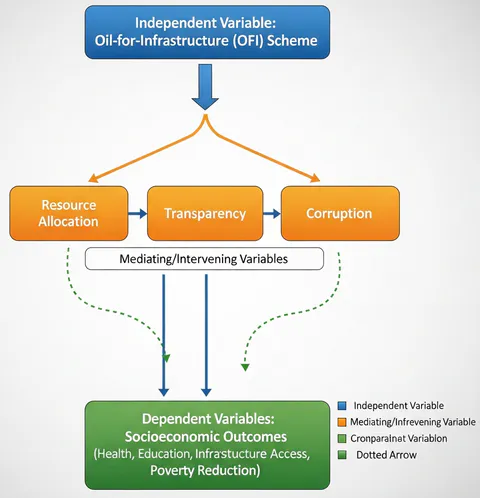
Figure: Figure 1: Conceptual Framework of the Study
4. Transparency: Governance and Disclosure Issues
Opacity in Contracting and Reporting
Transparency is a cornerstone of good resource governance, yet the OFI scheme in South Sudan is shrouded in opacity. Key details of contracts—including oil volumes, pricing, contractor selection, and payment terms—are rarely disclosed to parliament, civil society, or the public (EITI, 2023). Such opacity limits independent scrutiny, fosters public distrust, and impedes accountability.
The lack of transparency extends to the project implementation phase as well. Progress reports, audit findings, and performance evaluations are seldom published, making it difficult to track outcomes or identify problems early (Kolstad & Wiig, 2009). This information gap weakens both internal oversight and external advocacy, allowing inefficiencies and abuses to persist unchallenged. International best practices, such as those outlined by the Extractive Industries Transparency Initiative (EITI), emphasize regular publication of contracts, revenue flows, and project progress. South Sudan’s slow progress in meeting these standards has hindered efforts to improve governance and attract responsible investment. Without robust disclosure, the country risks missing out on the developmental benefits of transparency and accountability (Kolstad & Søreide, 2009).
Weak Institutional Oversight
South Sudan’s oversight institutions—including the National Audit Chamber and Anti-Corruption Commission—lack the resources, authority, or independence required to monitor the OFI scheme effectively (South Sudan Audit Chamber, 2021). Routine audits of OFI transactions are rare, and findings are not always made public or acted upon. Parliament’s oversight role remains limited, further weakening checks and balances.
The absence of effective oversight creates a governance vacuum in which contracts are negotiated and executed with minimal external review. This not only increases opportunities for mismanagement and abuse but also undermines the credibility of the government’s development agenda (World Bank, 2022). Without strong institutions capable of enforcing rules and standards, the risks of resource misallocation and elite capture are greatly heightened.
Strengthening oversight is not just a technical issue but also a political challenge. It requires high-level commitment to accountability, legal reforms to expand institutional mandates, and investments in capacity building. Only with these changes can South Sudan hope to build a governance architecture capable of managing oil wealth effectively and fairly (Collier, 2007; Doki, 2021).
Political Economy of Disclosure
The limited transparency observed in South Sudan’s OFI scheme is partly rooted in its political economy. Elites often benefit from non-transparent processes, which allow for patronage, rent-seeking, and side payments (Ross, 2012). Control over contract negotiations and project selection becomes a source of political power, reinforcing incentives to resist disclosure and accountability measures.
This dynamic is further complicated by the country’s fragile peace process and fragmented institutions. Efforts to enhance transparency may be perceived as threats to entrenched interests, provoking resistance from powerful actors. As such, advancing disclosure and openness will require both technical innovations—such as digital publication of contracts—and broader coalition-building to support reform (EITI, 2023). Ultimately, the challenge is to shift incentives so that transparency is valued as a means to public legitimacy and development success, not just a compliance exercise. This will require sustained advocacy, civic engagement, and international support to tip the balance in favor of open, accountable governance.
Corruption Risks
Opportunities for Rent-Seeking and Patronage
Opaque, non-competitive contracting procedures create fertile ground for corruption and rent-seeking. Reports from civil society and international organizations have highlighted instances of favoritism, kickbacks, and diversion of project funds for personal or political gain (IMF, 2023; Doki, 2021). The barter nature of the OFI scheme—where value is harder to track compared to cash transactions—further complicates efforts to prevent and detect corrupt practices.
Corruption not only depletes public resources but also distorts project selection and implementation, reducing the efficiency and quality of infrastructure delivery. As a result, the broader population suffers from the loss of vital services and opportunities for development (Ross, 2012). Corruption in the oil sector can also erode international confidence, making it harder for South Sudan to attract foreign investment or development assistance. The lack of consequences for corrupt acts reinforces negative incentives. Without credible enforcement, officials may come to see rent-seeking as a low-risk, high-reward strategy. This creates a vicious cycle, where corruption becomes normalized, perpetuating elite capture and undermining the country’s development prospects (Kolstad & Søreide, 2009).
Institutional and Systemic Barriers
Systemic weaknesses in South Sudan’s public financial management further exacerbate corruption risks. Limited capacity for contract negotiation, monitoring, and enforcement means that government counterparts are often at a disadvantage in dealings with private contractors, particularly foreign firms (Patey, 2022). The absence of whistleblower protections or effective grievance mechanisms discourages reporting of misconduct.
Moreover, the culture of impunity—where few officials are held accountable for corruption—reinforces negative incentives and perpetuates cycles of abuse. Addressing these institutional barriers is essential for safeguarding oil revenues and restoring public trust in government institutions (Kolstad & Søreide, 2009). Reforming the legal and regulatory framework to support accountability is therefore a priority. Capacity building and professionalization of the public sector are also critical. Training officials in contract management, procurement, and financial oversight can help reduce vulnerabilities to corruption and improve the effectiveness of anti-corruption strategies (IMF, 2023).
Social and Economic Costs
The prevalence of corruption in the OFI scheme has profound social and economic consequences. Resources that should be used to build schools, clinics, and roads are siphoned off, leaving communities underserved and deepening cycles of poverty. Corruption also undermines the rule of law, weakens social cohesion, and heightens grievances that can fuel conflict or instability (Ross, 2012).
On the economic front, the inefficiencies introduced by corrupt practices reduce the returns on oil investments and diminish the developmental impact of public spending. International partners may hesitate to provide aid or invest in South Sudan if corruption risks are perceived as unmanageable, constraining the country’s options for growth and recovery (World Bank, 2022). Combatting corruption is therefore not only a moral or legal imperative but a developmental necessity. Success in this area would unlock greater value from South Sudan’s oil wealth and lay the foundation for sustained, equitable progress.
Policy Recommendations
Enhance Transparency and Disclosure
South Sudan should mandate the public disclosure of all OFI contracts, including detailed information on oil volumes, pricing, project costs, and contractor identities. Ministries responsible for oil and finance must publish quarterly reports on oil revenue flows and infrastructure project status. These measures are aligned with EITI standards and will enable greater scrutiny and accountability (EITI, 2023).
Transparency should extend to the project implementation phase, with regular publication of progress reports, independent audits, and performance evaluations. A legal framework for proactive disclosure, coupled with digital platforms to make information accessible, would further strengthen public oversight. Civil society organizations and the media should be empowered to monitor and analyze published data, creating a feedback loop between government and citizens (Kolstad & Wiig, 2009). Finally, South Sudan should signal its commitment to transparency by joining and actively participating in international initiatives such as the EITI, which provides both technical guidance and peer support for resource-rich countries seeking to improve governance (EITI, 2023).
Strengthen Procurement and Oversight Mechanisms
All infrastructure contracts should be subject to open, competitive tendering processes, overseen by an independent procurement authority. The National Audit Chamber and parliamentary committees must be empowered and resourced to audit OFI transactions regularly and publish their findings. Establishing electronic procurement systems and independent complaint mechanisms can further reduce opportunities for collusion and rent-seeking (World Bank, 2022; AfDB, 2021).
Investments in capacity building for procurement and oversight institutions are essential. Training staff in modern procurement techniques, contract management, and project evaluation will improve efficiency and reduce vulnerabilities to corruption. Collaboration with international partners can bring in technical assistance and global best practices to support these reforms. Strengthening whistleblower protections and grievance redress mechanisms will also be important. Citizens and officials should have safe avenues to report misconduct, with assurances of confidentiality and legal protection. These steps will foster a culture of accountability and make it more difficult for corrupt practices to go undetected.
Prioritize Social Sector Funding
A legislated minimum allocation of oil revenues to health, education, and other essential services should be established before any new OFI deals are approved. Budgeting should be informed by comprehensive needs assessments and public consultations, ensuring that oil wealth is invested in projects with the greatest developmental impact (UNDP, 2022; Sachs & Warner, 2001).
Implementing participatory budgeting processes can help align spending with community priorities and increase the legitimacy of government decisions. Social sector investments should be monitored for results, with transparent reporting on outcomes and impacts. Evidence from other countries shows that prioritizing health and education yields high long-term returns, supporting productivity and reducing inequality (Mehlum et al., 2006). In the longer term, South Sudan should move towards an integrated development planning framework that balances infrastructure needs with human development goals, ensuring that resource allocation supports both immediate and future prosperity.
Conclusion
The Oil-for-Infrastructure scheme, as implemented through Nile Blend oil revenues since 2019, has profoundly shaped South Sudan’s resource allocation, governance, and corruption landscape. While the scheme was intended as a development catalyst, its opaque execution and weak oversight have limited its effectiveness and contributed to persistent social and infrastructural deficits. Meaningful reforms—focused on transparency, competitive procurement, robust oversight, and anti-corruption measures—are urgently needed to ensure that oil wealth is harnessed for inclusive national development and lasting peace.
The lessons from South Sudan’s experience underscore the importance of aligning resource management with best practice standards in transparency, accountability, and citizen participation. Policymakers must recognize that infrastructure investments alone cannot drive sustainable development; social sectors must also receive adequate, predictable funding. Only by pursuing holistic, integrated reforms can the country overcome the pitfalls of the resource curse and unlock the developmental potential of its oil reserves. Ultimately, the success of these reforms will depend on political will, institutional capacity, and sustained engagement from civil society, development partners, and the broader public. By embracing good governance principles and prioritizing the public interest, South Sudan can chart a more equitable and prosperous path forward.