Neural Networks and Rules-based Systems used to Find Rational and Scientific Correlations between being Here and Now with Afterlife Conditions
Neural Networks and Rules-based Systems used to Find Rational and
To: Author
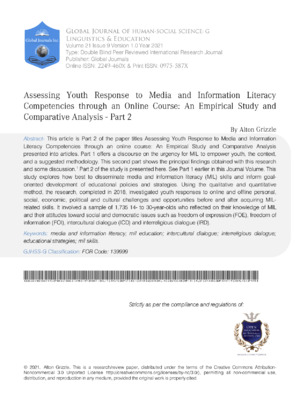
This article is Part 2 of the paper titles Assessing Youth Response to Media and Information Literacy Competencies through an online course: An Empirical Study and Comparative Analysis presented into articles. Part 1 offers a discourse on the urgency for MIL to empower youth, the context, and a suggested methodology. This second part shows the principal findings obtained with this research and some discussion. 1 Part 2 of the study is presented here. See Part 1 earlier in this Journal Volume. This study explores how best to disseminate media and information literacy (MIL) skills and inform goaloriented development of educational policies and strategies. Using the qualitative and quantitative method, the research, completed in 2018, investigated youth responses to online and offline personal, social, economic, political and cultural challenges and opportunities before and after acquiring MILrelated skills. It involved a sample of 1,735 14-to 30-year-olds who reflected on their knowledge of MIL and their attitudes toward social and democratic issues such as freedom of expression (FOE), freedom of information (FOI), intercultural dialogue (ICD) and interreligious dialogue (IRD).
Alton Grizzle. 2021. \u201cAssessing Youth Response to Media and Information Literacy Competencies through an Online Course: An Empirical Study and Comparative Analysis – Part 2\u201d. Global Journal of Human-Social Science - G: Linguistics & Education GJHSS-G Volume 21 (GJHSS Volume 21 Issue G9): .
Crossref Journal DOI 10.17406/GJHSS
Print ISSN 0975-587X
e-ISSN 2249-460X
The methods for personal identification and authentication are no exception.
Total Score: 101
Country: Brazil
Subject: Global Journal of Human-Social Science - G: Linguistics & Education
Authors: Alton Grizzle (PhD/Dr. count: 0)
View Count (all-time): 141
Total Views (Real + Logic): 2013

Total Downloads (simulated): 987
Publish Date: 2021 07, Tue
Monthly Totals (Real + Logic):
Neural Networks and Rules-based Systems used to Find Rational and
A Comparative Study of the Effeect of Promotion on Employee
The Problem Managing Bicycling Mobility in Latin American Cities: Ciclovias
Impact of Capillarity-Induced Rising Damp on the Energy Performance of
This article is Part 2 of the paper titles Assessing Youth Response to Media and Information Literacy Competencies through an online course: An Empirical Study and Comparative Analysis presented into articles. Part 1 offers a discourse on the urgency for MIL to empower youth, the context, and a suggested methodology. This second part shows the principal findings obtained with this research and some discussion. 1 Part 2 of the study is presented here. See Part 1 earlier in this Journal Volume. This study explores how best to disseminate media and information literacy (MIL) skills and inform goaloriented development of educational policies and strategies. Using the qualitative and quantitative method, the research, completed in 2018, investigated youth responses to online and offline personal, social, economic, political and cultural challenges and opportunities before and after acquiring MILrelated skills. It involved a sample of 1,735 14-to 30-year-olds who reflected on their knowledge of MIL and their attitudes toward social and democratic issues such as freedom of expression (FOE), freedom of information (FOI), intercultural dialogue (ICD) and interreligious dialogue (IRD).


We are currently updating this article page for a better experience.
Lorem ipsum dolor sit amet, consectetur adipiscing elit. Ut elit tellus, luctus nec ullamcorper mattis, pulvinar dapibus leo.