

Introduction
In contemporary financial systems, credit risk management relies on credit scoring models that lie at the heart of prudential frameworks and decisional efficiency in developed economies. However, in Sub-Saharan Africa, and particularly in Central Africa, this methodological advance contrasts with a still limited and incomplete adoption of internal credit risk assessment models. In Cameroon, the integration of credit scoring remains partial, both at the level of the BEAC[^1] ecosystem and within the internal practices of credit institutions (Abdou, et al., 2016). This raises a central question: are imported risk management tools genuinely adapted to local informational and institutional realities?
The Cameroonian banking system operates in an environment characterized by strong information asymmetry between lenders and borrowers (Mbama, et al., 2023), which is reflected in the credit portfolios quality. As at 30 June 2023, the non-performing loan ratio reached 20% in the CEMAC[^2] zone (BEAC, 2023). In Cameroon, this ratio stood at 13.5% for banks as at 31 December 2024, compared with 37.6% for some financial institutions[^3] and 22.3% for microfinance institutions. Yet this same ratio stands below 3% in France for the same year (BDF, 2024). This gap highlights the limitations of credit risk assessment mechanisms in a context where access to financial information remains fragmented and imperfectly structured (Nguimkeu et al., 2020). Indeed, in the absence of comprehensive and reliable databases, banks frequently resort to standardized models designed for other environments, without adequate calibration to Cameroon’s economic and socio-institutional specificities.
In this context, the predominance of expert judgment in credit granting reflects less an organizational preference than an adapted response to the insufficiency of quantitative tools. While this practice embodies a form of cautious rationality, it raises questions about the comparative performance of formalized models deployable in a context of high informational uncertainty. The research problem is therefore twofold: what are the contextual variables that predict default risk? Which credit scoring model offers the best predictive capacity for this risk in Cameroon?
Although the international literature on credit scoring is extensive, empirical studies conducted in Cameroon remain scarce, or tend to reproduce models developed in institutionally distinct environments, in contradiction with the contingency logic according to which the validity of a tool depends on the context in which it is deployed (Plane, 2015).
This article therefore aims to identify the model with the best predictive performance for individual default risk in the Cameroonian banking system. It compares two parametric models (logit and probit) and two algorithmic models (neural networks and support vector machines), and assesses the contribution of integrating contextual variables into the estimation of the probability of default. By contributing to a closer alignment between statistical modelling and institutional reality, this research aims to strengthen the effectiveness of credit allocation, reduce information asymmetry, and ultimately support financial stability and economic growth. The remainder of the article is organized as follows. We first present the theoretical framework and a review of existing work. We then describe the methodology adopted and the data used. Finally, we present and discuss the findings.
Modelling Default risk and Credit Scoring model performance: a Literature review
The modelling of default risk and the performance of credit scoring have been extensively discussed in the financial literature, from both theoretical and empirical perspectives (Abdou & Pointon, 2011; Markov, et al., 2022). Approaches grounded in information asymmetry, agency theory, and prudential frameworks constitute the principal analytical foundations mobilized in the study of credit risk (Akerlof, 1970; Jensen & Meckling, 1976). Drawing on these theoretical frameworks and on existing comparative analyses, we seek to highlight the relative performance of the principal credit scoring models and the contribution of contextual variables to the analysis of default risk in Cameroon.
From Statistical modelling to Algorithmic learning: Comparative performance of Credit Scoring models
Credit risk constitutes the core of banking intermediation activity. By transforming liquid deposits into risky assets, the bank assumes direct exposure to the potential default of borrowers (Allen & Santomero, 1997). This function rests on the capacity of the financial intermediary to produce, process, and transmit relevant information (Ullmo, 1988). However, in an environment characterized by information asymmetry (Akerlof, 1970), the lender does not always possess perfect knowledge of the borrower’s risk profile. The contractual relationship is therefore framed within an agency logic characterized by adverse selection and moral hazard (Jensen & Meckling, 1976), making it necessary to establish formalized selection and monitoring mechanisms (Diamond, 1984).
Credit risk, defined as the possibility that a borrower fails to meet its contractual obligations, rests on three fundamental components: exposure at default, probability of default, and loss given default (Brown & Moles, 2008). Due to its direct impact on the financial stability of institutions, it remains the most critical risk for banks (Greuning & Bratanovic, 2004; Markov, et al., 2022). In the face of informational uncertainty and the bounded rationality of agents (Simon, 1964), several mechanisms can be used: risk pricing (Borch, 1967), optimal portfolio diversification (Markowitz, 1991) or credit rationing (Stiglitz & Weiss, 1981).
It is within this logic of reducing and quantifying uncertainty that the development of credit scoring models fits. Their objective is to estimate the conditional probability of default from observable information and to discriminate between borrowers likely to honor their commitments and those presenting high risk (Baesens, et al., 2003). By standardizing lending procedures, these models limit decision-making arbitrariness and reinforce internal discipline. Their development has accelerated with the evolution of prudential requirements arising from the Basel Accords, which recognize internal rating systems in the determination of capital requirements (Dedu & Nechif, 2010; Louzada, et al., 2016). Furthermore, IFRS standards relating to the calculation of expected losses have increased the need for robust, traceable, and empirically validated predictive models (Markov, et al., 2022).
Historically, the first scoring models belong to classical parametric approaches: linear discriminant analysis (LDA), logistic regression (logit), and the probit model (Greene, 1998; Abdou & Pointon, 2011). These models rest on an explicit probabilistic structure linking a vector of explanatory variables to a binary dependent variable reflecting the state of default (Lin & Chen, 2023; Dastile, et al., 2020; Min & Lee, 2022). The success of the logit model owes particularly to its simplicity of implementation, statistical robustness,, ease of interpretation and transparency ; qualities that are essential in a regulated environment requiring the justification of decisions (Baesens, et al., 2003; Dastile, et al., 2020; Giannopoulos, 2018; Dedu & Nechif, 2010).
However, these models rest on the implicit assumption of a linear relationship between explanatory variables and the probability of default in the transformed space, an assumption that may be restrictive in the presence of complex non-linear interactions (Hurlin & Pérignon, 2019). This limitation has favored the emergence of machine learning approaches, such as: artificial neural networks, capable of modelling complex non-linear relationships (Dastile, et al., 2020; Min & Lee, 2022) ; support vector machines (SVM), which maximize the separation margin between classes (Baesens, et al., 2003); decision trees (CART) and ensemble methods combining several algorithms (Wang, et al., 2018; Markov, et al., 2022).
Comparative empirical studies do not, however, establish a systematic superiority of algorithmic models. Baesens et al. (2003), drawing on several European databases, show that while LS-SVM and neural networks exhibit good performance, logistic regression and discriminant analysis remain competitive. Lee & Chen (2005) demonstrate that a hybrid model (MARS combined with neural networks) can outperform individual models, highlighting the importance of methodological combination. Ince & Aktan (2009), comparing logit, LDA, neural networks, and CART on Turkish banking data, conclude that performance varies according to the metric retained: the CART model achieves a higher overall correct classification rate, while neural networks reduce Type II errors more effectively.
The macroeconomic dimension also proves decisive. Bellotti & Crook (2009) show that the integration of macroeconomic variables significantly improves the predictive capacity of survival models compared with standard logistic regression. Similarly, Giannopoulos (2018) observes that model effectiveness deteriorates during recessions, confirming the sensitivity of credit risk to economic conditions.
The systematic review by Markov et al. (2022) highlights the lasting coexistence of three main model families: classical parametric models, ensemble models, and machine learning models. While algorithmic approaches tend to display high predictive performance, logistic regression remains one of the most widely used models in banking practice. The authors stress an essential point: predictive performance depends heavily on data quality, validation techniques, the metrics retained, and the economic context of estimation.
Thus, the literature does not establish the universal superiority of any single model. While algorithmic approaches offer greater flexibility and an enhanced capacity to capture non-linear relationships, their performance remains heavily dependent on data quality, validation techniques, and the economic context of estimation (Markov, et al., 2022). Conversely, classical parametric models, and logistic regression in particular, offer advantages in terms of stability, interpretability, and regulatory compliance, while displaying satisfactory predictive performance in a significant number of studies (Baesens, et al., 2003; Dastile, et al., 2020).
In light of information asymmetry theories, prudential requirements, and comparative empirical results, the superiority of algorithmic models cannot be postulated independently of the context where they are implemented.
In an environment characterized by specific informational and institutional constraints, algorithmic complexity does not therefore necessarily guarantee a substantial predictive gain. From this perspective, we postulate that, in the context studied, the logit model exhibits predictive performance that is superior to, or at least comparable with, that of algorithmic models such as probit, neural networks, and support vector machines.
Contextualization of Credit risk in an Economy of Informational Asymmetry: Structural determinants of Default
The question of the determinants of default cannot be dissociated from the very nature of the informational environment in which banking activity takes place. If credit scoring models aim to estimate a conditional probability of default, this probability is not merely statistical: it reflects a given institutional, contractual, and macroeconomic configuration. In other words, the predictive performance of a model depends less on its technical sophistication than on its capacity to integrate the variables that genuinely structure risk in a specific context (Markov, et al., 2022).
In the logic of financial intermediation, the bank transforms liquid resources into risky assets, thereby assuming direct exposure to the behavioral and economic uncertainty of the borrower (Allen & Santomero, 1997). This transformation rests on the production of information, the central function of the intermediary (Ullmo, 1988). Now, credit risk — defined through exposure at default, probability of default, and loss given default (Brown & Moles, 2008) — is rooted in a structural information asymmetry between lender and borrower (Akerlof, 1970). The bank does not possess perfect knowledge of the intrinsic quality of the financed project, nor of the future effort to be made by the debtor.
This asymmetry feeds the mechanisms of adverse selection and moral hazard analyzed by Jensen & Meckling (1976). Ex ante, the riskiest borrowers may be incentivized to apply more actively for credit; ex post, repayment effort may diverge from the initial commitment. In such an environment, the intermediary acts under bounded rationality (Simon, 1964) and must build filtering and monitoring mechanisms (Diamond, 1984). The quality of the variables mobilized in the selection process then becomes decisive: they are what allows radical uncertainty to be transformed into probabilistic risk.
When formal information is abundant and structured — as in developed economies — standardized financial variables (income, credit history, and debt ratios) play a central role in discriminating risk profiles. Conversely, in environments where databases are fragmented and informational history is incomplete, the very structure of risk may differ.
The work of Abdou et al. (2016) highlights that in several African economies, the institutionalization of credit scoring remains limited, and the credit decision remains heavily reliant on expert judgment. This situation reflects less a technological lag than a pragmatic adaptation to an imperfect informational environment.
The theoretical models of credit rationing (Stiglitz & Weiss, 1981) are particularly illuminating in this regard. When information is asymmetric, adjusting the interest rate alone is insufficient to balance the market: it may even increase the average risk of the portfolio. In this context, banks resort to non-price selection mechanisms — collateral, reputation, professional stability — to limit exposure to default. These variables, often categorical’, in fact constitute strong economic signals in contexts where financial information is partial.
Portfolio theory (Markowitz, 1991) and risk pricing (Borch, 1967) provide complementary instruments for managing uncertainty, but their effectiveness remains conditional on the quality of initial probabilistic estimates. If the probability of default is poorly specified due to a lack of relevant variables, portfolio optimization or risk premium adjustment cannot compensate for this shortfall. The question of the structural determinants of default then becomes central: which variables effectively capture risk in a given environment?
The empirical literature confirms the contingent nature of credit risk. Bellotti & Crook (2009) demonstrate that the integration of macroeconomic variables significantly improves default prediction, revealing that repayment behavior also depends on aggregate economic conditions. Giannopoulos (2018) shows that model performance varies with the economic cycle, emphasizing that default is not solely a function of individual characteristics but also of the macro-financial context. Markov et al. (2022) stress that the superiority of a model depends largely on the nature of the available data and the institutional framework.
In an economy characterized by strong information asymmetry and incomplete income formalization, certain determinants take on particular importance. Employment stability can serve as an informational substitute for the absence of detailed financial statements; the existence of real collateral directly influences the anticipated recovery rate (Brown & Moles, 2008); professional stability reduces uncertainty about future repayment flows. These elements are not peripheral: they concretely structure the probability of default.
Thus, the probability of default is not solely a function of classical financial indicators, but results from an interaction between individual characteristics, contractual guarantees, and the institutional environment. The mechanical transposition of models designed for mature informational systems may lead to an underestimation or misspecification of risk in different contexts. The contingency logic, implicitly supported by comparative empirical work (Markov, et al., 2022; Giannopoulos, 2018; Bellotti & Crook, 2009), suggests that the identification of relevant determinants is a prerequisite for any performance comparison between models.
In the case of an economy such as Cameroon, where the production of financial information remains heterogeneous and where expert judgment retains a significant role (Abdou, et al., 2016), it is reasonable to consider that certain contextual variables play a structuring role in the formation of default risk. They constitute mechanisms of endogenous reduction of information asymmetry and directly influence the estimated probability of default.
In light of information asymmetry theories, credit rationing models, and empirical insights regarding the contextual dependence of models, we argue that variables specific to the Cameroonian credit system — notably those related to professional stability et and the institutional quality of the employer — significantly influence the probability of default of borrowers. They appear as structural determinants of risk, the integration of which is likely to improve the relevance and predictive performance of credit scoring in such a context.
Data and model Specification
Data
The data used in this study were collected in two phases. First, through semi-structured interviews conducted with credit, commitments, and risk managers from eight banks[^4] operating in Cameroon. Data collection adopted a purposive, non-probabilistic sampling approach, consistent with the principles of exploratory qualitative research (Miles & Huberman, 1994; Patton, 2002). This phase enabled identification of whether formalized scoring models exist, the nature of the variables mobilized, the consideration of contextual factors, and the origin of the tools employed (imported or locally developed models). Second, we draw on a database from the National Economic and Financial Committee (CNEF) of Cameroon, comprising 458,364 credit files granted to individuals over the period 2003–2024, for the comparative evaluation of the performance of the main default risk prediction models.
This database exhibits a marked imbalance between performing loans (439,397) and defaulted loans (18,967). To avoid learning bias in favor of the majority class, a combined strategy of cluster sampling and simple random sampling was adopted. Files were first separated into two groups (good and bad borrowers), then 5,000 observations were randomly drawn from each group to constitute a balanced training sample of 10,000 observations. The remaining data (448,364 files) constitute the external validation sample. This procedure follows the recommendations of Crone and Finlay (2012), who highlight the importance of balancing for machine learning models. It thereby reconciles institutional grounding, statistical robustness, and external validity.
In this study, the dependent variable is payment default, defined as a delay of 90 days or more, in line with international prudential standards. The explanatory variables are structured around four dimensions: (i) socio-demographic characteristics (gender, marital status, place of residence, dependents, etc.) ; (ii) employment status (which captures job stability) ; (iii) financial capacity (permanent income, current or savings account operations); (iv) banking history and history and reputation (length of the relationship, number of previous loans, known past delays, existence of past arrears, number of past payment delays, etc.) ; (v) contractual characteristics of the loan (amount, maturity, nominal rate, APR, existence of collateral, existence of an insurance policy).
A strict data cleaning protocol was applied to ensure statistical consistency: exclusion of inconsistent observations (age below 18, zero amount, APR below nominal rate, banking relationship duration incompatible with age). To limit scale effects and reduce distribution asymmetry, strictly positive variables were log-transformed using the natural logarithm, while variables that could take zero or negative values were transformed using Johnson’s (1949) procedure.
Model Specification and Estimation and evaluation Procedures
The empirical analysis aims to compare the predictive capacity of two parametric models (logit and probit) and two machine learning models (neural networks and support vector machine). Table 1 below provides a comparative summary of these four models.
Prior to estimation, multicollinearity is checked using the correlation matrix, the Variance Inflation Factor (VIF), and the Farrar–Glauber test. The models are then estimated on the training sample and evaluated on the external validation sample, thereby ensuring the robustness and generalizability of the results.
| Families | Models | Variables | Probability formulation | Estimation or optimization method | Key features | Performance indicator |
|---|---|---|---|---|---|---|
| Parametric Models | Logit | Dependent Variable: takes the value 1 in case of default and 0 otherwise (Y = {y1, y2}) Explanatory Variables: a vector of variables X = {x1, …, xp} characterizing the borrower | Coefficient estimation by maximum likelihood | Assumes a distribution function for the probability of default, namely the logistic function (also known as the sigmoid function): | Well predicted cases rate (TBP) = sensitivity (SEN): specificity (SPE): The false positive rate (FPR): The false negative rate (FNR) or Type II error: The area under the ROC (AUC): TN = True Negatives TP = True Positives FN = False Negatives FP = True Positives | |
| Probit | Coefficient estimation by maximum likelihood | Imposes a distribution function for the probability of default, namely the standard normal cumulative distribution function: | ||||
| Non-parametric Models: Machine Learning | Neural Networks (NN) | Based on a learning function: | Construction of a series of layers comprising an input layer, with the process ending at an output layer | The principle of the NN is to mimic the human brain by forming a network of neurons for decision-making. | ||
| Support Vector Machine (SVM) | Classification function: f(x) = sign(wTϕ(x) + b) | subject to the constraint: yi(wTϕ(xi) + b) ≥ 1 − ξi, ξi ≥ 0 where C is a constant, ξ is a margin vector of variables, ϕ(⋅) is a transformation from the input space to the borrower’s feature space | The SVM model proceeds by constructing an optimal hyperplane so as to maximize the distance between the nearest point and the hyperplane, known as the margin |
Source: (Louzada, et al., 2016; Dumitrescu, et al., 2021; Keita, 2015; Mwinkume, et al., 2025; Ying, et al., 2025; Xu & Qu, 2024; Le, et al., 2012)
Results, analysis, and Discussion
Results of the Exploratory Qualitative approach
The qualitative analysis yields three main findings. First, the semi-structured interviews reveal that the Cameroonian banking system remains characterized by institutional heterogeneity in the implementation of scoring systems, reflecting unequal levels of technological maturity and integration of prudential standards. Indeed, of the eight banks interviewed, only four have formalized and operational scoring models for non-financial enterprises.
Some banks, by contrast, have semi-empirical or deterministic models, while others use Excel-based scoring spreadsheets for individuals borrowers, incorporating socio-demographic and professional variables (age, seniority, contract type, salary level, professional stability) and behavioral indicators (repayment of prior loans, account activity, collateral). This practice illustrates an attempt at endogenous contextualization, based on locally collected data, but still suffering from statistical robustness and systematic empirical validation. These banks are, however, in the process of designing or migrating towards automated scoring tools, reflecting a progressive dynamic of alignment of the Cameroonian banking sector with international credit risk management practices.
Second, one observes the prevalence of models scoring models developed abroad among banks with formalized credit risk management mechanisms. These models are aligned with global prudential standards, based on internal ratings (Internal Ratings-Based Approach – IRB) as defined by the Basel directives. Their local transposition remains limited insofar as the risk parameters (probability of default, loss given default, exposure at default) are calibrated on credit portfolios built in foreign countries, and not on Cameroonian empirical data. This finding reflects the structural dependence of local subsidiaries on their parent companies, but also the difficulty of building models calibrated on reliable national data.
The third emerging trend concerns the persistence of human judgment and collegiality in credit decision-making. This finding reflects a cautious and relational rationality, better suited to an environment where informational uncertainty remains high. This pre-eminence of subjective judgment is corroborated by the work of Tversky & Kahneman (1974) on cognitive biases and heuristics in financial decision-making, but also illustrates a logic of organizational learning (Argyris & Schön, 1996), where the tacit knowledge accumulated by analysts plays a compensatory role in the face of the information deficit.
With regard to the nature of the variables used by banks in processing credit applications, the results reveal a differentiated structuring of the variables used in scoring models, according to the type of customer and the sophistication of the bank. For individuals, the most recurrent variables are: employment stability[^5]; the level of monthly income and its recurring nature; credit history and regularity of past repayments; the debt-to-income ratio; type of collateral; the customer’s behavior regarding their bank account. For non-financial firms, the models take into account: financial variables (profitability, liquidity, solvency, financial structure, cash flow); qualitative variables (industry sector, experience of legal representatives, quality of governance, dependence on the State or subsidies, competitive environment); behavioral and relational variables (history of the banking relationship, compliance with past commitments, frequency of overdrafts, compliance with covenants); and macroeconomic variables specific to the Cameroonian context (inflation rate, GDP growth, sector stability, budget deficit, regulatory constraints, commodity market trends).
Overall, the interview results highlight the relevance and necessity for the Cameroonian banking system to develop an endogenous scoring model that is both scientifically robust and contextually relevant.
Results of the Estimation of Default Probability prediction models
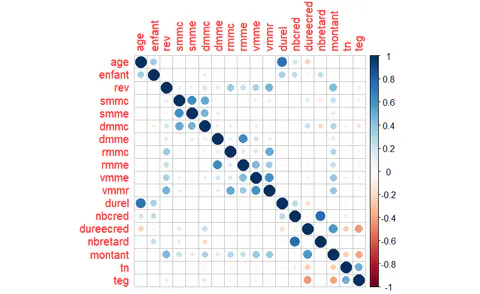
After analyzing the correlation matrix, the Variance Inflation Factor (VIF) value, and the Farrar–Glauber test, variables highly correlated with others were removed from the default probability equation. Four models were then implemented: a logit model, a probit regression, the NN and SVM models. All four models were estimated on the same balanced training sample of 10,000 credit files, comprising 5,000 ‘bad borrowers’ and 5,000 ‘good borrowers’, and then tested on the same validation sample of 448,364 credit files. The importance of contextual variables was assessed by first excluding these variables from the default probability equation, then reintegrating them in a second step.
The results of the logit model show that professional situation, financial capacity, banking reputation, and credit characteristics significantly influence the probability of default. Specifically, the results show that employment stability reduces the probability of credit default. Public-sector employees, whose employment is considered more stable, are less risky than those in the formal private sector, the informal private sector, and the self-employed. Similarly, financial capacity — assessed by income level, average monthly checking account balance, average monthly incoming transfers and average monthly account withdrawals - has a negative effect on the probability of default. As for reputational variables, the effects are also differentiated. The number of existing loans and the length of the banking relationship have a negative effect on the probability of default; conversely, a history of past delinquencies and the number of late payments positively influence the probability of default.
Furthermore, loan characteristics such as the loan term and the effective annual percentage rate (APR) negatively influence default risk; whereas the existence of an insurance policy and the nominal interest rate have a positive effect on the probability of default. Particularly, the positive coefficient associated with the existence of an insurance policy - which is a counterintuitive result - could simultaneously reflect a situation involving moral hazard on the part of insured customers (failure to comply with contractual terms) and adverse selection (the bank requires insurance only for high-risk profiles). Concerning APR, the negative coefficient stems from an indirect relationship. Indeed, in the Cameroonian context, small loans—and particularly student loans—are associated with high APRs, then are easily repayable and not prone to default. These loans are easily repayable and are not prone to default. Moreover, among socio-demographic characteristics, being in a common-law union positively influences default risk; while single clients, who generally carry fewer family financial obligations, are less prone to default than married individuals.
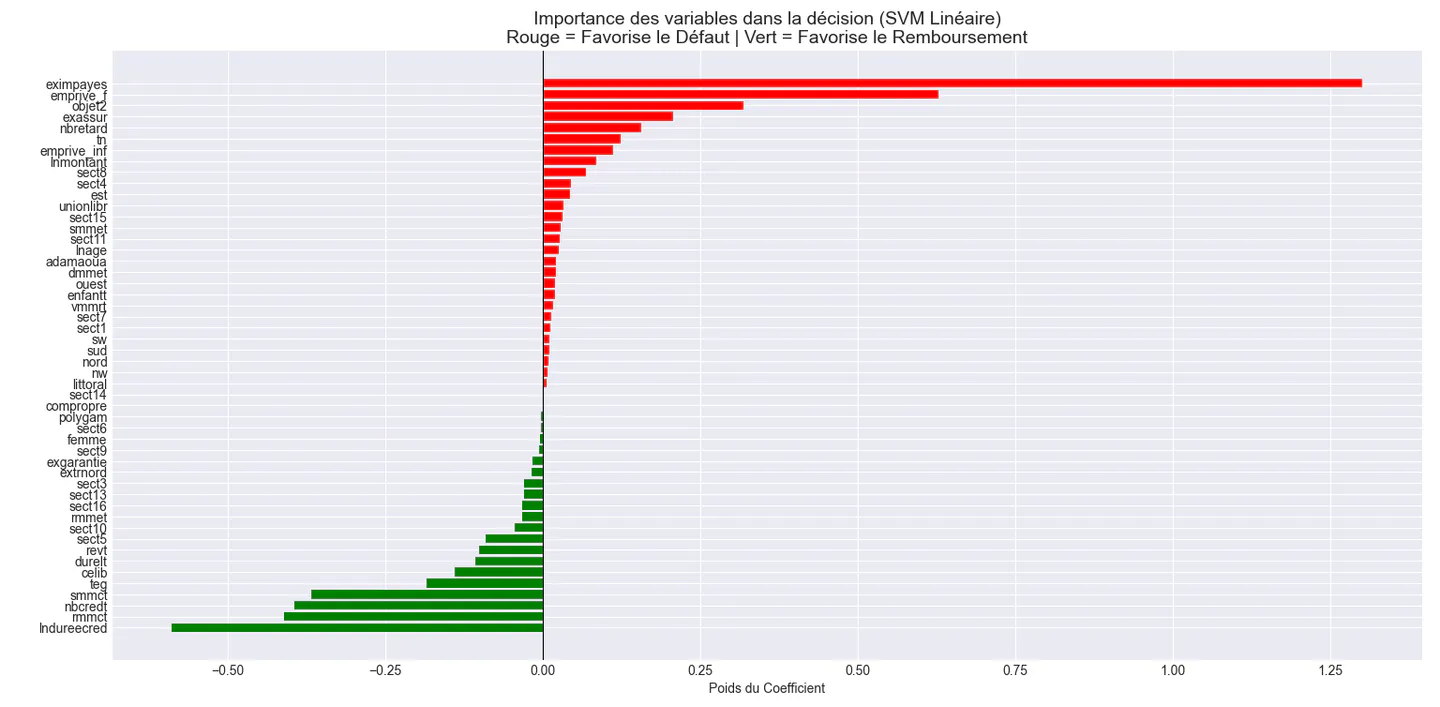
The probit placed under the same conditions as the logit produced almost identical results. The SVM model results corroborate certain findings of the logit and probit models. They reveal that variables relating to reputation (existence of past arrears, number of past payment delays, etc.), credit characteristics (existence of an insurance policy, nominal rate, investment credit), and formal and informal private-sector employment increase credit risk. As in the logit model, the SVM results reveal that loan duration and APR, permanent income, the number of loans obtained, and the length of the banking relationship reduce the probability of default.
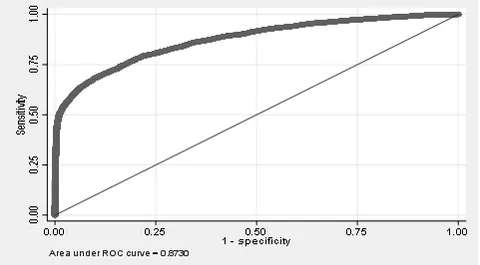
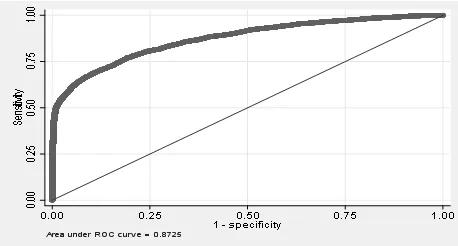
Regarding the performance of the four implemented models, the results show that the logit model has better predictive power in terms of total correct cases predicted. Indeed, it has an average correct classification rate of 90.80%, which is 4.83 points above the probit model, 5.68 above the NN model and 5.85 above the SVM model. However, the probit model performs better than the logit model in terms of ROC-AUC and F-score metrics. Finally, the NN and SVM models exhibit ROC-AUC, sensitivity, and type II error rates that are better than those of the logit and probit models, but their performance is significantly lower than that of the logit and probit models in terms of specificity, type I error, and F-score.
Overall, these results from scoring models consistently highlight four fundamental dimensions: financial capacity, banking history, socio-professional status, and credit usage patterns. Among these dimensions, banking history remains particularly important, both in terms of significance and stability of the sign of the coefficients. It acts positively on the probability of default. These results are consistent with those of Crook (2001), Thomas, Edelman & Crook (2002), and Altman & Sabato (2007), who showed that banking history constitutes a reliable indicator of borrowers’ payment behavior and financial discipline. They are also consistent with the findings of Nguena, Tsafack & Soumaré (2020), who showed that financial inclusion plays a decisive role in reducing information asymmetry and strengthening financial credibility in African economies.
Beyond these classical variables considered in several prior studies, contextual variables emerge as important predictors of credit risk. This result is consistent with contingency theory (Plane, 2015), and support the view of Beck & Cull (2014), who suggest that risk modelling must draw on local institutional reality to achieve operational validity. In this case, borrower employment stability significantly influences the probability of default for individuals in Cameroon.
By taking these contextual variables into account, the results of implementing the four models (logit, probit, NN, and SVM) highlight the superior predictive performance of the logit model compared to the other three models. These results corroborate those of Hurlin & Pérignon (2019), who noted that machine learning methods yield only marginal performance gains, although they sometimes allow productivity gains in terms of data pre-processing and the capacity to handle large volumes of information. Pacelli & Azzollini (2011) similarly argue that neural networks and the logit model simply have different strengths and weaknesses. In the same vein, Ince & Aktan (2009), working on credit data from a Turkish bank, demonstrated that the average correct classification rate of the logit model is higher than that of neural networks.
Conclusion
This article contributes to contemporary debates in international management on the transferability of analytical tools across institutionally heterogeneous environments. It implicitly challenges a widely accepted assumption: that the superiority of machine learning models in credit risk prediction is universal, regardless of context. The empirical analysis conducted on 448,364 credit files granted in Cameroon between 2015 and 2024 leads to a more nuanced and theoretically stimulating conclusion: predictive performance is institutionally situated.
The observed determinants of default reveal that credit risk, in an economic environment characterized by an incomplete informational infrastructure, is predicted by specific relational and socio-economic variables. Employment stability, the length of the banking relationship, and the regularity of financial flows act as signals that compensate for formal information deficits. The probability of default thus appears less as a simple statistical output than as the expression of a particular institutional architecture. This perspective invites us to move beyond a purely technical reading of credit scoring and to situate it within a contextualized approach to risk management. The explicit integration of these contextual variables generates substantial predictive gains across all tested models. The improvements observed in terms of correct classification and discriminatory power confirm that the quality and relevance of the information mobilized conditions performance more than the formal sophistication of the algorithm.
The most salient finding lies in the absence of empirical superiority of machine learning approaches. Despite their non-linear flexibility, neural networks and support vector machines do not outperform the logit model, which achieves an average correct classification rate of 90.80%.
On the theoretical level, this study contributes to the literature by showing that the performance of risk management mechanisms is inseparable from their institutional grounding. It thereby connects work on credit scoring with international management perspectives that emphasize the need to adapt managerial practices to local configurations. On the methodological level, it proposes a rigorous comparative protocol based on a large-scale database and a multi-indicator evaluation, strengthening the external validity of the conclusions. On the strategic level, it suggests that, for financial institutions in emerging economies, competitive advantage lies less in the importation of advanced technologies than in the construction of contextualized and reliable information systems.
Appendices
| Models | ROC-AUC | TBP | SEN | SPE | Error I | Error II | F Score |
|---|---|---|---|---|---|---|---|
| Training sample | 0.8597 | 78.08 | 67.64 | 88.52 | 11.48 | 32.36 | 72.49 |
| Validation sample | 0.7772 | 88.08 | 66.67 | 88.77 | 11.23 | 33.33 | 75.89 |
| Performance on training sample | |||||||
|---|---|---|---|---|---|---|---|
| Models | ROC-AUC | TBP | SEN | SPE | Error I | Error II | F Score |
| Logit | 0.8730 | 79.01 | 71.28 | 86.74 | 13.26 | 28.72 | 74.90 |
| Probit | 0.8725 | 78.90 | 70.80 | 87.00 | 13.00 | 29.20 | 74.67 |
| NN | 0.8915 | 80.70 | 75.40 | 86.00 | 14.10 | 24.50 | 79.62 |
| SVM | 0.8657 | 78.50 | 70.90 | 85.30 | 14.70 | 29.10 | 76.40 |
| Performance on validation sample | |||||||
| Models | ROC-AUC | TBP | SEN | SPE | Error I | Error II | F Score |
| Logit | 0.7828 | 90.80 | 65.00 | 91.60 | 8.42 | 35.03 | 75.74 |
| Probit | 0.7878 | 85.97 | 71.10 | 86.44 | 13.56 | 28.90 | 77.80 |
| NN | 0.8870 | 85.12 | 75.71 | 85.42 | 16.60 | 23.10 | 24.07 |
| SVM | 0.8659 | 84.95 | 71.60 | 85.38 | 14.60 | 28.40 | 22.87 |
| Y | Coef. | St.Err. | t-value | p-value | [95% Conf. | Interval] | Sig |
|---|---|---|---|---|---|---|---|
| Employment status | |||||||
| civil servant (ref.) | |||||||
| emprive_f | 1.259 | .089 | 14.19 | 0 | 1.085 | 1.433 | *** |
| compropre | 2.364 | 1.318 | 1.79 | .073 | -.219 | 4.948 | * |
| emprive_inf | .68 | .096 | 7.05 | 0 | .491 | .869 | *** |
| sect1 | -.079 | .132 | -0.60 | .547 | -.338 | .179 | |
| sect3 | -.814 | .678 | -1.20 | .23 | -2.143 | .516 | |
| sect4 | .05 | .179 | 0.28 | .781 | -.302 | .401 | |
| sect5 | -.288 | .12 | -2.39 | .017 | -.524 | -.052 | ** |
| sect6 | -.359 | .76 | -0.47 | .636 | -1.848 | 1.129 | |
| sect7 | .173 | .2 | 0.87 | .386 | -.219 | .566 | |
| sect8 | .502 | .301 | 1.67 | .096 | -.088 | 1.092 | * |
| sect9 | -.008 | .12 | -0.07 | .946 | -.243 | .227 | |
| sect10 | -.117 | .228 | -0.52 | .606 | -.564 | .329 | |
| sect11 | .054 | .108 | 0.50 | .615 | -.157 | .266 | |
| sect12 (ref.) | |||||||
| sect13 | -.294 | .084 | -3.51 | 0 | -.458 | -.13 | *** |
| sect14 | .281 | .161 | 1.74 | .082 | -.035 | .598 | * |
| sect15 | .218 | .543 | 0.40 | .688 | -.846 | 1.281 | |
| sect16 | -.328 | .228 | -1.44 | .149 | -.775 | .118 | |
| Financial Capacity | |||||||
| Revt | -.2 | .063 | -3.16 | .002 | -.324 | -.076 | *** |
| Smmet | .002 | .007 | 0.30 | .766 | -.012 | .016 | |
| Smmct | -.043 | .003 | -14.52 | 0 | -.049 | -.037 | *** |
| Dmmet | .007 | .009 | 0.78 | .437 | -.011 | .025 | |
| Vmmrt | -.014 | .008 | -1.80 | .072 | -.028 | .001 | * |
| Rmmct | -.174 | .017 | -10.10 | 0 | -.208 | -.14 | *** |
| Rmmet | -.002 | .009 | -0.28 | .78 | -.02 | .015 | |
| Banking reputation | |||||||
| nbcredt | -.878 | .07 | -12.59 | 0 | -1.014 | -.741 | *** |
| eximpayes | 4.784 | .179 | 26.70 | 0 | 4.433 | 5.135 | *** |
| nbretard | .007 | .001 | 6.54 | 0 | .005 | .009 | *** |
| Durelt | -.117 | .038 | -3.07 | .002 | -.192 | -.042 | *** |
| Socio-demographic characteristics | |||||||
| Lnage | .247 | .151 | 1.63 | .103 | -.05 | .544 | |
| Femme | -.004 | .071 | -0.06 | .953 | -.143 | .135 | |
| Enfant | .03 | .034 | 0.90 | .367 | -.036 | .096 | |
| polygam | -.308 | .396 | -0.78 | .437 | -1.085 | .468 | |
| unionlibr | .143 | .065 | 2.19 | .028 | .015 | .27 | ** |
| celib | -1.478 | .313 | -4.72 | 0 | -2.091 | -.864 | *** |
| adamaoua | .242 | .165 | 1.46 | .143 | -.082 | .565 | |
| est | .364 | .148 | 2.45 | .014 | .073 | .655 | ** |
| extrnord | -.371 | .146 | -2.54 | .011 | -.657 | -.084 | ** |
| littoral | .113 | .074 | 1.53 | .127 | -.032 | .258 | |
| nord | .006 | .137 | 0.04 | .965 | -.263 | .275 | |
| nw | .287 | .167 | 1.72 | .086 | -.041 | .615 | * |
| ouest | .14 | .12 | 1.17 | .243 | -.095 | .374 | |
| sud | .073 | .14 | 0.52 | .6 | -.201 | .347 | |
| sw | .155 | .119 | 1.30 | .193 | -.079 | .389 | |
| Credit characteristics | |||||||
| objet1 (réf.) | |||||||
| objet2 | 1.362 | .181 | 7.53 | 0 | 1.007 | 1.717 | *** |
| lnmontant | .114 | .074 | 1.55 | .121 | -.03 | .259 | |
| teg | -.061 | .015 | -4.03 | 0 | -.091 | -.032 | *** |
| tn | .083 | .018 | 4.54 | 0 | .047 | .12 | *** |
| lndureecred | -1.291 | .127 | -10.13 | 0 | -1.54 | -1.041 | *** |
| exassur | .742 | .106 | 7.03 | 0 | .535 | .949 | *** |
| exgarantie | -.227 | .454 | -0.50 | .618 | -1.116 | .663 | |
| Constant | 6.161 | 1.079 | 5.71 | 0 | 4.047 | 8.275 | *** |
| Mean dependent var | 0.500 | SD dependent var | 0.500 | ||||
| Pseudo r-squared | 0.385 | Number of obs | 10000 | ||||
| Chi-square | 5339.658 | Prob > chi2 | 0.000 | ||||
| Akaike crit. (AIC) | 8625.285 | Bayesian crit. (BIC) | 8993.013 | ||||
| *** p<.01, ** p<.05, * p<.1 | |||||||
| Sensitivity Pr(+ \mid D) | 71.28% | ||||||
| Specificity Pr(- \mid \sim D) | 86.74% | ||||||
| Positive predictive value Pr(D \mid +) | 84.32% | ||||||
| Negative predictive value Pr(\sim D \mid -) | 75.13% | ||||||
| False positive rate for true \sim D Pr(+ \mid \sim D) | 13.26% | ||||||
| False negative rate for true D Pr(- \mid D) | 28.72% | ||||||
| False positive rate for classified + Pr(\sim D \mid +) | 15.68% | ||||||
| False negative rate for classified - Pr(D \mid -) | 24.87% | ||||||
| Correctly classified | 79.01% | ||||||
| Source: the authors, based on CNEF Cameroon data | |||||||
| Y | Coef. | St.Err. | t-value | p-value | [95% Conf. | Interval] | Sig |
|---|---|---|---|---|---|---|---|
| Situation professionnelle | |||||||
| sect1 | .559 | .12 | 4.67 | 0 | .325 | .794 | *** |
| sect3 | -.097 | .69 | -0.14 | .888 | -1.45 | 1.256 | |
| sect4 | .651 | .17 | 3.83 | 0 | .318 | .984 | *** |
| sect5 | .171 | .11 | 1.55 | .121 | -.045 | .387 | |
| sect6 | .459 | .775 | 0.59 | .553 | -1.059 | 1.978 | |
| sect7 | .84 | .19 | 4.42 | 0 | .468 | 1.212 | *** |
| sect8 | 1.219 | .294 | 4.14 | 0 | .642 | 1.796 | *** |
| sect9 | .321 | .112 | 2.88 | .004 | .102 | .54 | *** |
| sect10 | .437 | .219 | 2.00 | .046 | .008 | .866 | ** |
| sect11 | .58 | .096 | 6.05 | 0 | .392 | .767 | *** |
| sect13 | -.426 | .081 | -5.24 | 0 | -.585 | -.267 | *** |
| sect14 | .444 | .158 | 2.81 | .005 | .134 | .755 | *** |
| sect15 | .573 | .525 | 1.09 | .275 | -.457 | 1.603 | |
| sect16 | -.124 | .223 | -0.55 | .579 | -.561 | .313 | |
| Financial Capacity | |||||||
| revt | -.245 | .062 | -3.98 | 0 | -.366 | -.124 | *** |
| smmet | -.006 | .007 | -0.81 | .419 | -.019 | .008 | |
| smmct | -.042 | .003 | -14.58 | 0 | -.048 | -.037 | *** |
| dmmet | .009 | .009 | 0.98 | .328 | -.009 | .026 | |
| vmmrt | .005 | .007 | 0.70 | .482 | -.009 | .019 | |
| rmmct | -.144 | .016 | -8.89 | 0 | -.175 | -.112 | *** |
| rmmet | -.001 | .009 | -0.16 | .871 | -.018 | .016 | |
| Banking reputation | |||||||
| nbcredt | -.827 | .068 | -12.25 | 0 | -.96 | -.695 | *** |
| eximpayes | 4.758 | .177 | 26.89 | 0 | 4.411 | 5.105 | *** |
| nbretard | .005 | .001 | 5.37 | 0 | .003 | .007 | *** |
| durelt | -.247 | .036 | -6.90 | 0 | -.317 | -.177 | *** |
| Socio-demographic characteristics | |||||||
| lnage | .589 | .142 | 4.14 | 0 | .31 | .868 | *** |
| femme | -.04 | .069 | -0.57 | .567 | -.175 | .096 | |
| enfantt | .027 | .033 | 0.83 | .406 | -.037 | .092 | |
| polygam | -.115 | .384 | -0.30 | .766 | -.868 | .639 | |
| unionlibr | .142 | .064 | 2.22 | .026 | .017 | .266 | ** |
| celib | -1.626 | .299 | -5.43 | 0 | -2.213 | -1.039 | *** |
| adamaoua | .155 | .161 | 0.97 | .334 | -.16 | .471 | |
| est | .412 | .144 | 2.86 | .004 | .13 | .694 | *** |
| extrnord | -.407 | .143 | -2.84 | .004 | -.687 | -.126 | *** |
| littoral | .195 | .072 | 2.71 | .007 | .054 | .336 | *** |
| nord | .013 | .134 | 0.10 | .921 | -.249 | .275 | |
| nw | .252 | .165 | 1.53 | .126 | -.071 | .576 | |
| ouest | .165 | .118 | 1.41 | .16 | -.065 | .396 | |
| sud | .113 | .137 | 0.83 | .409 | -.156 | .382 | |
| sw | .173 | .117 | 1.48 | .139 | -.056 | .401 | |
| Credit characteristics | |||||||
| objet2 | 1.607 | .173 | 9.27 | 0 | 1.268 | 1.947 | *** |
| lnmontant | .338 | .064 | 5.29 | 0 | .213 | .463 | *** |
| teg | -.024 | .011 | -2.10 | .035 | -.046 | -.002 | ** |
| tn | .072 | .017 | 4.23 | 0 | .039 | .105 | *** |
| lndureecred | -1.297 | .124 | -10.49 | 0 | -1.54 | -1.055 | *** |
| Constant | 2.51 | .892 | 2.81 | .005 | .762 | 4.259 | *** |
| Mean dependent var | 0.500 | SD dependent var | 0.500 | ||||
| Pseudo r-squared | 0.364 | Number of obs | 10000 | ||||
| Chi-square | 5044.389 | Prob > chi2 | 0.000 | ||||
| Akaike crit. (AIC) | 8910.554 | Bayesian crit. (BIC) | 9242.230 | ||||
| *** p<.01, ** p<.05, * p<.1 | |||||||
| Sensitivity Pr(+ \mid D) | 67.64% | ||||||
| Specificity Pr(- \mid \sim D) | 88.52% | ||||||
| Positive predictive value Pr(D \mid +) | 85.49% | ||||||
| Negative predictive value Pr(\sim D \mid -) | 73.23% | ||||||
| False positive rate for true \sim D Pr(+ \mid \sim D) | 11.48% | ||||||
| False negative rate for true D Pr(- \mid D) | 32.36% | ||||||
| False positive rate for classified + Pr(\sim D \mid +) | 14.51% | ||||||
| False negative rate for classified - Pr(D \mid -) | 26.77% | ||||||
| Correctly classified | 78.08% | ||||||
| Y | Coef. | St.Err. | t-value | p-value | [95% Conf. | Interval] | Sig |
|---|---|---|---|---|---|---|---|
| Employment status | |||||||
| emprive_f | .731 | .052 | 14.07 | 0 | .629 | .833 | *** |
| compropre | 1.325 | .723 | 1.83 | .067 | -.093 | 2.743 | * |
| emprive_inf | .391 | .056 | 6.93 | 0 | .28 | .502 | *** |
| sect1 | -.042 | .079 | -0.53 | .594 | -.196 | .112 | |
| sect3 | -.527 | .374 | -1.41 | .159 | -1.26 | .207 | |
| sect4 | .023 | .107 | 0.22 | .828 | -.186 | .232 | |
| sect5 | -.174 | .071 | -2.47 | .014 | -.312 | -.036 | ** |
| sect6 | -.217 | .456 | -0.48 | .634 | -1.11 | .677 | |
| sect7 | .099 | .119 | 0.84 | .403 | -.133 | .332 | |
| sect8 | .309 | .181 | 1.70 | .089 | -.047 | .664 | * |
| sect9 | 0 | .07 | 0.00 | .997 | -.137 | .138 | |
| sect10 | -.078 | .135 | -0.58 | .561 | -.343 | .186 | |
| sect11 | .019 | .064 | 0.30 | .766 | -.106 | .145 | |
| sect13 | -.177 | .048 | -3.66 | 0 | -.271 | -.082 | *** |
| sect14 | .152 | .096 | 1.58 | .114 | -.037 | .341 | |
| sect15 | .138 | .321 | 0.43 | .667 | -.49 | .767 | |
| sect16 | -.174 | .13 | -1.33 | .182 | -.43 | .082 | |
| Financial Capacity | |||||||
| revt | -.113 | .037 | -3.09 | .002 | -.185 | -.041 | *** |
| smmet | .001 | .004 | 0.27 | .788 | -.007 | .009 | |
| smmct | -.024 | .002 | -14.39 | 0 | -.027 | -.021 | *** |
| dmmet | .004 | .005 | 0.79 | .427 | -.006 | .015 | |
| vmmrt | -.008 | .004 | -1.72 | .085 | -.016 | .001 | * |
| rmmct | -.097 | .009 | -10.27 | 0 | -.116 | -.079 | *** |
| rmmet | -.001 | .005 | -0.26 | .792 | -.012 | .009 | |
| Banking reputation | |||||||
| nbcredt | -.512 | .041 | -12.64 | 0 | -.591 | -.433 | *** |
| eximpayes | 2.531 | .078 | 32.41 | 0 | 2.378 | 2.684 | *** |
| nbretard | .004 | .001 | 6.32 | 0 | .003 | .005 | *** |
| durelt | -.075 | .023 | -3.33 | .001 | -.119 | -.031 | *** |
| Socio-demographic characteristics | |||||||
| lnage | .154 | .089 | 1.73 | .083 | -.02 | .328 | * |
| femme | -.014 | .041 | -0.34 | .737 | -.095 | .067 | |
| enfantt | .015 | .02 | 0.76 | .447 | -.024 | .054 | |
| polygam | -.21 | .229 | -0.92 | .359 | -.659 | .239 | |
| unionlibr | .086 | .038 | 2.24 | .025 | .011 | .161 | ** |
| celib | -.747 | .169 | -4.43 | 0 | -1.078 | -.416 | *** |
| adamaoua | .138 | .097 | 1.43 | .154 | -.052 | .327 | |
| est | .212 | .088 | 2.40 | .016 | .039 | .385 | ** |
| extrnord | -.205 | .083 | -2.48 | .013 | -.367 | -.043 | ** |
| littoral | .07 | .043 | 1.62 | .106 | -.015 | .155 | |
| nord | .003 | .08 | 0.04 | .972 | -.154 | .159 | |
| nw | .177 | .097 | 1.83 | .067 | -.012 | .367 | * |
| ouest | .087 | .07 | 1.25 | .213 | -.05 | .224 | |
| sud | .032 | .083 | 0.38 | .703 | -.13 | .193 | |
| sw | .089 | .07 | 1.28 | .2 | -.047 | .226 | |
| Credit characteristics | |||||||
| object2 | .772 | .102 | 7.53 | 0 | .571 | .973 | *** |
| lnmontant | .058 | .042 | 1.35 | .176 | -.026 | .141 | |
| teg | -.037 | .009 | -4.30 | 0 | -.054 | -.02 | *** |
| tn | .049 | .01 | 4.72 | 0 | .029 | .07 | *** |
| lndureecred | -.73 | .072 | -10.13 | 0 | -.871 | -.589 | *** |
| exassur | .435 | .062 | 7.06 | 0 | .314 | .556 | *** |
| exgarantie | -.071 | .253 | -0.28 | .778 | -.566 | .424 | |
| Constant | 3.586 | .62 | 5.79 | 0 | 2.371 | 4.8 | *** |
| Mean dependent var | 0.500 | SD dependent var | 0.500 | ||||
| Pseudo r-squared | 0.384 | Number of obs | 10000 | ||||
| Chi-square | 5319.176 | Prob > chi2 | 0.000 | ||||
| Akaike crit. (AIC) | 8645.767 | Bayesian crit. (BIC) | 9013.495 | ||||
| *** p<.01, ** p<.05, * p<.1 | |||||||
| Sensitivity Pr(+ \mid D) | 70.80% | ||||||
| Specificity Pr(- \mid \sim D) | 87.00% | ||||||
| Positive predictive value Pr(D \mid +) | 84.49% | ||||||
| Negative predictive value Pr(\sim D \mid -) | 74.87% | ||||||
| False positive rate for true \sim D Pr(+ \mid \sim D) | 13.00% | ||||||
| False negative rate for true D Pr(- \mid D) | 29.20% | ||||||
| False positive rate for classified + Pr(\sim D \mid +) | 15.51% | ||||||
| False negative rate for classified - Pr(D \mid -) | 25.13% | ||||||
| Correctly classified | 78.90% | ||||||
| Source: the authors, based on CNEF Cameroon data | |||||||
Graphic 1 : ROC curve, AUC value of the logit model with contextual variables
Graphic 2 : ROC curve, AUC value of the probit model with contextual variables
Graphic 3 : Variable weights in the SVM model decision
Graphic 4.1: Correlation heat map
Variables Description and Calculation Method
| Variables | Codes | Explanation | Observations | Authors |
|---|---|---|---|---|
| Loan status | Y | Binary variable measuring the costumer's creditworthiness | Default = 1 Non-default = 0 | Ince et Aktan (2009), Medina-Olivares et al (2022), Bellotti et Crook (2009), Carling et al (2007), Abdou et al (2016) |
| Explanatory Variables | ||||
| Employment Status | ||||
| Employment status | SOC | Measures the client's employment status Ordinal qualitative variable | Has 4 categories: 1 = Public sector employee; 2 = Formal private sector employee; 3 = Self-employed; 4 = Informal private sector worker | Abdou et al (2016), Altman (1968), Ince et Aktan (2009) |
| Industry | SECT | Variable relating to the economic sector of the credit recipient | The modalities of this variable follow the Nomenclature of AFRISTAT Member States (NAEMA): sect1 = Agriculture, hunting, and forestry; sect2 = Fishing, fish farming, and aquaculture; sect3 = Mining and quarrying; sect4 = Manufacturing; sect5 = Electricity, gas, and water supply; sect6 = Construction; sect7 = Wholesale and retail trade; repair of motor vehicles and household goods; sect8 = Hotels and restaurants; sect9 = Transport, auxiliary transport activities and communications; sect10 = Financial activities; sect11 = Real estate, rental, and business services; sect12 = Public administration activities; sect13 = Education; sect14 = Health and social activities; sect15 = Community or personal activities; sect16 = Activities of households as employers of domestic staff; sect17 = Activities of extraterritorial organizations | Adamou, et al. (2020), Demirgüç-Kunt & Klapper (2012), Huang et al., (2005) |
| Financial Situation | ||||
| Permanent income | REV | Borrower's average monthly permanent income | Transformed quantitative variable. This transformation prevents higher values from dominating lower ones and improves the precision of results (Chen | Li, 2010) & Henri Calvet (1997, Cieply (1997), Stiglitz & Weiss (1981), Beaver (1966), Ince et Aktan (2009), client Dong, et al. (2010) |
| Average monthly current account balance | SMMC | Fluctuations in the borrower's current account balance on a monthly average | Transformed quantitative variable. Captures other income flows in the borrower's checking account | Abdou, et al., (2016), Chen & Pan (2019) |
| Average monthly savings account balance | SMME | Fluctuations in the borrower's savings account balance on a monthly average | Transformed quantitative variable. Captures other income flows in the borrower's savings account | Abdou, et al., (2016), Chen & Pan (2019) |
| Average monthly deposit | DMMC | Average of monthly deposits in the savings account | Transformed quantitative variable. Captures inflows into the borrower's current account | Abdou, et al., (2016), Chen & Pan (2019) |
| Average monthly savings deposit | DMME | Average of monthly deposits in the savings account | Transformed quantitative variable. Captures inflows into the borrower's savings account | Abdou, et al., (2016), Chen & Pan (2019) |
| Average monthly transfers received | VMMR | Average of monthly transfers received by the borrower | Transformed quantitative variable Captures the borrower's incoming financial banking operations | Abdou, et al., (2016), Chen & Pan (2019) |
| Average monthly outgoing transfers | VMME | Average of monthly transfers issued by the borrower | Transformed quantitative variable Captures the borrower's outgoing financial banking operations | Abdou, et al., (2016), Chen & Pan (2019) |
| Average monthly withdrawal from the checking account | RMMC | Average of monthly withdrawals from the current account | Transformed quantitative variable Measures the management of the borrower's current account through the significance of monthly withdrawals | Abdou, et al., (2016), Chen & Pan (2019) |
| Average monthly savings account withdrawal: | RMME | Average of monthly withdrawals from the savings account | Transformed quantitative variable Measures the management of the borrower's savings account through the significance of monthly withdrawals | Abdou, et al., (2016), Chen & Pan (2019) |
| Length of banking relationship | DUREL | Duration of the banking relationship between borrower and lender. Calculated as the difference between the loan disbursement/setup date and the date of entry into the banking relationship, divided by 30. | Quantitative variable It is expressed in number of months | Demirgüç-Kunt & Klapper (2012), (Mishkin, 1996). |
| Number of previously contracted loans | NBCRED | Total number of loans contracted by the borrower with the same bank | Quantitative variable Indicates the cumulative number of loans already granted to the client by the same bank | Chatterjee & Hossain (2002), Dong, et al. (2010). |
| Existence of repayment delays | EXRETARD | Binary variable measuring the existence of past payment delays | Existence of delays = 1 No payment delays = 0 | Altman (1968), Adera (1987) en Éthiopie et Pischke (1991) |
| Existence of arrears | EXIMPAY | Binary variable measuring the existence of past arrears | Arrears exist = 1 No arrears = 0 | Altman (1968), Adera (1987) en Éthiopie et Pischke (1991) |
| Socio-demographic characteristics | ||||
| Age | AGE | Borrower's age at the date of loan disbursement/setup. Calculated as the difference between the loan disbursement/setup date and the borrower's date of birth, divided by 365. | Quantitative variable It is expressed in number of years | Viganò (1993), Ince et Aktan (2009) Lin & Chen (2023), Diallo (2006), Abdou et al (2016), Adamou, et al (2020). |
| Gender | SEXE | Binary variable 1 = Female 0 = Male | Captures the influence of gender in explaining credit default | Viganò (1993), Ince et Aktan (2009) Lin & Chen (2023), Diallo (2006), Abdou et al (2016), Adamou, et al (2020). |
| Number of dependent children | ENFANT | Represents the number of children dependent on the borrower at the time of credit granting | Quantitative variable Captures the influence of household size in explaining credit default | Diallo (2006), Abdou et al (2016) |
| Marital status | SITMAT | Captures the influence of a borrower's marital status on repayment capacity | Categorical variable with 4 categories: 1 = monogamous married; 2 = polygamous married; 3 = cohabiting; 4 = single; 5 = widowed or divorced | Variable suggested by the qualitative study. |
| Region of residence | REGION | This variable indicates the borrower's location. It has 10 categories (1 = Adamaoua; 2 = Center; 3 = East; 4 = Far North; 5 = Littoral; 6 = North; 7 = Northwest; 8 = West; 9 = South; 10 = Southwest) | Captures the influence of cultural behaviors and the immediate economic environment on the borrower's repayment capacity | Adamou, et al (2020). |
| Purpose of loan | OBJET | Provides information on the intended use of the funds. This variable has two values: 1 = Consumer/equipment loan; 2 = Investment loan;3 = Other use. | Captures the influence of the nature of credit use in explaining credit risk | Viganò (1993), Ince et Aktan (2009) Abdou et al (2016), Graham et Pischke (1984) |
| Loan amount | MONTANT | Represents the amount of the loan granted | Measures the importance of loan value in explaining the probability of default | Viganò (1993), Ince et Aktan (2009) Abdou et al (2016), Graham et Pischke (1984) |
| Nominal rate | TN | Measures the interest to be paid periodically by the client in addition to capital repayment | This is the commercial cost of the loan | Deng et al. (2000) |
| Annual Percentage Rate | TEG | Measures the cost of the loan This is a value declared by the banks. | The annual percentage rate (APR) measures the true cost of the loan. It incorporates, in addition to the nominal interest rate, ancillary charges conditioning loan setup (file processing fees, insurance premium, notary fees, etc.) It is calculated using the discounted cash flow formula: i: annual APR; k: order number of a disbursement; m: order number of the last disbursement; Ak: amount of disbursement k; tk: time interval between the first disbursement and disbursement k; p: order number of a repayment instalment; n: order number of the last instalment; Ap: amount of instalment p; tp: time interval between the first disbursement and instalment p. | Deng et al. (2000) Etude qualitative The APR calculation is governed by two regulatory texts: Regulation No. 04/19/CEMAC/UMAC/CM of 10 August 2020 on the APR, the repression of usury, and the publication of banking conditions in CEMAC; Instruction of the Governor of the BEAC of 4 November 2021 setting out the procedures for calculating the APR |
| Loan duration | DURECRED | This is the loan duration in months. | This is a value declared by the banks. | Brealey & Myers (2013), Dong, et al. (2010), Lin & Chen (2023), Graham et Pischke (1984) |
| Existence of an insurance policy | EXASSUR | Binary variable measuring whether or not an insurance policy has been purchased 1 = Yes; 0 = No | Captures the impact of the insurance policy on credit risk management | (Demirgüç-Kunt & Klapper, 2012), Cohen et Siegelman (2010), Miller et Lessard (2000), Petersen et Rajan, (1995), Altman et Saunders (1998), Banasik et al. (2003), Friedman & Rafsky (2009), Merton & Perold, (1993), Kleinbaum & Klein (2010). |
| Existence of a guarantee | GARANTIE | This variable measures the existence of collateral required by the bank beyond insurance. 1 = Yes; 0 = No | Captures the impact of guarantees and collateral on credit risk management | Abdou et al (2016), (Mukete, et al., (2021), Henri Calvet, 1997), Ghosh et Ghosh (2013), Baker & Smith, 2015) |
| Repayment frequency | FREQ | Frequency of loan repayment. It has 4 options: 1 = monthly; 2 = quarterly; 3 = semiannual; 4 = annual | Captures the impact of repayment deadlines on the probability of default. | Viganò (1993), Ince et Aktan (2009) Abdou et al (2016), Graham et Pischke (1984) |