I. INTRODUCTION
Cowpea, Vigna unguiculata (L.) Walp. is an important grain legume gown mostly in the dry Savannah of the tropics in an estimated area of 12.5 million hectares with annual production of about 3.3 million tons (FAO, 2005). Nigeria is the world's largest producer with 2.1 million ton (IITA, 2000). It is a source of income for many smallholder farmers and contributes to the sustainability of cropping system and soil fertility improvement in marginal lands through provision of ground cover and plant residue, nitrogen fixation and suppression of weeds (Sanginga et al., 2003. Cowpea is a food legumes widely cultivated in the world with an estimated 3.3 million tons of dry seeds of which are produced in Africa. The worldwide-cultivated area is estimated to be more than 12.5 million hectares annually, with about 9.8 million hectares in West Africa. This region is therefore the largest producer and consumer of cowpea in the world.
Production of this important crop has been constrained by insect pests among other factors (Adedire, 2001). However, post-harvest losses of cowpea grain are a serious problem, and in Africa, as much as 20-50% of grain is lost because of infestation from pest. Infestation results into weight loss and quality deterioration and the growth of moulds (Adebayo and Hassan, 2017). This renders cowpea grain unfit for consumption and selling. Thus, farmers are forced to sell their products early after harvest when prices are still low partly because of anticipated losses in storage. Cowpea infestation by cowpea bruchids, Callosobruchus maculatus starts in the field and continues in storage. Bruchid are minor pests in the field which assume a major pest status during storage (Ofuya and Bamigbola, 1991; Adebayo, 2015). It is a cosmopolitan field-to-store pest of cowpea which causes substantial quantitative and qualitative losses manifested by seed perforation and reduction in weight, market value and germinability of seeds (Ogunwolu and Odunlami, 1996; Adeduntan and Ofuya, 1998; Ofuya, 2003). A substantial loss of about 30-80 percent of the total annual production of cowpea valued at over 30 million US dollars is lost annually in Nigeria alone to this bruchid.
Being a major pest of cowpea, black grams (Mungo hepper) and other grain legumes, the spotted cowpea weevil, Callosobruchus maculatus (F) is an important pest of pulses in Africa and tropical Asia both in field crops and in stores (Hill,1990). The pest causes damage only at immature stages because the adults normally do not feed in the granaries (Fox et al., 2004; Olotuah et al., 2007). Under traditional storage conditions, 100% infestation of cowpea occurring within 3 to 5 month of storage is common (Caswell & Akibu, 1980). It causes substantial qualitative and quantitative losses manifested by seed perforation, reduction in weight, market value and germinability of seeds (Anonymous, 1989; Ofuya, 2003). In the recent past, the control of insects and other storage pest was basically through the use of chemical methods comprising fumigation of stored commodity with carbon disulphide, phosphine or dusting with malathion, carbarly, pirimiphos-methyl or permethrin. These chemicals have been reported to be effective against C. maculatus and other insect pests (Akinkurolere et al., 2006). However, the problems of many synthetic insecticides which include: high persistence, poor knowledge of application by resource-poor farmers, high cost, non-availability, genetic resistance and hazards to environment and human health have necessitated the search for relatively cheap, environmental safe and sustainable control measures (Akinkurolere et al., 2006). As part of the quest for an alternative to chemical insecticides, research efforts are currently being focused on eco-friendly control measures such as irradiation, heat treatment, bio-pesticides, integrated pest management, use of insect hormones (Begum et al., 1991; Follet et al., 2007).
Solar heating of cowpeas is one of the alternatives, less hazardous and safe methods to control C. maculatus. Eggs deposited on the surface of the seeds exposed to high temperature and low humidity conditions will dry out. Furthermore, the eggs, larvae and pupa being immobile, are unable to escape from the hot environment. Therefore, bruchids living within grain are excellent targets for management using elevated temperature (Murdock et al., 1991). Farmers in many parts of the tropics are already using solar heat as a means of driving out insects from infested grains and, perhaps, in an attempt to kill any larvae which may be inside the grains (McFarlane, 1977). The effectiveness of the technique depends upon spreading the grains in thin layer and exposing them to the sun for a long period. Solar disinfestations technology is an effective, low cost, non-toxic pest control process, which does not alter the physical, cooking, nutritive, and other desirable properties of the cowpea grain (Nyankori, 2002). Exposing threshed cowpea to solar radiation on a simple solar heater developed at Purdue (USA) and tested in Cameroon can kill within minutes, resident infestation of cowpea weevils in grain. This technique has already undergone testing and extension in Cameroon and many West African countries, namely, Burkina Faso, Mali, Nigeria, Chad, Benin and Ghana (Ntoukam et al., 2000). Therefore, this study assessed the entomocidal effects of solar radiation in the management of cowpea seed beetles, C. maculatus.
II. MATERIALS AND METHODS
a) Study site
The experiments were conducted at the laboratory of the Department of Crop, Soil, Pest Management, Federal University of Technology, Akure, Ondo State, Nigeria under the ambient laboratory conditions of 26-28°C temperature and 60-75% relative humidity.
b) Collection of materials and culturing of C. maculatus
Clean uninfested seeds of Oloyin cowpea were purchased from Isinkan market in Akure, Ondo State while the stock culture of Callosobruchus maculatus was established using adults derived from infested beans seeds (Oloyin) obtained from the Oba market in Akure. Insects were reared on susceptible wholesome seeds (Oloyin) kept in plastic containers covered with muslin cloth held in place with tight rubber bands. The culture was maintained under laboratory conditions (28±2°C, 70-75% RH). Healthy 24-48 hours old adult's C. maculatus were used for the experiments. Sexing of C. maculatus adults was done following the methods of Halstead (1963).
c) Assessment of the effects of solar radiation on C. maculatus
Twenty seeds of previously sterilized cowpea seeds were infested with 5 pairs (5 males and 5 females) of newly emerged adults in Petri dishes and replicated three times. Petri dishes containing 20 seeds and the insects were exposed to solar radiation and later removed appropriately and leave on the bench in the laboratory for 7 days. On the day, the number of mortality was taken, the adults were allowed to lay eggs for another 3 days after which adults were removed from the treatments. The effects of solar radiation were evaluated by exposing Petri dishes and its content to solar radiation for 1, 2 and 3 hours from 12:00 to 1:00PM, 12:00 to 2:00PM and 12:00 to 3:00PM respectively. Data were taken on the number of eggs laid, number of seeds with eggs and without eggs, number of seeds with and without holes, number of adults that emerged, and fecundity of individual female C. maculatus.
d) Experimental design and data analysis
The experiment on the effects of solar heat (1, 2 and 3 hours) was laid out in a Completely Randomized Complete Design replicated three times. Data obtained as count were square root transformed and Analysis of Variance (ANOVA) performed using Statistical Package for Social Sciences (SPSS) version 15. Means were separated using Turkey's HSD test at level of significance.
III. RESULTS
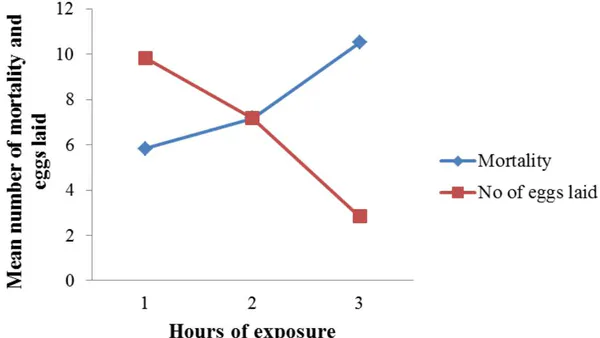
Results in Table 1 showed that solar radiation was effective against C. maculatus. Exposure to solar radiation significantly reduced the population of C. maculatus. Adults exposed to 3 hours of sun had the highest mortality value (10.50) while those exposed for 1 hour had the least value (5.83). There were no significant differences (P>0.005) in the mortality of adults exposed to radiation for 1 and 2 hours but there was a significant difference (P<0.05) in the mortality of C. maculatus exposed to solar radiation at 3 hours. Exposure to solar radiation significantly reduced the numbers of eggs laid by C. maculatus with the least number (2.82) of eggs laid by C. maculatus exposed for 3 hours and was significantly different (P<0.05) from those exposed to 1 and 2 hours of solar radiation (Table 1).
Highest number of seeds with eggs was obtained on C. maculatus exposed at 1 hour which was not significantly different (P>0.05) from that exposed at 2 hours. However, at 3 hours of exposure to solar radiation there was a significant difference (P<0.05). There were significant differences (P<0.005) in the number of seeds without eggs in Table 1. The least numbers of seeds without eggs was recorded were C. maculatus was exposed for an hour and was statistically different from those exposed for 2 and 3 hours. Fecundity of individuals C. maculatus was reduced by the exposure to solar radiation with the least number of eggs per female obtained when was exposed for 3 hours.
There was no significant difference (P>0.05) in the fecundity of C. maculatus at 1 and 2 hours of exposure to solar radiation while those exposed to solar radiation for 3 hours was significantly different (P<0.05) from those exposed for 1 and 2 hours.
| Treatments in Hour (s) | Mortality | No. of Eggs laid | No. of seeds with eggs | No. of seeds without eggs | Fecundity of individual |
| 1 | 5.83b | 9.83a | 13.50a | 7.50b | 1.87a |
| 2 | 7.17b | 7.17a | 4.17b | 16.83a | 1.33a |
| 3 | 10.50a | 2.83b | 1.17b | 19.83a | 0.15b |
The number of seeds with holes reduces with the hour of exposure to solar radiation. There were no significant differences (P>0.05) in the number of seeds with holes when cowpea seeds were exposed at 1 and 2 hours to solar radiation but significantly (P<0.05) least number (1.50) of seeds bearing holes was observed at 3 hours of exposure (Table 2). The numbers of seeds without holes increased with exposure time in Table 2. There was no significant difference in the numbers of seeds without holes of the cowpea exposed at 1 and 2 hours to solar radiation but significant difference (P<0.05) was indicated at 3 hours of exposure with highest number (7.17) of seeds without holes.
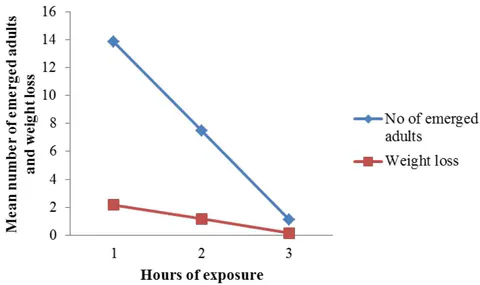
From table 2, the number of adult's C. maculatus that emerged was highest (13.83) at 1 hour of exposure compared with those of 2 and 3 hours. At 3 hours of exposure to solar radiation only an adult emerged and was significantly different (P<0.05) from values obtained at 1 and 2 hours of exposure. The weight loss occasioned by the C. maculatus infestation showed no significant difference (P>0.05) at 1 and 2 hours of exposure. However, the least value (0.15) weight loss obtained on seeds exposed to solar radiation for 3 hours was significantly different from the other times exposure (Table 2).
| Treatment (Hour(s)) | No of seed with holes | No of seeds without holes | No of emerged adults | Weight loss (g) |
| 1 | 5.50a | 1.83b | 13.83a | 2.18a |
| 2 | 3.83a | 5.50a | 7.50a | 1.18a |
| 3 | 1.50b | 7.17a | 1.12b | 0.15b |
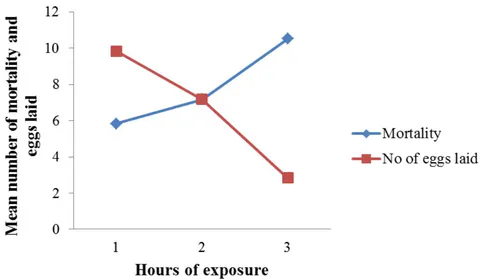
In figures 1 and 2, the trend of the effects of exposure time on the mortality, eggs laid, emerged adults and weight loss occasioned by the beetles was revealed. The mortality of the beetle increased with the increasing hour of exposure while the number of eggs that was laid decreased with the hour of exposure. However, both the number of emerged adults and weight loss decreased substantially with the increasing exposure time (Fig 2).
IV. DISCUSSION
The results obtained in this study revealed no significant differences in the weight loss of the cowpea but the mortality of C. maculatus was increased by the exposure to solar radiation. These results are consistent with those obtained by Sembene et al., (2006) on groundnut where the authors showed that under extreme temperatures over C, weight loss caused by Caryedon serratus was reduced. In another experiment, one hour of exposure to sun radiation in a device used by Murdock et al., (1991) was sufficient to kill all stages of C. serratus.
However, the sun exposure significantly reduced the level of infestation of seeds by C. maculatus with reduced number of eggs laid by adults exposed for 3 hours to sun radiation which was significantly lower than that deposited by adults with 1 hour and 2 hours of exposure. This low level of infestation of seeds by female C. maculatus, sun radiation can be explained by the behavior of these insects that prefer to hide under the seeds during the day time instead of laying (Doumma and Seyni, 2014). Furthermore, it appeared from the analysis of the egg laying, adults exposed to sun radiations, that this technique inhibits the hatching of deposited eggs leading to a higher high rate of abortions and affect larval development. The resulting effects of the radiations lead to an inhibition of the emergence of the offspring. (Doumma et al., 2006).
There was a decrease in insect emerging from seeds exposed to sun radiations. This reduction of emergence of larvae could be due to the intensity of the sun radiation that penetrated in the seeds. It could also be related to the difficulty encounter by the newly hatched larvae in penetrating the seeds either because of the heat or because of an increase in the hardness of seeds after the loss of their moisture content (Lale, and Vidal, 2003). This condition should naturally results in a significant reduction of the initial infestation rate of the seeds before storing them. Thus, sun radiations, by negatively influencing the growth parameters of C. maculatus appears to be an effective preventive measure of seeds store from cowpea beetles in general and C. maculatus in particular.
The results obtained in this study further explained the observations of (Doumma, 2007; Doumma and Seyni, 2014) which showed that exposure of cowpea pods to sun radiations for up to four weeks considerably limits the evolution of populations of beetles and their parasitoids. The study further shows the reduction in the fecundity rate of C. maculatus when exposed to sun radiation at different solar range. The effect of this method on the various biological parameters of C. maculatus is related to a reduction of water content of the seed (Doumma and Seyni, 2014).
According to Cruz (1988) when the water content of the seeds is very low, the eggs hatching is inhibited, and the larvae fail to develop. This method also promotes the departure of adult beetles that cannot tolerate extreme heat or intense sunlight (in stock, insects are often confined in darker areas).
V. CONCLUSION
Damage to cowpea seeds by C. maculatus during storage is widespread in Africa and constitutes a major constraint to food availability. Preservation of cowpea seeds to reduce losses due to bruchid's infestation is very important. Thus, in order to provide and make available the important dieting protein in cowpea seeds to the people in the tropics who depend on it, the reduction or prevention of C. maculatus damage to cowpea seeds meant for consumption and long storage by exposure to solar radiation of cowpeas can be adapted. Thus, solar radiation at 1 hour, 2 hours and 3 hours, were effective in causing mortality of cowpea bruchid and protecting cowpea seeds against C. maculatus.
Recommendation
This radiation method could be incorporated into the integrated management strategy of C. maculatus on stored cowpea.