
I. INTRODUCTION
Procurement in PSU (Public Sector Enterprises) is an important activity. It involves its stake holders like Government, its constituent departments, and other associated entities to execute their envisaged function effectively.
The whole process of getting the desired quality goods and services in an efficient and transparent manner on competitive terms including price. There are a number of critical elements to achieve the objectives. Specifications, demand forecasting, well advertised bidding along with timely culmination of the procurement process are notable among them. Lead Time (LT) is the amount of time taken from the initiation of the procurement process to its fructification. It is further divided into Internal Lead Time (ILT) and External Lead Time (ELT). ILT is the time taken from the demand generation till the placement of order to the vendor while ELT is the time taken from the placement of order till the receipt of material in the store. Longer lead time can potentially result in delay in provisioning of goods adversely affecting the service delivery. The managers need to stock a large amount of inventory to overcome long LT, increasing the carrying cost. Simultaneously, it negatively impacts the managers' capacity to respond quickly to demand fluctuations and urgent and unexpected requirements. Government of India launched Government e-Marketplace (GeM) on 9th August 2016 as a one-stop purchase platform offering an electronic procurement system to improve transparency and enhance speed of the procurement. Subsequently, the Government of India brought appropriate changes in the General Financial Rule (GFR) to facilitate procurement through the GeM platform. Keeping the aforementioned points in mind, a study of factors affecting lead time, the effect of newer intervention (GeM) on lead time and on the acceptance/rejection rate of the received goods are imperative to identify the bottlenecks and devise appropriate strategies accordingly.
Methodology In light of the above discussion, a prospective and observational study was designed to analyse the procurement process at a department level of Engineering Enterprise (BHEL Hyderabad) with more an annual budget outlay of approximately ₹4200 million. The focused study is in BHEL Hyderabad Pumps unit undertaking procurement of goods for the Assembly: In charge (Equipment Purchase) or PI (EP) dealing predominantly with purchase of equipment's. For study setting, the cases initiated by Central Stores and processed through Enterprises Purchase Division were considered to achieve the objectives of the study. The sample for the study were all the purchase files where the process was completed within the defined study period regardless of the time of process initiation were taken. It was found that 535 files were processed during the period of Q3 (Quater3) of financial period of FY23-24 were included in the study.
A prospective study design of the purchase files was undertaken to understand the factors associated with the study parameters i.e. lead time, acceptance/rejection and root cause analysis. For data collection, the conventional procurement process and procurement through GeM were studied in detail and compared. Time taken for the file to move at each step was noted along with the acceptance/rejection rate of the purchase done through both the platforms. The data was entered in a Master Sheet prepared in MS Excel format.
II. RESULTS
The purchase process at the Institute is guided by the rules and regulations formulated by Gol as contained in GFR. The purchase process under conventional method is grouped into two categories based upon whether competition is open or restricted: Tender/Quotation/Rate contract (RC) and Spot Purchase. The comparable purchase processes under GeM are Bidding and Direct purchase.
Table 1 depicts the distribution of files during the study period based on the purchase method adopted.
Table 1
| GEM Vs Traditional method Purchases evaluations | |||
| Purchase Platform | Number of Files | Percentage (%) | |
| GeM | 362 | 67.7 | |
| Conventional Methods | 173 | 32.3 | |
| Total (N) | 535 | 100 | |
| Purchase method adopted across platforms | |||
| GeM | Direct Purchase | 305 | 57.0 |
| Bidding | 57 | 10.7 | |
| Conventional Methods | Spot Purchase | 95 | 17.8 |
| Quotation | 43 | 8.0 | |
| Tender/RC | 35 | 6.5 | |
| Total (N) | 535 | 100 | |
| GeM (Direct Purchase) and Conventional Method (Spot Purchase) | 400 | 74.8 | |
| GeM (Bidding) and Conventional Methods (Quotation /Tender/RC) | 135 | 25.2 | |
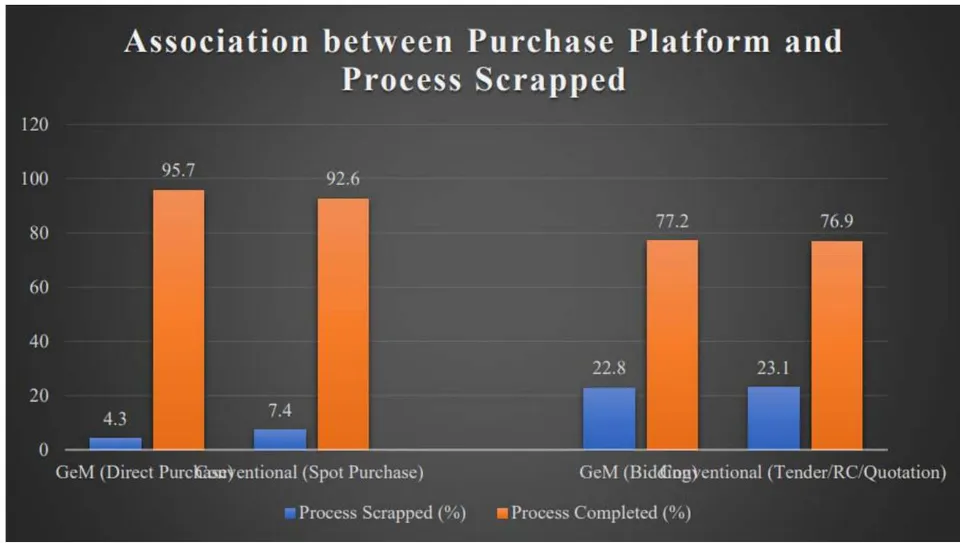
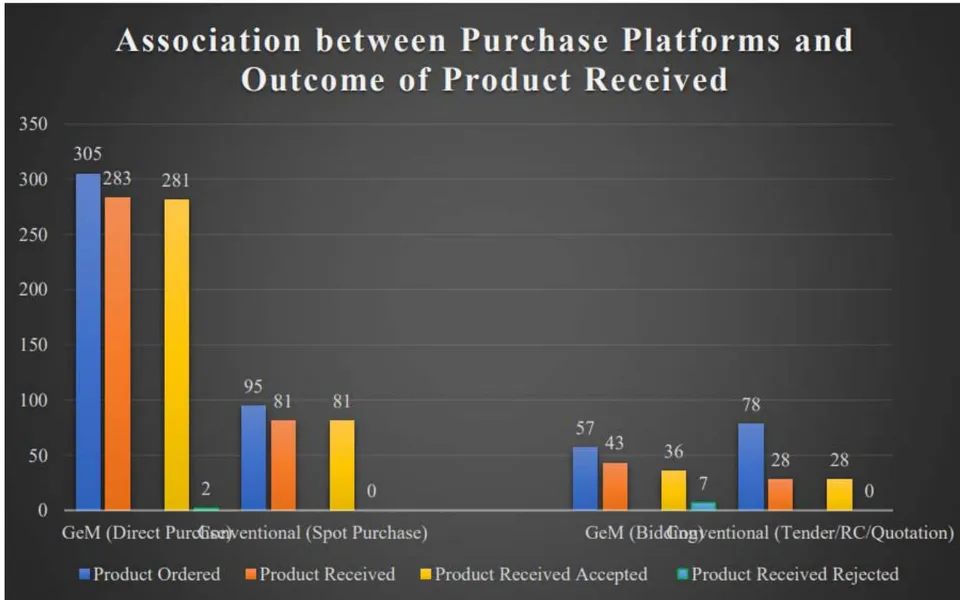
Table 2, represents the steps involved and the time taken at each step in making the purchases through GeM (Direct Purchase) v/s Conventional Method (Spot Purchase) and GeM (Bidding) v/s Conventional Methods (Quotation/Tender/RC). We used Median (IQR) for comparison as the data was not normally distributed and positively skewed due to some outlier values. Figure I depict in percentage where the purchase process was completed or scrapped for some reason. Fisher's exact test was used to explore the association between Purchase Platform and Scrapping of process in case of comparison between Gem (Direct Purchase) and Conventional Method (Spot Purchase) whereas Chi-Square test was applied to test the same while comparing Gem (Bidding) and Conventional Methods (Tender/RC/Quotation). The p value was 0.278 and 0.971 respectively suggesting no statistical difference (Figure 2). Figure 2 presents the number of products received following culmination of process on either platform adopting the purchase procedure described already. Fisher's exact test was used to explore the association between the purchase platform and the outcome of the product received. In the case of comparison between Gem (Direct Purchase) and Conventional method (Spot Purchase), no statistically significant difference was noted . However, in the case of comparison between Gem (Bidding) and Conventional methods (Quotation/Tender/RC), a statistically significant difference was noted . We did a Root Cause Analysis (RCA) of the factors for the time taken in each step. Figure 3 represents the various factors which were identified and thematically grouped.
| Purchase Platform | ||||||
| GeM (Bidding) (n = 57) | Convention al (Quotation/Tender/RC) (n = 78) | p value | GeM (Direct Purchase) (n = 305) | Convention al (Spot Purchase) (n = 95) | p value | |
| (n=135) | (n=400) | |||||
| Median (IQR) | Median (IQR) | Median (IQR) | Median (IQR) | |||
| From Purchase approval or I/C specific store to EPD | 1 (0.75-3) | 1 (0-3) | 0.6771 | 1 (1-2) | 1 (0-2) | 0.0591 |
| EPD approval to floating | 10 (1-63) | 9.5 (4-38.5) | 0.7021 | - | 2 (0-8.5) | - |
| Bidding time | 10 (10-10) | 21 (19.25-25.75) | <0.0011** | - | - | - |
| Opening of bid to Store | 3 (2-8) | 13 (5.5-31) | 0.0071*** | - | - | - |
| Store to User | 1 (0-3) | 0 (0-0.5) | 0.1061 | - | - | - |
| User department to Store | 3 (0-9.25) | 0 (0-5.5) | 0.3421 | - | - | - |
| Store to EPD after Technical evaluation | 3 (2-5) | 4 (2-7) | 0.4341 | - | - | - |
| EPD to Specific Store for Sample evaluation | - | 7 (4.25-10) | - | - | - | - |
| Store to User department for Sample | - | 3.5 (0-10) | - | - | - | - |
| User department to Store after sample | - | 12 (2.5-35) | - | - | - | - |
| Store to EPD after Sample evaluation | - | 5 (3-11) | - | - | - | - |
| EPD to Price bid | 5 (1-7) | 7 (3-16) | 0.0681 | - | - | - |
| Price bid opening to Store for comparative | - | 3 (1-4) | - | - | - | - |
| Vendor finalization by User department by making comparative | - | 2.5 (1-5.75) | - | - | 1 (0-2) | - |
| Vendor finalization to EPD | - | 1 (0-1) | - | - | 0 (0-1) | - |
| EPD to Accounts | 0.5 (0-1.5) | 6 (3-11.5) | 0.0011*** | - | 3 (2.25-4) | - |
| Accounts approval to EPD | 5 (0.5-7.5) | 9.5 (6-18) | 0.0371*** | - | 14.5 (10- | - |
| EPD to Supply order | 4.5 (2-10) | 6 (4-8.5) | 0.2491 | 10 (4-22) | 2 (2-6) | <0.0011 |
| Total Internal Lead | 82 (50-144) | 133 (88- | <0.0011** | 13 (6-26) | 13 (6-26) | 0.2381 |
| Total External Lead Time | 24 (13.25-31.75) | 42 (22-77) | 0.0021*** | 10 (5-19) | 13 (6-22) | 0.0311** |
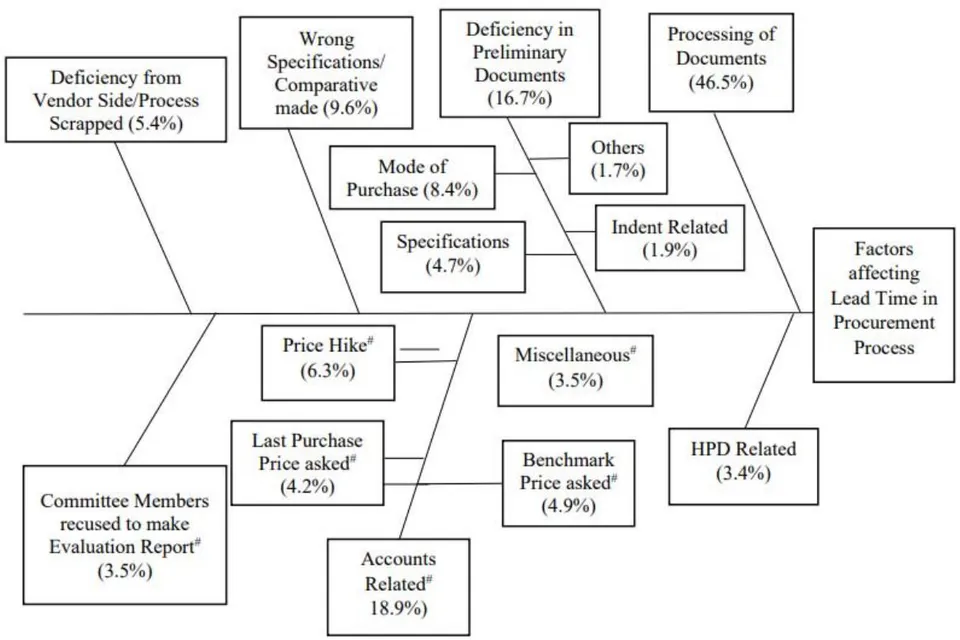
#In the case of Conventional Methods only.
(%) represents the percentage of files/cases (N=535) impacted by the factor/s identified in RCA.
III. BACKGROUND
Traditionally the government purchase process follows three pathways:
Local Purchase or Spot Purchase: A committee surveys the local market for quality and reasonable price and then obtain spot quotations.
Quotations: Quotations are invited from the interested parties through publication in suitable media via "notice inviting quotations (NIQ)".
Rate Contract/Tender: This process is adopted when the expected order amount is higher than the prescribed government threshold and/or where multiple reorders are expected and is publicized for prospective bidders by publication of "detailed notice inviting tender (DNIT)" in suitable media.
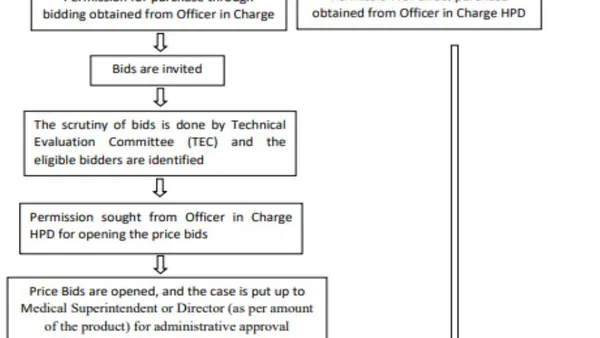
The aforementioned methods are labelled as "Conventional Methods" for the purpose of this study. A brief overview of such methods is summarized (Figure 4).

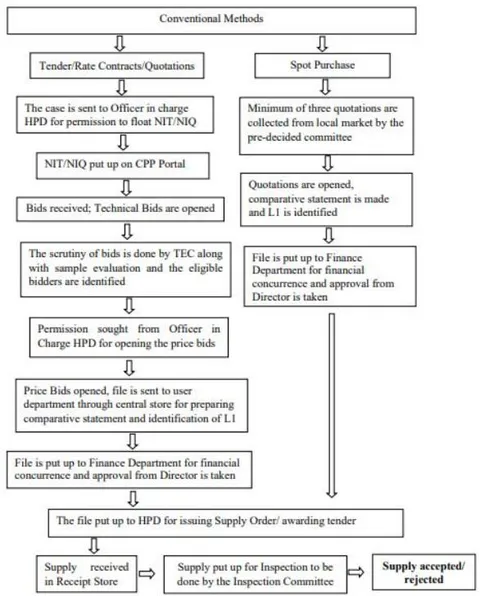
CPP Portal- Central Public Procurement Portal, TEC- Technical Evaluation Committee L1:- Lowest Bidder In the case of purchases through GeM, the procurement process is summarized in Figure 5.
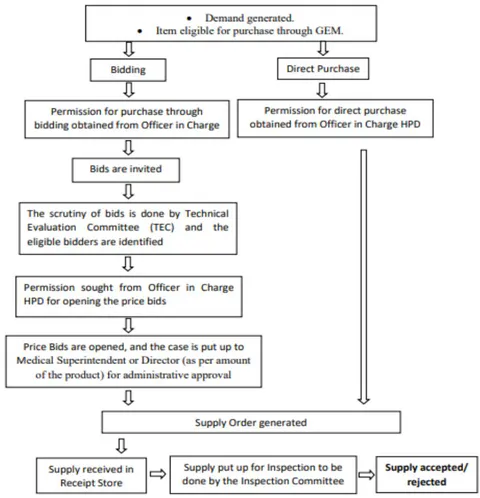
Internal lead time in bidding process: There is a significant difference in the available bidding time between GeM and conventional process (10 days v/s 21 days). The difference is inherent in the process itself and the institute or procuring agency has no role in it. However, it does impact the overall internal lead time. It is notable here that the difference persists even if the conventional bidding process is done through eprocurement method. Time taken to move a file from EPD (Engineering Purchase Division) to store for technical evaluation was significantly lower in GeM. In the conventional method, the required bid documents are submitted in the physical form (hard copy), which are then scrutinized before the file is sent to the store for analysis. In contrast, in GeM (Bidding), the need for physical submission is omitted as only an authorization certificate is uploaded by the bidding vendor on the GeM platform itself.
Additionally, in the case of the GeM platform, clarifications are made on platform itself or digitally, while postal means are used in the conventional method. At the time of study, there was no provision to call for samples while purchasing through GeM shortening the evaluation process. On the contrary, under conventional purchase, samples are submitted along with bids and in case of equipment there is a provision of demonstration of quoted product. This invariably increases the evaluation period. However, as of now, provision of sample submission is available on GeM platform.
In BHEL, all the purchase cases worth more than ₹ 100,000 are routed through Accounts department before issuing purchase order. This is an additional check akin to a concurrent audit (scrutinize the papers, allocation of funds, examination of price reasonability) to ensure that the process followed does not suffer from any infirmity. It took 6 (3-11.5) days for the file to move from EPD (Engineering Purchase Division) to Accounts Department for approval, and it took another 9.5 (6-18) days for the file to return to the EPD (Engineering Purchase Division) after financial approval.
On the contrary, when the cases are processed through GeM, only administrative approval is taken reducing the ILT. The total ILT in the case of conventional methods (Quotations/Tender/RC) was 133 (88-177.5) days, which was significantly higher than in the case of GeM bidding [82 (50-144) days], due to the different inherent steps for each process, as outlined above. The total Internal lead time (ILT) in Direct Purchase/Spot Purchase across GeM (Direct Purchase) and conventional method (Spot Purchase) was same, i.e., 13(6-26) days despite a lesser number of steps in making a purchase through GeM. External lead time (ELT) was found to be significantly lower in procurement through GeM under both the methods i.e. direct purchase as well as bidding. In the case of Scrapped cases, of purchase cases processed through GeM (Direct Purchase) and through conventional method (Spot Purchase) were scrapped at some stage of the process. Correspondingly of purchases cases routed through GeM (Bidding) were scrapped compared to through conventional methods (Quotations/Tender/RC).
The reasons for the scrapping of cases included, among others could be due to:
Clerical Errors: Ambiguity between product specification as uploaded on the GeM platform and as approved by appropriate authority, quotations getting misplaced;
Un Healthy Competition: Only one vendor participated in the bidding;
Omissions At The End Of Bidder: Wrong calculations of price, failure of the vendor to rectify the grounds on which the bid was rejected within the stipulated time, failure of the vendor to fulfill the order accepted and;
Administrative Reasons: Amendment in the original specifications, lack of technically compliant bidder. In the case of Acceptance/Rejection, one in five products ordered from GeM (Bidding) were rejected during inspection after receipt in the stores.
On the contrary all the products received after purchase through conventional methods (Spot Purchase, Quotation/Tender/RC) were accepted. This may be on account of the fact that a step of sample evaluation is in built, and only those products which meet the sample evaluation criterion qualify for opening of financial bids. Therefore, the chances of rejection of supply reduce to a great extent. However, sample evaluation has been incorporated under GeM as of now which should minimise rejection of the products.
Recommendation of this article suggests that longer ILT in conventional process is amenable to corrective actions. Therefore for in the recommendation several points are enlisted:
A timeline should be defined for processing of each file, and strict adherence to the same must be ensured. A software may be developed to track the progress of the file which should give a prompt /pickup reminder to the concerned person regarding the lapse of the timeline under intimation to the subsequent higher authority.
Each file should be accompanied by a checklist from its initiation to avoid deficiency in the documentation.
All the communications to and from the intending vendors should be done electronically instead of communicating through traditional (postal) means.
Fixed timelines should be established for the prospective vendors to complete the documentation and the prospective vendors who do not comply with the timelines need to be out rightly rejected.
The organization may formulate a policy to publish the NIT/NIQ on fixed dates of the month so that user departments and prospective vendors are aware of the relevant dates for the procurement process. Taking into consideration the limitations of the study, External Lead Time was found to be shorter in purchases made through GeM compared to the conventional method. The inferences in the study are drawn from experiences at a single organization, albeit a fairly large one. However, since processes are standardized across all organizations, the findings should resonate with other organizations as well. During the study period, there was no provision for sample evaluation for purchases made through the GeM platform, which led to the rejection and return of certain products. However, the process of sample evaluation has now been introduced in the newer version of GeM.
IV. STUDY FINDINGS
Government-e-Marketplace was introduced to improve the procurement process in publicsector. However, purchases in the Enterprises and Engineering sector add additional complexities simply on account of direct impact on project delivery. The concept is relatively young and evolving. The challenges faced by stakeholders and their feedback is important to improve the public procurement. Internal Lead Time using the conventional methods (Quotations/Tender/RC) was higher than GeM (Bidding). The leading cause for the increased ILT was time taken for the processing of documents. E-procurement is one probable solution to reduce the ILT but it has not yielded the desired result since the subsequent steps after inviting the bids remain more or less the same. GeM due to its inherent mechanism of processing the case has reduced the ILT. However, it compromises on certain checks and balances available in conventional methods to achieve this. This is reflected in the higher rejection rate of received products. As of now, GeM has tried to address some of these issues, but it remains to be seen whether this adversely affects the ILT or not. The procurement process for public entities should ensure efficiency, economy, and accountability in the system. Both the procurement platforms, i.e., Conventional Methods and GeM, have their unique set of advantages and disadvantages. The advent of GeM should not make the conventional methods irrelevant. Instead, both should feed on each other to improve the procurement process to the satisfaction of all the stakeholders.