
I. INTRODUCTION
In the recent times, tinnitus has become more rampant in the modern world, especially among the elderly with civilized and cosmopolitan background. It is an observed condition in which people experience different kinds of auditory sensation without any external stimulation. This health-related condition is more prevalent among those with stress-related or psychosocial health challenges. Tinnitus, as a health-related condition, can be described as an evidence of perception of noise or ringing in the ear/head without external influence or generation (propagation) of sound signals (Osisanya, 2019). According to Wang and Ho (2019), tinnitus is more like a civilized disease in most countries of the world, due to people's lifestyles which become more and more stressful, as stress is one of the risk factors and a psychological symptom of tinnitus. Also, tinnitus may be connected to ageing, auditory pathway, hearing loss, psychological issues, and loud sounds, because such exposure to noise could be a high-risk factor of tinnitus experience. Thus, tinnitus could negatively affect the communication skills, quality of life, and social life of any individual with such a condition (Wang and Ho, 2019).
Tinnitus is regarded as the sensation of hearing kind(s) such as ringing, buzzing, hissing, chirping, whistling or other sounds without external sound signal. It is rather a symptom of underlying condition(s) such as age-related hearing loss, drug-related conditions, high blood pressure, ear injury, evidence of accumulated ear wax, cardiovascular disorders or metabolic disorder and/or a circulatory system disorder (Osisanya, Ojetoyinbo and Olatunde, 2014). In some cases, tinnitus might be as a result of infections or blockages in the ear. Once the underlying cause has been treated in some cases, symptoms of tinnitus may completely be eradicated. Another prominent cause of tinnitus is long-term exposure to noise. People who work in construction sites, markets and other places with at least an average of 70dB are at higher risk of tinnitus. Vangerwua (2019) noted that the noise heard in the affected person's ear creates a vicious cycle of anxiety and increase in discomfort. The condition can also be unilateral or bilateral depending on the site of lesion as well as the causative factor. Moller (2006) defined tinnitus as the perception of meaningless sounds without any sound reaching the ear from outside or inside the body. The sound heard by tinnitus patients is different from the regular physical noise and there are indications that the noise perceived has to do with perception of "self" (Jastreboff, 1990; Møller, 2011). The sound often varies and fluctuates from time to time. In this regard, Møller (2011) noted that severe tinnitus can be accompanied by lowered tolerance of sounds (hyperacusis), while it is also associated with other conditions such as emotional distress, perception of pain among other psychosocial issues. Tinnitus is associated with a number of medical conditions such as presbycusis, meniere disease, otosclerosis, head trauma, acoustic neuroma, middle ear effusion, temporomandibular joint problems, hyperlidemia, meningitis, syphilis (Nodar, 1996).
National Institute of Health (2017) stated that sometimes tinnitus can be the first sign of hearing loss in elderly persons. In the United States, there is 19% incidence of tinnitus, with severity of condition usually increasing with age; only 1% of these patients below the age of 45 years experience tinnitus, and there are about 12% within the ages of 60 to 69 years of age and 25 to 30% in those who are 70 years and above (Borghi, Cosentino, Rinaldi, Brandloni, Rimondi, et. al. 2011). Another study also noted that the prevalence of tinnitus increases with age which also reported 5.7% of tinnitus within age of 17 to 30 years and 16% at ages 61 to 71 years. Overall, the National Institute on Deafness and Communication Disorders (NIDCD) as cited by Basaraba (2020) reports that about 10% of the total adult population in United States have some form of tinnitus. The prevalence is also similar in Nigeria as there are about 15.1% persons with tinnitus in the country (Adoga, Adoga and Obindo, 2008). In another research carried out by Adegbenro, Amusa, Ijadunola and Adeyemo (2013), a prevalence of 6.1% was reported and it was also found out that tinnitus was mostly prevalent in adults within age 45 and above as they had 14.3% incidence rate. In older persons, the most likely causes of tinnitus include high blood pressure, cumulative damage from loud noise, or reaction to medication (Negrilla-Mezei, Enache, and Sarafoleanu, 2011). Tinnitus sounds can be high-pitched, low-pitched, soft, loud, intermittent or constant. Therefore, it ranges from high pitch to low pitch with multiple tones or sounds without tonal quality, but it may be perceived as pulsed, intermittent or continuous noise. Often, this debilitating condition begins suddenly or gradually, as well as being sensed in one ear (or both ears) or in the head (Osisanya, 2019).
According to Han, Lee, Kim, Lim and Shin (2009), the manifestations of tinnitus are usually unrelated to any type or severity of any associated hearing impairment and most tinnitus patients match their tinnitus to a pitch above 3 kHz (Baguley, Williamson and Moffat, 2006) while those tinnitus patients with comorbid meniere's disease describe their sounds as matching a low-frequency tone that is usually 125 to 250 Hz (Douek and Reid, 1968; Han, Lee, Kim, Lim and Shin, 2009). About 90 percent of people with tinnitus also have hearing loss, which usually goes unnoticed until when it is diagnosed. While most people who have hearing loss do have tinnitus, only 30 percent of people with hearing loss have tinnitus (Ehrenfeld, 2019). Increased and prolonged noises have the capacity of damaging the hair cells in the cochlea as well as the nerve carrying information to the brain. Research has shown that it is the absence of audiological input from the brain which results in the hearing nerves between the inner ear and the brain to send signals intermittently to the brain which are misinterpreted as sounds. Similarly, age has a great impact on tinnitus diagnosis. Davis and Davis (2009) observed that mild hearing loss increases from 1 to 3 for persons within the age of 55 to 64 years; for those under the age 45 year there is not much impairment asides for mild hearing loss at 20 to 34 dB HL. Higher tinnitus distress increases with old age as the brain structure, function and plasticity are changing with age in a complex way (Goh and Park, 2009; Vangerwua, 2019).
American Tinnitus Association (2020) noted that sensorineural hearing loss is commonly associated with tinnitus. In a study carried out by Tan, Lecluyse, Mcferran and Meddis (2013), persons with tinnitus had worst indicators compared to the non-impaired group. The tinnitus group had lower absolute thresholds, greater residual compression and better tuning than the non-impaired group while the pattern of threshold of the tinnitus was predominantly that of high frequency loss. In a study carried out in Germany, as the data collected from 2838 patients with tinnitus revealed that the patients hearing pattern ranged from mild to moderate bilateral high frequency hearing loss at 4kHz, 50dB hearing loss above 4kHz to severe hearing loss across all frequencies (Langguth, Landgrebe, Schlee, Schecklemann, Vielsmeier, et. al, 2017). In the latter study, high frequency hearing loss is predominant among patients with tinnitus.
Currently, there is yet to be any universally accepted management technique(s) for complete eradication of tinnitus, although sound and relaxation therapies coupled with counseling have shown tremendous result in the management and reduction in the effect of tinnitus (Vangerwua, 2019; Basaraba, 2020). In a research conducted by Engineer, Riley, Seale, Vrana, Shetake, et. al (2011) as cited by Basaraba (2020), it was reported that the study was able to eliminate tinnitus in rats using a technique called Vagus Nerve Stimulation (VNS). This technique involves stimulating the Vagus Nerve in the neck of rats suffering from noise-induced tinnitus, and simultaneously playing paired-sounds at specific frequencies, in order to reconfigure the rats' brains to respond appropriately to all audible frequencies. Four (4) years later, a similar technique was used by the same team on a 59-year old man suffering from tinnitus, and 4 weeks of daily VNS therapy was employed, and with this technique, the man's tinnitus condition became rehabilitated. The findings of this study have prompted other kinds of research across the globe and the world awaits an expected outcome or a breakthrough in the management as well as in the act of rehabilitation of patients with tinnitus.
In the United Kingdom, it is estimated that there are about 4.7 million persons suffering from tinnitus with about 5% of this population having experienced persistent disorder which has reduced their quality of life (Brunger, 2008; Scott and Lindberg, 2000; Borghi, et al., 2011). Psychological disorders are among common comorbid conditions of tinnitus, as a high prevalence of anxiety and depression is reported among those who are diagnosed with the condition (Zoger, Svedlund and Holgers, 2006; Falkenberg and Wie, 2012). Folmer, Griest and Martin (2001), Wilson and Henry (2001), Sweetow (2000), and Falkenberg and Wie (2012) have demonstrated that consequences of chronic pain and tinnitus are similar, as emotional effects, reduced work performance, interpersonal problems, and decreased opportunities to previously enjoyed activities. The psychosocial reactions to tinnitus are so common that the majority of the therapies which have become prominent and grown to be accepted usually infuse psychotherapy techniques so as to solve the comorbid psychological issues. A considerable number of tinnitus patients usually relate tinnitus to significant changes in their lives ranging from divorce, being laid off, sickness in the family, accidents or having surgery (Falkenberg, Tungland and Skollerud, 2003).
Data regarding the psychosocial reactions to tinnitus vary across the globe. Findings from the research work of Zoger, Svedlund and Holgers (2006) show that 10 to 70% suffer from depressive disorder and 28 to 49% have anxiety symptoms while another study (Sullivan, Katon, Dobie, Sakai, Russo and Harrop-Griffiths, 1988) shows that 47 to 78% of the patients with chronic tinnitus met the criteria for one or more psychiatric disorders. Sleep disturbance is another condition which has been noticed among a considerable number of persons with tinnitus which might lead to distress in daily life and social function (Sanchez and Stephens, 1997; Jang and Yi, 2016). In a similar vein, Sweetow, Fehl and Ramos (2015) stated that the major components of tinnitus distress include auditory, attention and emotional challenges. Reports from studies such as the one above have shown that tinnitus patients are confronted with myriads of problems. Based on this, people with this kind of condition need to be educated on how to take care of their health and psycho-social issues occasioned by the condition, so as to avoid suffering from ringing in the ear as well as other psychological problems in their old age. Most times, people suffering from tinnitus go through tough time as a result of associated psychosocial, emotional and behavioural problems such as severe headache, negative thoughts, dizziness, hearing problem, anxiety, irritation, annoyance, concentration problem, sleep difficulties, depression and poor attention focus (Osisanya, Ojetoyinbo and Olatunde, 2014). Tinnitus is perceived differently and makes the individual to react to it differently. Consequently, it has been observed that a person suffering from tinnitus may not be aware of it and may not feel any discomfort occasioned by the affliction, while another person suffering from tinnitus is constantly aware of the difficulty in attention focus, falling asleep, and enjoying life. It is on this premise that this study investigated the effect of tinnitus on the auditory performance and the attendant psycho-social reactions of elderly individuals with tinnitus in Southwestern, Nigeria. In line with the objectives of the study, the hearing profile as well as the psycho-social feelings of the elderly were determined.
II. PURPOSE OF THE STUDY
The main purpose of this study is to assess the hearing profile and psychosocial reactions of elderly individuals with tinnitus in Southwestern, Nigeria.
III. RESEARCH QUESTIONS
The following questions were raised to guide the study:
What is the prevalence of elderly individuals with tinnitus in Southwestern Nigeria?
What is the hearing profile (types, degrees and pattern) of elderly individuals with tinnitus in Southwestern, Nigeria?
What are the psychosocial reactions of elderly individuals with tinnitus in Southwestern, Nigeria?
IV. METHODOLOGY
The study adopted ex-post facto research design since the researcher only assessed the existing variables. Multi-stage sampling technique was used to select 240 participants from each of the sampled four Southwestern States (Lagos, Ogun, Oyo, and Osun) of Nigeria, totaling 960 participants. Purposive sampling technique was used in selecting the tinnitus treatment centres that were utilized in the study, while random sampling technique was used in the selection of participants.
V. PROCEDURE FOR DATA COLLECTION
The researcher and three research assistants who have been recruited for the study visited all the treatment centres for people with tinnitus in the four Southwestern States of Nigeria. The visit was paid before the commencement of the study so as to sensitise and solicit the cooperation of both the health workers and the prospective participants. Afterwards, ethical approval was obtained from the tinnitus treatment centres in each of the four states. At the commencement of the study, a total number of 1020 suspected participants receiving different kinds of treatments based on the tinnitus condition in the four states were nominated by the health workers. Then, these suspected participants were screened in phases using both objective and subjective assessment to determine their qualification for participation in the study. In the first phase, the participants were subjected to otoscopic examination to rule out outer-ear related disorders or problems while a routine pure-tone audiometry was conducted to examine the hearing perception of the suspected participants. Eventually, 60 suspected participants were screened out for not meeting the inclusion criteria, and the remaining 960 participants were screened using Tinnitus Reaction Questionnaire (TRQ) and Tinnitus Handicap
Questionnaires (THQ), while MOS SF- 36 Health Survey was employed to investigate the perceived psycho-social reactions of the participants. All the participants were subjected to diagnostic auditory assessment via Puretone audiometric procedure to determine their nature of auditory performance as well as the types, degrees and patterns of hearing loss that might be associated their tinnitus experience in Southwestern, Nigeria.
a) Inclusion Criteria
Participants involved in this study must be:
- Persons identified with tinnitus and comorbid hearing loss.
2. Persons with tinnitus within the age of 50 and above
- Persons with tinnitus with a duration over 6 months.
b) Research Instruments
Data for the study were collected using the following instruments:
1. Tinnitus Reaction Questionnaire (TRQ)
2. Tinnitus Handicap Questionnaire (THQ)
3. MOS SF- 36 Health Survey
4. Otoscope
5. Maico 53 Diagnostic Audiometer
Answering Research Questions
- What is the prevalence of tinnitus in elderly individuals?
| Variables | Frequency | Percentage |
| Gender | ||
| Male | 520 | 54.2% |
| Female | 440 | 45.8% |
| Total | 960 | 100% |
| Variables | Frequency | Percentage |
| Age | ||
| 50-60 | 418 | 43.5% |
| 70 and above | 542 | 56.5% |
| Total | 960 | 100% |
Table 1 reveals that 520 (54.2%) of the participants were males while the remaining 440 (45.8%) were females. This implies that there were more male participants with tinnitus than their female counterparts in Southwestern, Nigeria. Also, 418(43.5%) of the participants were within the age range of 50 to 60 years, while the remaining 542(56.5%) were above 70 years of age. This indicates that elderly with tinnitus who were above 70 years of age dominated the study, and that tinnitus experience was more prevalent among the age group compared to other age groups.
- What is the hearing profile (types, degrees and pattern) of elderly individuals with tinnitus in Southwestern, Nigeria?
| Variables | Frequency | Percentage |
| Conductive hearing loss | 208 | 22 |
| Sensorineural hearing loss | 680 | 71 |
| Mixed hearing loss | 72 | 7 |
| Total | 960 | 100 |
| Degrees of hearing loss | ||
| Variables | Frequency | Percentage |
| Mild | 86 | 9 |
| Moderate | 226 | 23 |
| Moderately-severe | 436 | 45 |
| Severe | 212 | 28 |
| Total | 960 | 100 |
| Variables | Frequency | Percentage |
| Patterns of Hearing loss | ||
| Variables | Frequency | Percentage |
| Flat | 96 | 10 |
| Sloping | 88 | 9 |
| Rising | 116 | 12 |
| NIHL | 288 | 30 |
| U shape | 36 | 4 |
| High Frequency | 336 | 35 |
| Total | 960 | 100 |
Table 2 shows the hearing profile of elderly individuals with tinnitus in Southwestern, Nigeria. The type of hearing loss of the participants varied, 208 (22.0%) had conductive hearing loss, 608 (71.0%) had sensorineural hearing loss, which is the largest group, while 72 (7.0%) were diagnosed as having mixed hearing loss. As regards the degree of hearing loss of the participants, 86(9.0%) were with mild hearing loss, 226 (23.0%) present with moderate hearing loss, 436 (45.0%) with moderately severe hearing loss and 212 (28.0%) with severe hearing loss. Also, 96(10.0%) were with flat hearing pattern, 88(9.0%) present with sloping hearing pattern, 116 (12.0%) with a rising hearing pattern, 288 (30.0%) diagnosed with noise induced hearing loss, 36 (4.0%) having a U-shaped audiometry hearing pattern, and 336 (35.0%) having high frequency pattern. All the participants had reduced hearing perception, however those findings from the study
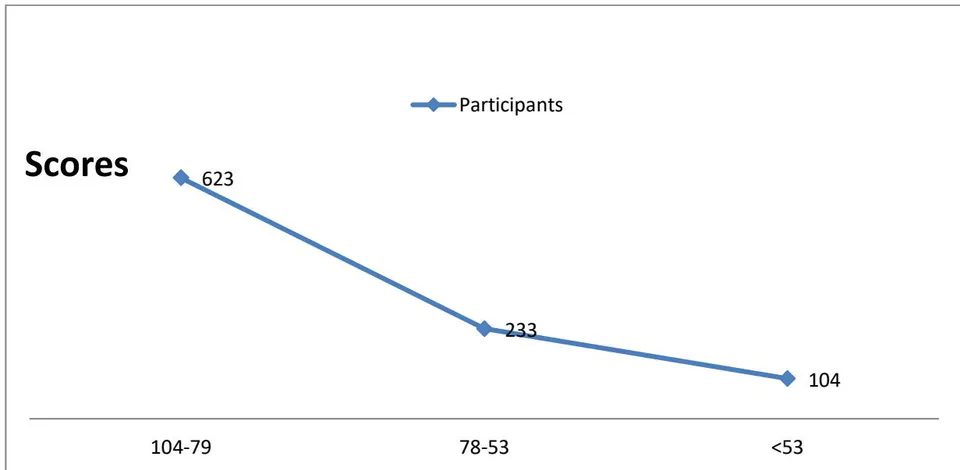
Figure 1 explains the reactions of elderly individuals with tinnitus in Southwestern, Nigeria. The figure shows that 623 (64.9%) participants scored between 104 to 79 on the tinnitus reaction questionnaire, closely followed by 223(24.3%) participants within the range of 78 to 53. The remaining had of less than 53. While, 104 (10.8%) participants had below average level of distress. Thus, in line with the rating of the scale, the higher the score the higher the level of distress. Therefore, those who were within the range of 104 and 79 score exhibited the highest level of distress, followed by those within the range of 78 and 53, while those who scored less than 53 exhibited the lowest level of distress.
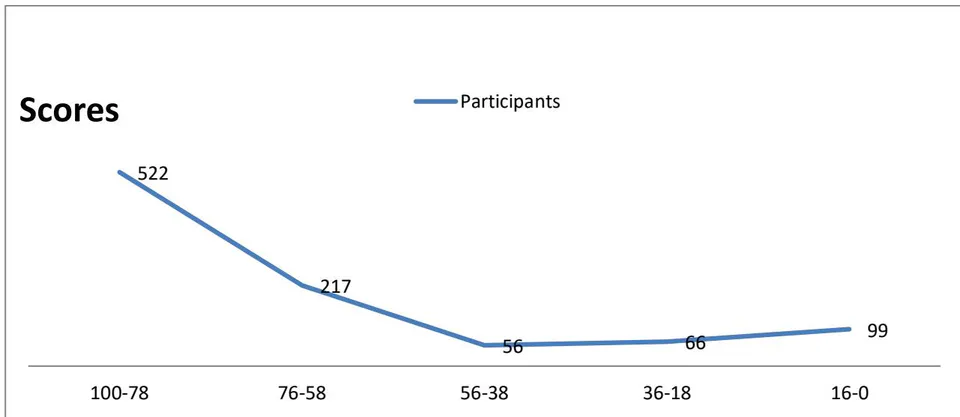
Result in figure 2 shows that 522 (54.4%) participants had catastrophic psycho-social reactions (psycho-social handicap) as a result of their continuous tinnitus experience, 217 (22.6%) exhibited severe psycho-social handicapping condition resulting from tinnitus, 56 (5.8%) present with moderate psycho-social handicapping reactions occasioned by tinnitus, 66 (6.9%) exhibited a kind of mild psycho-social handicapping reaction, while 99 (10.3%) exhibited slight psycho-social handicapping reactions resulting from tinnitus. Also, the result in figure 2 has shown that 522 of the participants, which is the category of the majority of the sampled always experience tremendous trouble or debilitating associated conditions due to their continued tinnitus experience. Thus, tinnitus has been confirmed as a condition capable of affecting the psycho-social life of elderly with tinnitus.
| S/N | Variables | Yes | Sometimes | No |
| 1 | Because of your tinnitus, is it difficult for you to concentrate? | 734 | 67 | 159 |
| 76.5% | 7% | 16.5% | ||
| 2 | Does your tinnitus interfere with your ability to enjoy social activities? | 670 | 67 | 223 |
| 69.8% | 7% | 23.2% | ||
| 3 | Do you feel that your tinnitus problem has placed stress on your relationships with members of your family and friends? | 780 | 89 | 91 |
| 81.2% | 9.3% | 9.5% | ||
| 4 | Does tinnitus make it difficult for you to enjoy life? | 500 | 45 | 415 |
| 52.1% | 4.7% | 43.2% | ||
| 5 | Does tinnitus make you feel desperate? | 820 | 23 | 117 |
| 85.4% | 2.4% | 12.2% | ||
| 6 | Does tinnitus interfere with your household responsibilities? | 773 | 45 | 142 |
| 80.5% | 4.7% | 14.8% | ||
| 8 | Because of your tinnitus, do you feel depressed? | 560 | 23. | 377 |
| 58.3% | 2.4% | 39.3% |
Table 3 reveals that 734 (76.5%) of the participants find it difficult to concentrate due to their continued tinnitus experience, 67(7.0%) of the participants claimed that they occasionally find it difficult to concentrate as a result of tinnitus, while 159 (16.5%) expressed that they do not experience any difficulty concentrating, even with their tinnitus experience. Similarly, 670 (69.8%) of the participants reported that they do not enjoy social activities due to tinnitus, 67 (7.0%) expressed that tinnitus always interfere with their social activities (deprived them to enjoy social activities) from time to time, while 232 (23.2%) claimed that they continue to enjoy social activities without any interference, regardless of their tinnitus condition. In response to the question 'do you feel that your tinnitus problem has placed stress on your relationships with members of your family and friends?' 780 (81.2%) answered yes, to indicate that their tinnitus condition has placed stress and difficulty on their relationship with family and friends, 89(9.3%) remarked that tinnitus sometimes affects their relationship with family and friends. While, 91 (9.5%) claimed that tinnitus does not. Tinnitus makes it difficult for 500(52.1%) to enjoy life, 415 (43.2%) claimed not to be fazed by their tinnitus, while 45(4.7%) sometimes enjoy life. 820 (85.4%) participants feel desperate as a result of tinnitus, 117 (12.2%) do not and 45(4.7%) occasionally feel desperate. Finally, 560 (58.6%) feel depressed as a result of tinnitus, 23(2.4%) sometimes feel depressed while 377(39.3%) do not experience such a feeling. The implication of this is that elderly individuals with tinnitus experience varying psycho-social reactions.
VI. DISCUSSION OF FINDINGS
a) Prevalence of Tinnitus in Elderly Individuals
The findings of the study revealed that 520 (54.2%) of the participants were males while the remaining 440 (45.8%) were females, implying that male participants dominated elderly individuals with tinnitus in Southwestern Nigeria. This is in line with the findings of McCormack, Edmondson-Jones, Fortnum, Dawes, Middleton et al (2014) where it was reported that prevalence of tinnitus is significantly higher in males compared to females. Those within the ages of 50 to 60 had lower prevalence of tinnitus compared to those within 61 years and above. The finding of this study also corroborates that of McCormack et. al (2014), which showed higher risk and prevalence of tinnitus as age increases. The finding of this study however negates Teixeira, Rosito, Gonçalves, Nunes, Dornelles and Olchik's (2017) as they reported in their own study that 72.2% of elderly individuals with tinnitus were women. The result of this study might be due to long-term exposure to industrial noise, which the majority of the male gender are exposed to, as well as the various health and psychological challenges which men within the geographical scope of this study are prone to, due to cultural and societal expectations.
b) Hearing Profile (Types, Degrees and Pattern) of Elderly Individuals
The report of this study showed that 608 (71%) had sensorineural hearing loss, 436 (45) with moderately severe hearing loss and 212 (28) with severe hearing loss and 116 (12%) with a rising hearing pattern, 288 (30%) diagnosed with noise-induced hearing loss, 36 (4%) having a U-shaped audiometry hearing pattern, and 336 (35%) having high frequency pattern. The result corroborates the finding of Seimetz, Teixeira, Rosito, Flores, Pappen, and Dall'igna (2016) who discovered that presbycusis individuals with tinnitus had a pitch of 6 kHz and 8 kHz indicating a higher prevalence of high frequency hearing loss among tinnitus patients. The study found no correlation between the hearing loss of the participants and the pitch of hearing loss. The majority of the participants (436 (45%) with moderately severe hearing loss and 212 (28%) with severe hearing loss were diagnosed with reduced hearing perception. The result of this study is also in agreement with that of Haider, Flook, Aparacio, Ribeiro, Marilla, Szczepek (2017) in which noise-induced hearing loss was reported as a major trigger for their tinnitus. The majority of the participants in the study of Haider et al. (2017) were also diagnosed with high frequency loss.
c) Psycho-social Reactions of Elderly Individuals with Tinnitus in Southwestern, Nigeria
The result of findings showed that 560(58.3%) felt depressed as a result of their tinnitus. The finding of this study is in tandem with that of Huang and Tang (2010) which reported that tinnitus interferes with the quality of life of elderly individuals with tinnitus. The result of this finding also corroborates that of Haider, et al (2017), which found out that the tinnitus participants assessed had varying levels of handicaps on the Tinnitus Handicap Inventory (THI) and only 10(25%) had slight or no level of handicap. Negrila-mezei, Enache, and Sarafoleanu (2011) also supported the claim that elderly individuals with tinnitus had significant negative perception of their overall health and poor quality of life. Findings from this study further showed that elderly individuals with tinnitus find it difficult to enjoy life as they cannot concentrate and feel desperate from time to time.
VII. CONCLUSION
The study was carried out to examine psycho-social reaction and hearing profile of elderly tinnitus in Southwestern Nigeria. The study observed that a predominantly high frequency hearing diagnosis among the respondents hence supporting the findings of similar research. The study also established that tinnitus impacts the hearing perception of the affected person as the findings revealed decline in the hearing ability of the respondents. The study concluded that elderly individuals with tinnitus experience bouts of psychosocial reaction to their condition hence necessitating the need for tinnitus therapy coupled with counseling.
VIII. RECOMMENDATIONS
Based on the findings of this study, the following are recommended:
There is need for training, awareness, orientation, reorientation and sensitization of the general public about risk factors for tinnitus while encouraging regular hearing assessment for the purpose of quickly nipping in the bud of hearing-related disorders which are likely to result in tinnitus.
Counselling programmes should be infused into the management techniques for tinnitus so as to deal with the comorbid psychological problems.
Noise pollution policies should be enacted so as to protect the auditory function and psychological well-being of elderly individuals with tinnitus.