I. INTRODUCTION
Soil management concerns all operations, practices and treatments used to protect soil and enhance its performance (Wikipedia). They are practices that affect soil quality which includes controlling traffic on soil surface, the use of cover crop, crop rotation, nutrient management and conservation tillage. The goal of soil management is to protect soil and enhance its performance, to farm profitably and preserve environmental quality for decades to come. This implies, the management of agricultural soils would maintain the soils productivity in an ecologically, economically and culturally sustainable system of soil management. Bationo, Traore, Kimetu, Bagayoko, Kihara, Bado, Lompo, Tabo, and Koala. (2004). According to Rahji and Omotesho, (2006), the main issue in the Nigerian agriculture is that of low productivity. The greatest threat to sustaining agricultural productivity in the Nigerian farming communities is the declining productivity of soil caused by the loss of soil fertility through the erosion of top-soil brought about by inappropriate land use practices and the loss of soil water content, soil structure and porosity due to persistent laterisation of the top soil as a result of continuous exposure to sun by man and animals (Aromolaran,1998).
Soil is the most important resource required for agricultural production (Khanif, 2010). The most important constraint limiting crop yield in developing nations, and especially among resource poor farmers, is declining soil fertility (Khosro and Yousef, 2012). Soil fertility is declining in many parts of Sub-Saharan Africa (Stoorvogel, Smaling, and Janssen., 1993). Soil fertility is declining throughout the country primarily due to reduction in the length of fallow periods, lower levels of fertilizer application, complete removal of crop residues from fields, use of dung as a household fuel, and lack of adequate soil conservation practices (Eyasu, 2002). As a result, there is a growing concern that fertility depletion will seriously limit food security and sustainable agricultural production in Ethiopia (Shiferaw and Holden 2000; Bewket and Sterk, 2002).
One of the most severe threats to the sustainability of agricultural crops production in Nigeria is declining productivity as a result of the loss of soil fertility. Soils in Nigeria suffer deficiency common to the soils in the tropic such as a low percentage organic matter and nitrogen, shallow depth and high acidity which predispose about of agricultural soils in Nigeria to low productivity (Lekwa and Whiteside, 1996). There are different ways in which farmers till the lands. Some of the methods include selective and total felling of trees, controlled and uncontrolled bush burning, conventional and manual tillage, different planting and harvesting methods and judicious and injudicious application of fertilizers (FAO, 2013). The stated methods and hosts of others not mentioned either adds nutrients to the soil or cause soil degradation. The problem of land scarcity for food crop production is aggravated by rapid urbanization, conversion to nonagricultural uses, and severe soil degradation (Birte
Robert, David, and Karl, 2008). Overuse of soils causes acidification, salinization or other chemical soil contamination. Soil Scientists need to adapt a positive approach to natural resources management. The soils need to be preserved to avert future hunger strike. Crop production depends largely on soil and is affected greatly by the quality of that soil. Soil quality also plays a role in the environmental effects of crop production. Soil management involves actions by land managers that affect soil quality and productivity and alter soils effects on environmental quality. Examples of these actions include land use or cropping pattern, type and extent of tillage, amount of cover or residue left on the soil and use of conservation buffers and structures. Soil as a plant growing medium is the key resource in crop production. Soil supports all the processes that plant needs to grow. Oladipo, Bolarin, Daudu, Kayode, and Awoyele, (2017).
Despite all these, recent evidence has shown that farmers have not been eager to adopt or invest in soil management practices. (FOA, 2011) observed that some of the farming system practices aimed at tackling soil quality decline and degradation has wide spread acknowledgement with low usage. FOA, further revealed that most of the projects on soil management were carried out on research farms and only a few on-farms with the participation of farmers. Therefore, there is a need to identify adopted soil management practices and assess them to address long term sustainability of Nigeria's soil resources which should be put in place by stakeholders and required to sustain yield increases in the major crop production systems in Nigeria and to increase the efficiency of farmers in the adoption of researched technologies. With the foregoing, this study assesses soil fertility status under different farmers' soil management practices in Karu Local Government Area of Nasarawa State.
II. MATERIALS AND METHODS
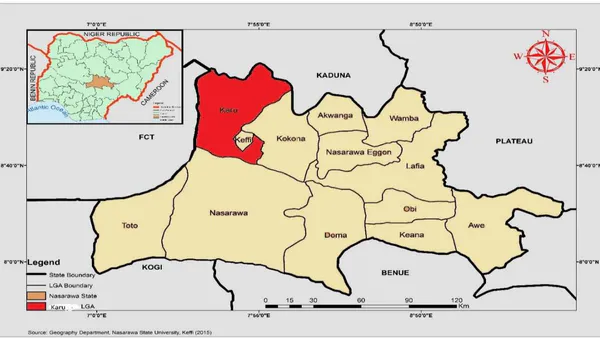
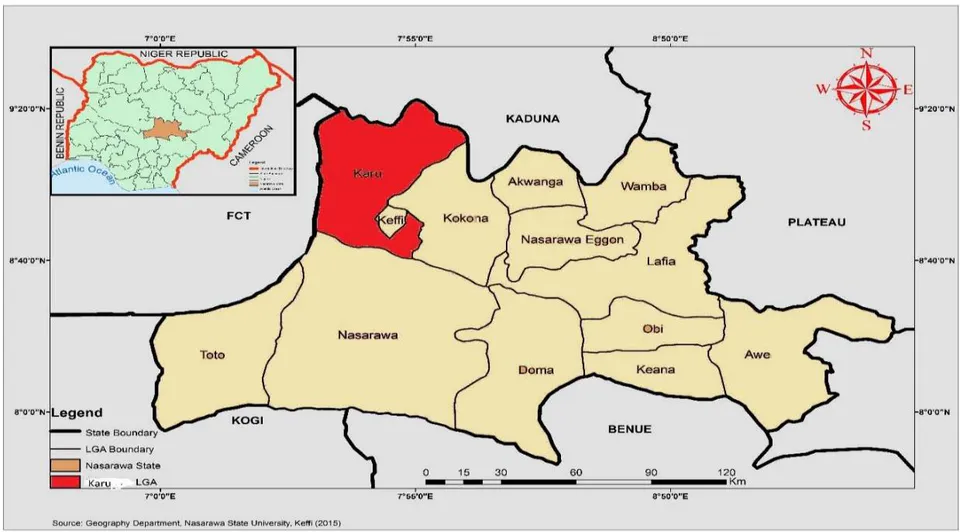
Karu Local Government Area is located within latitude and longitude Elatitude and . Karu is one of the Local Government areas of Nasarawa State Nigeria. It shares its western boundary with the Federal Capital Territory of Nigeria, its eastern boundary with Keffi Local Government of Nasarawa State, its southern boundary with Nasarawa Local Government Area and its northern boundary with Kaduna State. It has approximately area of . Karu L.G.A has its headquarters in new karu town. The L.G.A is made up of two development area which are Panda and Karshi Development Area and various settlements.
Karu Local Government Area of Nasarawa state like other parts of Northern Nigeria has climate that correlates with that of savanna belt. It is under the influence of inter-tropical convergence zone (ITCZ). The area has a distinct wet and dry season. The wet season starts from about the beginning of May and ends in October and the dry season is experienced between November and April. Annual rainfall ranges from about 1100mm to about 1200mm (Bimbol, 2007). About of the rain falls between May and September. The temperature is generally high during the day particularly between the months of March and April. The mean monthly temperature is in the range of to with the hottest month being March and April and the coolest month being December and January (Bimbol, 2007).
The vegetation on the hilly parts of the area are composed mainly of grasses and isolated trees. Trees of economic value including locust beans (Parkiabiglobosa), Shea butter (Vitellariaparadoxxa), Neem (Azadirachtaindica), Mango (Mangiferaindica), Citrus (Citrus X sinensis) and Banana (Musa acuminaia), are scattered across the area, particularly in the lowland areas and the southern part of the study area. (Aboki, Mailafiya and Osaba, 2007).
The area lies between 300-100 meters above the sea level except the hilly areas of Kajari and Gitata whose elevation reached 2154 meters in Kajari and 2760 meters in Gitata respectively. The Uke River is another major river in the state that flows through the northwestern corner of Karu hills to the southwest Kugwaru forest. The river takes its source from the North-Central Highlands and flows through towns like Panda and Nasarawa Benue east of Umaish. Its major tributaries are rivers Ado, Obi and Antau (Samaila and Bimbol, 2007).
Soil samples were collected where the following farmers' soil management are taking place (Compost, Mix farming, Tillage, Zero Tillage, Mix cropping and Mono cropping). The choice of the farmers' soil management fields was based on the duration of not less than three years at which the soil management has been in practiced on such a field. Three soil samples were taken at 50 meters interval on the soil management fields covered by this study for each season. A total of 18 soil samples were collected using a soil auger to burrow a hole thirty centimeters deep into the soil and 1 control sample from 50 meters away from the farming sites. The soil was thoroughly mixed and a representative sample was collected in polythene bags and for taken for laboratory analysis. Properties measured of soils included pH and electrical conductivity by Jenway portable meter, sodium, calcium and magnesium by Ammonium acetate leaching method, potassium and organic matter by Atomic absorption spectrophotometer, organic matter by dichromate wet oxidation, available phosphates using Olsen sodium bicarbonate method, Cation Exchange Capacity by Ammonium acetate method, nitrogen% by Macro Kjectedhal wet oxidation method and particle size analysis by Hydrometer method. The results of laboratory analysis for both the soils were summarized in table 1.
III. RESULT AND DISCUSSION
The result presented in table 1 shows that pH in the soil has a minimum concentration of 5.36 in zerotilled soils and a maximum concentration of 6.35 in mix-farming soils. The control point has a value of 6.34, indicating a moderately acid to slightly acid-base reactions. This shows that pH level under tillage management practices soil may affect the yield of crops in the study area. This could be attributed to low organic matter, high soluble content, amount of bases and the acidic nature of the soil is as a result of the parent material from which the soils were derived and high rate of leaching of nutrient down the profile, which makes the soil soluble that is it, can easily react with chemical properties in the soil. (Igwe,2005). Collaborate with the finding. That the acidic nature of the soil may be due to the acidic nature of the parent material from which the soils were derived and high rate of leaching of the nutrient down the profile.
Electrical conductivity has a minimum concentration of in tilled soils and a maximum concentration of , the control point has a concentration of . This uniformity may not be unconnected with the similarities in soil type, geology and the agricultural management found in the study area. This low Electrical conductivity values indicate that the area is not prone to salinity threats and the soils will support many crops. The slightly acid nature of the soil will enhance the availability of nutrients and as shown above may further facilitate the solubilisation of sodium ions which are the primary agents of salinization and alkalinisation especially in irrigated soils.
Organic matter has positive effects on the soil. It generally increases soil nutrient and water holding capacity, increases aeration, decreases bulk density, and leads to more stable aggregates. The result shows that the value of organic matter in the study area has a minimum concentration of in tilled soils, a maximum concentration of , the control point has a concentration of The organic matter in the study area can be categorise as low, this can attributed to erosion, leaching and due to the nature of the soil texture in the study area. Low organic matter reduces infiltration, CEC and buffering capacity of the soil. In agreement with the finding Tilahun, (2015) observed that leaching and erosion has eroded organic matter and organic carbon down the soil profile.
| Soil Properties | Unit | Compost | Mix-farming | Tillage | Zero-Tillage | Mix-cropping | Mono-cropping control | |
| pH | 5.40 | 5.71 | 6.12 | 5.36 | 6.35 | 6.11 | 6.34 | |
| ECe | uS/cm3 | 2.22 | 2.43 | 0.99 | 2.15 | 2.67 | 1.99 | 4.12 |
| O.M | % | 2.62 | 2.71 | 2.10 | 2.23 | 2.34 | 2.35 | 3.10 |
| N | meq/kg | 0.49 | 0.43 | 0.31 | 0.45 | 0.33 | 0.39 | 0.49 |
| P | meq/kg | 4.33 | 3.65 | 3.34 | 3.56 | 3.62 | 3.90 | 4.63 |
| K | meq/kg | 0.68 | 0.65 | 0.45 | 0.65 | 0.60 | 0.62 | 0.65 |
| Ca | meq/kg | 3.41 | 3.83 | 2.95 | 3.28 | 3.71 | 3.83 | 5.32 |
| Mg | meq/kg | 3.32 | 3.91 | 2.84 | 3.81 | 3.87 | 3.71 | 4.31 |
| Na | meq/kg | 0.49 | 0.45 | 0.31 | 0.39 | 0.40 | 0.42 | 0.95 |
| CEC | Cmol/kg | 6.98 | 7.10 | 5.52 | 7.05 | 5.59 | 6.45 | 7.34 |
| Texture | ||||||||
| Sand | % | 75.8 | 82.8 | 82.8 | 75.8 | 80.8 | 75.8 | 75 |
| Slit | % | 5.4 | 4.4 | 4.4 | 5.4 | 4.4 | 5.4 | 5.8 |
| Clay | % | 18.8 | 12.8 | 12.8 | 18.8 | 13.8 | 15.8 | 19.2 |
Total Nitrogen in the sampled soil, has minimum concentration of in tilled soils, a maximum concentration of in compost soils, with a control point concentration of
0.49meq/kg.Nitrogen is the most critical element obtained by plants from the soil and is a bottleneck in plant growth. The low value of Total Nitrogen can be attributed to the low level of Organic matter, organic carbon and continuously and intensively cultivated soil in the study area. Tilahun, (2005)collaborated with the finding. He observed that the N content is lower in continuously and intensively cultivated and high sodic soils of semi-arid and arid regions due to low Organic Matter content.
Available P in the study area, has a minimum concentration of in tilled soils, a maximum concentration of in compost soils, with a control point concentration of . The low concentration of available phosphorus in the study area can be attributed to the coarse nature of the soil, leaching and erosion in the study area. Available P is generally low in the all the sampled soils considered under this study. Low P can be attributed to textural class, and Organic Matter. Phosphorus is known as the master key to crop growth because lack of available P in the soils limits the growth of both cultivated and uncultivated plants. (Brady and Weil, 2002) collaborated the findings that erosion tends to transport clay and organic matter fractions of the soil, which are relatively rich in P fractions. The low content of available P of soils in the study area is in agreement with the study of (lgwe 2005; Mustapha and Udom 2005 and Shehu, Jibrin and Samndi, 2015) that available phosphorus under most soils of Nigeria decline by impacts of fixation, crop harvest and erosion.
Potassium has a minimum concentration of in tilled soils, a maximum concentration of in compost soils, with a control point value of . The Low value of potassium in the study area can be attributed to the acidic nature of the soils in the study area, leaching and intensive cultivation. Potassium is essential for the general vigor of the plants, encourages the development of a strong root system and increases resistance to certain diseases. Mesfin (1996) described low presence of K under acidic soils while Alemayehu, (1990) observed low K under intensive cultivated soils.
Calcium in the study area has a minimum concentration of in tilled soils, a maximum concentration of in mix-farming and monocropping soils, with a control point value of . Kowal and Kassam (1978), gave a range of 0.5-4.0 meq/kg as the range of calcium levels for savannah soils of West Africa.Luo, Lindsey, and Xue,(2004) recorded for Horotiu soils in China. The high calcium observed for the soil implies that the ion may not precipitate to a level in the soil to impact negatively on internal drainage and affect the performance of plants in their development. In the case of Magnesium, it has a minimum concentration of in tilled soils, a maximum concentration of in mix-farming soils, with a control point value of . The low level of Magnesium can be attributed to the low value of organic matter, solubility of the soil in the study area. The presence of adequate amounts of calcium and magnesium in the control soil is very important in order to obtain satisfactory crop yield.
Sodium values covered by the study has a minimum concentration of in tilled soils, a maximum concentration of in compost soils, with a control point value of . Low Na can be attributed to the sandy nature of the soil and low pH in the study area. Low Na affects the internal drainage of soil, water logging, plant developmental process, aeration, germination of plant and important macro nutrient requirement in the soil, which will make the soil not to precipitated Ca, Mg and K. Egboko, (2008) observed the same trend in the distribution of sodium at gully sites, on gully erosion in Agulu-Nanka, Anambra State Nigeria.
Cation Exchange Capacity in the study area, has a minimum concentration of in tilled soils, a maximum concentration of in mix-farming soils, with a control point value of . CEC is a basic single index of potential fertility, is the capacity of the soil to hold and exchange cations. It affects the soil capacity to supply nutrients cations for plant growth, it is generally low in all the soils sampled. The relatively low value of CEC in the study area can be attributed to low amount of clay and organic matter in the study area. Curtis and Courson, (1981), collaborated the findings by observing that CEC of soil is strongly affected by the amount of clay and organic matter present in the soil. Both clay and colloidal organic matter are negatively charged and therefore can acts as anions.
IV. CONCLUSION
Current information on farmers' soil management practices is needed to develop appropriate integrated nutrient management packages for sustainable crop production within the area. The six soil management practices in general maintain a comparative low soil quality than the control soil, the control soil has high level of organic content and the cultivated soil has a textural class which encourage soil erosion and leaching of major soil nutrients. This once again underscores the important role organic matter plays in maintaining soil fertility in tropical soils low activity clays where the study area is situated.
In order to raise the productivity level of the land to optimum performance for crop yield, the management techniques should enhance the nutrient and moisture holding capacity of the soil. Such techniques should include; continuous application of organic fertilizers/materials to the soil, improved efficiency of use of mineral fertilizers and use of low levels of chemical inputs, putting up appropriate drainage facilities in place to take care of the poorly drained area of the land while provision of irrigation facilities would make dry season farming possible.
Since the soils have been found to be deficient in some of the nutrients necessary for plants growth, there is the need for addition of organic or chemical fertilizers. The addition into the soil of about half a ton of NPK per hectare will greatly enrich the soil with nutrients which are a necessity for plants growth.