Assessment of Upper Basic Students’ Knowledge in Some Social Studies’ Basic Education Curriculum Contents in ondo West Local Government Area of Ondo State
This study assessed the knowledge of upper basic social studies students in some selected social studies contents. Specifically, the study investigated the knowledge acquisition of upper basic two students in some junior secondary one (JS I) social studies curriculum contents. 453 upper basic two social studies students from five randomly selected secondary schools were involved in the study. Six JS I social studies curriculum contents were selected and assessed in the study. The contents are: family life; culture; meaning and history of social studies; examination ethical concepts; HIV/AIDS and drug abuse. An instrument titled Knowledge Assessment in Social Studies Contents (KASSC) was used to generate data for the study. Descriptive analysis was used to analyze data obtained from the study.
## I. INTRODUCTION
Social studies was introduced in Nigeria as an educational programme that has the capacity to develop in learners intellectual and social skills that would enable them to function as effective citizens. Social studies equip learners with relevant information about socio-political and economic issues in their local and remote environment. Adebayo, Obaje & Uzokife (2015) posited that social studies education, apart from imparting knowledge and providing valuable information necessary for life, also aims at assisting students to acquire desirable attitudes and values needed for the survival of the individual in the society. The main aspiration of social studies is to get young people to better understand the intricacies of man's existence so that they can be well equipped for effective, meaningful and productive life. Social Studies is a subject that equips students with skills, knowledge and the development of positive attitudes towards Nigerian cultural heritage (Odey, 2019). Gbadamosi and Ajayi (2018) reported that social studies promotes acquisition of knowledge necessary for solving social problems in Nigeria and also promotes dutiful and responsible citizenship.
The introduction of social studies into the Nigerian secondary school curriculum in the 1960s was done with much expectations that the subject would develop required potentials in the youth and thereby generate national transformation. This led to expansion and spread of social studies at various school levels across the nation. Ogundare (2000) expressed that social studies gained national recognition when in 1969 the National Curriculum Conference that was held in Lagos adjudged the subject to be one of the learning experiences through which part of the designed national objectives of education can be achieved.
However, decades after the integration of social studies into the Nigerian school curriculum, the expected goals of the subject are far from realization. Presently, Nigeria is faced with challenges of different dimensions including youth restiveness, kidnapping, rape, examination malpractice, corruption, election rigging, cybal crime, lawlessness and other unpatriotic tendencies. In view of this, Edinyang, Effiom, Edwin & Doris (2020) argued that the recent upsurge of social ills in Nigeria is an indication that social studies has not been able to achieve its objectives at the Upper Basic level. Chioma (2016) pointed out that the introduction of basic education in Nigeria has not solved the problem of poor knowledge, skills and lack of access to quality education.
Poor implementation of social studies curriculum is a major hindrance to the attainment of social studies objectives in Nigeria. Owanenoh (2023) argued that a review of social studies education in Nigeria shows that, on paper, the curriculum content is sufficient to solve everyday issues in the society but this is not a reality because of lapses in the implementation of social studies curriculum. Poor teaching strategies adopted by social studies teachers and none inclusion of social studies in senior secondary school programme are some of the problems confronting the implementation of social studies curriculum in Nigeria.
One of the effects of poor implementation of social studies curriculum in Nigeria is students' low learning outcomes in social studies contents. Secondary school students demonstrate poor academic performance in social studies. This is partly responsible for undemocratic tendencies, youth restiveness, civil unrest, examination malpractice and other social vices that are prevalent in the country. Daramola (2020) pointed out that the present decay in academic ability of secondary school students and moral values in Nigeria emerged at the instance of poor knowledge of youths in social studies concepts and skills.
This study intends to assess the knowledge of secondary school students in some social studies contents. Specifically, the study will assess the knowledge of upper basic two students in the following UB social studies curriculum contents: family life; culture; meaning and history of social studies; examination ethical concepts; HIV/AIDS and Drug abuse.
## II. SECONDARY SCHOOL SOCIAL STUDIES
## PROGRAMME IN NIGERIA
Social studies is an integrated school subject that focuses on equipping learners with necessary intellectual, social and manipulative skills that will enable them to function effectively and be useful to themselves and the society. It inculcates in leaners civic traits and values for civic responsibility and effective citizenship. Adeyanju (2000) in Jakayina (2019) described social studies as programme of study which a society uses to inculcate in the pupils knowledge, skills, attitudes, values and actions it considers important concerning the relationship human beings have with each other, their environment and themselves.
Social studies was first taught in Nigeria at Ayetoro Comprehensive High School, Egbado, now in Ogun State. The joint efforts of the Western Nigeria Ministry of Education; United State Agency for International Development (USAID) and the Ford Foundation made the teaching of social studies at Ayetoro Comprehensive High School a possibility. Also the Nigerian 1969 national curriculum conference at Lagos promoted the awareness and recognition of social studies as a school subject. At the conference, social studies was recommended for primary, secondary and teachers' colleges in Nigeria. One of the major outcomes of the curriculum conference was the publication of its recommendations as the first National Policy on Education (NPE) in 1977 (Akanbi and Abiola, 2018). In the NPE, social studies was made a core subject in primary and junior secondary schools in Nigeria. Shuaibu and Shuaibu (2020) stressed that the national policy on education endorses the need for social studies education to be geared towards equipping the individuals with the necessary wherewithal not only for cultivating civic responsibility but also for creating avenues and opportunities germane and compatible with human and social development.
The teaching of social studies in Nigerian primary and secondary schools expanded in the 1970s as a result of the production of teaching and learning materials in social studies through the efforts of NERC; Nigeria, Social Studies Pogramme (NSSP) and Social Studies Association of Nigeria (SOSAN) (Ogundare, 2010; Jekayina, 2019). Social studies became an important and core subject in the Nigeria Universal Basic Education (UBE) because of the realization that the subject is a tool for achieving some aspects of Nigeria national goals. According to Oluwagbohunmi (2012), the relevance of social studies to national development hinges on its usefulness in preparing students for the understanding of everyday problems that could be encountered as citizens and how to find solution to them. In view of this, Ogundare (2012) emphasized that the curriculum of social studies in the UB programme focuses on social problems that are of national and international concerns. This explains the reason why social issues and problems of national and international concern like drug abuse; child and female trafficking; examination malpractice; HIV/AIDS; cultism; prostitution etc have been incorporated into the UBE social studies curriculum.
Basic education social studies curriculum is designed to help students to have adequate knowledge of social issues and problems as well as equip them with critical thinking and decision-making skills that will enable them to proffer solutions to theses problems. Also, the curriculum is expected to develop in them civic and ethical norms like obedience, respect, honesty, hardwork, cooperation and tolerance that can promote unity and national integration. Social studies curriculum in the UB programme is expected to inculcate in learners social values and skills for active social life; develop intellectual skills, knowledge and understanding of issues and problems in the immediate and remote environment; develop rational thinking ability for practical social life, identifying and solving problem (Abubakar, 2022).
At the secondary school level, pupils are in the process of transiting to adolescent stage. It is believed that social studies as a core subject in secondary school education is aimed at helping learners to:
i. Cultivate the spirit of patriotism. Social studies objectives focus on the preparation of the learners to be patriotic and effective citizens, conscious of the benefit of collaboration natural development and global interdependence. Social studies was incorporated into junior secondary school curriculum as a core subject of study for overall development of a sense of responsibility, patriotism and effective citizenship in the learner.
ii. Recognize the causes and consequences of environmental problem. The contents of social studies are organised around social, physical and environmental issues affecting man's existence and his capacity to manage and preserve the environment for sustainable development.
iii. Develop capacity to learn and acquire skills essential to the formation of satisfactory professional life and further studies.
iv. Help learners fit into the society which he belong.
v. Create an understanding of the environment; it's man-made, natural, cultural and spiritual resources and the conservation of these resources for development.
vi. Develop an awareness and appreciation for the inter-relatedness of human knowledge and human life.
vii. Enhance peaceful and harmonious social living among the diverse cultural and ethnic groups in Nigeria.
The relevance and potentials of social studies in developing social and intellectual skills notwithstanding, the subject has not been able to achieve its goals in Nigeria. Contemporary problems of youth restiveness, drug addiction, rape, examination misconducts, cybercrimes and lawlessness among Nigerian youths have been adduced to the failure of social studies in inculcating civic and social skills and values in secondary schools students. Daramola (2020) concluded that the present decay in academic ability of secondary school students and moral values in Nigeria emerged at the instance of poor knowledge of youths in Social Studies concepts and skills. This has resulted into various social problems like examination malpractice, cultism, violence, cybercrime and sexual immoralities. Some of the factors responsible for 'secondary school students' poor knowledge in social studies contents are: lack of competent teachers, poor teaching strategies, non-availability of instructional materials and lack of interest on the part of learners.
## III. METHODOLOGY
The study is a descriptive research. The survey design was used to assess basic two students' knowledge of some JS I social studies curriculum contents in Ondo West Local government area of Ondo State. The following six JS I social studies curriculum contents were selected for the study: family life; culture; meaning and history of social studies; examination ethical concepts; HIV/AIDS and drug abuse. The rationale for the selection of these curriculum contents were:
i. Assessment of students' knowledge acquisition on contents that they were taught at lower or middle basic school level vis-à-vis contents that they started learning at upper basic level. Three of the contents examined (family life; culture and meaning of social studies) are incorporated into lower and middle basic social studies curriculum while other contents are not learnt at lower and middle basic levels
ii. Assessment of students' knowledge acquisition on emerging social problems vis-à-vis other social studies curriculum contents.
Sample for the study is made up of four hundred and fifty-three (453) basic two students from five (5) randomly selected public secondary schools in Ondo West Local government area of Ondo State.
One self-designed instrument was used for the study. The instrument is titled Knowledge Assessment on Social Studies Contents (KASSC). The instrument was designed to measure the knowledge of basic two students in six JS I social studies curriculum contents. The instrument is made up of two sections. Section A requires respondents to supply some personal information. Section B is made up of thirty (30) items. The items were knowledge based questions on the six selected social studies contents. Five (5) knowledge based questions were drawn on each concepts to measure the knowledge acquisition of the students.
Face and content validity of the KASSC was done by three teacher educators from Adeyemi College of Education, Ondo. Corrections made by the experts were effected before the final draft was produced.
Two research questions was raised and answered in the study, these are:
1. What is the knowledge acquisition of basic two students in the following social studies contents: family life, culture, meaning and history of social studies, examination ethical concepts, HIV/AIDS and Drug abuse?
2. What are the differences in the knowledge scores of upper basic two students in the following social studies contents family life, culture, meaning and history of social studies, examination ethical concepts, HIV/AIDS and Drug abuse?
The instruments were distributed to the students in their various schools. They were collected immediately after they were completed.
## IV. RESULTS
The results are presented in order of the research questions raised for the study.
a) Research Question 1: What is the knowledge acquisition of basic two students on the following social studies contents: family life, culture, meaning and history of social studies, examination ethical concepts, HIV/AIDS and Drug abuse?
Table 1: Table Showing Percentage Score of Upper Basic 2 Students on Six Social Studies Contents
<table><tr><td>Social Studies Content</td><td>Score Obtainable</td><td>Total Score</td><td>Percentage</td></tr><tr><td>Family Life</td><td>2265</td><td>1328</td><td>58.6</td></tr><tr><td>Culture</td><td>2265</td><td>1086</td><td>47.5</td></tr><tr><td>Meaning and history of social studies</td><td>2265</td><td>681</td><td>30</td></tr><tr><td>Examination ethical concepts</td><td>2265</td><td>811</td><td>36</td></tr><tr><td>HIV/AIDS</td><td>2265</td><td>787</td><td>35</td></tr><tr><td>Drug abuse</td><td>2265</td><td>738</td><td>33</td></tr></table>
Table 1 reveals that upper basic two students scored $58.6\%$ in family life contents; $47.5\%$ in culture; $30\%$ in meaning and history of social studies; $36\%$ in examination ethical concepts; $35\%$ in HIV/AIDS contents and $33\%$ in drug abuse. This results show that upper basic two students had poor knowledge of upper basic social studies contents. They performed very poor in most of the social studies contents assessed.
b) Research Question 2: What are the differences in the knowledge scores of basic two students in the following social studies contents: family life, culture, meaning and history of social studies, examination ethical concepts, HIV/AIDS and Drug abuse?
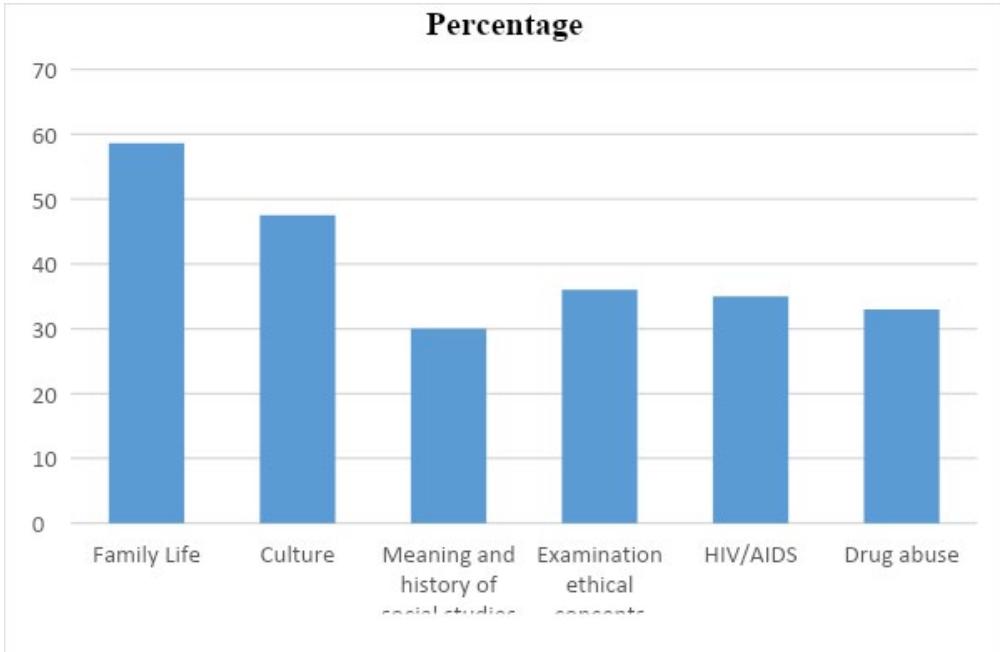 Fig. 1: Percentage Representation of Students' Knowledge Scores in UB social studies contents
The Bar chart above shows that upper basic two students scored higher in family life concepts. This is followed by concept of culture, examination ethics, HIV/AIDS, drug abuse, meaning and history of social studies respectively. The students scored very low (below average) in concepts relating to social problems, meaning and history of social studies.
## V. DISCUSSION OF FINDINGS
Table 1 reveals that upper basic two students had poor knowledge of JS I social studies curriculum contents. They scored above average (58.6%) only in contents relating to family life. They scored below average in all other contents that were examined. This finding is in agreement with the findings of Awhen, Peter and Polycarp (2017). They investigated the trend of upper basic social studies students' performance in public examination and discovered that upper basic students had poor performance in social studies. Daramola (2020) also reported low performance and poor knowledge of students in social studies contents. Studies show that students' poor performance in social studies is associated with their negative perception and lack of interest in the subject. Other variables identified to be responsible for students' performance in social studies are: peer influence, learners' self-esteem, family background, school culture, achievement motivation, social interaction, school type, classroom environment
and teaching or learning strategy (Okon, 2015; Akaraonye, Oruwari and Mang, 2017; Emilio, 2020; Ekpoto, Odey and Akpa, 2021; Basri, Mukhaiyar and Anwer, 2023).
Findings of this study also indicate that upper basic two students performed better in contents relating to family life and culture than contents relating to social problems as well as meaning and history of social studies. The results show that students scored $58.6\%$ and $47.5\%$ in contents relating to family life and culture respectively. Whereas, they scored $30\%$, $36\%$, $35\%$ and $33\%$ in contents relating to meaning and history of social studies; examination ethical concepts; HIV/AIDS and drug abuse respectively. Students' better performance in family life and cultural contents may be connected with their familiarity with these concepts. Students have day-to-day engagement with issues relating to family life and culture. This serves as prior knowledge which gives them required foundation to acquire more knowledge and enhance their learning engagements. This indicates that there is positive correlation between intelligence, prior knowledge and learning outcomes in social studies. Liliesari and Rahmatan cited in Arifin (2019) discovered that prior knowledge is a collection of individual knowledge, experience obtained in their whole life, and that they would bring those into a new learning experience. Thurn, Nussbaumer, Schumacher and Stern, (2022) emphasized that what students gain from formal instruction depends on their intelligence as well as prior encounter with proportional concepts.
Similarly, the spiral curriculum model adopted in social studies education has the tendency of providing prior learning experiences in family life and cultural contents. Family life and cultural contents are incorporated into lower and middle basic social studies curriculum. The spiral curriculum model helps learners to revisit these topics several times at different levels of school programme. With this, learning experiences and contents are reinforced and solidifies at each stage of the learning process (Woodward, 2019). Although, lower basic social studies curriculum also provides upper basic students with prior knowledge on the meaning of social studies, however, the content has no practical day-to-day reality that could reinforce and integrate it into learners' life experiences compared with family life and cultural contents.
In addition, poor knowledge of basic two students in contents relating to social problems is not unconnected with lack of adequate prior knowledge on concepts of examination malpractice, drug abuse and HIV/AIDS that were assessed in the study. Social studies curricula at lower and middle basic levels do not incorporate emerging social problems that can help learners to develop prior learning experiences that could reinforce their learning encounter at upper basic level. This may partly be responsible for students' poor knowledge in contents relating to social problems. Gbadamosi and Ajayi (2018) reported that social studies' theme under the umbrella of Religion and National Values, promotes learners' acquisition of knowledge necessary for solving social problems. However, poor students' knowledge in contents relating to social problems is a deterrent to their social and intellectual skills for solving emerging social problems. Studies have reported positive relationship between low level of education, poor learning outcome and youths' involvement in cybercrime, examination malpractice, rape, kidnapping, rebellion, violence and other social vices (Apase and Yawe, 2019).
## VI. CONCLUSION
The study assessed upper basic two students' knowledge in some JS1 social studies curriculum contents. The study examined the knowledge acquisition of 453 basic two students in the following JS1 social studies curriculum contents: family life, culture, meaning and history of social studies, examination ethical concepts, HIV/AIDS and Drug abuse. The study revealed that basic two students scored low in JS I social studies contents. The study further showed that basic two students had higher score in contents relating to family life and culture than contents relating to social problems, meaning and history of social studies. Learners' better performance in contents relating to family life and culture is not unconnected with their previous knowledge in the concepts. Also, the spiral model of social studies curriculum which enabled the students to learn the concepts of family life and culture at lower and middle basic levels provided reinforcement that aided their better performance in the concepts. Students' poor knowledge in concepts relating to social problems is partly responsible for the spate of youth restiveness and involvement in social vices in Nigeria.
## VII. RECOMMENDATION
On the basis of the findings of this study, the following recommendations are made:
1. Emerging social issues and problems in Nigeria should be incorporated into middle basic social studies curriculum. This will help upper basic students to have prior knowledge that can reinforce their learning experiences and thereby improve their learning outcome in contents relating to social problems.
2. Informal educational programme on social issues and problems should be incorporated into the Nigeria basic school programme. Middle and upper basic students should be engaged in informal activities that can help them to identify and proffer solutions to problems that they encounter in their day-to-day activities.
3. Training for effective and responsible citizenship begins at the elementary school level. Hence, efficient and adequate human and material resources should be made available in our Nigerian schools particularly at the basic school level.
4. Effective teaching of social studies contents require well trained, motivated and efficient teacher. The teaching of social studies contents in the current national values education should not be left in the hand of untrained teachers as done in many schools today. There is the need to recruit professionally trained social studies teachers to teach social studies contents in Nigeria primary and secondary schools.
Generating HTML Viewer...
References
7 Cites in Article
A Adebayo,A Obaje,G Uzokife (2015). Social Studies Integration and Cultural Cooperation in Nigeria Amalgamation: Retrospect and prospect.
Ahmad Abubakar (2013). Role of Social Studies Education in National Development in Nigeria.
J Apase,A Yawe (2019). The Role of Education in Managing Social Vices and Youth Restiveness.
Grace Akanbi,Oluremi Abiolu (2018). Nigeria’s 1969 Curriculum Conference: a practical approach to educational emancipation.
J Akaraonye,J Oruwari,O Mang (2017). Effects of Cooperative Learning on Students' Achievement in Social Studies.
I Arifin (2019). The Effects of Prior Knowledge on Students' Learning Outcomes on the Subject of Basic Science Concepts.
Ossai Charity,Dania Ogbianugene (2017). Teacher Characteristics, Classroom Management Skills and Students’ Academic Performance of Upper Basic Social Studies Students in Delta State.
No ethics committee approval was required for this article type.
Data Availability
Not applicable for this article.
How to Cite This Article
Mercy Falade. 2026. \u201cAssessment of Upper Basic Students’ Knowledge in Some Social Studies’ Basic Education Curriculum Contents in ondo West Local Government Area of Ondo State\u201d. Global Journal of Human-Social Science - G: Linguistics & Education GJHSS-G Volume 23 (GJHSS Volume 23 Issue G6): .
Explore published articles in an immersive Augmented Reality environment. Our platform converts research papers into interactive 3D books, allowing readers to view and interact with content using AR and VR compatible devices.
Your published article is automatically converted into a realistic 3D book. Flip through pages and read research papers in a more engaging and interactive format.
This study assessed the knowledge of upper basic social studies students in some selected social studies contents. Specifically, the study investigated the knowledge acquisition of upper basic two students in some junior secondary one (JS I) social studies curriculum contents. 453 upper basic two social studies students from five randomly selected secondary schools were involved in the study. Six JS I social studies curriculum contents were selected and assessed in the study. The contents are: family life; culture; meaning and history of social studies; examination ethical concepts; HIV/AIDS and drug abuse. An instrument titled Knowledge Assessment in Social Studies Contents (KASSC) was used to generate data for the study. Descriptive analysis was used to analyze data obtained from the study.
Our website is actively being updated, and changes may occur frequently. Please clear your browser cache if needed. For feedback or error reporting, please email [email protected]
Thank you for connecting with us. We will respond to you shortly.
Lorem ipsum dolor sit amet, consectetur adipiscing elit. Ut elit tellus, luctus nec ullamcorper mattis, pulvinar dapibus leo.
Assessment of Upper Basic Students’ Knowledge in Some Social Studies’ Basic Education Curriculum Contents in ondo West Local Government Area of Ondo State