

Loading menu…

Assessment on Magnitude of Needle Stick and Sharp Injuries and Associated Factors among Health Care Workers in East Gojjam Zone Health Institutions, Amahara Regional State Ethiopia

§ Public Health Department, Collegeof Health Sciences,...

Send Message

To: Author

Assessment on Magnitude of Needle Stick and Sharp Injuries and Associated Factors among Health Care Workers in East Gojjam Zone Health Institutions, Amahara Regional State Ethiopia

Article Fingerprint

ReserarchID

DISEASES2LZ3J

Assessment on Magnitude of Needle Stick and Sharp Injuries and Associated Factors among Health Care Workers in East Gojjam Zone Health Institutions, Amahara Regional State Ethiopia Banner

Key Research Insights

Synthesized scholarly intelligence & interactive research assistant
  • English
  • Afrikaans
  • Albanian
  • Amharic
  • Arabic
  • Armenian
  • Azerbaijani
  • Basque
  • Belarusian
  • Bengali
  • Bosnian
  • Bulgarian
  • Catalan
  • Cebuano
  • Chichewa
  • Chinese (Simplified)
  • Chinese (Traditional)
  • Corsican
  • Croatian
  • Czech
  • Danish
  • Dutch
  • Esperanto
  • Estonian
  • Filipino
  • Finnish
  • French
  • Frisian
  • Galician
  • Georgian
  • German
  • Greek
  • Gujarati
  • Haitian Creole
  • Hausa
  • Hawaiian
  • Hebrew
  • Hindi
  • Hmong
  • Hungarian
  • Icelandic
  • Igbo
  • Indonesian
  • Irish
  • Italian
  • Japanese
  • Javanese
  • Kannada
  • Kazakh
  • Khmer
  • Korean
  • Kurdish (Kurmanji)
  • Kyrgyz
  • Lao
  • Latin
  • Latvian
  • Lithuanian
  • Luxembourgish
  • Macedonian
  • Malagasy
  • Malay
  • Malayalam
  • Maltese
  • Maori
  • Marathi
  • Mongolian
  • Myanmar (Burmese)
  • Nepali
  • Norwegian
  • Pashto
  • Persian
  • Polish
  • Portuguese
  • Punjabi
  • Romanian
  • Russian
  • Samoan
  • Scots Gaelic
  • Serbian
  • Sesotho
  • Shona
  • Sindhi
  • Sinhala
  • Slovak
  • Slovenian
  • Somali
  • Spanish
  • Sundanese
  • Swahili
  • Swedish
  • Tajik
  • Tamil
  • Telugu
  • Thai
  • Turkish
  • Ukrainian
  • Urdu
  • Uzbek
  • Vietnamese
  • Welsh
  • Xhosa
  • Yiddish
  • Yoruba
  • Zulu
Reading Preferences
Font Size
Line Spacing
Background
This converted HTML version may contain rendering inconsistencies. Please refer to the PDF for the authoritative version, or click here to provide feedback.

Abstract

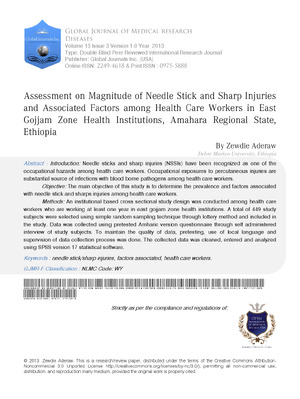
Introduction: Needle sticks and sharp injuries (NSSIs) have been recognized as one of the occupational hazards among health care workers. Occupational exposures to percutaneous injuries are substantial source of infections with blood borne pathogens among health care workers. Objective: The main objective of this study is to determine the prevalence and factors associated with needle stick and sharps injuries among health care workers. Methods: An institutional based cross sectional study design was conducted among health care workers who are working at least one year in east gojjam zone health institutions. A total of 449 study subjects were selected using simple random sampling technique through lottery method and included in the study. Data was collected using pretested Amharic version questionnaire through self administered interview of study subjects. To maintain the quality of data, pretesting, use of local language and supervision of data collection process was done. The collected data was cleaned, entered and analyzed using SPSS version 17 statistical software. Descriptive part of the result was presented using frequency tables, graphs and for the analytic part, association between dependent and independent variables was checked using binary logistic regression and p value less than 0.05 as significant level at 95% CI. Multivariate logistic regression was done to see the interaction effect of confounding variables. Result: This study revealed that from 449 selected study participants, 432 (96.2%) were responded the questionnaire. From the total study participants, 295 (68.3%) were from health centres and 137 (31.7%) were from hospitals. The one year prevalence of sharp and needle stick injury was 22.2%. The multivariate logistic regression indicated that sex of the worker(AOR:2.46,95% CI (1.37,4.42)), monthly salary (AOR:2.96,95% CI (1.57,5.24)), information access on health and safety (AOR:2.31,95% CI (1.37,3.95)), sleeping disturbance problem(AOR:2.81,95% CI (1.57,5.04)), Job sati sfaction (AOR:0.38, 95% CI (0.23,0.65)) and Job stress (AOR:2.22,95% CI (1.32,3.74)) were the predictors of sharp and needle stick injuries. Conclusion: In this study, the prevalence of sharp and needle stick injury had showed a decrease in magnitude from the previous similar study 41 results. Job stress, job satisfaction, having sleeping disturbance problem, having health and safety information access and low monthly salary had showed a significant association with the occurrence of sharp and needle stick injury.

References

21 Cites in Article
  1. 1. (1999). preventing needle stick injuries in health care settings. NIOSH, preventing needle stick injuries in health care settings, 1999, 2000-2108.
  2. 2. Ann Do,Carol Ciesielski,Russ Metler,Teresa Hammett,Jianmin Li,Patricia Fleming (2003). Occupationally Acquired Human Immunodeficiency Virus (HIV) Infection: National Case Surveillance Data During 20 Years of the HIV Epidemic in the United States. Infection Control & Hospital Epidemiology, 24(2), 86-96.
  3. 3. CDC NIOSH (2000). What every worker should know: How to protect yourself from needle stick injuries. What every worker should know: How to protect yourself from needle stick injuries. Publication No, 2000-2135.
  4. 4. V. Puro,G. De Carli,N. Petrosillo,G. Ippolito,by category,work area (2001). Risk of Exposure to Bloodborne Infection for Italian Healthcare Workers, by Job Category and Work Area. Infection Control & Hospital Epidemiology, 22(4), 206-210.
  5. 5. (2005). Estimation of the global burden of disease attributable to contaminated sharps injuries among healthcare workers. Yvan Hutin2: Estimation of the global burden of disease attributable to contaminated sharps injuries among healthcare workers: World Health Organization, Protection of the Human Environment (PHE), Geneva, Switzerland
  6. 6. E. Collaborative (1997). Jagger, J., Bentley, M.B., Injuries from vascular access devices: High risk and preventable. Nursing, 20, 33-39.
  7. 7. M. Mendelson,L. Chen,L. Finkelstein,E. Bailey,G. Kogan (2000). Evaluation of asafety IV catheter (Insyte Autoguard, Becton Dickinson) using the Center for Disease Control and Prevention (CDC) National Surveillance System for Hospital Healthcare Workers Database. Infection Control Hospital Epidemiology, 2, 111.
  8. 8. F. Lamontagne,D. Abiteboul,I. Lolom,et al (2007). Role of Safety-Engineered Devices in Preventing Needlestick Injuries in 32 French Hospitals. Infection Control & Hospital Epidemiology, 2007(28), 18-23.
  9. 9. R. Lekhraj,Z. Rosidah,Azhar Md,W. Leong Needle Stick and Sharps Injuries and Factors Associated Among Health Care Workers in a Malaysian Hospital. Europea Journal of Social Sciences
  10. 10. L. Lee (2005). Implications of the prevalence of needle stick injuries in a general hospital in Malaysia and its risk in clinical practice. Environment Health and Preventive Medicine, 10, 31-41.
  11. 11. Alam Maqbool (2002). Knowledge, Attitude and Practice among Healthcare Workers on Needle Stick Injuries. Annals of Saudi Medicine, 22(5-6), 1-4.
  12. 12. D. Gurubacharya,K. Mathura,D. Karki (2003). Karki, D.B., Knowledge, Attitude and Practice among Healthcare Workers on Needle Stick Injuries. Kathmandu University Medical Journal, 1(2), 91-94.
  13. 13. F. Hofranipour,M. Asadpour,H. Ardebili,S. Niknami,E. Hajizadeh (2009). Needle stick/sharp injuries and determinants in nursing care. European Journal of Social Sciences, 2(2), 191-197.
  14. 14. A. Pruss-Ustun,E. Rapiti,Y. Hutin (2005). Estimation of the global burden of disease attributable to contaminated sharps injuries among health‐care workers. American Journal of Industrial Medicine, 48, 482-490.
  15. 15. H. Mohammad,J. Jagger (1994). Mohammad H. Evaluation of Needle Stick Injuries among Nurses of Khanevadeh Hospital in Tehran. Advances in Exposure Prevention, 16.
  16. 16. Y. Ng,H. Noor (2007). Needlestick Injury Among Medical Personnel in Accident and Emergency Department of Two Teaching Hospitals. Med J Malaysia, 62(1)
  17. 17. Occupational Safety and Health Administration (OSHA) (1991). Final rule on occupational exposure to blood borne pathogens.
  18. 18. E. Orji,O. Fasubaa,Uche Onwudiegwu,F. Dare,S. Ogunniyi (2002). Uche Onwudiegwu, F. O. Dare and S. O. Ogunniyi Occupational health hazards among health care workers in an obstetrics and gynaecology.unit of a Nigerian teaching hospital. Journal of Obstetrics and Gynaecology, 22(1), 75-78.
  19. 19. (2006). Occupational HIV infection among health care workers exposed to blood and body fluids in Brazil. American Journal of Infection Control, 34, 237-240.
  20. 20. Janine Jagger (2007). Jagger, J., Caring for Healthcare Workers: A Global Perspective. Infection Control & Hospital Epidemiology, 28(1), 1-4.
  21. 21. Tadesse M,Tadesse T (2010). Epidemiology of needle stick injuries among health-care workers in Awassa City. Trop Doct, 40(2), 1113.

Funding

No external funding was declared for this work.

Conflict of Interest

The authors declare no conflict of interest.

Ethical Approval

No ethics committee approval was required for this article type.

Data Availability

Not applicable for this article.

How to Cite This Article

Zewdie Aderaw. 2013. "Assessment on Magnitude of Needle Stick and Sharp Injuries and Associated Factors among Health Care Workers in East Gojjam Zone Health Institutions, Amahara Regional State Ethiopia". Global Journal of Medical Research - F: Diseases GJMR-F Volume 13 (GJMR Volume 13 Issue 2 (F3)).
More Citation Formats

Download Citation

Issue Cover
GJMR Volume 13 Issue 2 (F3)
Pg. 41-50
Journal Specifications

Crossref Journal DOI 10.17406/gjmra

Print ISSN 0975-5888

e-ISSN 2249-4618

Keywords
Classification
GJMR-F Classification NLMC Code: WY
Version of record
v1.2

Issue date
January 25, 2013

Language
English
Order Article Reprint
Experience in AR

Explore published articles in an immersive Augmented Reality environment. Our platform converts research papers into interactive 3D books, allowing readers to view and interact with content using AR and VR compatible devices.

Read in 3D

Your published article is automatically converted into a realistic 3D book. Flip through pages and read research papers in a more engaging and interactive format.

Article Matrices
Total Views: 2.1K
Total Downloads: 112
All Trends

This is the heading

Lorem ipsum dolor sit amet, consectetur adipiscing elit. Ut elit tellus, luctus nec ullamcorper mattis, pulvinar dapibus leo.


High-quality academic research articles on global topics and journals.

Assessment on Magnitude of Needle Stick and Sharp Injuries and Associated Factors among Health Care Workers in East Gojjam Zone Health Institutions, Amahara Regional State Ethiopia

Zewdie Aderaw
Zewdie Aderaw Ethiopia

Request Access

Please fill out the form below to request access to this research paper. Your request will be reviewed by the editorial or author team.
X
