
I. INTRODUCTION
Some metals have toxic and carcinogenic properties. It is very important to develop the technologies by means of which it is possible to remove the toxic metals from the environment. Among the most prospective methods of remediation of polluted environment are the biological technologies based on the use of different microorganisms [1, 2].
The pollution of the environment by the materials containing Cr(VI) and other toxic elements is an urgent problem for many countries [3].
The recent researches proved that many of the well-studied bacterial species, Are not metal resistant/tolerant. They lose their viability in co-existence of high concentrations of heavy metals. Thus, it is reasonable to isolate the bacteria under investigation directly from soil, mineral strata and water contaminated by metals [4-8]. At present, the testing of technologies based on endogenic microorganisms is carried out intensively in many countries [9-11], providing that recently the application of biotechnologies is of high priority in the process of environment reduction in many countries [12]. The efficiency of biotransformation depends on the mechanism of bacteria-metal interaction, thus, for bacteria of any specific species it is necessary to study preliminarily this mechanism in detail.
The natural vital medium of bacteria we are interested in, contains, alongside with the elements under investigation (Cu) as well the elements (macroelements) that are widely spread in the nature (Ca, Na, K, Si, etc.). These elements have an influence on the growth – evolution of bacteria, including the process of assimilation of elements by bacteria and the biochemical process proceeding in bacteria [13,14].
It is interesting to study the influence of Ca on the process of assimilation and distribution of Cu in bacteria. Ca ions are important activators of enzymes inside the cell [13-15]. Calcium is the key intracellular metabolic regulator. Ca is also important for the functioning of cell membranes [16]. Ca is involved in life processes and cause compaction of cell membranes (in opposite of sodium and potassium ions, which increase permeability). Copper belongs to the life-essential metals as it is a part of more than 25 copper-containing proteins and enzymes, and is implicated in their activity. The experimental material, obtained as a result of the proposed investigation, makes it possible to draw a certain conclusion about the biochemical processes, taking place in bacteria and about the mechanisms, by which the assimilation of metals and the conversion of their compounds are made.
II. OBJECTIVES AND METHODS
For the object of investigation we chose the bacteria of Arthrobacter globiformis 151B. As is known, the bacteria of Arthrobacter family are aerobic gram-positive bacteria living in soil. They belong to Arthrobacteria class, type – Actinomycetales. Among the reductive bacteria, the interest to the bacteria of this family is great as, according to the existing data [17, 18] they have a high potential of remediation of chromium-contaminated environment. The Georgian investigators studied the distribution of Cr(VI) – resistant microorganisms in basalt rocks, taken from ecologically the most contaminated regions of Georgia (Kazreti, Zestaphony) [19]. The object of investigation is bacterial strains isolated from Kazreti basalts. This bacterium intensively absorbs various elements from the nutrient medium (Zn, Mg, Mn, Cr, etc.) [20, 21].
For studying the influence of Ca on the process of assimilation of Cu by Arthrobacter globiformis 151B, we cultivated bacteria in 500 ml Erlenmaier flasks in 100 ml TSB broth. We additionally introduced Ca solution in the form of into some samples (flasks), thus, the concentration of Ca, added in the nutrient medium, was 100 mkg/ml, 400 mkg/ml and 1600 mkg/ml.
In five samples, we additionally introduced a solution of Cu, the final concentration of which in the nutrient medium was 1 g/ml. The nutrient medium also (itself) contained elements of the following concentrations: Na-3.5mg/ml, K-0.6 mg/ml, Ca-25 g/ml, Cr-7 g/ml, Zn-1 g/ml. The cultivation of bacteria proceeded during 17 h, 24 h, 48 h, 96 h and 144 h. After cultivation we carried out the precipitation by centrifuge (3000 rpm, 10 min., 0°C), we poured out supernatants and the remained bacterial pellet washed in sterile distilled water. We dried the obtained biomasses by low-temperature lyophilizer [22] and weighted them (the whole masses). From the total quantity of bacterial pellet we took the amount necessary for analyses, weighted it ( 30 mg) and put it into test tubes. In order to convert the samples into a liquid state, we added the concentrated nitric acid (1 ml) into the test tubes, heated it and after a complete ashing dissolved it by bidistillate to a certain volume. The analysis of the obtained samples on the content of metals was made by atom-absorption spectrometer (Analyst 800, acetylene–air flame). We studied the process of assimilation of Cu by bacteria and the influence of Ca ions of this process.
III. RESULTS AND DISCUSSION
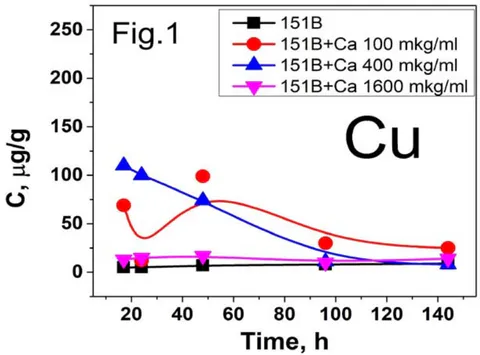
The results of measurement are given in Figs. 1 and 2.
The intensity of Cu uptake process from the nutrient media is practically similar during the whole experiment, when the concentration of Ca added in media is 1600 mkg/ml and 0 mkg/ml. When Ca concentration in nutrient media is 100 mkg/ml and 400 mkg/ml, the uptake of Cu is sharply increased at the start of experiment (17 h). During the following period of experiment (96 h and 144 h) the intensity of Cu uptake is decreased and the corresponding curves become similar to the curves that correspond to Ca concentrations 1600 mkg/ml and 0 mkg/ml.
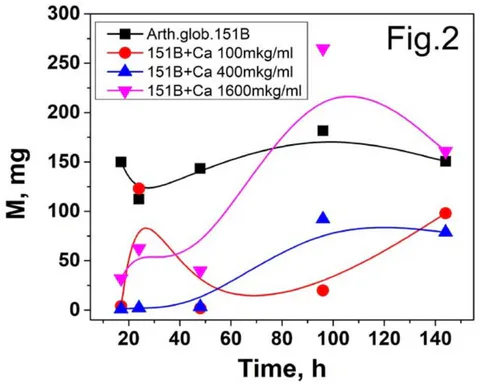
The addition of Ca to the medium slows down the growth of bacteria for the entire period of the experiment, when the concentration of calcium in the food medium is 100 g/ml and 400 g/ml. When the concentration of calcium in the food medium is 1.6 mg/ml, the growth of bacteria decreases at the initial stage of the experiment (17 hours, 24 hours, 48 hours). In this case, the mass of bacteria is much less than when calcium is not added to the food environment. At later stages of the experiment (96 h and 144 h), the bacterial mass is not less than when calcium is not added to the food medium. At the next period of cultivation, the bacterial masses grow and approach the value that bacteria have, cultivated without adding Ca.
IV. CONCLUSION
As shown by the results of the experiment, the addition of calcium in the medium does not reduce the penetration of copper in bacteria. At the initial stage of the experiment (17 h, 24 h, 48 h), when the concentration of calcium in the food medium is 100 g/ml and 400 g/ml, copper penetration increases sharply compared to the case, when calcium is not added to the food medium.
The addition of Ca in the medium slows the growth of bacteria, at various concentrations of Ca. The addition of Ca in the food medium leads to a sharp decrease in the bacterial mass. The exception is when the Ca concentration in the food medium is 1.6 mg/ml.
Interference is pronounced at the initial stage of the cultivation of bacteria. In the next cultivation period, the bacterial masses grow and approach the value that bacteria have, cultivated without adding Ca.
ACKNOWLEDGMENTS
This work was funded by Grant STCU-SRNSF #6316/STCU-2016-09 from the Science and Technology Centre in Ukrainian (STCU) and Shota Rustaveli National Science Foundation of Georgia (SRNSF).