
I. INTRODUCTION
Among the pathologies, disorders of the hemostasis system, that is, hemorrhagic diathesis, 70-80% are thrombocytopathies and thrombocytopenia [1,2,9]. Thrombocytopathies are a group of diseases in the pathogenesis, which is functional disorders and qualitative platelet inferiority. As everyone knows, thrombocytopathies can be both hereditary and acquired. Among the hereditary forms of thrombocytopathies, the most common is Thrombasthenia Glanzmann's disease, in which the disorder occurs due to the aggregation function of platelets, that is, hereditary disaggregation thrombocytopathy (HDTP) [3,4,5,8].
A number of scientific studies are being carried out in the world aimed at studying various aspects of the mechanisms of development and formation of TP . However, despite the progress achieved in this area, many of their sides, in particular with disaggregated forms of thrombocytopathies(DTP) (contribution of molecular genetic polymorphisms, their relationship with clinical manifestations) to this day remain an urgent problem , including among the Uzbek ethnic group. We conducted studies to assess the correlation between the clinical manifestations of dysaggregated thrombocytopathies and the molecular genetic markers of platelet dysfunction P2RY12, which is of particular importance today.
The aim of the study is to determine the associative relationship of clinical manifestations with the genetic marker P2RY12 (rs2046934) in patients with disaggregated thrombocytopathies of the Uzbek ethnic group.
II. MATERIAL AND RESEARCH METHODS
A comprehensive examination of 90 unrelated patients was carried out (the main group of road accidents, men - 30 (33.3%), women - 60 (66.7%) among which the 1st subgroup consisted of patients with HDTP (n=50)(Thrombasthenia Glanzmann) and 2nd subgroup - patients with ADTP (n=40), who were under observation and inpatient treatment in the clinic of the Research Institute of Hematology and Blood Transfusion of the Ministry of Health of the Republic of Uzbekistan. The selection of patients was carried out by the method of random sampling as they approached. The median age of patients in the main group of road traffic accidents was years. The control group consisted of 48 conditionally healthy unrelated persons with no history of hemostasis pathology, which matched the sex and age of the examined main group of patients.
The research methods were clinical and molecular genetic studies and statistical methods.
Clinical methods included collection of complaints, anamnesis and an objective examination of the patient.
As a material for the molecular genetic study of polymorphic variants of the platelet receptor gene P2RY12 (rs2046934), we used the venous blood of patients with road traffic accidents, as well as conditionally healthy individuals. Genotyping was performed using polymerase chain reaction (PCR) followed by analysis of restriction fragment length polymorphism (RFLP) of PCR products. Genomic DNA was isolated from the nuclei of leukocytes of venous blood stabilized with 0.5 M EDTA, after which its concentration was measured on a spectrophotometer, and amplification was performed. The specificity and the number of amplified fragments were checked by agarose gel electrophoresis. Amplification and restriction products were separated in 6.0-10.0% in 2.0-3.0% agarose or polyacrylamide gels. For the detection of amplification products in agarose gel, we used chambers for horizontal electrophoresis "Helikon" ("DNA-
Technology"). The patient's genotype was determined in accordance with the set of DNA fragments identified in the gel as a result of PCR-RFLP analysis.
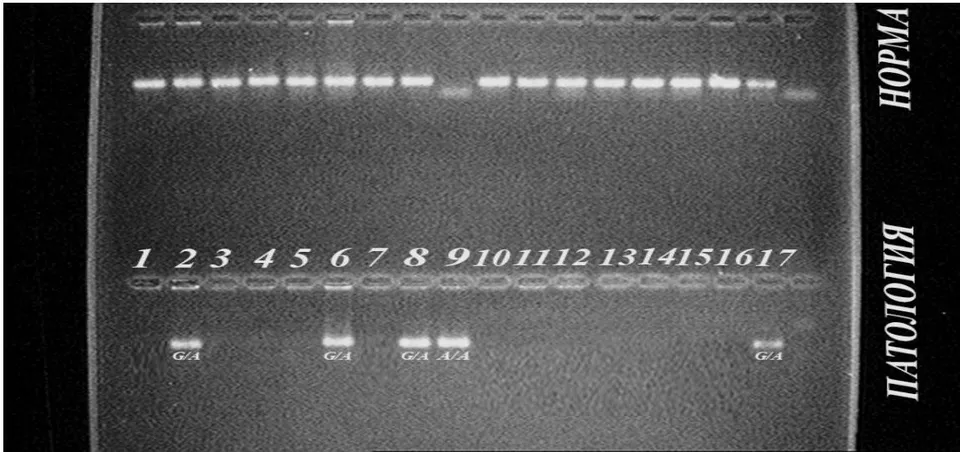
Electropherogram detection of rs2046934 polymorphism of the P2RY12 gene in the control group and in patients with road traffic accidents (see Figure 1).
a) Statistical analyses
Statistical processing of the obtained results was carried out on a personal computer using the programs "OpenEpi 2009, Version 2.3". To determine the differences in the frequency of occurrence of genotypes between the study groups, Fisher's exact test was used. The correspondence of the distribution of genotypes in the examined groups to the canonical distribution of Hardy-Weinberg was assessed using the test. Differences between groups were statistically significant at .
III. RESULTS AND DISCUSSIONS
Studying the clinical manifestations of the disease, it was revealed, that road traffic accidents, regardless of hereditary or acquired nature, are mainly manifested by nosebleeds (59.0%) and petechial rash on the skin (38.0%). However, at the same time, it is important to note that NDTP proceeds with more pronounced hemorrhagic manifestations, observed in 56.0% of cases already in preschool and 44.0% at school age. Whereas ADTP in the main (70.0% of cases), manifested itself in the adult period of life. Along with this, with increasing age, the DTP acquires a more severe course, which is confirmed by the significantly expressed and increase in the number of hemorrhagic clinical manifestations of the disease (p>0.05). In particular, road traffic accident patients with a median age of years more often had one clinical symptom, patients with a median age of had two symptoms, while patients with a median age of the disease manifested itself with three symptoms.
The results of studying the peculiarities of the P2RY12 gene polymorphism (rs2046934) revealed in the main group of road traffic accidents an increase in the proportion of the unfavorable allele A by 2.24 times ( ) in relation to the control, which indicates the presence of a tendency towards the risk of developing this disease. At the same time, a statistically insignificant 1.57-fold increase in the frequency of the heterozygous G/A genotype was observed in the group of patients ( ). In addition, the increase among patients with road traffic accidents of the mutant genotype A/A ( ) indicates the presence of a tendency to increase the risk of developing the disease (see Table 1).
| No | Group | n | Allele frequency | Genotype distribution frequency | ||||||||
| G | A | G/G | G/A | A/A | ||||||||
| n | % | N | % | n | % | n | % | n | % | |||
| 1 | Main group DTP | 71 | 118 | 83,1 | 24 | 16,9 | 51 | 71,8 | 16 | 22,5 | 4 | 5,6 |
| A | HDTP | 39 | 63 | 80,8 | 15 | 19,2 | 27 | 69,2 | 9 | 23,1 | 3 | 7,7 |
| B | ADTP | 32 | 55 | 85,9 | 9 | 14,1 | 24 | 75,0 | 7 | 21,9 | 1 | 3,1 |
| 2 | Control group | 48 | 88 | 91.7 | 8 | 8.3 | 40 | 83,3 | 8 | 16,7 | 0 | 0 |
The study of the associative relationship between the carriage of an unfavorable allele A and the risk of road traffic accidents showed that in the subgroup of patients with HDTP, this allele significantly increases the risk of developing the disease by 2.62 times ( ; P=0.035; OR=2.62; 95% CI: 1.05-6.55). In the subgroup of ADTP patients in carriers of the unfavorable allele A, the risk of developing the disease increased by 1.8 times, but this was not significant ( ; P=0.25; OR=1.8; 95% CI: 0.66-4.94).
The study of the associative relationship between the carriage of the heterozygous genotype G/A
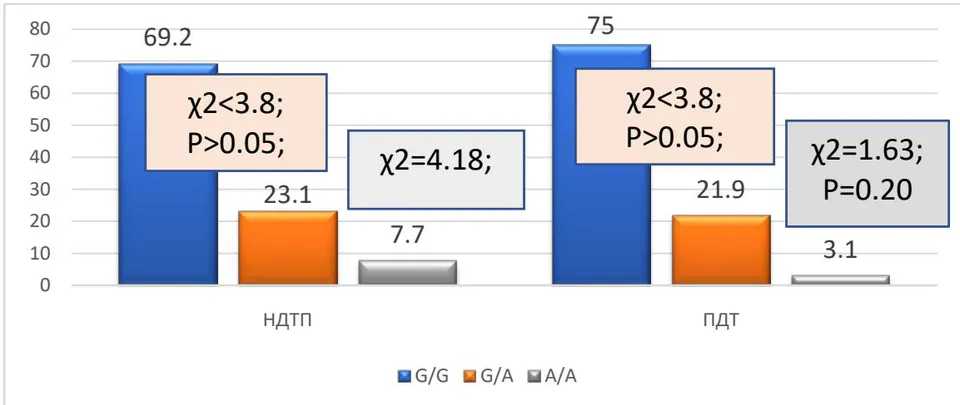
The results of a comparative analysis of the frequency and structure of carriage of the polymorphism of the genes of the platelet receptor P2RY12 (rs2046934) in patients with NDTP and in relatively healthy individuals allowed us to establish the involvement of the mutant genotype A/A ( ; P=0.04) of the P2RY12 polymorphism (rs2046934) in the formation of NDTP in individuals Uzbek ethnic group.
Thus, the results showed that the P2RY12 gene polymorphism (rs2046934) is an independent marker of an increased risk of developing a hereditary form of dysaggregation thrombocytopathy, and does not act as an independent genetic marker in the development of the acquired form of disaggregated thrombocytopathy in persons of the Uzbek ethnic group.
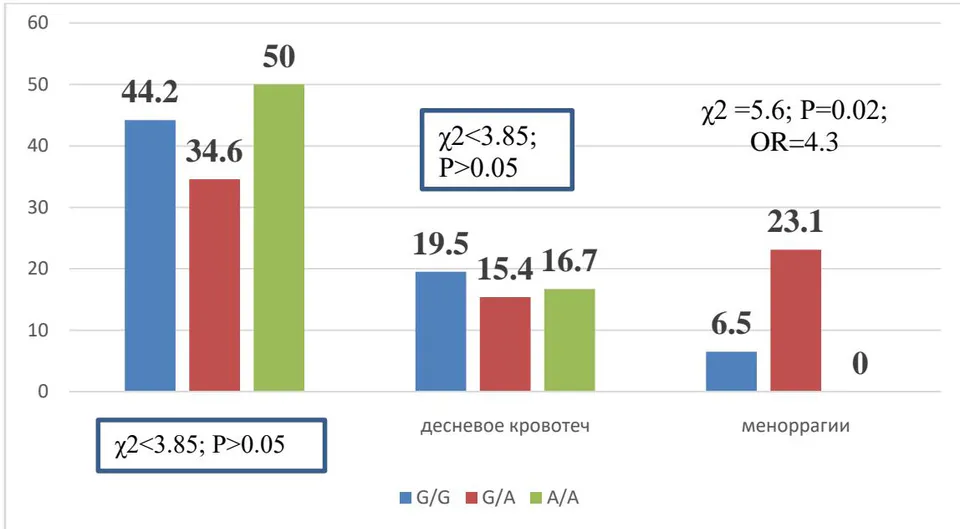
At the same time, we studied the presence of a possible association of the molecular genetic marker P2RY12 of platelet dysfunction with the clinical manifestations of road traffic accidents. The study showed that there was a significant relationship between the carriage of an unfavorable heterozygous G/A genotype of the rs2046934 polymorphism of the P2RY12 gene in patients with a hereditary form of road traffic accidents and the frequency of menorrhagias ( ; P=0.02; OR=4.3) and the absence of a significant association with respect to other clinical signs with carriage unfavorable genotypes of the studied genes ( ; P>0.05) (see Figure 3).
IV. CONCLUSIONS
It is known that the platelet receptor P2RY12, being bound to the G-protein, is responsible for the enhancement and completion of platelet aggregation by inhibiting adenylate cyclase, leading to limitation of the activity of protein kinase A by dephosphorylation of phosphoprotein and activation of phosphoinositol-3-kinase and small guanosine triphosphotics. A genetic defect or exogenous inhibition of the P2RY12 platelet receptor leads to a pronounced impairment of platelet aggregation .
It was found that the genetic predisposition to the development of disaggregation thrombocytopathies for the rs2046934 polymorphism of the P2RY12 gene is reliably associated with the functionally unfavorable homozygous genotype A/A, which is expressed especially in patients with hereditary disaggregation thrombocytopathies, however, carriers of an unfavorable heterozygous genotype have an extremely low risk of developing aggregation disorders.
Thus, as a result of the study, it was established that the development of road traffic accidents is genetically determined. A significant association of the risk of menorrhagia in patients with NDTP with polymorphism of the platelet receptor gene P2RY12 (rs2046934), which is involved in the main pathogenetic mechanisms of platelet dysfunction, was revealed. The results obtained make it possible to use this genetic marker as a prognostic factor for the formation of hereditary road traffic accidents and the identification of risk groups for the development of the disease in persons of the Uzbek ethnic group.