Atmospheric tank projects cover a wide range of technical characteristics, ranging from their purpose, according to the regulatory framework, the type of product stored, the technical characteristics of the tank to serve this storage with structural safety and finally the devices and technical resources to make the equipment financially and economically viable and sustainable. As a basis for criteria for this assessment, the correct regulatory framework for each type of tank, based on its application, as well as the correct selection of material for its performance and life expectancy, were addressed. Performance improvement criteria were also evaluated, such as the correct sizing of the tank inlet, outlet and vent nozzles, the use of sensors and devices and equipment to avoid overpressure or vacuum and the use of internal floating roofs. In addition, environmental criteria were also presented, such as the correct selection of tank colors and the assessment of their area of incidence of solar radiation.
## I. INTRODUCTION
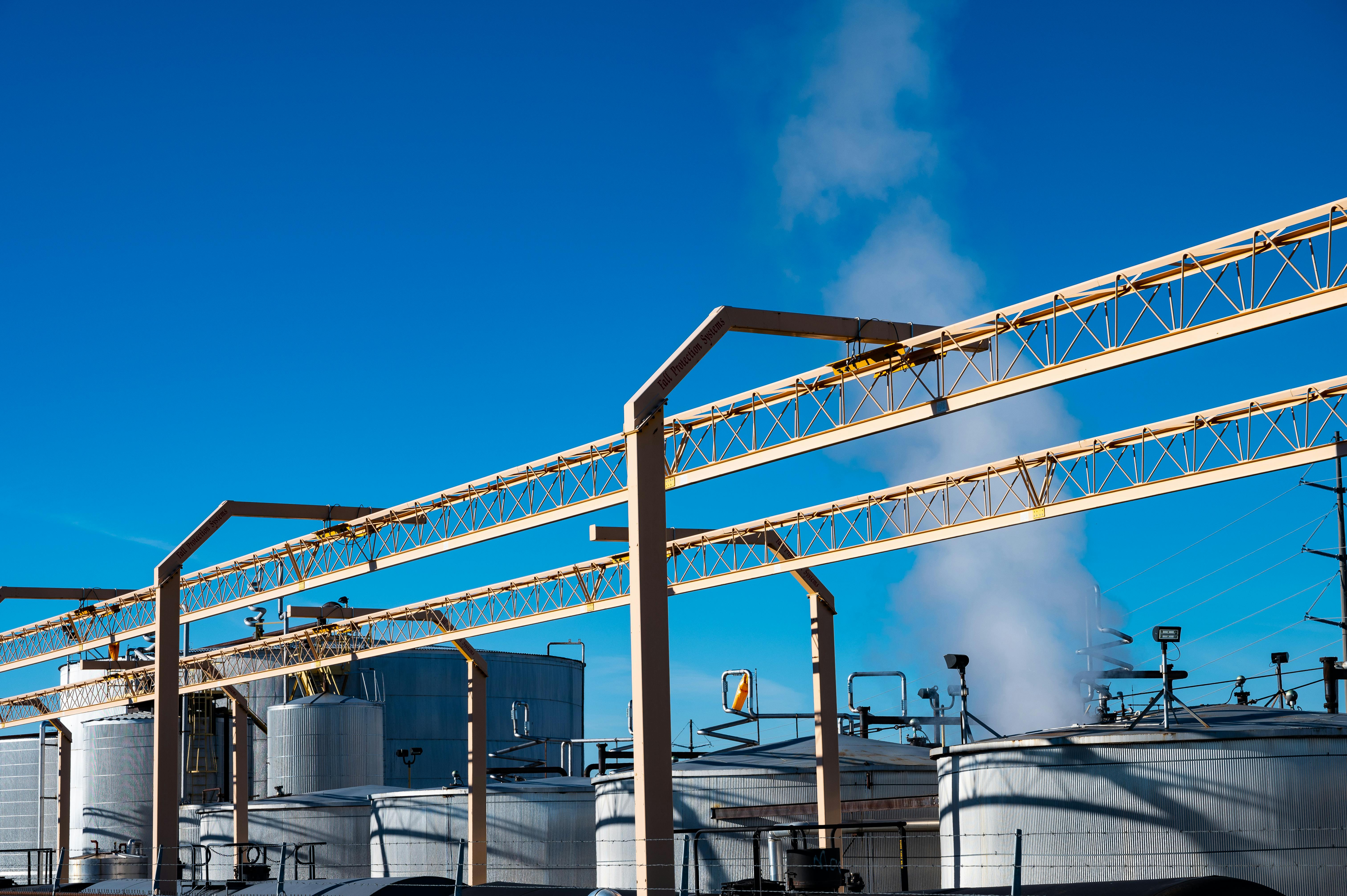
Equipment classified as atmospheric tanks for storing products in general has a long history and importance in supplying industrial and urban centers around the world. Its conglomerates (tank parks) usually have a very specific objective and are usually directly related to the petrochemical industry (CASTILHO, 2018). However, the applicability of atmospheric tanks is very wide, having strong importance in several industries such as chemistry, paper, bioenergy, thermoelectric and sugar and alcohol plants, biofuels, food and even in firefighting, which can range from industrial to commercial.
The design of atmospheric storage tanks can be basically divided into: bottom, side, roof, metal structures and nozzles (GUIZZE, 1989). In addition to the different design variables, ranging from dimensional, stored product, temperature and pressure conditions, construction material and others, there are also conditions for each component of the tank.
The bottom can be classified by patterns of "annular plates" or rectangular plates, depending on the welding characteristics between the bottom and the side, as this is the most fragile region of the tank (MAIA and AURELIO, 2012; CONTEC, 2010). The sidewall has different methods of calculating sheet thickness: like the more traditional 1-foot method; the variable point method, the appendix A and the appendix S methods (LIMA et al., 2014; COSTA, 2011). The metallic structures, which are usually selected according to the customer's standard, must observe the minimum loads of standards such as NBR 8800 (ABNT, 2007), as well as safety standards NR 18 (BRASIL, 1978).
With regard to accessories, for example for nozzles, which are generally directly linked to the operating standard of the place where the tank is installed, they may have manholes and cleaning ports meeting the minimum quantities required or according to the customer's standard, generally being $180^{\circ}$ out of phase around the tank, to ensure air flow (BARROS, 2003).
The different types of ceilings vary according to project definitions, stored product, and local characteristics. The influence of the choice of roof type on the composition of the tank has consequences on the storage efficiency during the useful life of the equipment (API-650, 2010). The main types of ceilings (self-supporting conical, supported conical, self-supporting dome, external floating, internal floating and aluminum geodesic dome). According to Oliveira (2017), the proper choice of the roof of storage tanks reduces the emission of volatile organic compounds (VOC).
The fugitive emission of VOCs from storage tanks can lead to different air pollution problems, with harm to people's health, impacts on flora and fauna, degradation of materials and climate change. Studies carried out by Wei et al (2014) at an oil refinery in Beijing showed that the tank park contributed with $18.3\%$ of the refinery's VOC emissions. Chen et al (2019) evaluated the presence of VOCs in a region close to an industrial complex in central Taiwan and found that 23 to $32\%$ of the pollutants identified in the region came from an industrial source - refinery and petrochemicals. In addition, to the environmental issue, according to Oliveira (2017) the release of these compounds means economic loss of volatilized products.
The establishment of environmental criteria, in addition to economic ones, are important for the development of hydrocarbon storage tank projects to minimize the environmental impact of tank parks due to the fugitive emission of VOCs. In this context, the objective of this study was to propose a preliminary analysis that considers financial costs, technical and structural safety, as well as the environmental impact of tank sizing. The analysis also included suggestions for accessories that improve the tank's performance and promote the reduction of energy losses and fugitive emissions from the tank throughout its useful life.
In this way, the tank design parameters were organized to establish a methodology for the project that considered in its development, the normative framework, the product characteristics, the construction materials and boundary conditions (accessories for performance improvement), without forgetting the environmental impacts. This analysis will enable the dimensioning of equipment with adequate costs in its construction (financial criterion), guarantee of durability during its period of operation (technical criteria) of operation and better energy conditions (environmental criteria), bringing environmental and economic gains throughout its operation. In this sense, this study presents some important guidelines in relation to the framework in technical standards; product features; material selection, accessories for performance improvement; painting; adequate selection of the irradiation area to contemplate the environmental criteria in the design of hydrocarbon storage tanks.
## II. ESTABLISHMENT OF DESIGN CRITERIA FOR STORAGE TANKS
When checking the construction standards for tanks, the design criteria for the equipment are predominantly functional and economic, with no emphasis on issues related to air pollution caused by emissions related to this equipment. The evaluation of VOC emissions in different types of hydrocarbon storage tanks indicates that the application of some constructive criteria can represent considerable environmental advantages, with associated economic advantages.
### a) Criterion in Relation to Compliance with Technical Standards
Atmospheric tanks have a wide range of applications, and their designs range from small low-volume tanks (from 1 to $100\mathrm{m}^3$ ) used in small industries for storing small amounts of oil, chemical products and even water to large volume tanks (above $60,000\mathrm{m}^3$ ) applied to the petrochemical, oil and gas industry.
Therefore, it is essential to have a correct normative framework to establish a project optimized. Among the most widely used and well-known Brazilian standards for tank design, the NBR-7821 is cited (ABNT,
1983)and the complementary standard N-270 (PETROBRÁS, 2020), Petrobras' internal standard, which is most used as a reference. In addition to these, the standards of the American Petroleum Institute, USA, API-650 (API, 2010) and API-653 (API, 2009) are considered, the first being aimed at new projects and the second for tank renovations. These four standards deal specifically with tanks for the oil and gas industry.
However, in addition to these four standards, we can also cite other standards, such as the American standard NFPA 22 (NFPA, 2013) for tanks of fire-fighting systems, the European standard EN-1993-4-2 (EN, 1999) and the American standard AWWA D-100-96 (AWWA, 1997) intended for water storage tanks. These standards apply only to welded tanks, there are also specific standards for bolted, riveted, helical mounting and "Australian" type tanks.
In these standards, the methodology and calculation have the same technical basis. In general, the hydrostatic pressure of the product to be stored is related to the mechanical resistance of the thickness of the cylindrical body of the tank. What differentiates the standards is the safety factor adopted by the standard, which normally allows for the determination of minimum working thicknesses of the tank. With the exception of the EN-1993-4-2 (EN, 1999) standard, which, in addition to basic calculations, allows for a more refined dimensioning since it considers the calculation of resistance by finite elements that allows a more precise calculation when performed by experienced designers, as it does not apply simplifications common in standards to its design, which, as they always work with a safety margin, normally end up over-dimensioning the project.
Therefore, observe it should be noted that, for each tank application, the standard that best fits its functionality must be correctly selected, in order not to oversize the tank thicknesses when applying a more rigorous standard, incurring in greater consumption of metal for the construction of the tank and unnecessary costs. In this way, the use of an adequate standard makes the project sustainable and of lower cost. The study of the cited norms provided the elaboration of Table 1, which allows a comprehensive vision and an initial reference for the analysis of the designer. In this analysis, it was considered that small tanks are those with a capacity of less than $200\mathrm{m}^3$. This type of tank can be purchased ready-made, that is, without the need for assembly at the installation site.
Table 1: Normative framework criteria depending on the usefulness of the tank
<table><tr><td>Application</td><td>Product</td><td>Size</td><td>Standard</td></tr><tr><td rowspan="2">Chemical
alcohol plants
Biofuels
Thermoelectric</td><td rowspan="2">Naphtha (Gasoline)
Diesel
aviation kerosene</td><td>Big</td><td rowspan="2">API-650, API-653, NBR 7821 and N-270</td></tr><tr><td>Small</td></tr><tr><td rowspan="2">Paper And Cellulose
Heavy Chemical
Industry</td><td rowspan="2">Biodiesel
Alcohol</td><td>Big</td><td rowspan="2">API-650 (Appendix A)</td></tr><tr><td>Small</td></tr><tr><td rowspan="2">Paper And Cellulose
Water treatment</td><td rowspan="2">White liquor
Black Liquor
Assorted chemicals (acids, caustic soda, solvents, etc.)</td><td>Big</td><td>API-650, API-653, NBR 7821 and N-270</td></tr><tr><td>Small</td><td>API-650 (Appendix A)</td></tr><tr><td rowspan="2">Chemical
alcohol plants
Biofuels
Thermoelectric</td><td rowspan="2">Industrial Water</td><td>Big</td><td>AWWA D-100-96</td></tr><tr><td>Small</td><td>EN-1993-4-2</td></tr><tr><td rowspan="2">Water for industrial use</td><td rowspan="2">Industrial Water</td><td>Big</td><td>AWWA D-100-96</td></tr><tr><td>Small</td><td>EN-1993-4-2</td></tr><tr><td rowspan="2">Drinking water</td><td rowspan="2">drinking water</td><td>Big</td><td>AWWA D-100-96</td></tr><tr><td>Small</td><td>EN-1993-4-2</td></tr><tr><td rowspan="2">Food industry</td><td rowspan="2">Processed and Ultra-processed for
consumption</td><td>Big</td><td>AWWA D-100-96</td></tr><tr><td>Small</td><td>EN-1993-4-2</td></tr><tr><td rowspan="2">Fire Fighting</td><td rowspan="2">Firefighting system water</td><td>Big</td><td rowspan="2">NFPA-22</td></tr><tr><td>Small</td></tr></table>
### b) Criterion in Relation to the Selection of Materials
Similarly, each design has an optimal solution for tank construction materials, considering the product stored and the expected service life of the tank. Fuel storage is done in carbon or stainless-steel tanks to reduce corrosion problems, but according to Komariah et al (2023) corrosion is still one of the main problems found in fuel tanks. In this way, the selection of the correct material is fundamental in the sizing of the storage tank. The analysis of the most suitable types of steel for the construction of storage tanks for different products in order to avoid corrosion processes led to the elaboration of Table 2.
Table 2: Criteria for choosing construction material depending on the application of the tank
<table><tr><td>Application</td><td>Product</td><td>Material</td><td>Internal painting</td><td>Corrosion over thickness</td><td>Observation</td></tr><tr><td>Oil and Gas</td><td rowspan="2">Naphtha (Gasoline) Diesel aviation kerosene Biodiesel Alcohol</td><td rowspan="2">Carbon steel</td><td rowspan="2">Yes</td><td rowspan="2">1 to 2 mm</td><td rowspan="2">Preferably A-36 due to its normative condition of greater resistance</td></tr><tr><td>Chemical alcohol plants Biofuels Thermoelectric</td></tr><tr><td rowspan="2">Paper And Cellulose Heavy Chemical Industry</td><td rowspan="2">White liquor Black Liquor Miscellaneous chemicals (acids, caustic soda, solvents)</td><td>Carbon steel</td><td>Yes</td><td>above 3mm</td><td>Preferably A-36 due to its normative condition of greater resistance</td></tr><tr><td>304L stainless steel</td><td>No</td><td>-</td><td>The use of stainless steel only due to the corrosivity of the chemical</td></tr><tr><td>Paper And Cellulose Water treatment</td><td>Industrial Water</td><td>Carbon steel</td><td>Yes</td><td>1 to 2mm</td><td>Preferably A-36 due to its normative condition of greater resistance</td></tr><tr><td>Water for industrial use</td><td>Industrial Water</td><td>Stainless Steel 439.</td><td>No</td><td>-</td><td>The use of stainless steel depending on water quality</td></tr><tr><td>drinking water</td><td>drinking water</td><td rowspan="2">Stainless Steel 304 or 316.</td><td rowspan="2">No</td><td rowspan="2">-</td><td rowspan="2">The use of stainless steel due to the potability of the water</td></tr><tr><td>Food industry</td><td>Processed and Ultra-processed for consumption</td></tr><tr><td>Fire Fighting</td><td>Firefighting system water</td><td>Carbon steel</td><td>Yes</td><td>1 to 2 mm</td><td>Preferably A-36 due to its normative condition of greater resistance</td></tr></table>
Based on Table 2, the designer obtains initial guidance on the most suitable materials and finishes for the project. However, it should be noted that the designer's final decision must consider the specifications and particularities of the product (if any) and the minimum requirements of the customer.
### c) Criteria for using Accessories to Improve Performance
Although the influence of tank accessories, for example nozzles and internal floating roofs, is low when considering the total weight of the tank. Consequently, the direct cost of acquiring the tank is little affected, but the correct sizing of the accessories and their application can bring benefits in the operation of the tank and increase its useful life.
In order to assess the influence and impact of accessories on the performance of the tank, these criteria were subdivided into sizing of the inlet and outlet nozzles and the breather valve, use of accessories and sensors and use of internal floating roofs.
## i. Inlet, Outlet and Tank Breather Nozzles
The filling, outlet and breather nozzles directly interfere with the exchange of emissions with the environment and, consequently, must be well dimensioned to avoid air pollution. Incorrect sizing of these can deform the structure of the tank (see Figure 1), in addition to increasing emissions into the environment, with consequent environmental and economic impact. To guarantee the performance and safeguard the integrity of the tank against operational damage such as: corrosiveness in the nozzles due to abrasion, under pressure or vacuum; proper sizing of nozzles and vents is essential.
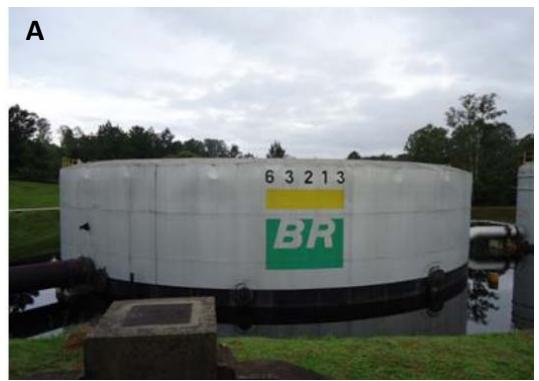
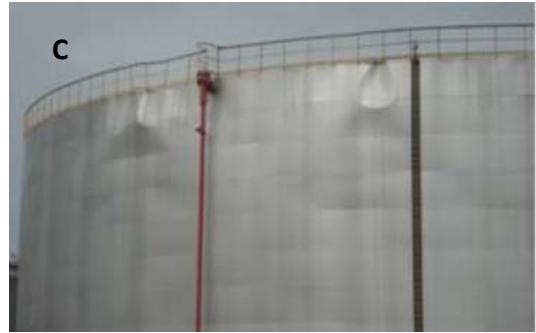
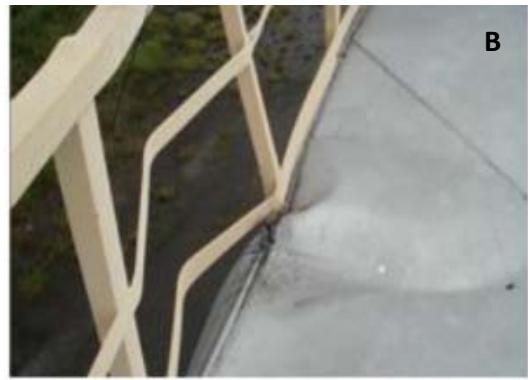
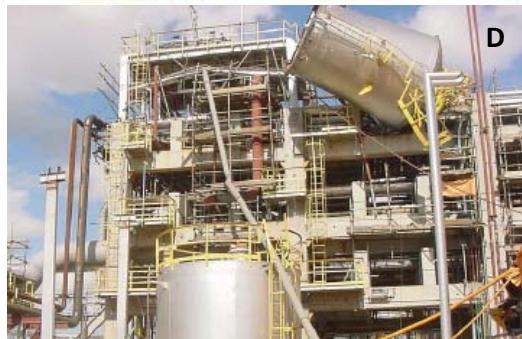
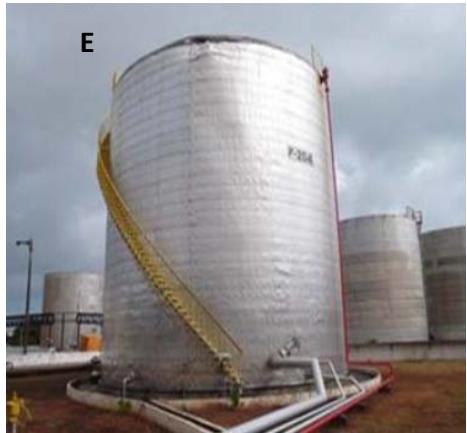
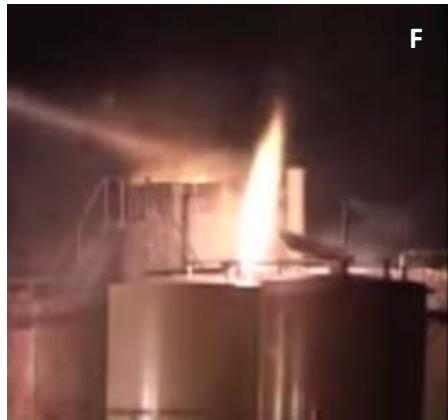 Figure 1: Examples of overpressure or vacuum situations in tanks
(A) Vaporization of stored liquid due to steam or condensate leakage from heating system in REPAR - Curitiba/PR - BRAZIL. (B) High temperature variation in RNEST - Ipouca/PE - BRAZIL. (C) Pumping above the pressure admitted by the tank in RLAM - São Francisco do Conde Bahia/BA - BRAZIL. (D) Tank inertization with racket relief valves, preventing its operation in REFAP - Canoas/RS - BRAZIL. (E) Sudden vaporization of water inside the tank in LUBNOR - Mucuripe/CE - BRAZIL. (F) Start of fire, flow through the emergency valve in LAMESA TEXAS - USA. Source: Vector-Mathias (2015)
The dimensioning of nozzles and vents for fuel storage tanks - and other chemical products - is essential for reducing emissions. And, when associated with the other criteria evaluated in this study, emissions losses are minimized. The use of criteria provides sustainability and economy during the useful life of the tank, especially in tank farms.
The correct sizing of the inlet and outlet nozzles and the tank vent is carried out based on the flow rates of the pumps used for filling and temperature variations. The sizing of breather valves is done by API-2000(2009). Table 3 indicates the factors that must be evaluated for sizing the nozzles and the vent depending on the fluid that will be stored inside.
Table 3: Optimum fluid velocities, for calculating the pipe size based on the flow of the filling and emptying pumps
<table><tr><td>Fluid</td><td>Economy Speed (m/s)</td><td>Piping Material</td></tr><tr><td>Water for general services</td><td>0.9 to 2.5</td><td>Steel</td></tr><tr><td>Water for industrial network</td><td>0.9 to 2.2</td><td>Steel</td></tr><tr><td>pump suction line</td><td>0.9 to 2.2</td><td>Steel</td></tr><tr><td>Pump discharge line</td><td>2.1 to 3.0</td><td>Steel</td></tr><tr><td>Hydrochloric acid</td><td>15</td><td>rubber coating</td></tr><tr><td>Sulfuric acid 88% to 98%</td><td>1.2</td><td>Cast iron</td></tr><tr><td>Ammonia</td><td>1.8</td><td>Steel</td></tr><tr><td>Benzene</td><td>1.8</td><td>Steel</td></tr><tr><td>chlorine</td><td>1.5</td><td>Steel</td></tr><tr><td>Chloroform</td><td>1.8</td><td>Copper and Steel</td></tr><tr><td>Sodium Hydroxide 30%</td><td>1.8</td><td>Steel</td></tr><tr><td>30% to 50% Sodium Hydroxide</td><td>1.5</td><td>Steel</td></tr><tr><td>Sodium hydroxide from 50% to 73%</td><td>1.2</td><td>Steel</td></tr><tr><td>Lubricant</td><td>1.8</td><td>Steel</td></tr><tr><td>Fuel oil</td><td>1.8</td><td>Steel</td></tr><tr><td>Brine (CaCl2)</td><td>1.2</td><td>Steel</td></tr><tr><td>Carbon tetrachloride</td><td>1.8</td><td>Steel</td></tr><tr><td>ethylene trichlor</td><td>1.8</td><td>Steel</td></tr></table>
## ii. Using Accessories and Sensors
Just as it is good sizing is necessary for the inlet and vent nozzles of the tanks, it is necessary to use sensors and devices for redundant guarantees against overpressure or vacuum, such as: pressure and vacuum relief valves, emergency pressure valves, high-level, high-high sensors, level radars, measuring rod and or pressure sensors, combined to guarantee overpressure or vacuum and temperature control. In this way all these items must be considered by the designer.
Accessories ensure efficient work of tanks, balance fluid fluctuations in the tank and regulate its internal pressure. The use of sensors allows activating and opening the accessories only, when necessary, thus reducing losses due to VOC emissions - air pollution - and, consequently, the environmental impact.
Therefore, care must be taken when calculating the thickness of the pressure relief valve cover, so that it does not cause mechanical damage due to non-opening or environmental damage due to unnecessary opening. The following example shows the correct sizing of the thickness of the pressure relief valve cover. Figure 2 shows the actions of pressure on the cover of an emergency valve, basically counterbalanced with the cover's own weight.
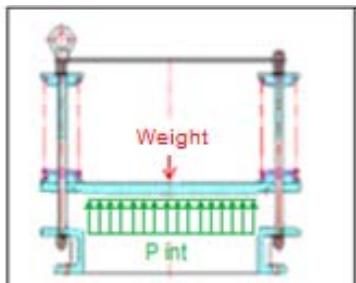
Therefore, we have the internal pressure $\mathrm{Pint} = 37\mathrm{mmca}$ or $37\mathrm{kgf / m^2}$ Considering the lid of a metal with a density $(\rho)$ of $7850\mathrm{kg / m^3}$ (carbon steel or stainless steel, for example), we will have its thickness determined by:
Thus, the pressure provided by the lid is its force weight divided by the area of the lid, or
Lid pressure $=$ Ptamp $\equiv$ F/A, with Weight Force $\mathbb{F} = \rho \mathbb{V}$ or $\rho^{*}\mathrm{e}^{*}\mathrm{A}$,with: V= lid volume and lid area and. So, Ptamp $\equiv$ P int $\equiv$ $\rho^{*}\mathrm{e}_{\parallel}$ from where: e=P int / $\rho$ (in m) (1) in our of our example: $e = 37 / 7850 = 4.71$ mm (4.75mm commercial thickness)
## iii. Internal Floating Ceilings
The internal floating roof has the objective of eliminating the vapor space between the seal and the surface of the stored liquid, to avoid the fugitive emission in the storage of fuels and chemical products with low vapor pressure. In this way, the use of this type of accessory reduces the emission of VOCs. According to Oliveira (2015), the application of internal floating roofs compared to fixed roofs provides a reduction in VOC emissions of up to $98\%$ on average, depending on the application conditions.
The application of internal floating roofs, in accordance with Appendix H of API-650 (API, 2010), has become a more practical alternative in terms of design, manufacture, assembly and costs in sizing tanks (LIMA et al., 2014). This type of ceiling is a simple construction device, lightweight and an excellent financial alternative for reducing emission losses (OLIVEIRA, 2017; OLIVEIRA, 2020a). Figure 32 illustrates the constructive details of the internal floating roof.
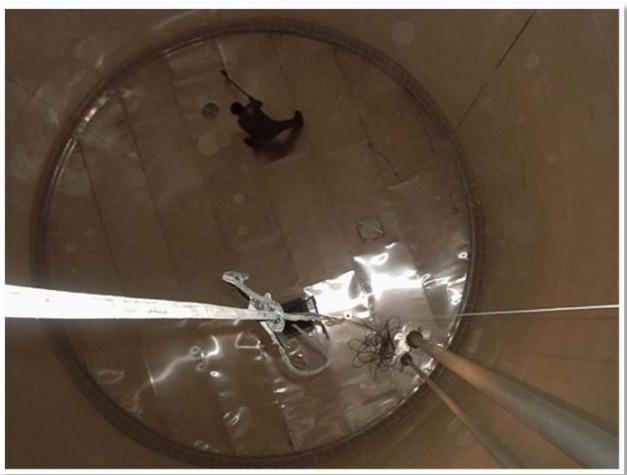 Figure 2: Examples of emergency relief valve sizing (Oliveira, 2020b)
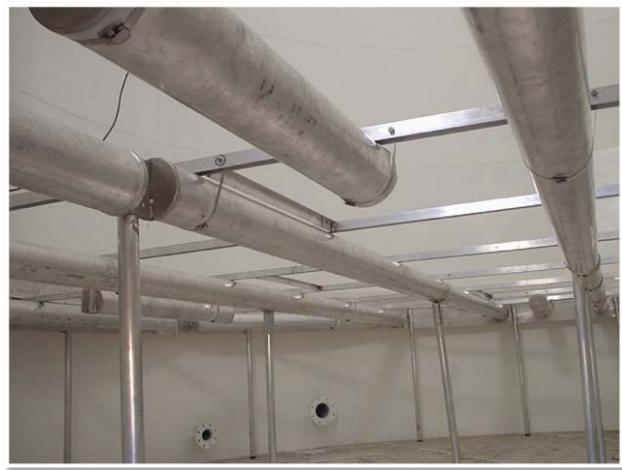 Figure 3: Constructive details of internal floating roof
Source: Vector-Mathias (2015)
Studies carried out by Oliveira (2020a; 2015) show that the more volatile the product stored and the larger the tank diameter, the efficiency of the internal floating roof will be better. Figure 4 illustrates the reduction in losses due to VOC emissions in tanks with and without floating roofs for alcohol and gasoline storage tanks.
Floating roofs bring benefits in firefighting in the NBR 17.505e (ABNT, 2006), because by reducing VOC emissions, it also reduces the area subject to explosion risks. The use of this type of ceiling can also be applied to other specific cases, such as the reduction of contamination of products with water - biodiesel or demineralized water - however these applications still need specific studies to prove the efficiency of internal floating ceilings.
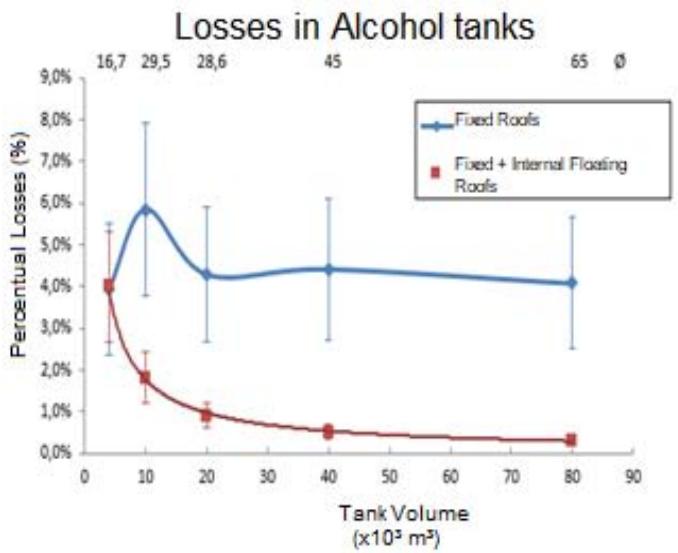
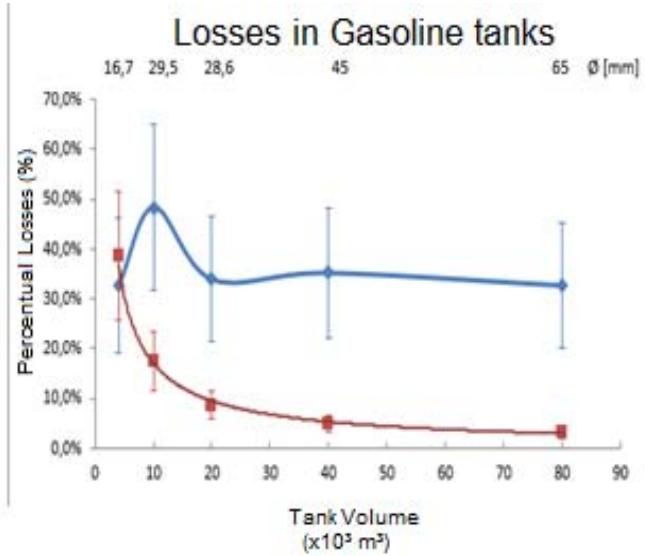 Figure 4: Reduction of emission losses in tanks with and without floating roofs
Source: Adapted from Oliveira, 2020a
### d) Environmental Criteria
In order to alert the designer to environmental and not only economic efficiency for the design of storage tanks, but this study also evaluated the influence of the external painting of the tanks and the area of solar irradiation.
## i. Appropriate Choice of Exterior Paint
The external painting of the fuel storage tank can have a big impact on the evaporative loss of stored products. According to Castilho (2018) losses can be reduced by up to $25\%$. According to the author, the darker the color of the paint adopted for the external painting, the greater the energy absorbed, and, consequently, the loss by evaporation of VOCs will increase.
Other factors must be considered when sizing the tank, such as the volatility of the stored product and the area to be painted in the tank, since the larger the area to be painted, the greater the influence of the choice of paint to reduce losses due to evaporation. The use of light colors – white or gray – is the most suitable for fuel storage (Table 4) and the choice of these colors for painting tanks with floating roofs is relevant for reducing VOC emissions during the useful life of the tanks. It is observed that in the case of fixed roof tanks the influence is very relevant, especially for gasoline storage.
For Castilho et al (2023) the use of white color in storage tanks, instead of gray, relatively common in tank parks, can represent a reduction of up to $40\%$ in VOC emissions. However, if there is an interest in the tank absorbing greater thermal energy to keep the product warm, such as the storage of biodiesel obtained from animal tallow, the use of dark colors will reduce the need for adding heat by through internal coils, with consequent environmental gain for the tank design.
Table 4: Influence of tank color to reduce losses from VOC Emissions
<table><tr><td>Product</td><td>Roof type</td><td>Color</td><td>Relevance</td></tr><tr><td rowspan="3">Gasoline</td><td>Fixed</td><td rowspan="3">White</td><td>H</td></tr><tr><td>External Floating</td><td>A</td></tr><tr><td>Internal Floating</td><td>A</td></tr><tr><td rowspan="3">Diesel</td><td>Fixed</td><td>White</td><td>A</td></tr><tr><td>External Floating</td><td>White or Gray</td><td>L</td></tr><tr><td>Internal Floating</td><td>White or Gray</td><td>L</td></tr><tr><td rowspan="3">Crude Oil</td><td>Fixed</td><td rowspan="3">White</td><td>A</td></tr><tr><td>External Floating</td><td>A</td></tr><tr><td>Internal Floating</td><td>A</td></tr></table>
H – High Relevance // A – Average Relevance // Low Relevance
Source: Adapted from Castilho (2023)
## ii. Evaluation of the Solar Irradiation Area
The solar irradiation area is obtained by evaluating the diameter/height ratio of the storage tank. With this analysis, it was concluded that, for the same volume, tanks with a smaller diameter/height ratio – smaller area of solar irradiation – provide reductions in VOC emissions. According to Castilho et al (2023) the reduction of emissions in gasoline storage tanks was around $40\%$ for tanks with an external floating roof and above $50\%$ in tanks with an internal floating roof.
The option for the smallest irradiation area allows the designer to obtain tank dimensions close to those that occupy a smaller surface area. And, therefore, the amount of sheet necessary for the construction of the tank and maintenance of the external coating will be smaller, consequently the cost for the construction of the tank will be lower. According to Castilho et al (2023) the use of tanks with the smallest irradiation area and in the appropriate amount can lead to reductions of up to $80\%$ of VOC emissions in the storage of gasoline and oil in a tank park, regardless of the type of ceiling adopted.
## III. CONCLUSIONS
The universe of data and information necessary for the proper sizing of a storage tank is very wide and the current tendency of projects is to use the API-650 and API-653 standards, which are complete standards, but designed for sizing tanks. to be installed in an industry where operational risks are greater and, consequently, the rigor required in sizing is also greater. However, it is observed that, in general, designers do not observe the other existing normative frameworks, which are equally competent in their specialties. This mistaken decision leads to the dimensioning of greater thicknesses, which increases the cost of the storage tank, due to the greater amount of metal for construction, which becomes unnecessary both from an economic and environmental point of view.
The sizing criteria, even being a preliminary analysis, will allow tank designers to avoid increasing the construction cost of the tank and minimize the environmental impact due to reduced emissions and energy loss. It is worth mentioning that for some situations of greater risk, such as flammable products, location of installation with unfavorable weather conditions and specificities of the industry, the analysis criteria must be complemented with specific information, however these do not invalidate the criteria proposed in this study. The environmental criteria identified in this study should not override other relevant criteria for the entrepreneur, such as logistics, maintenance, operational facilities and construction or installation. It is recommended that they be evaluated together with these, that is, that tank designs consider emission estimates when deciding on the best constructive alternative.
The list of criteria established in this work can also be complemented with the evaluation of other parameters, such as types of sealing, roofs supported by columns, types and number of accessories, relief valves with different pressures and tanks with geodesic fixed roofs according to the designer's assessment deems relevant for specific cases of tank sizing.
Generating HTML Viewer...
References
22 Cites in Article
Luiz Paulo Barcellos De Assis Jr (1983). DESAFIOS PARA A MANUTENÇÃO DA ADERÊNCIA À NORMA ABNT NBR ISO/IEC 17025 NO LABORATÓRIO DE ENSAIOS MECÂNICOS DA PONTIFÍCIA UNIVERSIDADE CATÓLICA DO RIO DE JANEIRO – PUC-RIO.
(2006). Development of ULC Standards for Underground Storage and Handling of Flammable and Combustible Liquids.
(2009). API-2000: Venting Atmospheric and Low-pressure storage Tanks.
(2009). API-650 Welded Tanks for Oil Storage. Standard body, chapters 1 to 10 and annexes: C -External Floating Roofs; G -Structurally-Supported Aluminum Dome Roofs.
Brazil (1978). Palmer, His Honour (Robert) Henry (Stephen), (13 Nov. 1927–27 July 2015), a Circuit Judge, 1978–93.
Barros (2003). SM Course on Storage Tanks.
J Castilho (2018). Establishment of criteria for the design of storage tanks based on the evaluation of the reduction of emissions of volatile organic compounds.
J Castilho (2023). Paints and varnishes � Determination of volatile organic compounds (VOC) and/or semi volatile organic compounds (SVOC) content.
Chun-Hao Chen,Yen-Chang Chuang,Chu-Chin Hsieh,Chih-Sheng Lee (2019). VOC characteristics and source apportionment at a PAMS site near an industrial complex in central Taiwan.
(null). Eurocode 3. Design of steel structures.
A Guizze (1989). Manual of Heat Exchangers, Vessels and Tanks.
Ln; Komariah,S Arita,B Prianda,Dewi (2023). TK Technical assessment of biodiesel storage tank; A corrosion case study.
Maria Do Nascimento,José Almeida E Silva,Adriano Lucena,Lêda Lucena,Stephanny Do Egito Costa (2014). Comportamento mecânico de misturas asfálticas recicladas com uso de compactação por impacto e por amassamento.
Ediná Alves Costa,Eliana Auxiliadora Magalhães Costa,Mariluce Karla Bomfm De Souza,Patrícia Sodré Araújo,Gisélia Santana Souza,Yara Oyram Ramos Lima,Bianca Maria Santos Da Paz (2012). Desafos à atuação dos trabalhadores de Vigilância Sanitária nos serviços de saúde.
Oliveira (2015). RAA Mathematical model for environmental and financial evaluation of the application of emission control devices in storage tanks: internal floating roofs.
Oliveira (2017). RAA Use of TANKS Software to calculate emissions in tanks.
Raphael Oliveira,Mônica Kolicheski,Mauricy Kawano (2020). Using software tanks for emission calculation in storage tanks.
Oliveira (2020). RAA Practical example of calculation, sizing and testing for emergency valves in tanks NBR 7821 (API 650).
(2020). N-270 -Atmospheric Storage Tank Project.
Silva Telles (1999). Metallic industrial piping.
Vector-Mathias (2015). Reference material and company information.
W Wei,S Cheng,G Li,G Wang,H Wang (2014). Characteristics of volatile organic compounds (VOCs) emitted from a petroleum refinery in Beijing, China.
Explore published articles in an immersive Augmented Reality environment. Our platform converts research papers into interactive 3D books, allowing readers to view and interact with content using AR and VR compatible devices.
Your published article is automatically converted into a realistic 3D book. Flip through pages and read research papers in a more engaging and interactive format.
Atmospheric tank projects cover a wide range of technical characteristics, ranging from their purpose, according to the regulatory framework, the type of product stored, the technical characteristics of the tank to serve this storage with structural safety and finally the devices and technical resources to make the equipment financially and economically viable and sustainable. As a basis for criteria for this assessment, the correct regulatory framework for each type of tank, based on its application, as well as the correct selection of material for its performance and life expectancy, were addressed. Performance improvement criteria were also evaluated, such as the correct sizing of the tank inlet, outlet and vent nozzles, the use of sensors and devices and equipment to avoid overpressure or vacuum and the use of internal floating roofs. In addition, environmental criteria were also presented, such as the correct selection of tank colors and the assessment of their area of incidence of solar radiation.
Our website is actively being updated, and changes may occur frequently. Please clear your browser cache if needed. For feedback or error reporting, please email [email protected]
Thank you for connecting with us. We will respond to you shortly.