I. INTRODUCTION
Safety concern in construction industry is key because it is a means of preventing accidents on site and from structural collapses, defects in buildings among others. It is the basis of design of structures by the engineer to ensure structural stability, durability, serviceability and safety in their life span without endangering life or yielding to adverse condition easily(Gilbert et. al. 2017). Hence, buildings are defined as structures for human activities, which must be safe for the occupants (Odulami, 2002). In the light of that designs are accompanied by strict detailed specification to be followed in executing whatever project in question to avoid collapse and defects such as excessive cracking and deflection during and after execution. However, safety consciousness of operatives in construction is rather not encouraging. Hamid et al. (2008) found from a study in Malaysia that construction site accident results from workers' negligence, failure to obey work procedures, failure to use personal protective equipment, low knowledge and skill level of workers and poor workers' attitude to safety. Similarly, Fordjour (2015) in Ghana concluded that poor health and safety performance was due to negligence/ carelessness on the part of construction managers and workers. If operatives ignore simple personal safety, would they be concerned with the safety of the structure they are working on? Would they pay particular attention to given specifications of the projects they work on? Can there be a link between observation of personal safety and innate adherence to project specification? The effect could result in collapse of buildings killing the occupants(e.g., MELCOM Limited shop in Ghana in 2012 leading to 14 deaths and 70 injuries (Asante and Sasu, 2018)and loss of investment. According to Windapo and Rotimi (2012) majority of structural collapses in Nigeria were attributable to human action or inaction, including largely poor supervision and workmanship, disregard for approved drawings and faulty designs (Windapo and Rotimi, 2012); non-compliance with building specifications and regulations (Oloyede et al., 2010). Ghana recorded 123 injuries and 28 deaths from year 2000 to 2016 out of fifteen (15) reported structural collapses. Out of the fifteen collapses, eight (8) occurred in the capital city (Accra) and its suburbs (Asante and Sasu, 2018). Similarly, Bangladesh recorded 1000 injuries and 150 deaths in 2013 as a result of the collapse of an eight-storey factory building (Asante and Sasu, 2018). These collapses were blamed on the use of weak materials, neglect of proper building procedure, negligence on the part of operatives among others. To curb this, prevention through strict observance of safety regulation is paramount.
Personal and Project Safety are crucial in structural construction, and whereas extensive studies have been conducted in the past on personal safety, none so far have been done on the project safety. For example Abdelhamid and John (2000) found that the major factors affecting unsafe condition include actions and inactions of Management; unsafe behaviour of workers and unsafe working site conditions. This study therefore aimed to determine the attitude of operatives to safety on construction site, and if the attitude affects adherence to project structural specification during construction to ensure safety of structures. Specifically determined operatives' level of attitude to safety; how operative groups and education level affect safety attitude; and if attitude to safety and supervision affects adherence to project structural specifications.
II. PROPOSED FRAMEWORK
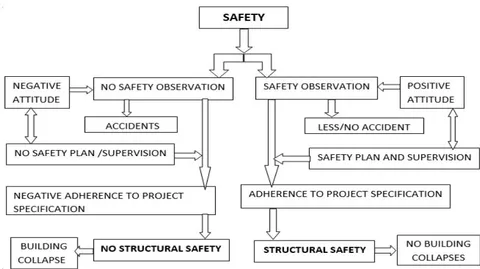
The model illustrated in figure 1 presents the argument for this study. Conscious Safety Observation may reflect in Adherent to Project Structural Specification. The resultant effect would be attainment of safe structure to preventing cracks, defects and possible collapse of buildings; while accident cases lessen. However, attitude can affect safety observation while safety plan coupled with supervision may be influencing factors to safety attitude and the relationship between safety observation and adherence to project structural specification. Operatives may be conscious of safety because of strict supervision and implementation of safety rules on site, and vice versa (Akortia, 2020).
III. METHODOLOGY
The Population considered for the study consists construction operatives (management and labour teams) working on public and private projects in Ghana. A total of 110 participants were conveniently but randomly selected, however, 101 responded to the questionnaire. They were predominantly male workers and mature adults who were largely Ghanaians (Akortia, 2020). Their responses were analyzed to form the basis for findings of this study. Survey design was used with questionnaire (open/close) to collect data from operatives on selected construction project sites except store keepers and security officers. The questionnaire was in two major parts, demographic and constructs-attitude to safety and adherence to structural specification - questions. As a procedure, list of ongoing projects were taken from selected District Assemblies which were further selected at random and narrow down to eight (8) state projects and total of fourteen (14) private projects from communities in which the state projects were located for observation. At every site, self-introduction was made and questionnaire distributed and explained where necessary while observing kingly activities on site. Respondents who could not read and write were supported. The responses were scored and analyzed for discussion. The Scoring was in two parts. The demographic part of the questionnaire helped in categorization of respondents and the construct questions were scored on a 5 point Likert scale in both direct and reverse manner depending on the direction of the specific question. Descriptive, Student 't' test, one way ANOVA, correlation and hierarchical multiple regression were used to analyze the data.
IV. ANALYSIS OF RESULTS
a) Demographics
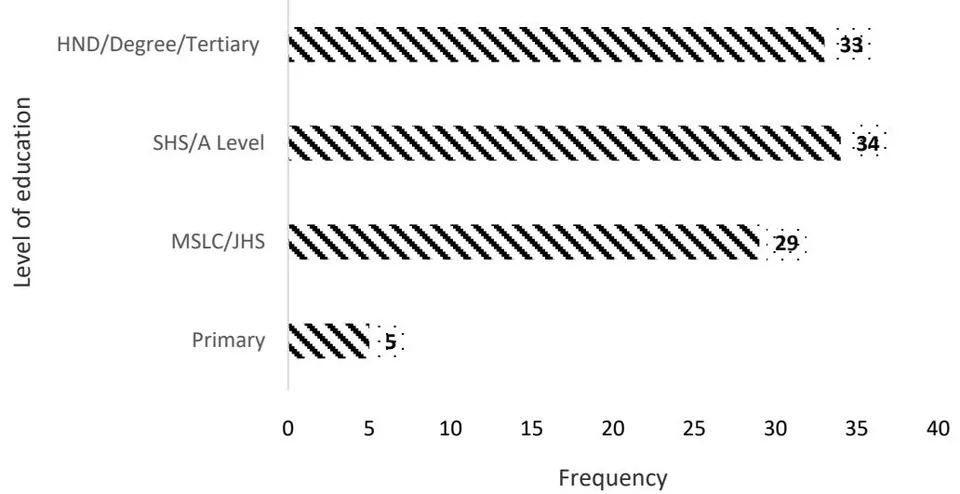
A total of 101 (92%) recovery of the data instrument was made out of 110 participants. Respondents were largely males(91% of respondents) and adult Ghanaian (84% of respondents against 14% Togolese) of various levels of formal education. Private (14) and 8 government projects were considered. Out of 91% male, 39% and 61% for government and private projects respectively. Two categories of labour team 61 and management team 40 respondents in all were observed. Figure 2 indicates that 33.7% (34/101) and 32.7% (33/101) of the respondents had Secondary and Tertiary educations respectively, while 33.6% (34/101) had elementary education. Thus every one of the respondents has some level of formal education which is a good sign to the industry, especially where good number of them had secondary and tertiary education.
b) Attitude to Safety
Table 1 presents Student 't'test result in which the mean M = 55.82 (Sd = 16.16) and a test value of 51. The result, , P < 0.05 disclosed that the mean value was significant at 0.05 level of significance. Consequently the respondents have significantly or largely Good Attitude to safety
| Item | N | Mean | Std | df | t | p-value | p | Test value |
| General Attitude to safety | 101 | 55.82 | 16.16 | 100 | 2.99 | 0.003 | <0.05 | 51 |
However, from table 2, the score of Management team on the attitude scale largely influenced Good Attitude to safety than that of Labour
| Category | N | Mean | sd |
| Labour team | 61 | 51.02 | 16.27 |
| Management team | 40 | 63.16 | 13.08 |
| Total | 101 | 55.82 | 16.16 |
From Table 3 the results , P < 0.05 indicates that significant difference exists between Labour and Management teams at 0.05 level of
| Group | Sum of squares | df | Mean | F | p-value | p |
| Between groups | 335.71 | 1 | 3556.71 | 15.61 | 0.00 | <0.05 |
| Within groups | 22552.08 | 99 | 227.80 | |||
| Total | 26108.79 | 100 |
F is test statistic
Similarly, as illustrated in table 4, respondents with tertiary education show better attitude to safety than those with pre-tertiary education as confirmed in table 5.
| Education level | N | Mean | sd |
| Primary | 5 | 43.80 | 10.92 |
| MSLC/JHS | 29 | 51.72 | 16.58 |
| SHS/A & O levels | 34 | 54.74 | 16.28 |
| Tertiary | 33 | 62.36 | 14.28 |
| Total | 101 | 55.82 | 16.16 |
| Group | Sum of squares | df | Mean square | F | p-value | p |
| Between groups | 2661.95 | 3 | 887.32 | 3.67 | 0.015 | <0.05 |
| Within group | 23446.85 | 97 | 241.72 | |||
| Total | 26108.79 | 100 |
From table 5 the result , P < 0.05 indicates a significant difference exists between at least two of the means of the educational levels on Attitude to Safety. From the post hoc results in Table 6, the values F = 7.92, P > 0.05; F = 10.94, P > 0.05 and F = -3.01, P > 0.05 indicates that there is no significant difference between the mean attitude to safety score of pre-tertiary groups. However, the result , and indicated a significant difference between the tertiary group and pre-tertiary educational levels compared at 0.05 level of significance.
| Educ. level | 1 | 2 | 3 |
| Primary | |||
| MSLC/JHS | -7.92 | ||
| SHS/A & O levels | -10.94 | -3.01 | |
| Tertiary | -18.56* | -10.64* | 7.63* |
This may be due to the higher level of knowledge they probably acquire along their educational ladder about the importance of safety and their experiences. So this class of operatives with tertiary education in the industry must be empowered to ensure observation of safety regulation during construction process through resources and further refresher programs.
c) Project Structural Specification Adherence
The result of , P < 0.05 shown in table 7 indicated that the respondents' adherence to project structural specification is high since the mean value was significant at 0.05 level of significance.
| Item | N | Mean | Std | df | t | p-value | p | Test value |
| Specification adherence | 101 | 68.22 | 13.90 | 100 | 8.11 | 0.00 | <0.05 | 57 |
However, from Table 8, result , P > 0.05 indicates that respondents disregard observation of project details during construction as a safety measure at 0.05 level of significance
| Item | N | Mean | Std | df | t | p-value | p | Test value |
| Project Details as safety? | 101 | 2.85 | 1.13 | 100 | -1.33 | 0.00 | >0.05 | 3 |
This finding is an indication of the need for immediate reorientation of players in construction to begin thinking that adherence to project structural specification is equally a safety measure to ensure safety of structures.
Pearson's correlation of general attitude to safety, management attitude to safety supervision and project structural specification was tested and the results are presented in table 10.
Test for normality and homogeneity using skewness and kurtosis was within the acceptable range of (Tabachnick et al. 2007) while the Crombach alpha ( ) indicates the reliability of constructs as illustrated in table 9.
| Min | Max | Mean | SD | Skewness | Kurtosis | Cronbach alpha (α) | N | |
| Knowledge of safety | 29 | 56 | 47.34 | 5.831 | 0.352 | 0.255 | 0.77 | 101 |
| General Attitude to safety | 28 | 82 | 55.82 | 16.16 | -0.331 | 0.210 | 0.84 | 101 |
| Managt Attitude to safety | 20 | 69 | 48.66 | 15.03 | -0.331 | 0.210 | 0.87 | 40 |
| Safety supervision | 8 | 30 | 22.91 | 6.51 | 0.811 | 0.396 | 0.81 | 40 |
| Adherence to project specification | 40 | 91 | 68.22 | 13.90 | 0.111 | 0.509 | 0.73 | 101 |
| Variables | 1 | 2 | 3 | 4 | 5 | |
| 1 | Knowledge of safety | - | ||||
| 2 | General Attitude to safety | 0.72** | - | |||
| 3 | Management Attitude to safety | 0.68** | 0.83** | - | ||
| 4 | Safety supervision | 0.64** | 0.78** | 0.96** | - | |
| 5 | Adherence to project specification | 0.57** | 0.80** | 0.57** | 0.59** | - |
Results from table 10 indicate that almost all the independent variables related significantly with at least one dependent variable as a requirement to analyze for moderation (Holmbeck, 1997). The descriptive result is detailed in Table 9.
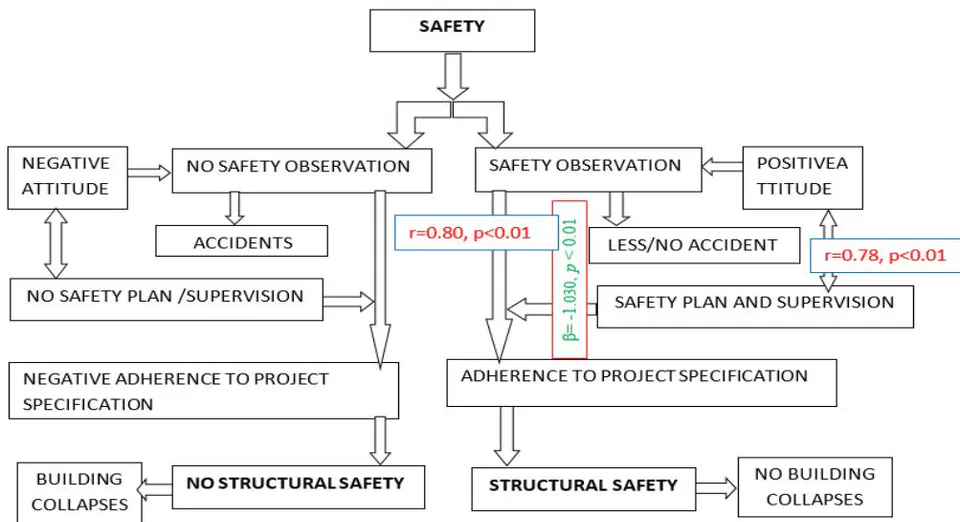
The results of Pearson correlation are given in table 10. The value r=0.80, N=101, p<0.01 indicates a very high/strong association (Davis, 1971) and positively significant correlation between attitude to safety and project structural specification adherence of the respondents at 0.01 significance level. Thus, an increase in the attitude to safety or positive safety behaviour results in increase in project structural specification adherence by operatives. Similarly, from the same table, Pearson's correlation, r=0.59, N=40, p<0.01 indicates a substantial association (Davis, 1971), significantly positive correlation between management attitude to safety supervision and project structural specification adherence at 0.01 level of significance. This shows that an increase in the management attitude to safety supervision would result in the increase project structural specification adherence and vice versa.
d) Influence of Safety plan/supervision on the relation between Safety Observation and Project Structural Specification Adherence
The hierarchical regression in which three distinct steps are stipulated was conducted. The main effect (Attitude to Safety) was entered first, the main effect of moderator (safety supervision) was entered second, and the interaction term (Attitude to Safety X Safety Supervision) was entered third (Aiken & West, 1991). The basic requirement for testing for moderation effect that there should be a relationship between the predictor variable(s) and the criterion variables (Holmbeck, 1997) was met as illustrated in Table 10 (correlation table). The results of the moderation analyzed are shown in Table 11.
| Model | B | Std. Error | β | P | |
| Step 1 | (Constant) | 57.723 | 3.388 | ||
| safety attitude | -0.403 | 0.07 | -0.434***0.000 | ||
| (Constant) | 32.856 | 5.582 | |||
| Step 2 | safety attitude | -0.237 | 0.076 | -0.255** | 0.002 |
| safety supervision | 0.406 | 0.076 | 0.436***0.000 | ||
| (Constant) | -3.157 | 14.071 | |||
| Step 3 | safety attitude | 0.636 | 0.323 | 0.684* | 0.051 |
| safety supervision | 1.264 | 0.318 | 1.360** | 0.000 | |
| safety attitude * safety supervision | -0.021 | 0.008 | -1.030**0.006 |
From Table 11, it can be inferred from the first step that Safety Attitude had a significant influence on Adherence to Project Specification ( , p < 0.001). In the second step, Safety Supervision also explained a significant increase in variance of Adherence to Project Specification ( , , p < 0.001). In the third step of the regression analysis, the interaction term between attitude to safety and Safety Supervision explained a significant increase in variance in Adherence to Project Specification ( ). Thus, Safety Supervision significantly moderated the relationship between Safety Attitude and Adherence to Project Specification such that Safety Supervision strengthens the relationship between Attitude to Safety and Adherence to Project Specification. Hence, safety plan/supervision will influence the relation between Safety Observation and Project Structural Specification Adherence.
e) Outcome of the Framework
V. DISCUSSION OF RESULTS
In the first place respondents generally exhibited good attitude to safety on site, and this was more obvious with the Management team than Labour team. This observation is inconsistent with Fordjour (2015) who concluded that poor health and safety performance was due to negligence and or carelessness on the part of construction Managers and workers. The present finding indicates that the both groups- management and labour teams – have relatively good Attitude to Safety but differ in reaction to safety guidelines.
Meanwhile Education influence on Attitude to Safety between pre-tertiary and tertiary groups of education is consistent with Gharibi et al. (2016) that as educational level increases workers' safety attitude correspondingly significantly changes positively. However, it does not support the education level among pre-tertiary groups, contradicting the conclusion of Gharibi et al. (2016) that either occupational accident experience or the level of education could affect positively on changing safety attitudes. So this class of operatives with high educational level in the industry must be empowered to ensure observation of safety regulation during construction process through resources and further refresher programs. According to Sanaei Nasab et al. (2009) it is of utmost importance to educate workers regarding the fact that level of knowledge or education about occupational health and safety enhances attitude to safety.
Furthermore, Adherence to Project Structural Specification by respondents is generally good on the adherence scale though they specifically disregard observation of project details as safety. Attitude to Safety and Safety Supervision positively and significantly correlate with Project Structural Specification Adherence. The significant positive correlation of the direct relationship between Attitudes to Safety, Safety Supervision and Specification Adherence variables is the primary reason for which nobody in the construction industry should take safety for granted. What it means is that reduction in either of these variables (Attitudes to Safety and Safety Supervision) may lead to reduction in the other (Specification Adherence) and the consequences may be detrimental to life and property. Hence, attitude such as Workers' negligence to Safety, Disregard for Work Procedures, Operating Equipment without Safety Devices, Poor Site Management, Harsh Work Operation, Low Knowledge and Skill level of Workers and Failure to use Personal Protective Equipment (Hamid et al., 2008); Disregard for Approved Drawings and Faulty Designs (Windapo and Rotimi, 2012); Non-compliance with Building Specifications and Regulations (Oloyede et al., 2010) should not be tolerated on projects
Finally, Safety Supervision significantly moderated the relationship between Attitude to Safety and Adherence to Project Structural Specification such that Safety Supervision strengthens the relationship between Attitude to Safety and Adherence to Project Specification. This is an indication that supervision has its own improving factor on the system to further perform better though from the above discussion, Observation of Safety/Attitude to Safety already has very high or strong association (Davis, 1971) and positive correlation with Project Structural Specification Adherence. Hence this is a revelation that a reduction in the strength of supervision would lead to reduction in Attitude to Safety and then Structural Specification Adherence, and vice versa. No wonder, Windapo and Rotimi (2012) indicated that majority of structural collapses in Nigeria were attributable to human action or inaction, including largely poor supervision and workmanship. Therefore, supervisors who have the most frequent contacts with workers should be the directly responsible persons to guarantee good safety performance on site (Hofmann et al., 2003; Kapp, 2012; Zohar, 2002). Thus, the better choice here is to encourage functioning supervision at all times to increase the probability of Adherence to both Safety measures and Project Structural Specifications.
VI. SUMMARY AND CONCLUSION
In conclusion, attitude to safety was generally good among the respondents especially the management team while level of education could not be left out in how they vary on attitude to safety between pre-tertiary and tertiary groups. Again, positive relationship exists between Attitude to Safety, Safety Supervision and Project Structural Specification Adherence. Finally, Safety Supervision significantly influences or moderates the relationship between Attitude to Safety and Adherence to Project Structural Specification. Hence the better choice here is encouraging functioning supervision at all times to increase the probability of adherence to both Safety measures and Project Structural Specifications. Thus, conscious Safety Attitude is a recipe for Project Structural Specification Adherence.
ACKNOWLEDGEMENT
I sincerely express my profound gratitude to my co-author, Prof. Charles Kwame Kankam for the time spent in addressing all the concerns and his encouragement.
I am also thankful to KafuiBuo and Sena Ama Buo for their immense advice, support and encouragement during my study.
I likewise express gratitude to Isaac Agbemafle, Emma Sekyere, John Dotse, Daniel Detor, Eddison-Mark Bodjawah, David Aidam, Rejoice Mordey, Nicholas Bagida, Emmanuel Banini, and Evans Biney for their diverse supports during the study. May God bless you allabundantly.