I. INTRODUCTION
According to A. Einstein's general theory of relativity, the speed of light in a vacuum is not a fundamental constant and can vary depending on the curvature of space [1]. Confirmation of this position is, for example, the experimentally established effect of gravitational lensing.
In [2], a four-dimensional model of space is considered, in which our three-dimensional Universe expands in the direction of an orthogonal fourth spatial dimension, and we perceive this movement as the passage of time. One of the consequences of this hypothesis is the conclusion about the low propagation speed of radiations with a large red shift.
These theoretical prerequisites justified the expediency of measuring the propagation speed of such radiation, which was fully confirmed as a result of the conducted experiment with relict background radiation [3]. Another confirmation of the validity of the hypothesis about the physical essence of time was the possibility of an extremely simple explanation for the abnormally high temperature of the solar corona [4] associated with the variability of the speed of light, which stimulated the need to search for new evidence.
Our Sun significantly bends the surrounding space, which, in accordance with the proposed hypothesis, suggests that radio emission originating in its interior also experiences a red shift due to the inclination of space at the point of origin and, accordingly, has a lower propagation speed compared to the speed of light, which has been experimentally verified.
II. METHOD AND EQUIPMENT OF THE EXPERIMENT
The principle of determining the propagation speed of radio emissions used in [3] is based on the difference in radiation speeds before and after reflection from the metal mirror of the antenna, as a result of which the primary relatively slow radiation interacts with electrons generating secondary radiation with the same frequency and propagating at the speed of light almost instantly from the mirror to the antenna irradiator. For any equal values of propagation speeds before and after reflection, the autocorrelation function (ACF) of a broadband noise signal should have the form of a -function, and with slower propagation of primary waves, it takes a triangular shape with a width equal to the time of their propagation from the near to far edge of the parabolic mirror of the antenna, which allows determining the propagation speed of the primary radiation by correlation time.
For the experiment, the same composition of equipment was used as in the study of relict radiation [3]: a parabolic offset antenna with a width of the main lobe of the radiation pattern of and an antenna depth in the receiving direction of , a converter with a noise coefficient of , a radio receiver carrying an input signal in the frequency range of and a 16-bit ADC with a sampling rate of . The continuous recording time of the signal was with a duty cycle of 12. The results were averaged over at least 50 implementations. The measurements were carried out in the mode of continuous pointing of the main beam of the antenna pattern at the Sun.
III. THE RESULTS OF THE EXPERIMENT
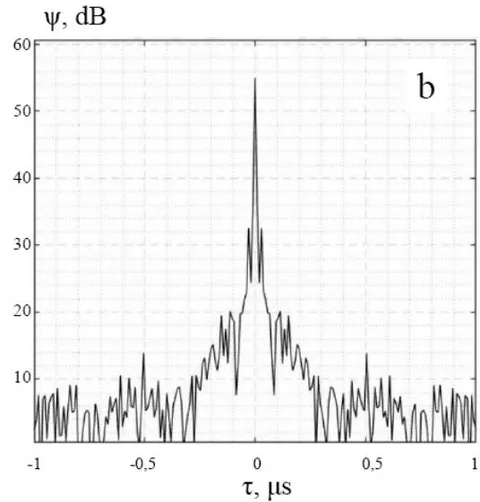
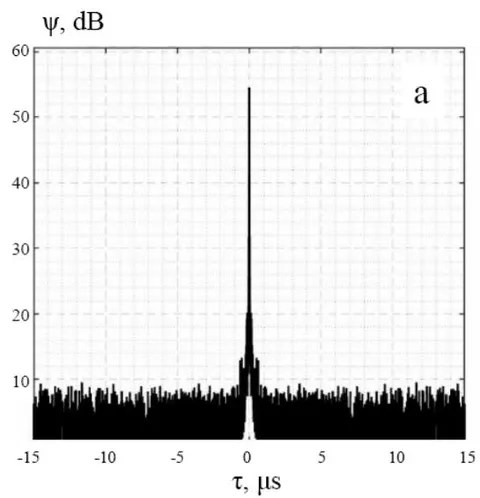
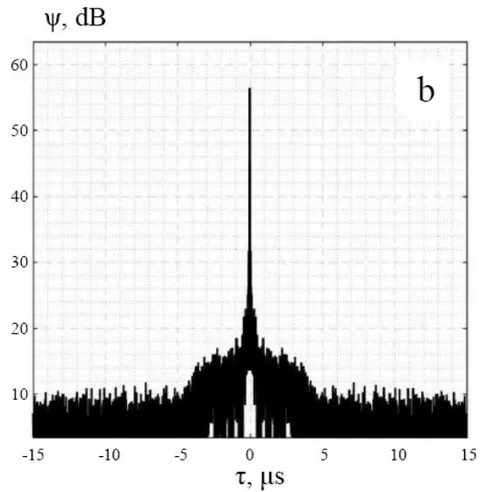
Fig. 1, a demonstrate as a reference, the average ACF of the radio emission of the clear sky, the level of which is about 8 dB less than the level of the radio emission of the Sun. The ACF of the Sun's radio emission in the complete absence of clouds is shown in Fig. 1,b.
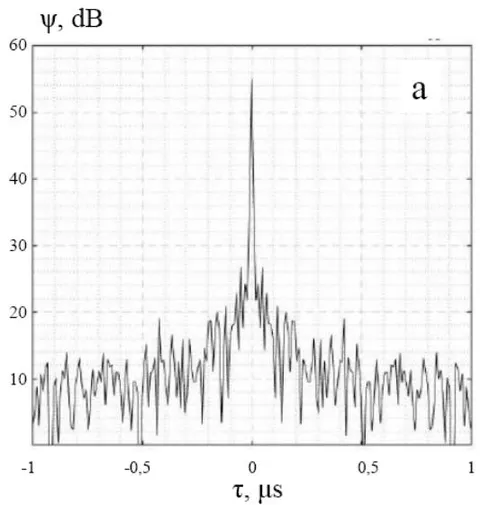
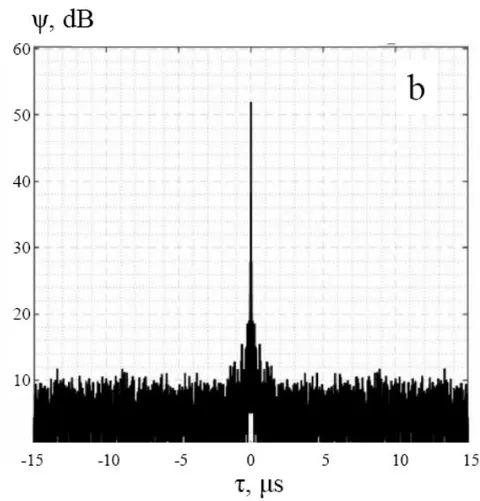
When clouds appear, the shape of the ACF of the Sun's radio emission changes. This is due to an increase in the path length of the rays in the atmosphere and the possibility of hitting the side lobes of the antenna radiation pattern due to refraction, as well as a lower propagation speed of radio waves compared to the usual speed of light. Indeed, if we take the maximum possible angle of refraction of radio emission at atmospheric in homogeneities equal to , the difference in the course of the rays can be no more than 40 m, i.e. 133 ns, which, at the accepted scale, would be impossible to detect in any of the figures below. Nevertheless, there is a clear increase in the width of the ACF by 10 - 15 times in proportion to the increase in inhomogeneities in the atmosphere, as shown in Fig. 2, 3.
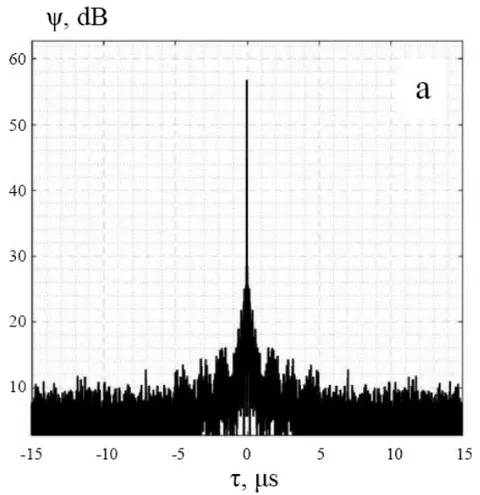
For comparison, Fig. 4 shows the ACFs of the relict background radiation under almost the same conditions [3].
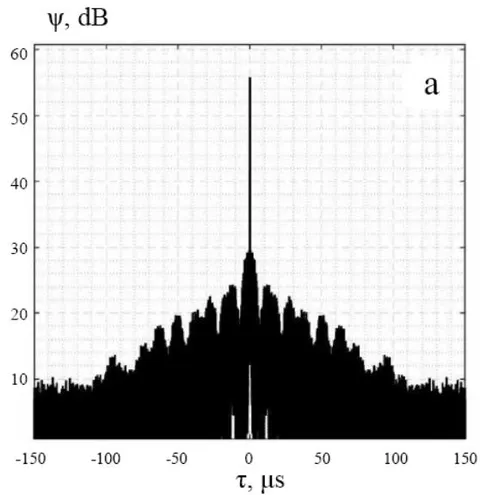
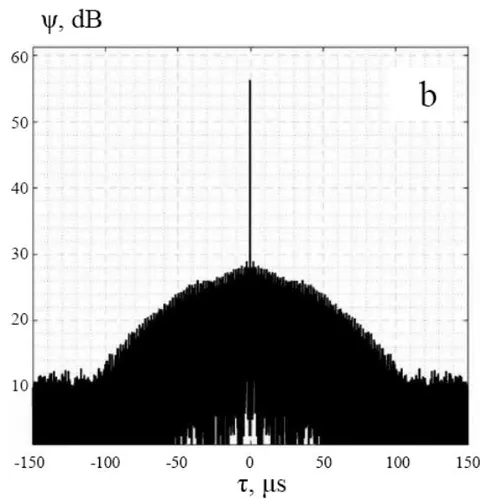
From the comparison of Fig. 3 and Fig. 4, it follows that the nature of the change in the shape of the ACF, depending on the density of clouds or turbulence of the atmosphere, does not change, i.e. the nature and magnitude of the refractive angles do not change, but the width of the ACF of the Sun's radio emission is about 20 times smaller, which corresponds to 20 times the value of its propagation speed. Considering that the established speed of propagation of the relict background radiation in the direction of the blue shift of the spectrum is [3], the propagation speed of the Sun's radio emission can be assumed to be approximately .
The propagation speed of the Sun's radio emission can also be determined by the width of the ACF with the most transparent atmosphere [3]. However, monitoring the state of the constantly changing atmosphere is a separate complex task, therefore, in accordance with Fig. 1,b, the width of the ACF under experimental conditions can be estimated at approximately . Given the possibility of turbulence expanding the ACF during signal averaging, the propagation speed of solar radio emission can be estimated at a value of at least km/s.
To exclude the influence of the atmosphere and more accurately measure the time of autocorrelation of solar radio emission, it is possible to carry out extra-atmospheric measurements.
The experimental speed estimates obtained in various ways are close in values, which allows us to conclude that they are correct and, consequently, that the propagation speed of solar radio emission is about
85 – 100 times less than the currently accepted value of the speed of light in a vacuum.
IV. CONCLUSION
The results of the conducted experimental studies allow us to conclude that the expected abnormally low propagation speed of solar radio emission in the 12 GHz range is approximately 3000 – 3500 km/s. Together with the previously obtained experimental value of the speed of propagation of relict background radiation equal to 123 km/s, this is an indisputable confirmation of the conclusions of the general theory of relativity about the limits of possible values of the speed of light and confirmation of the validity of the hypothesis about the physical essence of time, which is our perception of the expansion of the three-dimensional Universe in four-dimensional space, the conclusions of which are consistent with GRT.
The authors have no conflict of interest.
This work was done without financial support.
The data sets generated and analyzed during the current study are available from the author V.A.Tokarev upon reasonable request.