Autoridade Nao Hierarquica No Uso Dos Direitos Non Hierachical Authority in the Use of Rigths

α
Rafael Navarro
Rafael Navarro

Send Message

To: Author

Autoridade Nao Hierarquica No Uso Dos Direitos Non Hierachical Authority in the Use of Rigths

Article Fingerprint

ReserarchID

91QD8

Autoridade Nao Hierarquica No Uso Dos Direitos Non Hierachical Authority in the Use of Rigths Banner

AI TAKEAWAY

Connecting with the Eternal Ground
  • English
  • Afrikaans
  • Albanian
  • Amharic
  • Arabic
  • Armenian
  • Azerbaijani
  • Basque
  • Belarusian
  • Bengali
  • Bosnian
  • Bulgarian
  • Catalan
  • Cebuano
  • Chichewa
  • Chinese (Simplified)
  • Chinese (Traditional)
  • Corsican
  • Croatian
  • Czech
  • Danish
  • Dutch
  • Esperanto
  • Estonian
  • Filipino
  • Finnish
  • French
  • Frisian
  • Galician
  • Georgian
  • German
  • Greek
  • Gujarati
  • Haitian Creole
  • Hausa
  • Hawaiian
  • Hebrew
  • Hindi
  • Hmong
  • Hungarian
  • Icelandic
  • Igbo
  • Indonesian
  • Irish
  • Italian
  • Japanese
  • Javanese
  • Kannada
  • Kazakh
  • Khmer
  • Korean
  • Kurdish (Kurmanji)
  • Kyrgyz
  • Lao
  • Latin
  • Latvian
  • Lithuanian
  • Luxembourgish
  • Macedonian
  • Malagasy
  • Malay
  • Malayalam
  • Maltese
  • Maori
  • Marathi
  • Mongolian
  • Myanmar (Burmese)
  • Nepali
  • Norwegian
  • Pashto
  • Persian
  • Polish
  • Portuguese
  • Punjabi
  • Romanian
  • Russian
  • Samoan
  • Scots Gaelic
  • Serbian
  • Sesotho
  • Shona
  • Sindhi
  • Sinhala
  • Slovak
  • Slovenian
  • Somali
  • Spanish
  • Sundanese
  • Swahili
  • Swedish
  • Tajik
  • Tamil
  • Telugu
  • Thai
  • Turkish
  • Ukrainian
  • Urdu
  • Uzbek
  • Vietnamese
  • Welsh
  • Xhosa
  • Yiddish
  • Yoruba
  • Zulu

Abstract

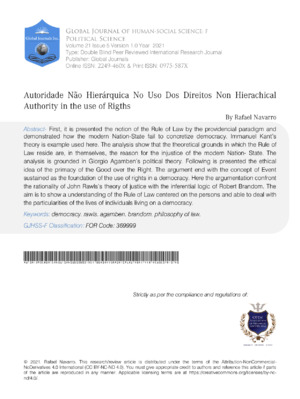
First, it is presented the notion of the Rule of Law by the providencial paradigm and demonstrated how the modern Nation-State fail to concretize democracy. Immanuel Kant’s theory is example used here. The analysis show that the theoretical grounds in which the Rule of Law reside are, in themselves, the reason for the injustice of the modern Nation-State. The analysis is grounded in Giorgio Agamben’s political theory. Following is presented the ethical idea of the primacy of the Good over the Right. The argument end with the concept of Event sustained as the foundation of the use of rights in a democracy. Here the argumentation confront the rationality of John Rawls’s theory of justice with the inferential logic of Robert Brandom. The aim is to show a understanding of the Rule of Law centered on the persons and able to deal with the particularities of the lives of individuals living on a democracy.

References

32 Cites in Article
  1. Giorgio Agamben (2014). Altíssima Pobreza.
  2. Giorgio Agamben (2004). Estado de Exceção.
  3. Giorgio Agamben (2010). GIORGIO AGAMBEN:.
  4. Giorgio Agamben (2015). Meios sem fim: notas sobre a política.
  5. Giorgio Agamben (2011). O reino e a glória: uma genealogia teológica da economia e do governo: homo sacer.
  6. Giorgio Agamben (2010). O que resta de Auschwitz: homo sacer III: o arquivo e a testemunha.
  7. Giorgio Agamben (2013). Opus Dei.
  8. Giorgio Agamben (2007). Profanações.
  9. Hannah Arendt (1958). Origins of Totalitarianism.
  10. Marco Zingano (2005). Dispersão categorial e metafísica em Aristóteles.
  11. Robert Brandom (2001). Articulating Reasons an introduction to inferentialism.
  12. Robert Brandom (1998). Making it Explicit Reasoning, Representing & Discursive Commitment.
  13. Robert Dahl (1982). Dilemmas of pluralist democracy.
  14. Ralf Dahrendorf (1958). Out of Utopia: Toward a Reorientation of Sociological Analysis.
  15. Donald Davidson (2001). Inquires into Truth and Interpretation.
  16. William Desmond (1995). The Metaxological.
  17. William Desmond (2000). Neither Deconstruction nor Reconstruction.
  18. William Desmond (1995). Agapeic Origin.
  19. Ronald Dworkin (2002). Levando os Direitos a sério.
  20. Paul Feyerabend (1993). Against method.
  21. Martin Heidegger (2010). Questão sobre a técnica.
  22. Martin Heidegger (1988). A Essência do Fundamento.
  23. Hans Kelsen (2009). Teoria Pura do Direito.
  24. Steven Levitsky,Daniel Ziblatt (2018). Como as Democracias Morrem.
  25. Alasdair Macintyre (2006). Ethics and Politics selected essays.
  26. Alasdair Macintyre (1991). Justiça de quem? Qual racionalidade?.
  27. John Owen (2010). The Clash of Ideas in World Politics Transnational Networks, States, and Regime Change, 1510-2010.
  28. John Rawls (1975). Fairness to Goodness.
  29. John Rawls (1971). Selected Bibliography on John Rawls: Post 1971.
  30. John Rawls (1988). The Priority of Right and Ideas of the Good.
  31. Amartya Sen (2011). The idea of justice.
  32. Quentin Skinner (1998). Liberty before liberalism.

Funding

No external funding was declared for this work.

Conflict of Interest

The authors declare no conflict of interest.

Ethical Approval

No ethics committee approval was required for this article type.

Data Availability

Not applicable for this article.

How to Cite This Article

Rafael Navarro. 2021. \u201cAutoridade Nao Hierarquica No Uso Dos Direitos Non Hierachical Authority in the Use of Rigths\u201d. Global Journal of Human-Social Science - F: Political Science GJHSS-F Volume 21 (GJHSS Volume 21 Issue F5): .

Download Citation

Alt="Academic journal cover on human rights and non-hierarchical authority analysis".
Issue Cover
GJHSS Volume 21 Issue F5
Pg. 27- 49
Journal Specifications

Crossref Journal DOI 10.17406/GJHSS

Print ISSN 0975-587X

e-ISSN 2249-460X

Keywords
Classification
GJHSS-F Classification: FOR Code: 369999
Version of record

v1.2

Issue date

September 28, 2021

Language
pt
Experiance in AR

Explore published articles in an immersive Augmented Reality environment. Our platform converts research papers into interactive 3D books, allowing readers to view and interact with content using AR and VR compatible devices.

Read in 3D

Your published article is automatically converted into a realistic 3D book. Flip through pages and read research papers in a more engaging and interactive format.

Article Matrices
Total Views: 1919
Total Downloads: 911
2026 Trends
Related Research

Published Article

First, it is presented the notion of the Rule of Law by the providencial paradigm and demonstrated how the modern Nation-State fail to concretize democracy. Immanuel Kant’s theory is example used here. The analysis show that the theoretical grounds in which the Rule of Law reside are, in themselves, the reason for the injustice of the modern Nation-State. The analysis is grounded in Giorgio Agamben’s political theory. Following is presented the ethical idea of the primacy of the Good over the Right. The argument end with the concept of Event sustained as the foundation of the use of rights in a democracy. Here the argumentation confront the rationality of John Rawls’s theory of justice with the inferential logic of Robert Brandom. The aim is to show a understanding of the Rule of Law centered on the persons and able to deal with the particularities of the lives of individuals living on a democracy.

Our website is actively being updated, and changes may occur frequently. Please clear your browser cache if needed. For feedback or error reporting, please email [email protected]

Request Access

Please fill out the form below to request access to this research paper. Your request will be reviewed by the editorial or author team.
X

Quote and Order Details

Contact Person

Invoice Address

Notes or Comments

This is the heading

Lorem ipsum dolor sit amet, consectetur adipiscing elit. Ut elit tellus, luctus nec ullamcorper mattis, pulvinar dapibus leo.

High-quality academic research articles on global topics and journals.

Autoridade Nao Hierarquica No Uso Dos Direitos Non Hierachical Authority in the Use of Rigths

Rafael Navarro
Rafael Navarro

Research Journals