


Article Fingerprint
ReserarchID
RE6Z8VI

Choose where you want to hide AI Takeaway. Your site-wide choice will be remembered in this browser.
The aim of this paper is to investigate the power factor correction (PFC) of Boost Converter under an average current-mode control. Boost converter topology is used to accomplish this active power-factor correction in many discontinues/ continuous modes. The boost converter is used usually it is easy to implement and works well. In this paper comparative evaluation of different techniques for harmonic reduction in input current of ac-dc converter is presented. Converters employing as side switching and boost converter is simulated in PSIM Software. Average current tracks the current program with a high degree of accuracy. This is especially important in high power factor pre-regulators, enabling less than 5% harmonic distortion to be achieved with a relatively small inductor. In fact, average current mode control function works well even when the mode boundary is crossed into the discontinuous mode at low current levels. The outer voltage control loop is oblivious to this mode change. Firstly I have simulated only single bridge rectifier without any use of converter to find the THD (Total Harmonic Distortion) at input and then applied open loop converter with single bridge rectifier to see how it affects the input THD and at last applied a converter with current control and voltage control loops so that to improve the input THD. A step change at Load end is applied and the result is displayed so that to show the response of the system to be stable. All the results are shown below in the paper.
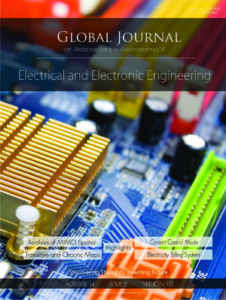
Kashif Habib. 2014. "Average Current Control Mode Boost Converter for the Tuning of Total Harmonic Distortion & Power Factor Correction using PSIM". Global Journal of Research in Engineering - F: Electrical & Electronic GJRE-F Volume 14 (GJRE Volume 14 Issue F5).
Crossref Journal DOI 10.17406/gjre
Print ISSN 0975-5861
e-ISSN 2249-4596
v1.2
Explore published articles in an immersive Augmented Reality environment. Our platform converts research papers into interactive 3D books, allowing readers to view and interact with content using AR and VR compatible devices.
Your published article is automatically converted into a realistic 3D book. Flip through pages and read research papers in a more engaging and interactive format.
Total Score: 133
Country: China
Subject: Global Journal of Research in Engineering
Authors: Kashif Habib, Aftab Alam, Shahbaz Khan (PhD/Dr. count: 0)
View Count (all-time): 389
Total Views (Real + Logic): 1532
Total Downloads (simulated): 86
Publish Date: 2014 01, Wed
Monthly Totals (Real + Logic):
We use cookies and similar technologies to improve site performance, understand traffic, and enhance your publishing experience. Cookie Policy
Choose which optional cookies Global Journals can use. Your preference applies across this platform and can be updated any time.
These cookies are required for core website functionality and security.

Lorem ipsum dolor sit amet, consectetur adipiscing elit. Ut elit tellus, luctus nec ullamcorper mattis, pulvinar dapibus leo.



