## I. INTRODUCTION
Cyclic loads have practical significance for solving many geotechnical engineering problems. Some examples of cyclic loads of non-endogenous origin are. A cyclic load can be caused by transportation movement (high-speed trains, maglev trains), industrial sources (crane rails, machine foundations), wind and waves (onshore and offshore wind turbines, coastal structures), or recurring filling and emptying processes (locks, reservoirs, and silos) [3-5]. Additionally, cyclic loads in soil are caused by construction processes (for example, vibration of sheet piles) and mechanical compaction (for example, vibriocception) [6]. Cyclic load can also be caused by endogenous sources. For instance, earthquakes lead to the propagation of shear waves in the soil, causing cyclic behavior [8-10]. The primary focus of geotechnical engineering is soil behavior related to foundations. The ultimate bearing capacity of foundations is considered by geotechnical engineers and researchers as a complex task. The self-weight of the structure, as well as the applied load, including cyclic loads, must be economically and safely transferred to the soil [11-13]. The ultimate bearing capacity of a foundation can be defined as the load at which shear failure occurs in the soil beneath the foundation. To date, a large number of numerical and experimental studies have been conducted to establish the bearing capacity of foundations on clayey soils [14-16]. In most cases, calculations of bearing capacity of foundation bases were evaluated using traditional theory, in which bearing capacity factors were employed. Elasticity theory, which considers soil as rigid, homogeneous, and isotropic, was also applied to simplify geotechnical practice [17-19]. However, soils consist of different layers underground; they are not simply stratified soils with varying depths and properties. Therefore, accounting for the effect of block-mode cyclic loading and its consequences plays an important role in geotechnical projects, where the behavior of clay soils under cyclic loading is a critical issue. Thus, the question arises about the need to develop a method for calculating settlement and bearing capacity of clay foundations under block-mode cyclic loading.
## II. MATERIALS AND METHODS
To determine the mechanical properties of soils, a series of tests is performed. Well-known methods are associated with the works of Professor I.T. Mirsayapov, his students, and others. An analysis of the capabilities of existing devices for cyclic testing led to the idea of developing a device that allows determining mechanical properties depending on cyclic loading. The choice of the type of loading was made based on the analysis of the stress-strain state (SSS) of the soil under cyclic action. Soils in nature are subjected to multicomponent loading, with the direction of principal stresses varying during the loading process. To study the influence of loading regime and stress state type on the strength and deformation properties of clay foundations, experimental investigations were conducted using triaxial compression devices and flume tests under
block cyclic loading conditions. The experimental research was carried out according to the program shown in Fig. 1.
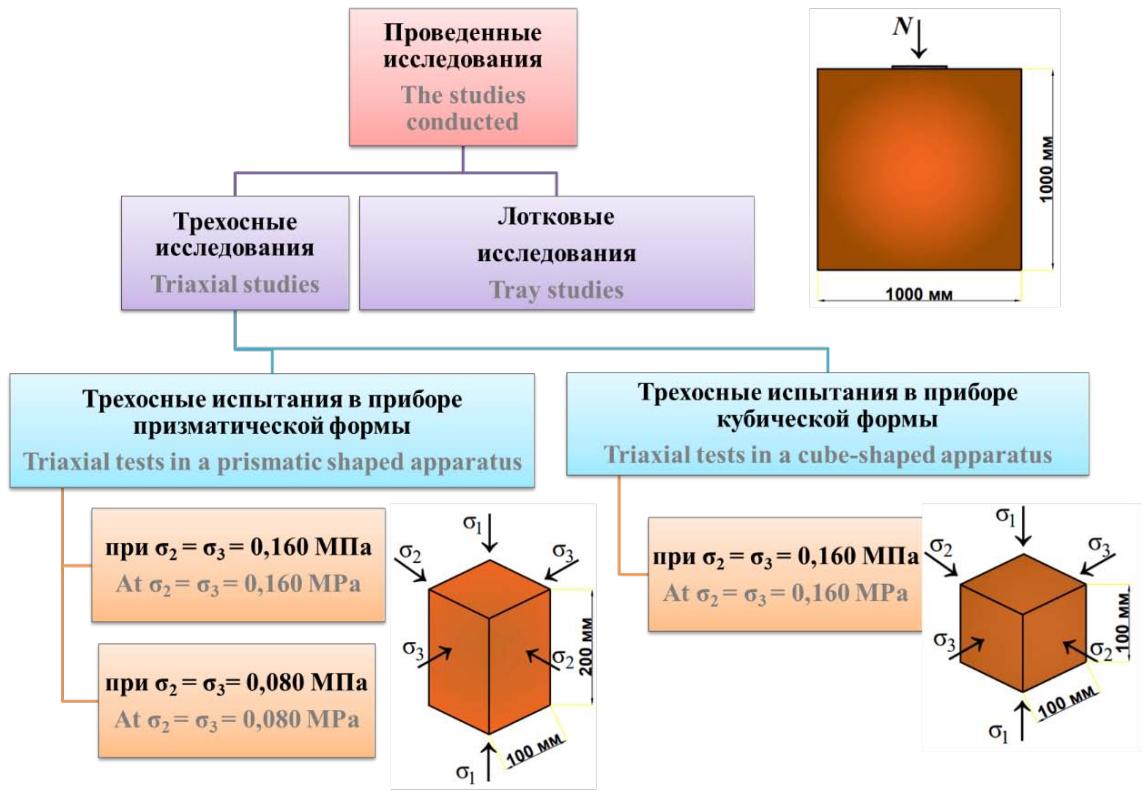 Fig. 1: Scheme of the experimental research program
To account for the influence of loading regimes on clay foundations, the loading regimes shown in Fig. 2 were adopted.
Semi-solid clay was used as the soil for testing. This material has the following characteristics: $\rho = 1.9$ g/cm3; W = 23%; WL = 38%; WP = 21%; plasticity index JP = 0.17 conventional units; liquidity index JL = 0.117 conventional units; friction angle j = 20°; cohesion C = 63 kPa.
The methodology for conducting experimental studies and the procedure for preparing the soil foundation were developed at the Department of Foundation Engineering, Dynamics, and Engineering Geology of Kazan State University of Architecture and Engineering (KGASU) by Professor I.T. Mirsayapov and his students.
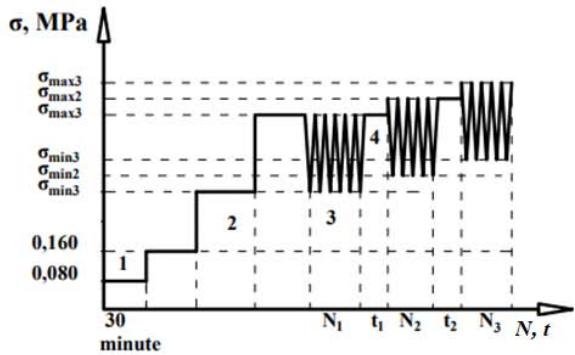
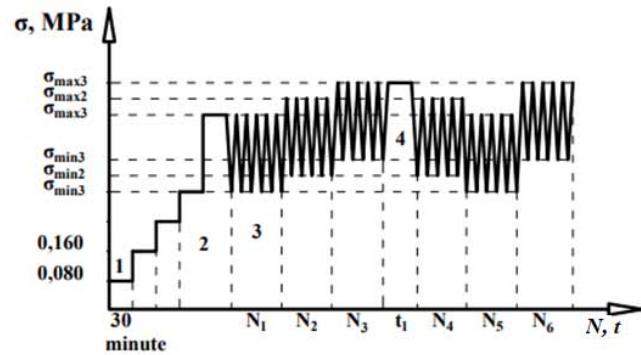
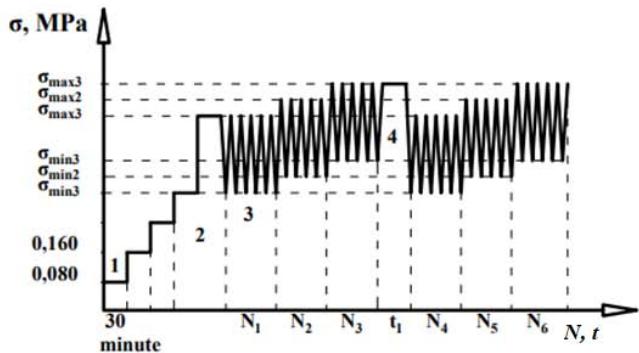 Fig. 2: Loading regimes: $N$ — number of cycles; $t$ — holding time 1-3tan BcectopohHero 06kaTHa; 1-stage of comprehensive compression; 2-3tan DeBHaTOpHOro HarpyKeHHa; 2-stage of deviatory loading; 3-3tan IIHKIIHueckoro HarpyKeHHa; 3-stage of cyclic loading; 4-3tanBpeMa BbIeepKKn IIOI DeIeHCTBHEm CTaTHueckoH Harpy3K; 4-stage holding time under static loading
## III. THE RESULTS OF THE STUDY
The response of soils to cyclic loading is largely determined by the mechanical properties of the soil, with the level of deformation response depending on strength and damping. Moreover, at high levels of deformation, besides the deformation magnitude, other parameters such as the rate and number of cycles of cyclic loading must be considered. The rate and number of cyclic loading cycles also significantly influence soil strength, especially the deformation rate of soils under cyclic loading conditions (mainly for clay soils).
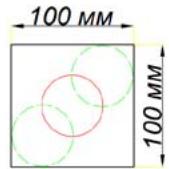
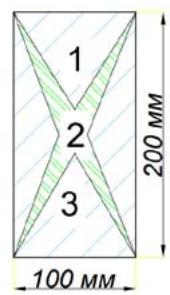
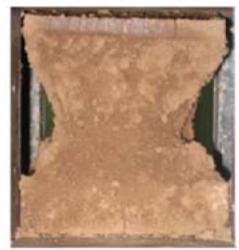
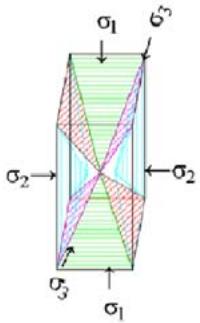
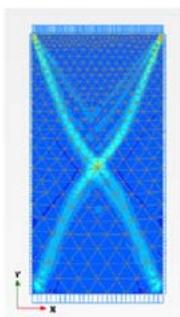
During tests conducted under triaxial block cyclic loading, specific patterns, structures, and failure characteristics of soil samples were identified, comprising the following components: during increases and decreases in load magnitude and the number of loading cycles over the holding period, closed zones of pyramidal shape form at the top part of the sample and on its lateral surfaces (Fig. 3).
The sizes of these compressed pyramids may vary depending on the loading regime. Since these pyramids move as rigid bodies, deformation of the sample occurs. At the same time, massive pyramids form soil with a denser structure, while shear and separation occur in the zones between the pyramids, accompanied by the appearance of small cracks. The occurrence of separation and shear is confirmed by a sharp increase in deformation values and the emergence of cracking sounds. When studying the influence of the spatial stress state on the physical properties of the soil, samples were taken from the characteristic zone after the sample failure.
 (a)
 (b)
 (c)
 (d)
 (e)
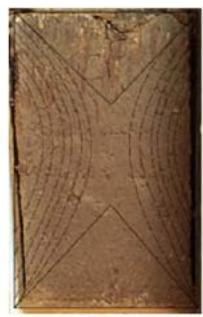 (1) Fig. 3: Fracture pattern of a soil specimen after tests; $a, b$ — scheme of a local zone of different density in a specimen under triaxial testing (1—upper hardening zone; 2 — unstrengthening zone; 3— lower hardening zone); c— under long-term static loading of a cubic form according to I.V. Koroleva [26]; $d$ — under block-cyclic loading of a prismatic form; $e$ — under static loading of a Plaxis 20v prismatic form; $f$ - scheme of a stressed state of a prismatic form)
The characteristic signs of sample failure observed in the soil sampling zones with different densities differ from the initial values. This indicates varying degrees of soil destruction in these zones. Soil density increased by $6 - 10\%$ in zone No. 1, by $1 - 3\%$ in zone No. 2, and by $3 - 5\%$ in zone No. 3, as well as in all three cases under cyclic loading. According to the research results, after testing, the sample density decreased by $3 - 6\%$ compared to the initial density. Under repeated cyclic loading conditions, moisture content decreased by up to $7\%$.
When considering cyclic creep deformations and strength characteristics of soil under sequential block loading, the influence of the vertical pressure of the previous block $\sigma_{1}$ on the strength and deformation characteristics of each subsequent cycle should be taken into account (Fig. 4).
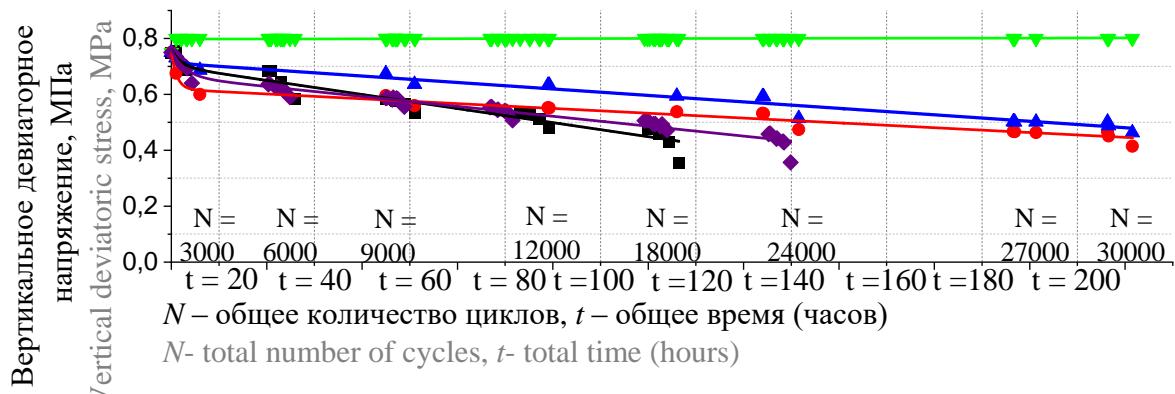 Fig. 4: Variation of maximum allowable vertical deviatoric soil pressure under block cyclic loading
- $\nabla$ IIpn cTaTHueckOM HaIpyJxHHeHH under static loading
- IIprn 6JIouHOM IIOBbIIaIoiIeMcI IHKJIInueckOM HaIpyJKeHHN B IIprH3Me under block increasing cyclic loading in a prism
- $\triangle$ IIpn6IIOUHOM IIOBbIIaHOIIeMc8 IINKJIInueckOM HaIpyKeHHN B Ky6HKe under block increasing cyclic loading in a cube
- Iprn 6JIOHOM (IOBbIIaHOIIeMcH IOHHKaIOIIeMcH) IHKJIHueCKOM HaIpyKeHHN B IprH3Me under block (increasing and decreasing) cyclic loading in the prism
- $\Leftrightarrow$ IIINIOBTOPHOM 6JIOUHOM (IOBbIaIOIeMc) IHKJIHueCKOM HaRpyKeHHN B IIpH3Me under repeated block (increasing) cyclic loading in the prism
### a) Bearing Capacity of Clay Soil under Block Cyclic Loading
Foundations are a crucial element of structures, as they reliably transfer loads from the surface to the underlying soil medium, preventing failure of both the soil and the foundation. Therefore, it is important to assess the bearing capacity of the soil mass. Many geotechnical researchers have shown interest in the topic of bearing capacity failure both in the past and at present. Excessive settlement and insufficient bearing capacity are common problems for foundations on clay soils. When calculating the bearing capacity of foundations, it must be considered that the foundation should be stable and capable of resisting displacement or overturning. The failure mechanism of the foundation upon reaching its ultimate state must be statically and kinematically feasible for the given loading (Fig. 5).
The bearing capacity of the foundation is considered ensured if the condition according to SP 22.13330 is satisfied:
$$
F \leq \frac {\gamma_ {c} \cdot F _ {n}}{\gamma_ {n}}, \tag {1}
$$
rnde $F$ design load on the foundation; $F_{n}$ ultimate resistance force of the foundation; $\gamma_{\mathrm{c}}$ work condition factor; $\gamma_{\mathrm{n}}$ reliability factor for responsibility.
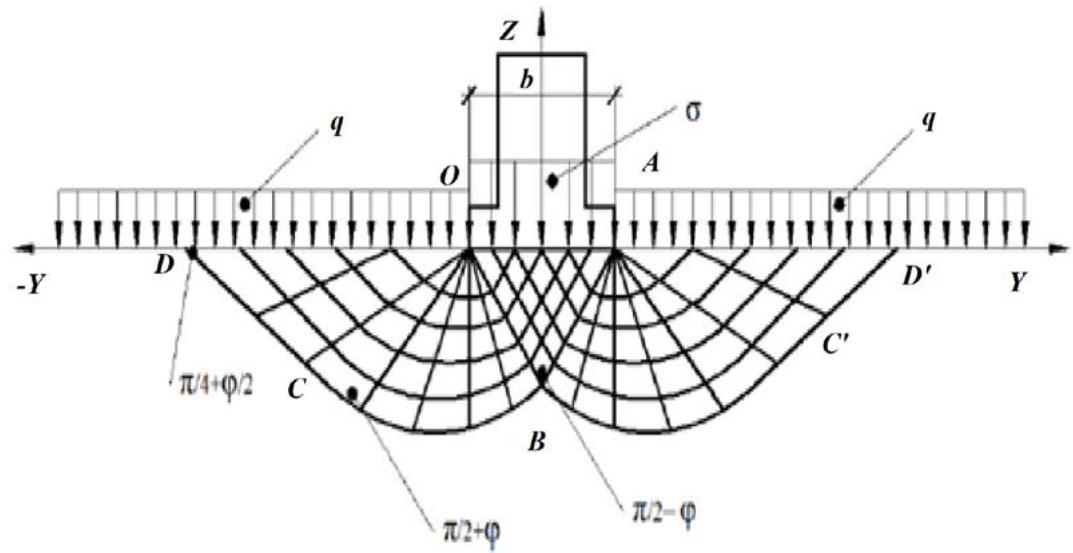 Fig. 5: Scheme for calculating the bearing capacity of the foundation
In accordance with foundation design standards, the design soil resistance (bearing capacity) beneath the foundation base is determined by the following equation:
$$
N _ {u} = b ^ {'} \cdot l ^ {'} \cdot \left(N _ {\gamma} \xi_ {\gamma} b ^ {'} \gamma_ {1} + N _ {q} \xi_ {q} \gamma_ {1} ^ {'} + N _ {c} \xi_ {c} C _ {1}\right), \qquad (2)
$$
where $l'$ and $b'$ — are the length and width of the foundation, in meters; $N_{\gamma}$, $N_{q}$ and $N_{c}$ — are the dimensionless bearing capacity factors of the soil under the foundation base, depending on the internal friction angle $\varphi_{i}$; $\xi \gamma$, $\xi q$, $\xi c$ are coefficients depending on the ratio of the length to width of the cross-section; 1 and $\gamma'1$ — are the unit weights of the soil above and below the foundation base, respectively.
The strength characteristics $C(N, t, \tau)$ and non-stationary cyclic loading are determined by formulas (3) and (4). Then, the value of the specific cohesion under block cyclic loading conditions is represented as follows:
$$
C(N,t,\tau)=C_{0}+\sum_{i=1}^{n}\Delta C_{dpl}(t,\tau)-\sum_{j=1}^{n}\Delta C(N,t),
$$
where $C_0$ is the initial value of the soil's Specific cohesion; $\Delta C_{dp}(t, \tau)$ is the change in specific cohesion during the stages of triaxial and deviatoric loading; $\Delta C(N, t)$ is the change in specific cohesion under the influence of block cyclic loading.
Thus, the equation for the specific cohesion under block-mode cyclic loading is represented as follows:
$$
\begin{array}{l} C (N, t, \tau) = C _ {0} + \sum_ {i = 1} ^ {n} \Delta C _ {d p l} (t, \tau) - \sum_ {j = 1} ^ {m} \Delta C (N, t) = \left[ \right.\left(C _ {0} + \left[ C _ {0} \cdot \sum_ {i = 1} ^ {n} \left(2 \cdot \left(\Delta \varepsilon_ {i j} ^ {p l} (t, \tau) - \frac {1}{3} \Delta \varepsilon_ {v i} ^ {p l} (t, \tau) \cdot \delta_ {i j}\right) \cdot \Delta \varepsilon_ {v i} ^ {p l} (t, \tau)\right) ^ {1 / 2} \right]\right) - \\\left. \sum_ {j = 1} ^ {m} \left(K _ {\varepsilon p l i} ^ {v} (N, t, t _ {o}) \cdot \Delta \varepsilon_ {p l i} ^ {v} (N, t, t _ {o}) + + K _ {\gamma p l i} ^ {v} (N, t, t _ {o}) \cdot \Delta \gamma_ {p l i} ^ {v} (N, t, t _ {o})\right) \right], \tag {4} \\\end{array}
$$
where $\Delta \varepsilon_{ij}^{pl}(t,\tau)$ is the increment of the creep strain tensor at the corresponding loading stages; $\Delta \varepsilon_{vi}^{pl}(t,\tau)$ is the increment of the volumetric creep strains at the corresponding loading stages; $\delta_{ij}$ is the Kronecker delta; $\Delta \varepsilon_{pli}^{v}(N,t,t_{o})$ and $\Delta \gamma_{pli}^{v}(N,t,t_{o})$ are the increments of vertical and shear strains of cyclic creep during increasing and decreasing blocks of cyclic loading; $K_{\varepsilon pli}^{v}(N,t,t_{o})$ and $K_{\gamma p l i}^{v}(N,t,t_{o})$ are proportionality parameters relating $\Delta C(N,t,t_o)$ to $\Delta \varepsilon_{p l i}^{v}(N,t,t_{o})$ and $\Delta \gamma_{p l i}^{v}(N,t,t_{o})$, respectively, defined based on experimental studies.
The change in the internal friction angle $\varphi$ of the soil is evaluated by the equation:
$$
\varphi (N, t, \tau) = \tan^{-1} \left(\frac{\tau_{ultgrt} (N , t) - C (N , t , \tau)}{\sigma (N , t)}\right), \tag{5}
$$
where $\varphi (N,t,\tau)$ nC $(N,t,\tau)$ -are the strength characteristics of the soil under block-mode cyclic loading; $\tau_{ultgrt}(N,\mathbf{\sigma}) = \sigma (N,\cdot)t\mathbf{g}\varphi (N,t,\tau) + C(N,t,\tau)$ is the Coulomb-Mohr failure criterion under block-mode cyclic loading; $\sigma (N,t)$ -is the maximum normal stress during block-mode cyclic loading.
Here is how the transformed equation of the ultimate bearing capacity of a foundation can be expressed:
$$
\begin{array}{l} N _ {u} = \dot {b} \cdot \dot {l} \cdot \left[ (N _ {\gamma} \xi_ {\gamma} \dot {b} \gamma_ {1} + N _ {q} \xi_ {q} \dot {\gamma_ {1}} + N _ {c} \xi_ {c} \right. \cdot \left(\left[ C _ {0} + C _ {0} \cdot \sum_ {i = 1} ^ {n} \left(2 \cdot \left(\Delta \varepsilon_ {i j} ^ {p l} (t, \tau) - \frac {1}{3} \Delta \varepsilon_ {v i} ^ {p l} (t, \tau) \cdot \delta_ {i j}\right) \cdot \Delta \varepsilon_ {v i} ^ {p l} (t, \tau)\right) ^ {\frac {1}{2}} \right] \right. \\\left. - \sum_ {j = 1} ^ {m} K _ {\varepsilon p l i} ^ {v} (N, t, t _ {o}) \cdot \Delta \varepsilon_ {p l i} ^ {v} (N, t, t _ {o}) + K _ {\gamma p l i} ^ {v} (N, t, t _ {o}) \cdot \Delta \gamma_ {p l i} ^ {v} (N, t, t _ {o})\right). \tag {6} \\\end{array}
$$
After transformation, the function of soil bearing capacity under stationary and non-stationary cyclic loading is generally expressed in a form that accounts for the changes in soil strength parameters due to cyclic effects. A generalized from could be represented as:
$$
N _ {\gamma} = \left(N _ {q} - 1\right) \cdot \left(\operatorname{arctg} \left(\frac{\tau_ {u l t g r t} (N , t) - C (N , t , \tau)}{\sigma (N , t)}\right)\right);
$$
$$
N _ {q} = \mathrm{t g} ^ {2} \left(4 5 ^ {0} + \frac{\varphi_ {1}}{2}\right) \cdot e ^ {\pi \cdot \operatorname{arct} \mathrm{g} \left(\frac{\tau_ {u l t g r t} (N , t) - C (N , t , \tau)}{\sigma (N , t)}\right)};
$$
$$
N _ {c} = \frac {N _ {q} - 1}{a r c t g \left(\frac {\tau_ {u l t g r t} (N , t) - C (N , t , \tau)}{\sigma (N , t)}\right)} \tag {7}
$$
### b) Settlement of Clay Foundations under Block Cyclic Loading
The overall process of geotechnical settlement accumulation consists of three main components occurring at different stages: immediate settlement (also known as elastic settlement); consolidation settlement (or primary settlement); and creep settlement (or secondary settlement). As the name suggests, immediate settlement occurs immediately after the load is applied to the soil. When the load is applied, stresses in the soil change, soil particles rearrange, resulting in a reduction of the soil's void space volume. Consolidation settlement arises because water gradually escapes over time from the voids between soil particles. As a result, the void space separating the soil particles decreases, and the soil settles downward.
Following the completion of the consolidation settlement phase, creep settlement begins. This portion of soil settlement continues over an extended period under pressure from the external load — the magnitude of creep depends on the soil type, its anisotropy, as well as the stress history and stress level in the soil. The calculation method is based on the concept of layer-by-layer summation, taking into account the volumetric stress state of the soil and the mechanical change in its condition under stage loading. Consequently, this calculation results in the estimation of foundation settlement under actual stage loading conditions (Fig. 6).
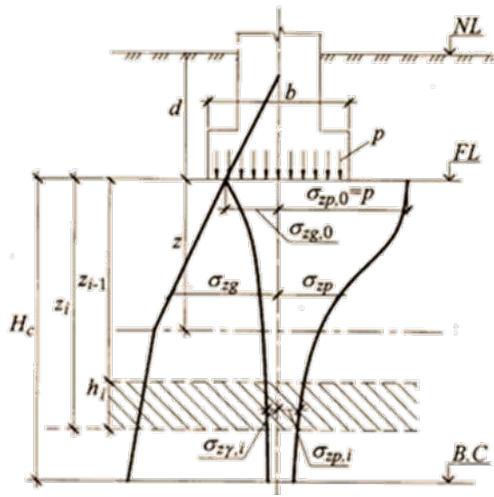
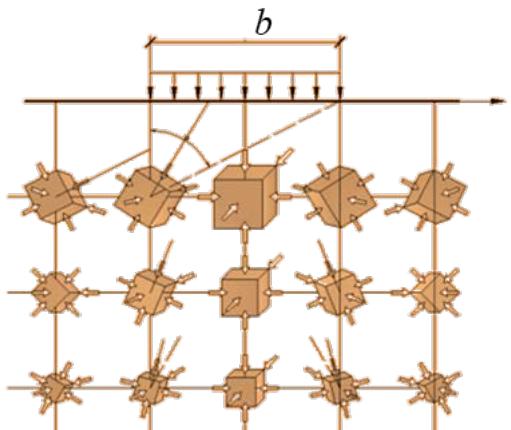 Fig. 6: Schematic diagram for calculation of foundation settlement under mode loading
A volumetric stressed state is perceived, where the state of the soil foundation in the compressible layer is divided into several layers. In each layer, deformations corresponding to the magnitude of vertical pressure are determined based on the deviatoric stresses, and then the deformation values within the compressible layer are summed [10,11].
The increment of strain at the moment of loading is determined by the equation:
$$
\Delta \varepsilon_ {z i} = \frac {\Delta \sigma_ {z}}{G _ {v}} - \Delta G \cdot \frac {3 k _ {v} - G _ {v}}{3 k _ {v} \cdot G _ {v}} \tag {8}
$$
The increment of axial strains under block-mode cyclic loading is established as follows:
$$
\begin{array}{l} \varepsilon_ {p l i} ^ {v} (N, t, t _ {0}) = \sum_ {i = 1} ^ {n} \left[ \sigma_ {i} ^ {\max } (N, t, t _ {0}) \cdot k _ {R} \left\{\left[ \frac{f _ {U P} (N)}{\sigma (N , t , t _ {0})} \right] \cdot f _ {U P} (N) \cdot \rho_ {c y c} + \left[ \frac{f _ {d o w} (N)}{\sigma (N , t , t _ {0})} \right] \cdot f _ {d o w} (N) \cdot \rho_ {c y c} + \left[ \frac{f (t)}{\sigma (N , t , t _ {0})} \right] \cdot f (t) + \\\left[ \frac{f _ {U P} \left(t _ {0}\right)}{\sigma (N , t , t _ {0})} \right] \cdot f _ {U P} \left(t _ {0}\right) + \left[ \frac{f _ {d o w} \left(t _ {0}\right)}{\sigma (N , t , t _ {0})} \right] \cdot f _ {d o w} \left(t _ {0}\right)\right\} \right], \tag{9} \end{array}
$$
where $\sigma_{i}^{max}(N,t,t_{0})$ —maximum vertical stresses in the blocks of block-mode loading; $k_{R}$ —factor defining the ratio of creep parameters of soil under block-mode loading; $\sigma (N,t,t_0)$ —allowable vertical stresses during block-mode cyclic loading; $\rho_{\mathrm{cyc}}$ —asymmetry of the vertical stress cycle; $f_{UP}(N),f_{dow}(N),f(t),f_{UP}(t_0),f_{dow}(t_0)$ —functions of cyclic creep deformations of soil in increasing and decreasing blocks of the block-mode cyclic loading regime.
The settlement of the foundation under block-mode cyclic loading is then identified by the equation:
$$
S(N,t,t_{0}) = \sum_{i}^{n} \left[ \Delta\varepsilon_{zi} + \varepsilon_{pli}^{v}(N,t,t_{0}) \right] \cdot h_{i} ,
$$
where $\Delta \varepsilon_{zi}$ — increment of axial strain of the i-th layer at the moment of loading application; $\Delta \varepsilon_{pli}^{Y}(N,t,t_{0})$ — increment of axial strain under block-mode cyclic loading; $h_i$ — thickness of the i-th layer; $n$ — number of layers.
To evaluate the proposed equations for calculating foundation settlement, plate load tests were conducted on clay foundations (models of slab foundations in trays measuring $1.0 \times 1.0 \times 1.0 \times 1.0$
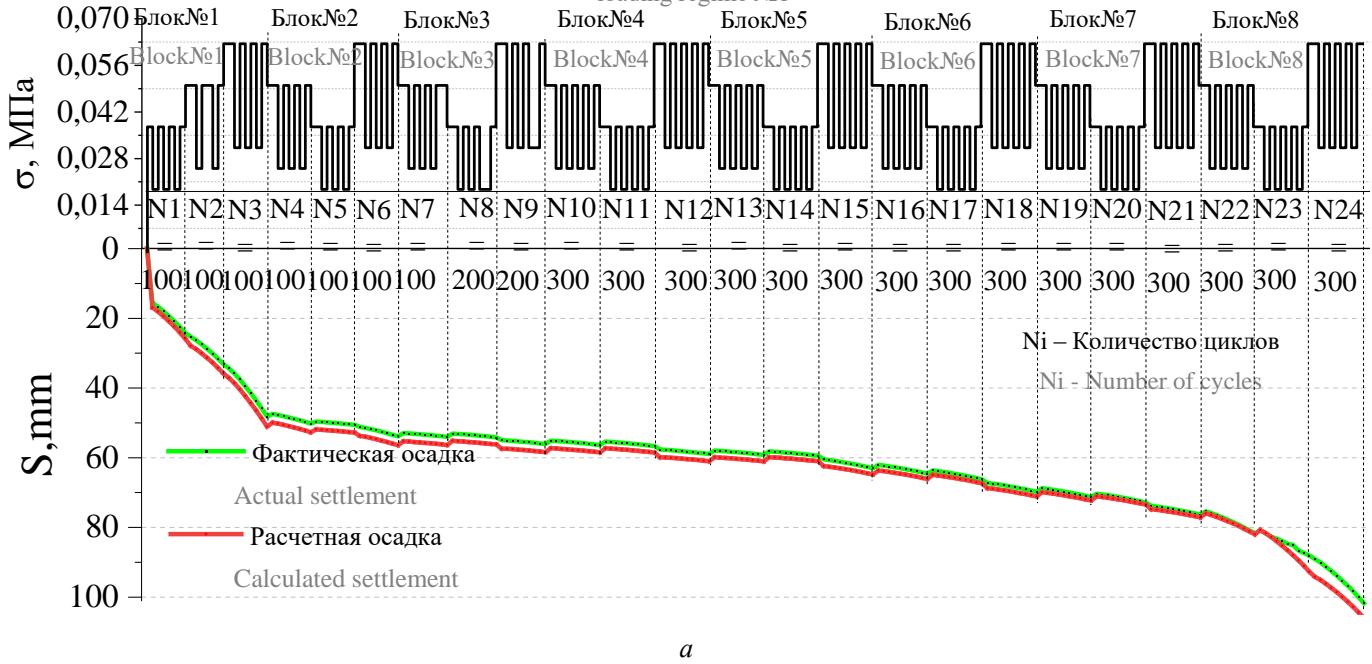
m). Based on the analysis of the test results on the development of settlements of the slab foundation in the trays under block-mode cyclic loading, it can be concluded that the presented relationship describing the change in settlement under block cyclic loading is in complete analogy with the experimental data. The calculated values differ from the experimental ones by within $10 - 20\%$ (Fig. 7).
 peKHM HaIpyKeHHNaNo1 loading regime No1
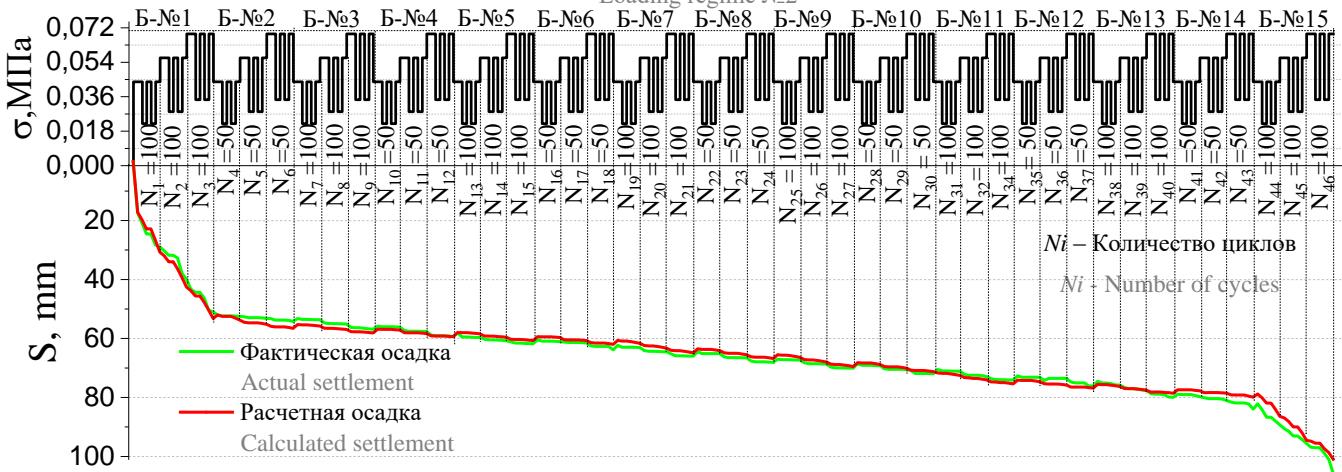 PekHM HaIpyKeHHaNo2 Loading regime No2 b Fig. 7: Settlement estimation of slab foundation models under cyclic block regime loading in volumetric trough: a—under increasing and decreasing block loading; b—under repeatedly increasing block loading
## IV. CONCLUSION
Based on the research results, the following conclusions can be drawn:
- Equations for the ultimate bearing capacity of clay foundations under block-mode cyclic loading were formulated, taking into account changes not only in
the rheological but also in the strength characteristics of clay soils simultaneously;
- A new method for calculating the settlement of clay foundations was developed, based on the layer-by-layer summation method, which simultaneously considers changes in the soil's strength parameters and mechanical properties under cyclic loading in block-mode conditions;
- The analysis of the calculation results using the proposed engineering method for evaluating the bearing capacity and settlement of clay foundations under block-mode cyclic loading corresponds well with experimental data obtained from tray tests. The calculated values differ from experimental ones by within $10 - 20\%$.
Generating HTML Viewer...
References
30 Cites in Article
E Augeard,E Ferrier,L Michel (2020). Mechanical behavior of timber-concrete composite members under cyclic loading and creep.
H Karim,Z Samueel,A Jassem (2020). Behaviour of soft clayey soil improved by fly ash and geogrid under cyclic loading.
Yuke Wang,Yongshuai Wan,Ershuai Wan,Xijun Zhang,Bei Zhang,Yanhui Zhong (2021). The pore pressure and deformation behavior of natural soft clay caused by long-term cyclic loads subjected to traffic loads.
Z Fu,G Wang,W Song,Y Yu,P Wei,T Wu (2021). Deformation Behavior of Saturated Soft Clay under Cyclic Loading with Principal Stress Rotation.
T Wichtmann,M Tafili,P Staubach,J Machaček (2023). Soil behaviour under cyclic loading-experiments, constitutive modelling and numerical applications.
Syed Shah,Abdul Asif,Waqas Ahmed,Ihtisham Islam,Muhammad Waseem,Hammad Janjuhah,George Kontakiotis (2023). Determination of Dynamic Properties of Fine-Grained Soils at High Cyclic Strains.
Ebru Civelekler (2023). Using GIS for the allowable soil bearing capacity estimation according to the Terzaghi (1943) equation in Eskişehir city center, Türkiye.
Mahdi Karkush,Mahmood Ahmed,Ammar Abdul-Hassan Sheikha,Ayad Al-Rumaithi (2020). Thematic Maps for the Variation of Bearing Capacity of Soil Using SPTs and MATLAB.
Haifeng Cheng,Houle Zhang,Zihan Liu,Yongxin Wu (2023). Prediction of Undrained Bearing Capacity of Skirted Foundation in Spatially Variable Soils Based on Convolutional Neural Network.
G Adunoye,S Kareem,H Odetola (2023). Experimental Investigation on the Bearing Capacity of Selected Soils in Ayedaade Local Government Area, Osun State, Nigeria.
D Dasho,B Aga (2023). Comprehensive Characterization of Soils with Analytical and Numerical Simulation for Bearing Capacity and Settlement Requirements of the Footing.
E Sychkina,I Ofrikhter,A Ponomaryov (2020). Bearing capacity equations of piles in weathered claystone and sandstone.
Huxi Xia,Mi Zhou,Fujun Niu,Xihong Zhang,Yinghui Tian (2022). Combined bearing capacity of bucket foundations in soft-over-stiff clay.
C Yang,Z Zhu,Y Xiao (2020). Bearing Capacity of Ring Foundations on Sand Overlying Clay.
Xiushao Zhao,Zhitao Fu,Qijing Yang,Daxin Geng,Zhiyao Wang (2020). Study on Bearing Capacity Performance and Influence Factors of Phyllite Soil Blended with Red Clay.
Samir Benmoussa,Sadok Benmebarek,Naima Benmebarek (2021). Bearing Capacity Factor of Circular Footings on Two-layered Clay Soils.
N Hataf,N Nabipour,A Sadr (2020). Experimental and numerical study on the bearing capacity of encased stone columns.
Avinash Bhardwaj,Ravi Sharma (2023). Bearing Capacity Evaluation of Shallow Foundations on Stabilized Layered Soil using ABAQUS.
Pengpeng He,Tim Newson (2023). Undrained capacity of circular shallow foundations on two-layer clays under combined VHMT loading.
Abbas Fadhil,Sarah Hussein Mandeel,Haider M. Mekkiyah (2020). Bearing Capacity of Square Footing Resting on Layered Soil.
Marco Samy,Ali Abdelfattah,Ayman Fayed,Tamer Sorour,Mahmoud Elshawaf (2023). Prediction of the settlement associated with construction on soft clay improved using rigid inclusions considering the installation effect.
Ilizar Mirsayapov,Hani Sharaf (2019). Experimental studies of bearing capacity and settlement of foundations on clays under regime block cyclic loading.
I Mirsayapov,H Sharaf (2023). Settlement of clay soils foundations under block cyclic loading.
I Mirsayapov (2021). Method of Calculating the Strength of Clay Soils Under Triaxial Regime Loading.
Ilizar Mirsayapov,Hani Sharaf (2020). Experimental studies of bearing capacity and settlement of foundations on clays under regime block cyclic loading.
Irina Koroleva (2021). Assessment of clay soils strengthening under triaxial cyclic loading.
I Mirsayapov,H Sharaf (1928). Features of clay soil deformation under triaxial block regime cyclic loading, taking into account the formation of micro and macro-cracks.
Ilizar Mirsayapov,Hani Sharaf (2022). Studies of Clay Soils Under Triaxial Block Cyclic Loading.
I Mirsayapov,H Sharaf (2023). Bearing capacity and settlement of foundations on clayey soils under regime block cyclic loading.
Aamal Al-Saidi,Khawla Al-Juari,Mohammed Fattah (2022). Reducing settlement of soft clay using different grouting materials.
No ethics committee approval was required for this article type.
Data Availability
Not applicable for this article.
How to Cite This Article
Dr. Hani Mohammed Abdo Sharaf. 2026. \u201cBearing Capacity and Settlement of Clay Bases Under Block Cyclic Loading\u201d. Global Journal of Research in Engineering - J: General Engineering GJRE-J Volume 25 (GJRE Volume 25 Issue J1): .
Explore published articles in an immersive Augmented Reality environment. Our platform converts research papers into interactive 3D books, allowing readers to view and interact with content using AR and VR compatible devices.
Your published article is automatically converted into a realistic 3D book. Flip through pages and read research papers in a more engaging and interactive format.
Our website is actively being updated, and changes may occur frequently. Please clear your browser cache if needed. For feedback or error reporting, please email [email protected]
Thank you for connecting with us. We will respond to you shortly.