
Benefits SMEs derive from MFIs

1
Francis Daka
Francis Daka
1 Gideon Robert University,

Send Message

To: Author

GJMBR Volume 23 Issue B1

Article Fingerprint

ReserarchID

37357

Benefits SMEs derive from MFIs Banner
  • English
  • Afrikaans
  • Albanian
  • Amharic
  • Arabic
  • Armenian
  • Azerbaijani
  • Basque
  • Belarusian
  • Bengali
  • Bosnian
  • Bulgarian
  • Catalan
  • Cebuano
  • Chichewa
  • Chinese (Simplified)
  • Chinese (Traditional)
  • Corsican
  • Croatian
  • Czech
  • Danish
  • Dutch
  • Esperanto
  • Estonian
  • Filipino
  • Finnish
  • French
  • Frisian
  • Galician
  • Georgian
  • German
  • Greek
  • Gujarati
  • Haitian Creole
  • Hausa
  • Hawaiian
  • Hebrew
  • Hindi
  • Hmong
  • Hungarian
  • Icelandic
  • Igbo
  • Indonesian
  • Irish
  • Italian
  • Japanese
  • Javanese
  • Kannada
  • Kazakh
  • Khmer
  • Korean
  • Kurdish (Kurmanji)
  • Kyrgyz
  • Lao
  • Latin
  • Latvian
  • Lithuanian
  • Luxembourgish
  • Macedonian
  • Malagasy
  • Malay
  • Malayalam
  • Maltese
  • Maori
  • Marathi
  • Mongolian
  • Myanmar (Burmese)
  • Nepali
  • Norwegian
  • Pashto
  • Persian
  • Polish
  • Portuguese
  • Punjabi
  • Romanian
  • Russian
  • Samoan
  • Scots Gaelic
  • Serbian
  • Sesotho
  • Shona
  • Sindhi
  • Sinhala
  • Slovak
  • Slovenian
  • Somali
  • Spanish
  • Sundanese
  • Swahili
  • Swedish
  • Tajik
  • Tamil
  • Telugu
  • Thai
  • Turkish
  • Ukrainian
  • Urdu
  • Uzbek
  • Vietnamese
  • Welsh
  • Xhosa
  • Yiddish
  • Yoruba
  • Zulu

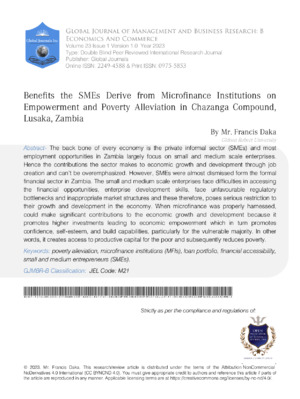
The back bone of every economy is the private informal sector (SMEs) and most employment opportunities in Zambia largely focus on small and medium scale enterprises. Hence the contributions the sector makes to economic growth and development through job creation and can’t be overemphasized. However, SMEs were almost dismissed form the formal financial sector in Zambia. The small and medium scale enterprises face difficulties in accessing the financial opportunities, enterprise development skills, face unfavourable regulatory bottlenecks and inappropriate market structures and these therefore, poses serious restriction to their growth and development in the economy. When microfinance was properly harnessed, could make significant contributions to the economic growth and development because it promotes higher investments leading to economic empowerment which in turn promotes confidence, self-esteem, and build capabilities, particularly for the vulnerable majority. In other words, it creates access to productive capital for the poor and subsequently reduces poverty.

Funding

No external funding was declared for this work.

Conflict of Interest

The authors declare no conflict of interest.

Ethical Approval

No ethics committee approval was required for this article type.

Data Availability

Not applicable for this article.

Francis Daka. 2026. \u201cBenefits SMEs derive from MFIs\u201d. Global Journal of Management and Business Research - B: Economic & Commerce GJMBR-B Volume 23 (GJMBR Volume 23 Issue B1): .

Download Citation

Microfinance strategies for SMEs growth.
Issue Cover
GJMBR Volume 23 Issue B1
Pg. 29- 33
Journal Specifications

Crossref Journal DOI 10.17406/GJMBR

Print ISSN 0975-5853

e-ISSN 2249-4588

Keywords
Classification
GJMBR-B Classification: JEL Code: M21
Version of record

v1.2

Issue date

February 6, 2023

Language

English

Experiance in AR

The methods for personal identification and authentication are no exception.

Read in 3D

The methods for personal identification and authentication are no exception.

Article Matrices
Total Views: 1400
Total Downloads: 20
2026 Trends
Research Identity (RIN)
Related Research

Published Article

The back bone of every economy is the private informal sector (SMEs) and most employment opportunities in Zambia largely focus on small and medium scale enterprises. Hence the contributions the sector makes to economic growth and development through job creation and can’t be overemphasized. However, SMEs were almost dismissed form the formal financial sector in Zambia. The small and medium scale enterprises face difficulties in accessing the financial opportunities, enterprise development skills, face unfavourable regulatory bottlenecks and inappropriate market structures and these therefore, poses serious restriction to their growth and development in the economy. When microfinance was properly harnessed, could make significant contributions to the economic growth and development because it promotes higher investments leading to economic empowerment which in turn promotes confidence, self-esteem, and build capabilities, particularly for the vulnerable majority. In other words, it creates access to productive capital for the poor and subsequently reduces poverty.

Our website is actively being updated, and changes may occur frequently. Please clear your browser cache if needed. For feedback or error reporting, please email [email protected]
×

This Page is Under Development

We are currently updating this article page for a better experience.

Request Access

Please fill out the form below to request access to this research paper. Your request will be reviewed by the editorial or author team.
X

Quote and Order Details

Contact Person

Invoice Address

Notes or Comments

This is the heading

Lorem ipsum dolor sit amet, consectetur adipiscing elit. Ut elit tellus, luctus nec ullamcorper mattis, pulvinar dapibus leo.


High-quality academic research articles on global topics and journals.

Benefits SMEs derive from MFIs

Francis Daka
Francis Daka Gideon Robert University,

Research Journals





























































