This article seeks to establish a debate about the contradiction in the current situation of the world of work: the objective force of working class, including the absolute and relative growth of the number of jobs around the world, in parallel with its fragmentation and the development of new modalities and divisions in the world of work, such as the most recent case of uberization. In this sense, it resumes the debates of “end of work”, the fragmentation in the neoliberal period, the inflection promoted in 2008, during the financial crisis, in order to develop the analysis of what we call a new productive restructuring, which has been taking place in the current period and needs to be mainly analyzed if we want to understand the trends in the world of work and its challenges.
## I. INTRODUCTION
The problem of the fragmentation of the working class is not new, but it has gained new proportions in the twenty-first century. Its importance lies not only in the analyses of the transformations in the working class in the last decades, but above all, it has enormous importance for the debate on the nature of the working class today. The unity of sectors of the working class is a great challenge, especially in the context of a new productive restructuring ongoing, with the emergence of new morphologies of work and the phenomenon of uberization. This article aims, therefore, to analyse the recent changes in the world of work, taking into account the impacts of the 2008 crisis, and the objective aspects of the fragmentation in the world of work.
# a) The "end of
As part of reflecting strategically on the issues that arise from the world of work, it is first necessary to reflect on the objective evolution of the working class in recent decades to understand its strength and extension in opposition to an intense propaganda that we would be, once again, entering an era of communicativeness that would eliminate human work, a new "end of work".
Theoretical speculations that technological changes would lead to a drastic reduction or even elimination of human work date decades ago. The Works of André Gorz, with his well-known Farewell to the working class, from 1980, or Jünger Habermas, with his classic Theory of communicative action, a work of 1981, coinciding with the emergence of Reagan in the United States and his confrontation with the flight controllers' strike, one of the hallmarks of the beginning of international neoliberalism.[^1] It is worth mentioning that the discussion about the "end of work" developed a new format with the emergence of the internet, in which not only automation, but information and communication technologies gave the impression of a substitution of the necessities of work. Manuel Castells' 1996 book, *The Rise of the Network Society*, is perhaps the most developed expression in this theoretical sense.
Indeed, several Marxist authors opposed this vision of the end of work, which grew as the ideological influences of neoliberalism expanded, including the idea of the end of classes, the end of socialism, and even the end of history, in the famous expression of Frans Fukuyama.
Among authors who, already in the neoliberal years, offered counterpoints and antagonistic theoretical visions to those mentioned in this matter of work, we can highlight those who sought to oppose the neoliberal notion of the end of work by going to the roots of the new contradictions and thinking about the changes, which implied the study of the overproduction crisis of 1973 and 1970 (the so-called oil crisis) like Ernest Mandel[^2]2 or the idea of István Mészáros[^3]3 that a structural crisis of capital emerged. In the sociology of work, some authors defended the centrality of the working class and the maintenance of its objective force but enriched the sociological analysis to understand that this class was in the process of transformation in its morphology. We can highlight in this context the work of Harry Braverman[^4]4, who studied the work of office labourers or in sociology the outstanding study by Ricardo Antunes, starting from his "Farewell to work?"[^5], seeking to oppose the end of work theorists.
This was the display of forces that developed in the difficult 1990s, in which the neoliberal offensive sought to shatter with postmodern relativizations any notion that came close to Marxism or a thought of social transformation, and in this sense, denying the centrality of work became the number one point of the dominant programmatic booklet.
The 2008 crisis reshuffled the cards and the neoliberal globalisation order was expressing its crisis, especially in times of recession, austerity plans, fiscal adjustments. However, in the face of moderate stabilization of the situation, the old theses of the end of work were once again forcefully resumed, but now covered by the new slogan of the moment: the fourth industrial revolution. A new era of communication that would be based on artificial intelligence (developed from Big Data technologies) and the internet of things, would be leading the world to enter a new moment of communicative and interactive capacity, expressed in social networks, now in its latest version with the Metaverse, which would supposedly revolutionize the jobs of the future (related to technological areas) and even drastically reduces its importance and quantity.
Hence, theories that are also classic in philosophy and cinema (including the resumption of the movie The Matrix) that machines would evolve in their technological capacity to the point of gaining an autonomous consciousness flood social networks and serve as an ideological ferment for this idea that work is losing importance in society. But from an objective point of view, what have we seen happening?
## II. AN ASLEEP GIANT
Theories that artificial intelligence is creating the conditions for eliminating work face a subtle problem to defend their point of view: the tendencies of reality. This is because what we have seen in recent years, contrary to a progressive reduction of work, has been expressed in a systematic increase in the objective dimension of the international working class.
This statement, which may seem controversial in the current economic and sociological debate, is easily proven by data from international agencies, such as the International Labour Organisation. According to a graph extracted from the World Bank based on ILO data[^6], the situation of the working class in the world today is as follows:
### Labor force, total
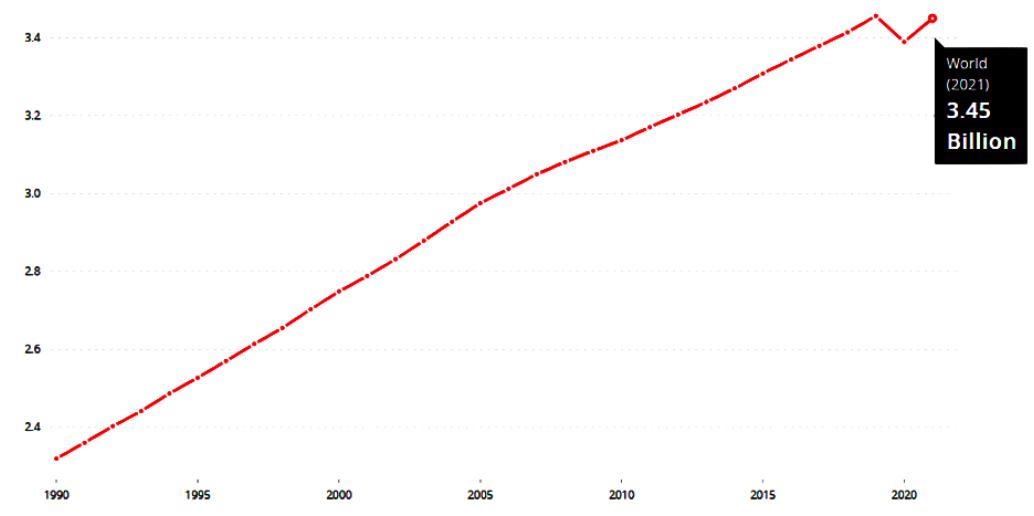 Derived using data from International Labour Organization, ILOSTAT database Source: World Bank
The analysis of the graph leaves no doubt about the tendencies pointed out. It indicates that between 2000 and 2020, the international "Labor force" has grown from 2.7 billion people to 3.4 billion, an increase in twenty years of no less than 700 million people, approximately the size of the entire European population. Effectively, the only moment of cleavage in
its size given the immense destruction of productive forces was during the pandemic period, but for reasons completely unrelated to the "new era of communication" – on the contrary, in the pandemic the most repeated phrases were about the "essential workers", and not essential robots.[^7]
Within this "labor force", which is expressed in data from the International Labor Organization perhaps best defined as an "economically active population", the percentage of working class within a Marxist vision would be smaller, but still highly robust. Some authors, such as Kim Moody, have better reflected the data and methodologies, just over 2.2 billion[^8]. This is what Gastón Gutierrez and Paula Varela point out when reflecting on these data:
As Aaron Benanav recovers, from 1980 to 2018 - according to the ILO - the economically active population, both waged and unwaged, grew by $75\%$. This implies that more than 1.5 billion people were added to the world's labor markets, bringing the total to just under 3.5 billion people. Based on ILO data, Kim Moody points out that about two-thirds of them, i.e., just over 2 billion, belong to the working class, comprising wage earners and "self-employed" or "own-account workers". Meanwhile, according to research by Marcel van der Linden (also based on ILO data), between 1991 and 2019, the percentage of people living on their wages will never breach the $44\%$ threshold and, on the contrary, will rise to $55\%$ of the economically active population.
As we have pointed out, this does not mean that a transformation is not taking place in its morphology, that is, that an immense formation of a new service proletariat is not taking place and that the debate on the meaning of this new sector is not open, whether with qualifiers that define it as precariat[^9], as did Guy Standing[^10], or that emphasize the digital aspect of new work modalities, qualifying them as cybertariat, as defined by Ursula Huws[^11]. But this phenomenon of transformation has been occurring in parallel with the maintenance of a robust dimension of classic sectors of the working class, particularly the industrial sector.
Working again with data to get an idea, according to China Statistical Yearbook (2020)[^12] and the website Statista.com[^13], in 2020, the number of economically active population in that country was between 811 and 783 million workers, of which, in both sources, around $30\%$ were factory workers. This means that, in China today, at least 210 million workers are allocated in the statistics of "secondary industry", a proletariat mass that in the nineteenth century, and even at the beginning of the twentieth century, could not have been imagined. By comparison, Stephen Anthony Smith[^14] points out that in 1917, Russia had 3.4 million industrial workers, compared to an immense population at the time of 182 million inhabitants. Today, we speak of more than 200 million factory workers in China, an absolute proletariat mass at least fifty times larger than the entire Russian proletariat in the socialist revolution of 1917. The methodological issue here, therefore, is to look at the theme of the world of work today from an international perspective. With the globalisation of capital[^15] and the most aggressive forms of imperialism, hegemony of financial capital, concentration of capital and oligopolies, there is no economic perspective that survives without sticking to the unequal and combined dynamics of the world economy. The so-called international division of labor seeks to account for this international process of production and reproduction of capital today.
Thus, these main tendencies in work analysis must be taken into consideration: an expressive growth of the working class in recent decades; intense concentration in some poles, such as the Chinese industrial cities complex or India; accelerated expansion of the service sector, in large metropolis and megalopolis in particular, with the expression of a new service proletariat, a new morphology of the working class - a trend that we are going to deal with subsequently.
## III. NEOLIBERAL FRAGMENTATION AND THE NEW MORPHOLOGY OF THE WORKING CLASS
The problem of the fragmentation of the working class as a form of domination is not an expression of an isolated policy of finance capital in a given context, as was more than evident in the dramatic neoliberal years. Karl Marx[^16] had an acute look and a strong perception that the role of the bourgeoisie within the People's Spring of 1848 was an indeclinable indication that this class had assumed a reactionary character.
Since then, until the turn of the twentieth century and the entrance of the imperialist era[^17], reality is expressed in the paths of financial advances of monopolies occurring in parallel with interstate shocks, the social decomposition of workers, the destruction of nature and cultural decay. Social and ideological fragmentation is becoming a mark of the bourgeoisie, an irony for a world of increasing financial concentration.
The Hungarian philosopher György Lukács[^18] analyzed this phenomenon from literature (with an instigating analysis in nineteenth-century realism but mistaken in its emphases against the avant-garde and defense of Soviet realism in the twentieth century) and philosophy, and argued that even the spirits of capitalism philosophy in a decadent phase, like Friedrich Nietzsche, perceived the extremes of fragmentation in the ideological decay of society. Quoting the German philosopher:
The individual Word (...) becomes sovereign and leaps out of the sentence, the sentence bursts its bounds to obscure the sense of the page; the page acquires life at the expense of the whole - the whole is no longer a whole. But this is the picture of every decadent style... the vitality, vibrance and exuberance of life withdraws into the minute image; whatever is leftover lacks life... The whole is no longer alive; it is a synthetic, contrived artifact[^19]
The great irony of the matter is that what philosophers saw as an initial philosophical process during the last decades of the nineteenth century, outlined in literature and the arts, were the first expressions of philosophies that became much more acute in the twentieth century, arriving in neoliberalism with the discreet charm of combining, at the same time, the postmodern philosophies, of total relativism, with the disenchanted fragmentation bombs - a military expression of the shattered society.
And in the world of work, it could not be different: neoliberal productive restructuring combined the latest technologies of Toyotism to control work and the just-in-time regime, with the territorial dispersion of production in the new international division of labor, the so-called flexible accumulation[^20] and the mechanisms of division within the working class, expressed above all in the phenomenon of outsourcing. In other words, the hallmarks of neoliberal restructuring include job rotation, intensification, rights precariousness, benefit cuts, extension of working hours with hour banks, labour instability, among others. But one of these expressions worth mentioning was managing to insert an international division in the categories of workers between permanent and outsourced workers, a fragmentation of the working class that symbolised the great victory of years of neoliberal reaction.
This transformation in neoliberalism implied a course of the precariousness of work, not only internally in different countries but also as an international movement in a historical period of accelerated economic hyper-financialization $^{21}$, where the monopoly force of financial capital and its incessant yearning to expand profit margins are combined, with the possibilities that neoliberal globalization had placed in the sense of enhancing the ability to use the unequal forms of the international division of labor to connect the brutal spoliation of absolute surplus value in countries on the periphery of capitalism (mainly Southeast Asia, Africa, and Latin America) with the increase of technological poles. The combination of these elements of precarious work, withdrawal of rights, not only as a phenomenon to be analysed internally, but also internationally, made David Harvey use the expression "flexible accumulation" to characterise this period[^22].
Bearing in mind these central aspects of accumulation in the neoliberal period and the ways to increase work spoliation and class fragmentation, we can think about the cleavages that we are experiencing in recent years, taking the 2008 financial crisis as a turning point in international dynamics and also in the world of work.
## IV. THE INFLECTIONPROMOTED BY THE 2008 CRISIS
Broadly speaking, three historical phenomena have had a significant influence on the course of international capitalism in the twentieth century: crises, wars, and revolutions. Amidst the possibilities of social stability that the period of neoliberal globalisation took from the restoration of capitalism in the former Soviet bloc countries and China $^{23}$, military conflagrations and, especially, rebellions and social revolutions did not were the decisive mark during the three neoliberal decades. The inflexible phenomenon in the dynamics of international capitalism was the economic crisis.
The fall of the investment bank Lehman Brothers marked the beginning of the financial crisis. Still, it was quickly realized that the artificial separation between finance and the real economy could not apply in this event and that we were facing a historic economic crisis, with effects and consequences throughout the international dynamics of capitalism.[^24]
Essentially, the crisis engendered transformations that we could summarize in four areas: a) firstly, in the dynamics of the world economy itself, since we experienced the intense phenomenon of the global recession of 2009, which left noticeable marks on the tendencies, to use Larry Summers' expression, of secular stagnation[^25]; with stagnant growth, in addition to relatively low levels of investment and labour productivity; b) also transformations of geopolitical nature, with a particular fracture in the previous accumulation dynamics in which China was the world's factory and the United States its main buyer, shifting to a dynamic of latent conflict between these countries over the dispute over technological prominence; c) the transformation that takes place in the world of work, which we will address below as from the crisis, synthesized in a trend towards a new international productive restructuring; d) and the dynamics of more significant conflicts between capital and labour, expressing itself in rebellions such as the Arab Spring, youth uprisings, new social movements such as the feminist spring and Black Lives Matter, also expressing ideological conflict and clashes that question the forms of hegemony of the neoliberal period.
In economics, geopolitics, the world of work and conflicts, we perceive a new configuration in the dynamics of international capitalism, which expresses that the 2008 crisis meant the crisis of neoliberal globalisation.[^26] A crisis of the neoliberal accumulation pattern but without having found a new accumulation impulse that can shape a new one and generate some stability in the system internationally.
And if we talk about a transformation in the dynamics of capital, this could not happen without also expressing a restructuring of the world of work. The most evident traits of this have been widely debated in the sociology of work internationally, from what has been called platform capitalism or uberization of work.[^27]
## V. THE FACTORS OF A NEW PRODUCTIVE RESTRUCTURING ONGOING
The conditions of economic crisis always favour the laboratories of experimentation of labour exploitation for capital. With the excuses of the complex crisis, and even the difficulties of organising and fighting workers in a context of rising unemployment and high living costs, capital could think of new strategies to increase the rates of surplus value. It was no different with the 2008 crisis, which initially had its most acute social expressions on the European continent, particularly in the weak links of the European Union such as Greece, Spain, and Portugal.
Austerity plans and various fiscal adjustment mechanisms were applied, labour and social security reforms were implemented, and all the recipes of the old neoliberal therapy, which only aggravate the problem and create increasingly unstable situations. In the European context, the experience of precarious work was intensified with the phenomenon of immigration, with migrants being incorporated into the most precarious jobs and racism being one of the factors in the process of precariousness and accumulation in these new conditions.[^28]
These tendencies of attacks via fiscal policy and labor rights took place in a context that also in the neoliberal year's, fragmentation was based on an accelerated expansion of the service sector, forming not a new class but a transformation in the morphology of this sector, a new proletariat of services (Antunes, 2019). In this sense, if we think about the attacks and this transformation, we can come to the understand that after the 2008 crisis, what we saw was exclusively a repetition of the neoliberal recipe, a neoliberalism 4.0. However, such an interpretation, although partially anchored in truth aspects, if generalized, end up impoverishing the analysis of economic and political transformations in general, and the transformations of the world of work and strategic reflection in particular, since we are not only facing a deepening of the phenomenon of neoliberal fragmentation somewhat intensified by the conditions of the crisis, but in front of the opening of a new productive restructuring, an expressive modification and with transformations of quality in the morphology of the working class.
What aspects would be marking this new productive restructuring? In our view, in addition to the inherited tendencies of neoliberalism, such as the precarious conditions arising from the crisis, an expressive proletariat of services, and intensified phenomena such as immigration, we also see the junction, among others, of three main determinants: the technologies of industry 4.0, sharing economies and the insertion of applications as forms of work control. Let's analyze each of these aspects.
As a product of the situation arising from the crisis, in which layoffs in companies and economic downturns are expressed in the context of recession, investments in the productive sphere are impacted. As a way of attracting new investments and having a productive and technological leap, the expression Industry 4.0 appeared in Germany in 2011. The proposal was an industrial change, but it was based on a much larger propaganda transformation, an epoch one. It was about the idea that we would be experiencing a fourth industrial revolution, in which we would pass by an era of communicativeness, based on a series of technologies that would revolutionise society. Klaus Schwab, president of the social economic forum, summarised this change as follows:
Think about the staggering confluence of emerging technology breakthroughs, covering wide-ranging fields such as artificial intelligence (AI), robotics, the internet of things (IoT), autonomous vehicles, 3D printing, nanotechnology, biotechnology, materials science, energy storage and quantum computing, to name a few. Many of these innovations are in their infancy, but they are already reaching an inflection point in their development as they build on and amplify each other in a fusion of technologies across the physical, digital and biological worlds[^29].
The fact is that industrial revolutions and a mass of new investments do not combine with economic crises. So it is not very difficult to realize, as we explained in a previous topic, that we are not heading towards an era of robots, as reaffirmed by the period of the pandemic in which "essential workers" were reiterated.[^30] However, this does not mean that we fail to realize the importance of introducing new technologies into the world of work and the impacts they can have on new forms of exploitation.[^31]
The main thing that we want to highlight is that new work control capabilities have taken an essential shift by having machines interconnected on the internet, capturing each step of the workers' work activity and transforming it into data to be processed to amplify the control capacity - elements present in other restructurings of the past, but now in new and more complex formats. In this sense, in analogy to Fordism or Toyotism, it is from these industrial technologies that one of the pillars of the new current productive restructuring is structured.
This will be a decisive process to provide the technological basis for new experiments in labor exploitation. The combination of Industry 4.0 with the precarious proletariat occurred through other processes. The material base on which new experiments could be carried out was the concentrated volume of neoliberal-type attacks in the context of the 2009 recession. First, the so-called "austerity plans", with aggressive fiscal policies cutting health, education, and public spending of all kinds. This was combined with the institution by force of new labour and social security reforms, with the first establishing the famous figure of "intermittent work".[^32] And within this context of precariousness, it is worth noting the role of immigrant work, with expressions that, in addition to the over spoliation of labour, especially in the service sector, reached expressions of, as Pietro Basso said, the use of unpaid labour power, twenty-first century forms of enslaved work.[^33] Thus, the European and international proletariat, which already came from a process of exploitation and withdrawal of rights in neoliberalism, with the expansion of the service sector as its flagship, had this configuration deepened in the context of the strong economic recession, a factory of precariousness as "creative work" of finance capital.
Another essential element of mediation between the new 4.0 technologies and the precarious sector, a product of neoliberalism and the conditions of economic crisis was the share economies. This is because it was through this proposal, which long preceded the crisis, but was enormously potentiated in the post-recession period, that we saw the doors open for hiring workers that circumvented all the labor legislation in force. This process was carried out through the ideological discussion that it was possible to create a sharing of things economy (which even had a critical bias towards consumerism), which would allow the shared use of means of consumption, such as transport or renting a car, houses, in a way that would be sharing or exchanging services, not implying capital and labor relations. It is precisely in this process that the path of labor fraud emerged. Tom Slee explains how this post-crisis move worked:
The buzz around the Sharing Economy began a few years ago, but it really started to enter the mainstream in 2013 and 2014. It makes promises that appeal to many people; they certainly appeal to me. Start with informal exchanges — giving a friend a car ride or borrowing a power drill, or running a few errands for neighbors — and use the connecting power of the Internet to scale them up, so that we as individuals can rely more on each other and less on faceless, distant corporations. Each exchange helps someone make a little money and helps someone save a little time: what's not to like? By taking part in the Sharing Economy we help to build our community instead of being passive and materialist consumers; we help to create a new era of openness, in which we can find a welcome and a helping hand wherever we go.[^34]
Such was the ideological argument that forged the basis for Uber to be able to circumvent labour legislation and say that it is not a taxi service company, but a facilitator of exchanges between service providers and customers. This resource is vital to be analyzed precisely because in a single move, you tear up the set of labor legislation conquered over years of workers struggle, you are absent from any labor claim, workers' accidents, or any damage, and at the same time promotes the figure of the "entrepreneur", the new ideological form that camouflages the capital-labor relationship and removes from the worker his class identity.
A fourth component of this framework is the introduction of platforms and applications and their accelerated relationship with the world of work. This is not an isolated mechanism from the others, but precisely determining that bundles the other factors and precisely because of this it has gained relevance in the determination of new forms of labor exploitation, called platform capitalism or work platformization (Grohmann, 2020). Platforms were ways of translating industry 4.0 technologies into the service sector, with applications that manage to have an indefinite number of workers at their base and use big data technologies to control work, a form of "algorithmic management" (who managed innovative means of extracting surplus value using forms of gamification[^35] and offering bonuses and punishments, even going so far as to dismiss employees through algorithmic via. $^{36}$ In addition, still with algorithmic management, it is possible to plan the use of available resources, given the enormous precariousness of work and unemployment in the context of crisis, having at its disposal a "just-in-time" labor power $^{37}$, that is, remunerating work strictly during labor activities, which, taking into account that it takes place without any labor legislation, results in an alchemy of exploitation in maximum yield.
Hence, we can conclude that we are facing a phenomenon that, on the one hand, repeats the old formulas of capital when it faces crises, that is, the attempts to increase profitability by increasing the rates of relative surplus value through technological means. But what we want to emphasize is that the means to be used are not only outsourcing and the mechanisms of the neoliberal era of the 1990s but also algorithmic management and what we could synthesize in the phenomenon of uberization of work, one of the decisive marks of the new productive restructuring underway in international capitalism, with new consequences in the fragmentation of the working class and in the strategic reflection to confront capital.
After all, to think about the unity of the working class in the twenty-first century, it is crucial to understand the mechanisms of fragmentation and what is the meaning of the new ongoing productive restructuring (not consolidated, since the expansion of uberization is something that depends on the clashes between capital and labor in the follow years). But what we want to draw attention to is that one of the main strategic challenges posed is the unity of the traditional sectors of the working class, generally in more strategic positions and with better living conditions; the sectors that suffered the consequences of neoliberalism, outsourcing in general, with unstable jobs and fewer rights; the new sectors arising from this last productive restructuring, the uberized, who do not know any labor rights and have been designated as entrepreneurs and, finally, the self-employed and informal workers, who not only do not have no rights or job stability, but they do not have any direct or indirect relationship with a capital company and therefore have more difficulties in achieving a class identity. Permanent worker, outsourced, uberized, autonomous, and informal, here is the strategic challenge of unification.
## VI. FRAGMENTATION, PRODUCTIVE WORK AND STRATEGIC POSITIONS
Starting from the understanding of the objective aspects of fragmentation, it is possible to reflect on the subjective dimensions in the world of work today: reflection on the current situation of unions, the aspects and influences of the cultural industry in this process of fragmentation or even the debates on the party-form that were carried out in the light of the reflection of the 21st century.
But we would like to highlight one aspect, that gives continuity to the reflection we have made, which is to return to the categories of productive and unproductive work in the light of the fragmentation debate since it is related to the challenge of thinking the theory of value in the context of the emergence of varied forms of interweaving between the financial, commercial, industrial sectors and with new technological-digital ventures.
Let us move on to a brief note, therefore, of the reflection on productive and unproductive work.
### a) Productive and unproductive work
The problem of the accelerated expansion of the service sector and the imbrication of information and communication technologies with the world of work, a phenomenon that already took place in neoliberalism, made the distances between the sphere of production and circulation more complex, between industry for a hand, and commerce and services, on the other. From the point of view of the new productive restructuring ongoing, this fact can also be analysed in a particular deepening of this imbrication movement, when we examine the confluence of 4.0 industrial technologies with the service sector, primarily through uberization or phenomena such as the amazonification of the work (taking the logistics giants).
Based on this reflection, Ursula Huws posed an interesting question: "Shouldn't we just accept that we are all, in one way or another, part of a huge undifferentiated labor power, producing undifferentiated value for an undifferentiated capital?" She then responds: "I argue no". Huws seeks to explain this kind of "knot", a medley of forms of work that converge from the objectives of capitalist accumulation, but without losing sight of the "point at which workers have the power to challenge capital: the center of the knot"38, directly affects the production of surplus value and which maintains its validity and strategic importance.
The fundamental thing here is to observe that, first of all, industrial production internationally is maintained with full force and has a strategic character, it is something of the classic aspect of the production of surplus-value that is maintained. But also to note that as a result of the accelerated expansion of the service sector and its industrialization, including some logistics and commerce sectors, giant monopolies were formed that set a "tone" for international capitalist accumulation, whether arising from the commercial area such as
Walmart and Amazon, or the digital world, such as Microsoft and then the recent ones linked to social networks. In other words, a decisive definition is that the industrial logic invaded services and large logistics sectors, shaping an industrialization of the service sector, which made these positions producers of surplus value and holding "strategic positions", to use the expression by John Womack[^39], for the world of work.
This does not mean that the class as a whole is in these positions, nor that a significant portion of the class does not continue to be unproductive, in Marx's terms, they do not directly generate surplus value.[^40] Observing how the sectors of a factory, company or sector of the labour movement directly impact in a strike is something of great importance to think about those that have the power to have an immediate impact.
But also some categories can be strategic not because of their ability to affect surplus value directly, but because of their hegemonic potential, which in the long run can influence civil society. Elementary education teachers are an example of this sector of hegemonic potential, including being spokespersons, tribunes of the people, in the face of other conflicts.
Finally, it is worth noting that even categories that could have a more minor impact with their strikes, within given contexts, assume a stronger position. A strong example of this was expressed in Brazil during 2014 in the garbage collectors' strike, in which this sector was paralyzed precisely during of the country's most significant cultural event, Carnival, and the accumulation of garbage in an international event in a national metropolis expressed an influence power of the sector, when the result of the strike was a $37\%$ salary increase and a national subjective impact.
The understanding of the transformation in workers' morphology and the strong imbrication of productive and unproductive sectors should not leave aside the understanding of the production nuclei of surplus value, the strategic positions in the workers' movement, and the theoretical categories of productive and unproductive work.
## VII. FINAL CONSIDERATIONS
What is the importance of reflecting on the particularity of the current productive restructuring? Perhaps one of the significant theoretical aspects of this characterization lies in the fact that a part of the "matrix of thought" of social science authors who are reflecting on the transformations in the world of work is linked to the debates that took place, especially in the 1990s, on neoliberalism. In this sense, researchers think from the neoliberal productive restructuring, but little to the current transformations, which we point out cannot be analyzed as a mere repetition but have new implications and require particular reflection.
In particular, the significant inflection that we have seen in the world since the 2008 crisis is being demonstrated[^41], which opened a process of economic, geopolitical, social, and ideological transformations, and particularly in the world of work, this new phenomenon of productive restructuring. The war in Ukraine is perhaps the last great expression of this new moment of global capitalism, in which it has become customary in international journalism to use the expression "deglobalization".
The main thing to consider is that when we analyze the current productive restructuring we must have the perception that we are dealing with a new phenomenon and with a dynamic of expansion that is still open. This means that the capacity that capital at the international level will have to "uberize" new modalities of work and transform the consequences of this new crisis with its technological insertions into new forms of real subsumption of labor to capital, to use Marx's expression, is something that is still under dispute. The clashes between capital and labor in the next period will be decisive for thinking about the contours of the new restructuring underway, whether it will enter into a dynamic of expansion, or whether the world of labor will be able to resist and point to another path in the international dynamic, to stop the continuous dynamic of labor precarization and point to the recomposition of its rights, wages, and future.
[^6]: On the World Bank website, the chart can be accessed at: https:// data.worldbank.org/indicator/SL.TLF.TOTL.IN _(p.2)_
[^7]: Antunes 2022 _(p.3)_
[^8]: See Kim Moody. Available: https://newpol.org/issue_post/workers-of-the-world-%E2%80%A8growth-change-and-rebellion/ _(p.3)_
[^9]: With the mistake of considering this as a "new dangerous class", and not as a precarious part of the working class. _(p.3)_
[^10]: Standing 2011 _(p.3)_
[^11]: Huws 2003 _(p.3)_
[^12]: China Statistical Yearbook. Available in: www.stats.gov.cn/tjsj/ndsj/2020/indexeh.htm, last access: 19/07/2022 _(p.3)_
[^13]: Labor force in China from 2000 to 2020 Available: https://www.statista.com/statistics/282134/china-labor-force/; accessed in: _(p.3)_
[^15]: Chesnais 1994 _(p.3)_
[^16]: Marx 1994 _(p.3)_
[^17]: 17Lenin 1979 _(p.3)_
[^18]: Lukacs 1917, p 132) _(p.4)_
[^19]: Nietzsche, Friedrich. In: Lukács 1971, p. 132 _(p.4)_
[^20]: Harvey 2011, p. 140 _(p.4)_
[^22]: Harvey 2011, p. 140 _(p.4)_
[^24]: Tonelo 2021 _(p.4)_
[^25]: Bach 2016 _(p.4)_
[^26]: Dumenil and Levy 2011 _(p.5)_
[^27]: Antunes 2019 _(p.5)_
[^28]: Basso 2016 _(p.5)_
[^29]: Schwab 2016, p.7 _(p.5)_
[^30]: Antunes 2022 _(p.6)_
[^31]: Bubbico 2021, p. 39. In Brazilian cases, it was also analyzed in the works of Ladosky 2021 or Veras and Rodgers, 2021 _(p.6)_
[^32]: Adascalitei and Morano 2015 _(p.6)_
[^33]: Basso 2015 _(p.6)_
[^34]: Slee 2020 _(p.6)_
[^35]: Woodcock, 2019 _(p.6)_
[^39]: Womack 2007, p. 50. _(p.8)_
[^40]: As Marx said in his chapter 14 of Book 1 of "Capital", being a productive worker is not luck, but rather bad luck. There is no moral value or claim to the 'productive' over the "unproductive". _(p.8)_
[^41]: See Tonelo, luri (2021). No entanto, ela se move: a crise de 2008 e a nova dinâmica do capitalismo. São Paulo. Boitempo/Iskra _(p.8)_
[^2]: Mandel 1982 _(p.1)_
[^3]: Mészáros, 1995. _(p.1)_
[^4]: Braverman 2022 _(p.1)_
[^21]: Chenais 1917 _(p.4)_
[^23]: Albamonte and Maiello, 2017 _(p.4)_
[^37]: Abilio 2020 _(p.7)_
Generating HTML Viewer...
References
39 Cites in Article
Emilio Albamonte,Matias Maiello (2017). Estrategia socialista y arte militar.
Ludmila Abilio (2020). Uberização: a era do trabalhador just-in-time? 1.
Dragos Adascalitei,Clemente Morano (2015). Labour market reforms since the crisis: Drivers and consequences.
Ricardo Antunes (2021). Farewell to Work?.
Ricardo Antunes (2022). Viraler Kapitalismus: Die Pandemie und ihr Einfluss auf die Arbeitswelt.
Hannah Arendt (2018). The human condition.
See Tonelo,Iuri (2021). A crise do capital e seus efeitos.
Paula Bach (2016). Estancamiento secular, fundamentos y dinámica de la crisis.
Pietro Basso (2016). Le racisme européen : critique de la rationalité institutionnelle de l'oppression.
Pietro Basso (2015). As emigrações são sempre forçadas.
Walter Benjamin (1996). Selected Writing.
Harry Braverman (2021). Labor and Monopoly Capital: The Degradation of Work in the Twentieth Century.
Davide Bubbico (2021). Melfi no Brasil vinte anos depois: semelhanças e diferenças entre os investimentos greenfield da FCA em Melfi e em Goiana.
Manuel Castells (1994). The Rise of the Network Society.
(2020). Finance Capital Today : Corporations and Banks in the Lasting Global Slump.
Gérard Duménil,Dominique Lévy (2011). The Crisis of Neoliberalism.
Francis Fukuyama (2013). The “End of History” 20 Years Later.
Gorz André (1981). Adieux Au Prolétariat : Au-Delà Du Socialisme.
Antonio Gramsci (1971). Prison Notebooks.
Rafael Grohmann (2020). Revista Tempo do Mundo (RTM): n. 22, abr. 2020.
Jurgen Habermas (1984). The Theory of Communicative Action.
David Harvey (2005). The postmodern condition.
Ursula Huws (2003). The Making of a Cybertariat: Virtual Work in a Real World.
Ursula Huws (2014). Vida, trabalho e valor no século XXI: desfazendo o nó.
Mario Ladosky (2021). A indústria automobilística vista do espaço local: a experiência da Jeep (FCA) em Pernambuco e outras montadoras.
Vladimir Lenin,Ilitch (1979). Extract from ‘Imperialism, the Highest Stage of Capitalism’.
Georg Lukacs (1971). Narrate or describe?.
Ernest Mandel (1982). La Crise 1974-1982: Les Faits, Leur Interpretation Marxist.
Karl Marx (1994). 19. Intelligence and Counter- Revolution. Part II: From 1848 to the Death of Karl Marx.
Juan Maso (2019). O marxismo de Gramsci.
István Mészáros (1995). Beyond Capital: Toward a Theory of Transition.
Gastón Rossi,Paula Varela (2023). Hacia dónde va el trabalho? Apuntos sobre a clase trabajadora global.
Klaus Schawab (2016). Unknown Title.
Slee Tom (2015). Agaist the sharing economy.
Guy Standing (2011). The precariat: the new dangerous class.
Stephen Anthony,Smith (1917). Red Petrograd: Revolution in the factories.
Iuri Tonelo (2021). No entanto, ela se move: a crise de 2008 e a nova dinâmica do capitalismo.
John Womack,Jr (2007). Posición estratégica y fuerza obrera.
Jamie Woodcock (2019). Marx at the arcade: Consoles, controllers, and class struggle.
No ethics committee approval was required for this article type.
Data Availability
Not applicable for this article.
How to Cite This Article
Iuri Tonelo. 2026. \u201cBeyond Fragmentation: Challenges of the World of Work in the Face of Ongoing Productive Restructuring\u201d. Unknown Journal GJHSS-C Volume 23 (GJHSS Volume 23 Issue C6): .
Explore published articles in an immersive Augmented Reality environment. Our platform converts research papers into interactive 3D books, allowing readers to view and interact with content using AR and VR compatible devices.
Your published article is automatically converted into a realistic 3D book. Flip through pages and read research papers in a more engaging and interactive format.
This article seeks to establish a debate about the contradiction in the current situation of the world of work: the objective force of working class, including the absolute and relative growth of the number of jobs around the world, in parallel with its fragmentation and the development of new modalities and divisions in the world of work, such as the most recent case of uberization. In this sense, it resumes the debates of “end of work”, the fragmentation in the neoliberal period, the inflection promoted in 2008, during the financial crisis, in order to develop the analysis of what we call a new productive restructuring, which has been taking place in the current period and needs to be mainly analyzed if we want to understand the trends in the world of work and its challenges.
Our website is actively being updated, and changes may occur frequently. Please clear your browser cache if needed. For feedback or error reporting, please email [email protected]
Thank you for connecting with us. We will respond to you shortly.