
I. INTRODUCTION
In recent years, increasing attention has been paid to the role of diet in human health. Several epidemiological studies have indicated that a high intake of plant products is associated with a reduced risk of several chronic diseases, such as atherosclerosis and cancer (Xiao and Bai, 2019). These beneficial effects have been partly attributed to the compounds, which possess antioxidant activity. The major antioxidants of vegetables are vitamins C, carotenoids, chlorophylls, phenolic compounds and glucosinolates (Xiao et al., 2019).
Those antioxidants may act together to reduce reactive oxygen species level, more effectively than single dietary antioxidants, because they can act as synergists (Baenas et al., 2017).
Brassica is a wide plant family that include different genus of cultivated plants, collectively called Brassica vegetables. Within the Brassica oleracea species, various types of cabbages are comprised (white, red, Savoy, Chinese), cauliflower, broccoli, Brussels sprouts and kale. These vegetables possess antioxidant and anticarcinogenic properties (Xiao and Bai, 2019).
However, when studying the role of bioactive compounds in human health, their bioavailability is not always well known. Thus, an important area of research about brassicas and cancer prevention is a better understanding of the bioavailability of bioactive compounds after human consumption (Clarke et al., 2011).
The concept of a compound bioaccessibility has been defined as the fraction released from the food matrix in the gastrointestinal tract that becomes available for absorption (Carbonell-Capella et al., 2014).
Thus, the objective of this research work was designed to identify and quantify the principal health-promoting compounds of two brassicas, broccoli 'Parthenon' and Savoy cabbage 'Dama'. In addition, a comparison study was completed to assess the bioaccessibility of these compounds after the process of intestinal digestion in vitro. By the determination of bioaccessibility, the consumers can have information about nutritional and functional efficacy of food products, providing valuable information in order to select the appropriate portion and source of food matrices.
II. MATERIALS AND METHODS
a) Plant Material
Broccoli (Brassica oleracea L. var. italica Plenck) 'Parthenon' and Savoy cabbage (Brassica oleracea L. var. sabauda) 'Dama' were used in this study as they had shown the best characteristics in previous studies
(Fernández-León et al., 2012; Fernández-León et al., 2014). A total of 20 fresh head samples were analyzed for each cultivar of broccoli and Savoy cabbage. The plants were harvested and rapidly transported to the laboratory. Savoy cabbage leaves were randomly selected external, middle and internal leaves from the cabbage heads and broccoli. Both broccoli and Savoy cabbage were processed separately, performing on the same day in vitro digestion of both brassicas.
b) Vitamin C Determination
Ascorbic acid and dehydroascorbic acid (DHAA) contents were determined as described by Zapata and Dufour (1992) with some modifications (Gil et al., 1999). The HPLC analysis was achieved after derivatisation of DHAA into the fluorophore 3-(1, 2-dihydroxyethyl) furol [3, 4-b] quinoxaline-1-one (DFQ), with 1, 2-phenylenediamine dihydrochloride (OPDA). Samples of were analysed with an Agilent 1100 Series HPLC from Agilent Technologies (Madrid, Spain). Vitamin C was quantified as the sum of ascorbic and dehydroascorbic acid, and the results were expressed as mg ascorbic acid/100 g of fresh weight (FW).
c) Carotenoid Pigments Determination
Carotenoid pigments were determined by HPLC according to Mínguez-Mosquera and Hornero-Méndez (1993) method slightly modified by García et al. (2007), from the saponified acetone extracts of broccoli and Savoy cabbage plants. The pigments were quantified by external standard calibration, and results were expressed as mg of -carotene and mg of lutein/100 g FW (González-Gómez et al., 2011). The total carotenoids content was quantified as the sum of -carotene and lutein, and the results were expressed as mg -carotene /100 g FW.
d) Chlorophyll Pigments Determination
Chlorophyll A and B contents were determined using multivariate calibration by means of Partial Least Squares (PLS) (Fernández-León et al., 2010). Briefly, acetone chlorophyll extracts were obtained from the different broccoli and Savoy cabbage samples. After that, UV spectrum of each sample was collected for the range and the amount of chlorophylls A and B was determined by applying a PLS methodology optimized by means of a set of chlorophyll standards. The results were expressed as mg chlorophyll A or B per of fresh weight, the total chlorophyll content was quantified as the sum of chlorophyll A and B, and the results were expressed as mg chlorophyll A/100 g FW.
e) Phenolic Compounds Determination
The extraction of phenolic compounds was performed according to Bernalte et al. (2007) and Lima et al. (2005). After acidic hydrolysis, the aglycons of individual phenolic compounds were chromatographic determined using a high-performance liquid chromatography instrument coupled to an Ion Trap mass spectrometer (Varian 500-MS, Varian Ibérica S.L., Spain). For aglycons identification, the mass spectrometer was tuned by direct infusion of standards, producing maximum abundant precursor ions and fragment ions signals during MS/MS. Thus, three derivates of phenolic acids (gallic acid, chlorogenic acid and sinapic acid) and two flavonoids (quercetin and kaempferol) were identified. For the quantification, standard calibration curves were made with these compounds using these mass spectrometric conditions. Results were expressed in mg/100 g FW, for each compound.
f) Simulated Gastrointestinal Digestion
To study the bioaccessibility of health-promoting compounds, 6 samples of broccoli and Savoy cabbage were subjected to in vitro digestion process. In vitro digestion was performed for each sample, thus obtaining 6 independent extracts for each digested brassica, . The employed method simulates the gastric and intestinal phases of the human gastrointestinal digestion process.
g) Gastric Phase
Simulated gastric fluid (SGF) was prepared according to the USP method (Pharmacopeia, 2000). The SGF contained pepsin and sodium chloride in deionised water to give a final volume of at
Crushed sample (broccoli or Savoy cabbage) (10g) was added of the SGF and the mixture was stirred for at pH 2.2, .
h) Intestinal Phase
The pH of the mixture was then adjusted to pH 6.5, to inactivate pepsin (Fruton, 1971) and it was added simulated intestinal fluid (SIF). It was kept under stirring for at and .
SIF was prepared according to Lee et al. (2003) in PBS buffer (phosphate buffered saline), of this buffer at was added of pancreatin, lipase, cholic acid and deoxycholic acid.
Once digested, the samples were centrifuged at 14,000 rpm for 10 min at . In the supernatant obtained after centrifugation, the analysis of biocompounds was performed to assess bioaccessibility. To calculate the percentage of bioaccessibility of health-promoting compounds were considered the initial content of these in the fresh samples (crude) and after digestion (bioaccessibility).
i) Statistical Analysis
For statistical studies SPSS 15.0 software was used (SPSS Inc. Chicago, IL, USA). Correlations were estimated with the Pearson test at significance level. Data were expressed as means SD of six independent analysis and samples. Mean values were analyzed by Student's test at and .
III. RESULTS AND DISCUSSION
The in vitro biological activity of any functional or bioactive compound will always be conditioned by its digestive stability, the extent of its absorption and the metabolism suffered. Therefore, studies of bioavailability and metabolism are fundamental for the knowledge of the concentrations at which these compounds are bioavailable and exert their biological activity (Kroon et al., 2004). Thus, an in vitro digestion study of two types of brassicas, broccoli and Savoy cabbage, was carried out.
Table 1 shows the average values of the bioactive compounds content, of broccoli and Savoy cabbage respectively, before and after in vitro digestion.
| Broccoli | Savoy cabbage | |||||
| Crude | Digested | Significance | Crude | Digested | Significance | |
| 1Ascorbic acid | 64.7±2.34 | 17.1±1.01 | ** | 50.1±2.85 | 11.2±0.61 | ** |
| 1Dehydroascorbic acid | 12.0±0.65 | 3.60±0.11 | ** | 11.8±0.76 | 3.94±0.18 | ** |
| 2Vitamin C | 76.7±2.28 | 20.7±0.94 | ** | 61.9±3.54 | 15.1±0.69 | ** |
| 1β-carotene | 0.770±0.05 | 0.050±0.03 | ** | 0.340±0.07 | 0.010±0.004 | ** |
| 1Lutein | 0.560±0.06 | 0.030±0.01 | ** | 0.170±0.04 | 0.010±0.003 | ** |
| 3Total carotenoids | 1.33±0.03 | 0.080±0.04 | ** | 0.510±0.06 | 0.020±0.01 | ** |
| 1Chlorophyll A | 8.79±1.90 | 0.160±0.05 | ** | 2.17±0.29 | 0.060±0.01 | ** |
| 1Chorophyll B | 3.02±0.50 | 0.080±0.05 | ** | 0.82±0.08 | 0.040±0.01 | ** |
| 4Total chorophyll | 11.8±1.60 | 0.240±0.09 | ** | 2.99±0.37 | 0.100±0.01 | ** |
| 1Gallic acid | 1.26±0.06 | 0.240±0.01 | ** | 0.69±0.06 | 0.100±0.01 | ** |
| 1Chlorogenic acid | 1.83±0.04 | 0.350±0.01 | ** | 0.94±0.06 | 0.140±0.01 | ** |
| 1Sinapic acid | 1.23±0.04 | 0.260±0.03 | ** | 1.28±0.04 | 0.180±0.004 | ** |
| 5Total phenolic acids | 4.32±0.07 | 0.850±0.04 | ** | 2.91±0.07 | 0.410±0.02 | ** |
| 1Quercetin | 6.42±0.25 | 2.64±0.07 | ** | 1.19±0.05 | 0.330±0.01 | ** |
| 1Kaempferol | 3.19±0.08 | 1.25±0.03 | ** | 1.75±0.06 | 0.460±0.01 | ** |
| 6Total flavonoids | 9.61±0.26 | 3.89±0.08 | ** | 2.95±0.10 | 0.790±0.03 | ** |
a) Vitamin C
The vitamin C content, expressed as mg ac. ascorbic/100 g FW, corresponds to the sum of the ascorbic and dehydroascorbic acids (oxidation product of the ascorbic acid), with ascorbic acid being the majority in both brassicas (approximately ).
The highest vitamin C content was obtained in the crude broccoli (76.7 vs 61.9 mg ascorbic acid/100 g
FW in Savoy cabbage). Vitamin C content varies significantly within the brassica genus, as well as between and within its subspecies (Podsedek, 2007; Xiao and Bai, 2019).
After in vitro digestion, the ascorbic acid and vitamin C content were also higher in broccoli (17.1 and 20.7 mg ascorbic acid/100 g FW respectively) than in digested Savoy cabbage (11.2 and 15.1 mg ascorbic acid/100 g FW). On the contrary, the bioaccessible content of dehydroascorbic acid was significantly higher in Savoy cabbage.
Figure 1 shows the bioaccessibility percentages of ascorbic acid, dehydroascorbic acid and vitamin C in broccoli and Savoy cabbage. The percentages of ascorbic and dehydroascorbic acid were significantly different between the two brassicas under study, while for the vitamin C percentage no significant differences were found.
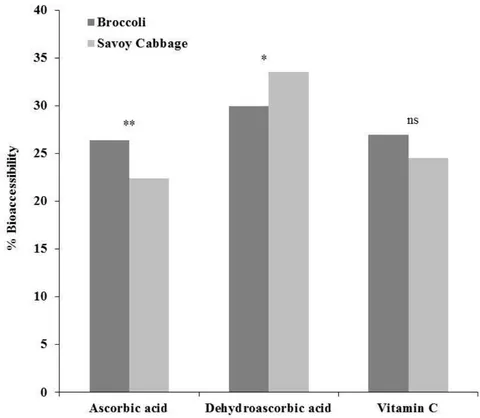
A reduction was observed around of these compounds after in vitro gastrointestinal digestion, with respect to the intact product, results very similar to those found by other authors (Pérez-Vicente et al., 2002; Vallejo et al., 2004). This loss may be due to differences in pH of the different media used to simulate digestion and the presence of oxygen.
The oxidized form of the ascorbic acid, dehydroascorbic acid, is better absorbed, since at physiological pH it is not ionized, it is less hydrophilic and, therefore, it is able to cross better the cell membranes. This is the reason why the bioaccessibility percentage of dehydroascorbic acid is superior to that of ascorbic acid for both brassicas studied (Figure 1).
b) Carotenoids
It was observed that both, -carotene and lutein, were significantly more abundant in broccoli
(0.770 and 0.560 mg/100 g FW, respectively) than in Savoy cabbage (0.340 and 0.170 mg/100 g FW, respectively), broccoli with more -carotene and more lutein than Savoy cabbage. Consequently, total carotenoids content was approximately higher in Broccoli 'Parthenon' than in Savoy cabbage 'Dama' (Table 1). The data obtained for these compounds were in the range of concentrations found in other studies (Singh et al., 2007, Fernandez-León et al., 2014).
Of the two carotenoids identified, it was -carotene that showed the highest bioaccessible content after in vitro digestion for broccoli (0.050 mg -carotene/100 g FW). For Savoy cabbage, similar bioaccessible contents were obtained for both carotenoids (0.010 mg/100 g FW) (Table 1).
Figure 2 shows the bioaccessibility percentages of -carotene, lutein and total carotenoids of broccoli and Savoy cabbage. As observed, there are no significant differences between the two brassicas in the bioaccessibility percentage for lutein. Although starting from a higher initial content in broccoli, the
bioaccessibility percentage is statistically similar for both matrices.
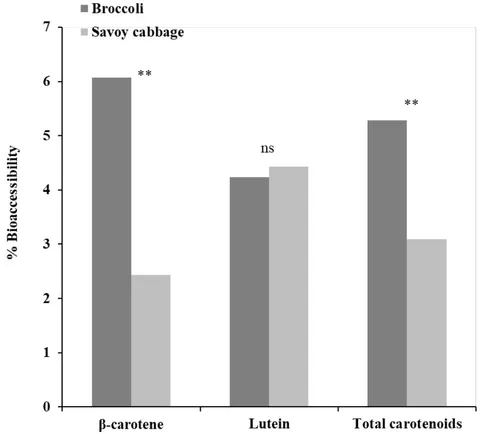
The percentage of bioaccessibility of -carotene and total carotenoids was higher in broccoli than in Savoy cabbage (Figure 2), being significantly different and presenting similar values to those found by other authors for different matrices (O'Connell et al., 2007; O'Sullivan et al., 2010).
As can be seen in Figure 2, the bioaccessibility percentage of the carotenoid compounds studied is low, not more than . This may be due to the fact that, although most of these pigments are stable at extreme heat and pH in the intact tissues of plants, when extracted in isolation they oxidize rapidly due to the addition of oxygen over the double bonds (Melendez-Martínez et al., 2004). This could explain the critical loss of these compounds during in vitro digestion.
Studies carried out by other authors show the high variability in the absorption of different carotenoids and the significant differences in the bioavailability of these between fruits and vegetables. In general, the percentage of bioavailability is higher in fruit, i.e., fruit carotenoids are potentially more available for absorption by gastrointestinal cells (O'Connell et al., 2007). Among the main factors affecting the bioavailability of carotenoids are food matrix, fat, fiber, polarity, and interactions between them (Yeum and Russell, 2002;
Faulks and Southon, 2005; Maiani et al., 2009; Ornelas-Paz et al., 2012).
It is generally accepted that xanthophylls are more bioavailable than carotenes, indicating that polarity is important about absorption (Ormelas-Paz et al., 2012). This can be seen in the results obtained for Savoy cabbage, where, although starting from higher content of -carotene (carotene) than lutein (xanthophyll), a higher percentage of bioavailability is obtained for lutein than for -carotene (Figure 2). Also, in foods in which several carotenoids are present, such as brassicas, interactions may occur between them that affect their bioavailability.
c) Chlorophylls
Chlorophyll A and chlorophyll B are genuine components of photosynthetic membranes and are present in a 3:1 ratio (Chen and Chen, 1993), as observed in this study (Table 1, crude values). The A:B chlorophyll ratio may vary due to growth and environmental conditions (Lichtenthaler et al., 1982), and this ratio is considered a quality parameter for green vegetables, such as the two brassicas under study.
Chlorophyll A was the majority pigment, with values of chlorophyll A/100 g FW for broccoli and 2.17 mg chlorophyll A/100 g FW for Savoy cabbage, differing significantly, being in broccoli approximately higher than in Savoy cabbage (Table 1). The content of chlorophyll B was also higher in broccoli (3.02 mg chlorophyll B/100 g FW) than in Savoy cabbage (0.820 mg chlorophyll B/100 g FW), in a proportion of approximately (Table 1).
The results obtained for total chlorophyll content were similar to those found by our group in previous studies (García et al., 2005; Fernández-León et al., 2010; Fernández-León et al., 2014). It can be stated that broccoli has approximately more total chlorophyll than Savoy cabbage (Table 1). The bioaccessible content of chlorophyll A, as well as the total, were also significantly higher in broccoli (0.160 and chlorophyll A/100 g FW, respectively).
Figure 3 shows the bioaccessibility percentages of chlorophyll A, chlorophyll B and total chlorophyll for broccoli and Savoy cabbage. The values are statistically higher for Savoy cabbage, with chlorophyll B having the highest percentage of bioaccessibility (approximately ).
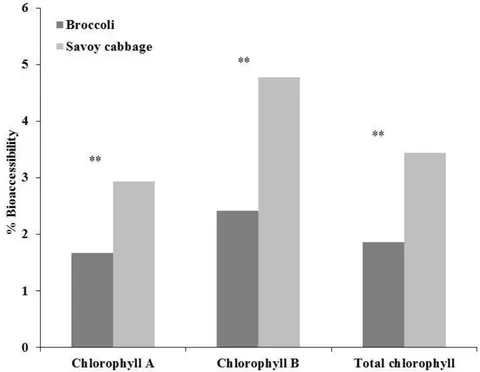
This low percentage of bioavailability can be linked to the alterations suffered by chlorophyll at acid pH, during the digestion processes. The main alteration experienced in these conditions is the loss of the magnesium atom, forming the pheophytin, with an olive-green color with brown tones, instead of the bright green of chlorophyll. This loss of magnesium is produced by substitution by two ions, and consequently, it is favored by the acid medium (Deschene et al., 1991; Zhuang et al., 1995).
It must be considered that vegetables are always acidic and that in thermal treatment acids are generally released from vacuoles in the cells, which lower the pH of the medium, so that the temperature also affects this alteration (Deschene et al., 1991; Zhuang et al., 1995). It is also known that chlorophyll B is somewhat more stable than chlorophyll A at acid pH, as can be seen in the results obtained of greater bioavailability and, therefore, less loss of chlorophyll B after in vitro digestion (Figure 3).
Although the chlorophyll content was higher in broccoli, both crude (not digested) and in the bioavailable fraction, the difference between the values in crude and after gastrointestinal in vitro digestion was more significant, so it can be said that there were greater loss and lower absorption of these compounds in broccoli than for Savoy cabbage.
It has not been possible to compare the results obtained in this work as there is no available literature referred to the bioavailability of chlorophylls. It is known that the absorption of natural chlorophyll occurs practically only at level of the small intestine due to its lipophilic character (Pérez-Gálvez and Mínguez-Mosquera, 2007).
d) Phenolic Compounds
Broccoli exhibited a higher total content of phenolic acids and flavonoids, with values of 4.32 and 9.61 mg/100 g FW, respectively, being significantly different from those obtained for Savoy cabbage. While for 'Parthenon' broccoli the content of total flavonoids was higher than total phenolic acids, for Savoy cabbage the values were very similar and close to FW (Table 1).
With respect to the individual phenolic compounds, three phenolic acids (gallic, chlorogenic and synapic acid) and two flavonoids (quercetin and kaempferol) were quantified (Table 1). It was observed that the content was significantly higher for broccoli, except for synapic acid, which showed a higher concentration in the Savoy cabbage. The concentrations of phenolic acids and flavonoids for the brassicas under study were similar to those found by USDA/ARS (2007) and by other authors (Vallejo et al., 2003a; Vallejo et al., 2003b; Koh et al., 2009).
The total phenolic acids and total flavonoids in the bioaccessible fraction of broccoli and Savoy cabbage, after in vitro gastrointestinal digestion, are shown in Table 1.
The total content of phenolic acids in the bioaccessible fraction was higher in broccoli than in Savoy cabbage (0.850 and 0.410 mg/100 g FW, respectively), as was the total content of flavonoids (3.89 and 0.790 mg/100 g FW, respectively). Although the behavior in the content of these compounds was similar to that observed in the undigested product, after in vitro gastrointestinal digestion the general trend was a decrease in the level of total phenolic acids and total flavonoids, as observed by other authors for other food products (Gil-Izquierdo et al., 2002; Pérez-Vicente et al., 2002; Vallejo et al., 2004). In the case of flavonoids, there are authors (Vallejo et al., 2004) who indicate that this loss may be due to the fact that during pancreatic digestion compounds are released (macromolecules such as proteins and fiber) capable of being associated with flavonoids thus preventing their absorption.
Generally, phenolic compounds are relatively stable, but they can be degraded due to chemical, microbiological and, above all, enzymatic oxidations by the action of the enzyme polyphenol oxidase (PPO), which as the membranes deteriorate comes into contact with phenolic compounds and oxidizes them (Dixon, 2001). But this enzyme is deactivated at pH lower than 2 and therefore, the oxidation reaction of the phenolic compounds is slower. This may be the reason why the loss of these bioactive compounds after in vitro digestion was not as pronounced as in the case of carotenoid and chlorophyll pigments, as pH=1.5 at the beginning of digestion would favor no degradation of phenolic compounds in this step.
The individual phenolic acid with the highest bioaccessible content in broccoli was chlorogenic acid (0.350 mg chlorogenic acid/100 g FW), followed by synaptic acid and finally gallic acid, while in Savoy cabbage, synaptic acid exhibited the highest concentration (0.180 mg/100 g pf) after gastrointestinal digestion in vitro. Comparing the two brassicas studied, broccoli 'Parthenon' presented the highest content of all individual phenolic acids in the bioaccessible fraction. Regarding the flavonoids quercetin and kaempferol, the bioaccessible content was also higher in broccoli, as was the case in the undigested sample. The most abundant individual flavonoid in broccoli, after gastrointestinal digestion in vitro, was quercetin (2.64 mg quercetin/100 g FW) while in Savoy cabbage it was kaempferol (0.460 mg kaempferol/100 g FW.
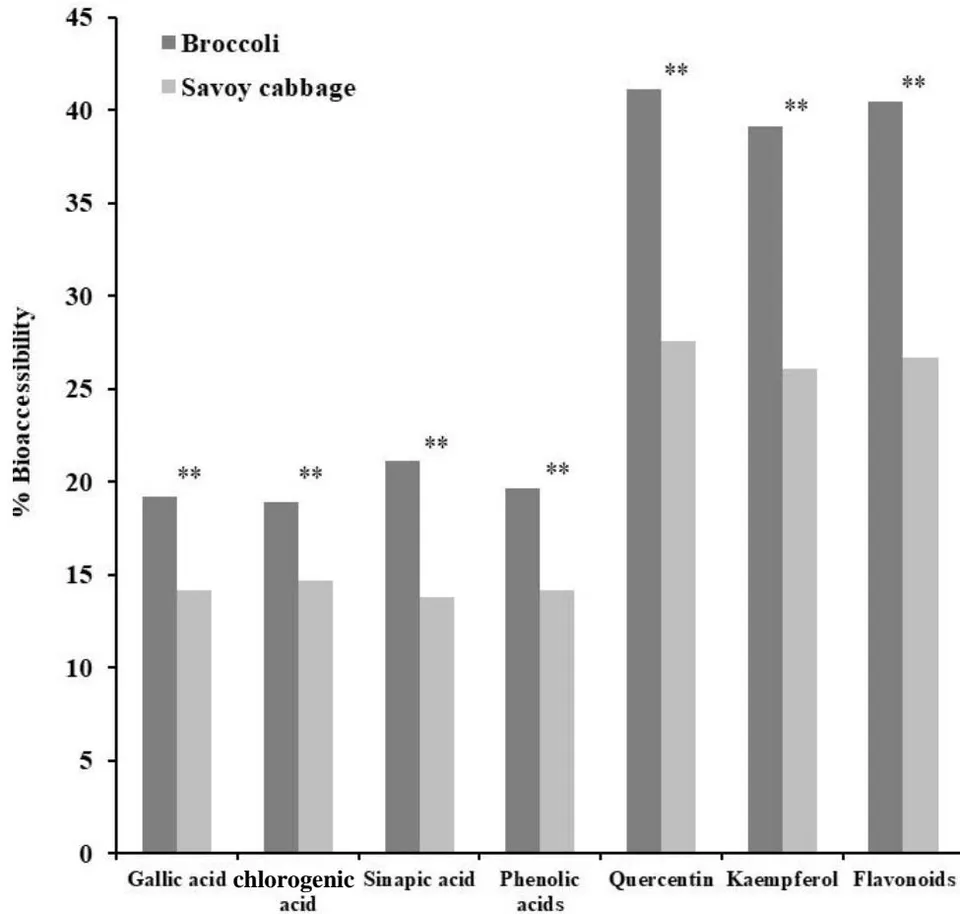
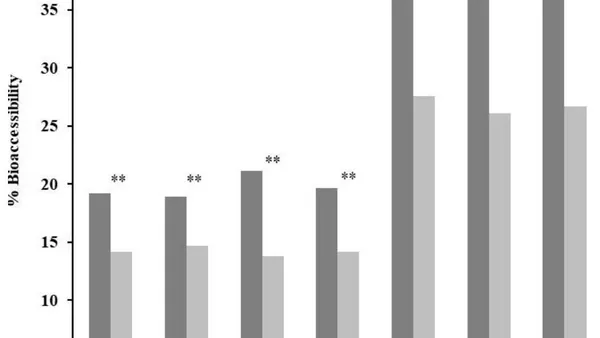
Figure 4 shows the bioaccessibility percentages of total phenolic acids and total flavonoids. The total phenolic acids presented a low percentage of bioaccessibility (less than ), being therefore the ones that had greater losses after the in vitro gastrointestinal digestion, as previously reported by Vallejo et al. (2004).
However, the bioaccessibility percentage of total flavonoids was much higher than that obtained for total phenolic acids, contrarily to other authors such as Vallejo et al. (2004), Saura-Calixto et al. (2007) and Crozier et al. (2010), who found, in general, that the bioavailability of phenolic acids was greater than that of flavonoids, because the latter are compounds with more complex chemical structures, with higher polymerization index and glycosylation, so their absorption in the small intestine is more difficult, thus passing to the large intestine where most of the absorption occurs, mainly due to the fermentation produced by the bacteria of the colonic microbiota.
Comparing the two brassicas studied, it was the broccoli 'Parthenon' that presented the highest percentage of bioaccessibility both in the total phenolic acids and flavonoids (Figure 4). With respect to the individual phenolic compounds, the synaptic acid was the individual phenolic acid that presented the highest percentage of bioaccessibility in broccoli and chlorogenic acid in Savoy cabbage, around 21 and respectively, values similar to those obtained by Vallejo et al. (2004) for the broccoli cultivar 'Marathon'.
It should be noted that although for broccoli chlorogenic acid was the single phenolic acid majority in the bioavailable faction (Table 1), it exhibited the lowest bioaccessibility percentage of the three individual phenolic acids identified in this work (Figure 4). For Savoy cabbage, synaptic acid was the majority in the bioavailable fraction (Table 2), but its bioaccessibility percentage (Figure 4) was the lowest of the three individual phenolic acids. Therefore, it can be said that for both chlorogenic acid in broccoli and synaptic acid in Savoy cabbage, the most significant losses occurred after in vitro gastrointestinal digestion, and therefore the lowest percentages of bioaccessibility.
Concerning the bioaccessibility percentage of the flavonoids identified individually (Figure 4), quercetin presented the highest value in both brassicas (41% for broccoli and 27% for Savoy cabbage). The fact that in Savoy cabbage kaempferol was the most abundant in the bioavailable fraction (Table 1) and, however, the one with the lowest percentage of bioaccessibility (Figure 4), indicates that greater losses occurred after in vitro gastrointestinal digestion for this flavonoid.
The results obtained in this work for the phenolic compounds studied individually (whether acids or flavonoids) are difficult to compare with others, as the data on bioavailability provided by other studies are scarce and controversial. Thus, studies carried out on bioavailability and metabolism of these compounds indicate that flavonoids are poorly absorbed in the small intestine as opposed to phenolic acids. In most cases, flavonoids are present in foods in the form of more complex combinations with sugars and aliphatic and aromatic organic acids, which substantially decreases their absorption in the small intestine, producing the transit to the large intestine, where the microbiota of the colon metabolizes the flavonoids naturally present in the food to give rise to simpler compounds, mainly derived from phenylacetic acid and phenylpropionic acid (Selma et al., 2009), which are those that will be absorbed and metabolized by the organism. However, this behavior has also been observed in some phenolic acids with or without complex structure, and even the opposite has been observed for flavonoids such as quercetin, for which better absorption has been seen when it is as glucoside than as agglicone (Manach et al., 2005).
IV. CONCLUSIONS
After in vitro digestion it was observed that, as in the crude (or undigested) product the content of functional compounds was higher in 'Parthenon' broccoli than in 'Dama' Savoy cabbage. Regarding the percentage of bioaccessibility, it was higher in 'Parthenon' broccoli for ascorbic acid, -carotene and phenolic compounds, while for chlorophyll A, chlorophyll B and the sum of both (total chlorophylls), as well as for dehydroascorbic acid, it was higher in 'Dama' Savoy cabbage.
In general, and according to the data obtained in this research work, it can be said that the bioaccessibility of the health-promoting compounds of 'Parthenon' broccoli were higher than those of 'Dama' Savoy cabbage (except for chlorophyll pigments), and therefore broccoli would have a higher functional value.
ACKNOWLEDGEMENTS
Part of this research has been funded by Junta de Extremadura and FEDER (Project GR10006) and Project "Red de Investigación Transfronteriza Extremadura-Centro-Alentejo (RITECA-II)".