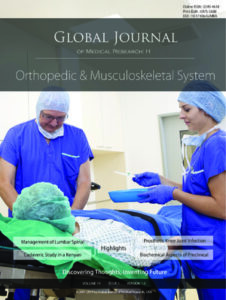
Biochemical Aspects of Preclinical Prediction of the Severity of the Knee Joint Injuries in Acute Period

α
Surayyo Z. Yuldasheva
σ
Bekhzod Abdullaev
Bekhzod Abdullaev
ρ
Murod Karimov
Murod Karimov
Ѡ
Feruza Inoyatova
Feruza Inoyatova
¥
Umid Kholmurodov
Umid Kholmurodov
§
Kirill Tolochko
Kirill Tolochko

Send Message

To: Author

Biochemical Aspects of Preclinical Prediction of the Severity of the Knee Joint Injuries in Acute Period

Article Fingerprint

ReserarchID

T44MN

Biochemical Aspects of Preclinical Prediction of the Severity of the Knee Joint Injuries in Acute Period Banner

AI TAKEAWAY

Connecting with the Eternal Ground
  • English
  • Afrikaans
  • Albanian
  • Amharic
  • Arabic
  • Armenian
  • Azerbaijani
  • Basque
  • Belarusian
  • Bengali
  • Bosnian
  • Bulgarian
  • Catalan
  • Cebuano
  • Chichewa
  • Chinese (Simplified)
  • Chinese (Traditional)
  • Corsican
  • Croatian
  • Czech
  • Danish
  • Dutch
  • Esperanto
  • Estonian
  • Filipino
  • Finnish
  • French
  • Frisian
  • Galician
  • Georgian
  • German
  • Greek
  • Gujarati
  • Haitian Creole
  • Hausa
  • Hawaiian
  • Hebrew
  • Hindi
  • Hmong
  • Hungarian
  • Icelandic
  • Igbo
  • Indonesian
  • Irish
  • Italian
  • Japanese
  • Javanese
  • Kannada
  • Kazakh
  • Khmer
  • Korean
  • Kurdish (Kurmanji)
  • Kyrgyz
  • Lao
  • Latin
  • Latvian
  • Lithuanian
  • Luxembourgish
  • Macedonian
  • Malagasy
  • Malay
  • Malayalam
  • Maltese
  • Maori
  • Marathi
  • Mongolian
  • Myanmar (Burmese)
  • Nepali
  • Norwegian
  • Pashto
  • Persian
  • Polish
  • Portuguese
  • Punjabi
  • Romanian
  • Russian
  • Samoan
  • Scots Gaelic
  • Serbian
  • Sesotho
  • Shona
  • Sindhi
  • Sinhala
  • Slovak
  • Slovenian
  • Somali
  • Spanish
  • Sundanese
  • Swahili
  • Swedish
  • Tajik
  • Tamil
  • Telugu
  • Thai
  • Turkish
  • Ukrainian
  • Urdu
  • Uzbek
  • Vietnamese
  • Welsh
  • Xhosa
  • Yiddish
  • Yoruba
  • Zulu

Abstract

Early detection of markers of joint damage in order to predict the course of the inflammatory process and the risk of developing post-traumatic osteoarthritis is one of the urgent problems of traumatology and orthopedics. Determining the molecules of average mass and necrotic substances in the hemosynovial fluid of the injured knee joint demonstrates a significant association with the severity of the injury, the severity of the inflammatory process and the progression of post-traumatic osteoarthritis. Increasing the level of necrotic substances in hemosynovial fluid to 1.6-2.0 U/ml, 45.4% corresponds to significant damage to the intra-articular structures and leads to the development of the inflammatory process; an increase in excess of 2.0 U/ml is an indicator of severe joint injury and leads to a complicated postoperative course.

References

12 Cites in Article
  1. L Manni,T Lundeberg,S Fiorito,S Bonini,E Vigneti,L Aloe (2003). Nerve growth factor release by human synovial fibroblasts prior to and following exposure to tumor necrosis factor-α, interleukin-1β and cholecystokinin-8: the possible role of NGF in the inflammatory response.
  2. K Baker,A Grainger,J Niu,M Clancy,A Guermazi,M Crema (2010). Relation of synovitis to knee pain using contrast-enhanced MRIs.
  3. L Torres,D D Dunlop,C Peterfy,A Guermazi,P Prasad,K Hayes,J Song,S Cahue,A Chang,M Marshall,L Sharma (2006). The relationship between specific tissue lesions and pain severity in persons with knee osteoarthritis.
  4. Panna Sanga,Nathaniel Katz,Elena Polverejan,Steven Wang,Kathleen Kelly,Juergen Haeussler,John Thipphawong (2013). Efficacy, safety, and tolerability of fulranumab, an anti-nerve growth factor antibody, in the treatment of patients with moderate to severe osteoarthritis pain.
  5. M Brown,I Murphy F T, Radin D M, Davignon,M D Smith,C West (2012). Tanezumab reduces osteoarthritic knee pain: results of a randomized, double-blind, placebo-controlled phase III trial.
  6. G Hernández-Molina,T Neogi,D J Hunter,J Niu,A Guermazi,S Reichenbach,F Roemer,C Mclennan,D Felson (2008). The association of bone attrition with knee pain and other MRI features of osteoarthritis.
  7. L Haywood,D F Mcwilliams,C Pearson,S E Gill,A Ganesan,D Wilson (2003). Inflammation and angiogenesis in osteoarthritis.
  8. D A Walsh,D F Mcwilliams,M Turley,M R Dixon,R Franses,P Mapp,D Wilson (2010). Angiogenesis and nerve growth factor at the osteochondral junction in rheumatoid arthritis and osteoarthritis.
  9. Nancy Lane,Thomas Schnitzer,Charles Birbara,Masoud Mokhtarani,David Shelton,Mike Smith,Mark Brown (2010). Tanezumab for the Treatment of Pain from Osteoarthritis of the Knee.
  10. Catherine Hill,David Hunter,Jingbo Niu,Margaret Clancy,Ali Guermazi,Harry Genant,Daniel Gale,Andrew Grainger,Philip Conaghan,David Felson (2007). Synovitis detected on magnetic resonance imaging and its relation to pain and cartilage loss in knee osteoarthritis.
  11. Christian Barthel,Nataliya Yeremenko,Roland Jacobs,Reinhold Schmidt,Michael Bernateck,Henning Zeidler,Paul-Peter Tak,Dominique Baeten,Markus Rihl (2009). Nerve growth factor and receptor expression in rheumatoid arthritis and spondyloarthritis.
  12. J Bedson,P Croft (2008). The discordance between clinical and radiographic knee osteoarthritis: a systematic search and summary of the literature.

Funding

No external funding was declared for this work.

Conflict of Interest

The authors declare no conflict of interest.

Ethical Approval

No ethics committee approval was required for this article type.

Data Availability

Not applicable for this article.

How to Cite This Article

Surayyo Z. Yuldasheva. 2019. \u201cBiochemical Aspects of Preclinical Prediction of the Severity of the Knee Joint Injuries in Acute Period\u201d. Global Journal of Medical Research - H: Orthopedic & Musculoskeletal System GJMR-H Volume 19 (GJMR Volume 19 Issue H1): .

Download Citation

Journal Specifications

Crossref Journal DOI 10.17406/gjmra

Print ISSN 0975-5888

e-ISSN 2249-4618

Keywords
Classification
GJMR-H Classification: NLMC Code: WE 348
Version of record

v1.2

Issue date

February 12, 2019

Language
en
Experiance in AR

Explore published articles in an immersive Augmented Reality environment. Our platform converts research papers into interactive 3D books, allowing readers to view and interact with content using AR and VR compatible devices.

Read in 3D

Your published article is automatically converted into a realistic 3D book. Flip through pages and read research papers in a more engaging and interactive format.

Article Matrices
Total Views: 2980
Total Downloads: 1323
2026 Trends
Related Research

Published Article

Early detection of markers of joint damage in order to predict the course of the inflammatory process and the risk of developing post-traumatic osteoarthritis is one of the urgent problems of traumatology and orthopedics. Determining the molecules of average mass and necrotic substances in the hemosynovial fluid of the injured knee joint demonstrates a significant association with the severity of the injury, the severity of the inflammatory process and the progression of post-traumatic osteoarthritis. Increasing the level of necrotic substances in hemosynovial fluid to 1.6-2.0 U/ml, 45.4% corresponds to significant damage to the intra-articular structures and leads to the development of the inflammatory process; an increase in excess of 2.0 U/ml is an indicator of severe joint injury and leads to a complicated postoperative course.

Our website is actively being updated, and changes may occur frequently. Please clear your browser cache if needed. For feedback or error reporting, please email [email protected]

Request Access

Please fill out the form below to request access to this research paper. Your request will be reviewed by the editorial or author team.
X

Quote and Order Details

Contact Person

Invoice Address

Notes or Comments

This is the heading

Lorem ipsum dolor sit amet, consectetur adipiscing elit. Ut elit tellus, luctus nec ullamcorper mattis, pulvinar dapibus leo.

High-quality academic research articles on global topics and journals.

Biochemical Aspects of Preclinical Prediction of the Severity of the Knee Joint Injuries in Acute Period

Bekhzod Abdullaev
Bekhzod Abdullaev
Murod Karimov
Murod Karimov
Feruza Inoyatova
Feruza Inoyatova
Umid Kholmurodov
Umid Kholmurodov
Kirill Tolochko
Kirill Tolochko

Research Journals