Blockchain on Voting System in Africa

1
adeolu_seun_obamehinti
2
Adeolu Seun Obamehinti

Send Message

To: Author

GJCST Volume 21 Issue E1

Article Fingerprint

ReserarchID

CSTNWSJ945R

Blockchain on Voting System in Africa Banner
  • English
  • Afrikaans
  • Albanian
  • Amharic
  • Arabic
  • Armenian
  • Azerbaijani
  • Basque
  • Belarusian
  • Bengali
  • Bosnian
  • Bulgarian
  • Catalan
  • Cebuano
  • Chichewa
  • Chinese (Simplified)
  • Chinese (Traditional)
  • Corsican
  • Croatian
  • Czech
  • Danish
  • Dutch
  • Esperanto
  • Estonian
  • Filipino
  • Finnish
  • French
  • Frisian
  • Galician
  • Georgian
  • German
  • Greek
  • Gujarati
  • Haitian Creole
  • Hausa
  • Hawaiian
  • Hebrew
  • Hindi
  • Hmong
  • Hungarian
  • Icelandic
  • Igbo
  • Indonesian
  • Irish
  • Italian
  • Japanese
  • Javanese
  • Kannada
  • Kazakh
  • Khmer
  • Korean
  • Kurdish (Kurmanji)
  • Kyrgyz
  • Lao
  • Latin
  • Latvian
  • Lithuanian
  • Luxembourgish
  • Macedonian
  • Malagasy
  • Malay
  • Malayalam
  • Maltese
  • Maori
  • Marathi
  • Mongolian
  • Myanmar (Burmese)
  • Nepali
  • Norwegian
  • Pashto
  • Persian
  • Polish
  • Portuguese
  • Punjabi
  • Romanian
  • Russian
  • Samoan
  • Scots Gaelic
  • Serbian
  • Sesotho
  • Shona
  • Sindhi
  • Sinhala
  • Slovak
  • Slovenian
  • Somali
  • Spanish
  • Sundanese
  • Swahili
  • Swedish
  • Tajik
  • Tamil
  • Telugu
  • Thai
  • Turkish
  • Ukrainian
  • Urdu
  • Uzbek
  • Vietnamese
  • Welsh
  • Xhosa
  • Yiddish
  • Yoruba
  • Zulu

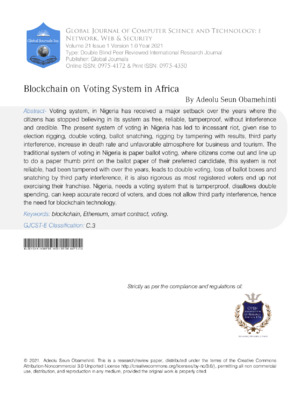
Voting system, in Nigeria has received a major setback over the years where the citizens has stopped believing in its system as free, reliable, tamperproof, without interference and credible. The present system of voting in Nigeria has led to incessant riot, given rise to election rigging, double voting, ballot snatching, rigging by tampering with results, third party interference, increase in death rate and unfavorable atmosphere for business and tourism. The traditional system of voting in Nigeria is paper ballot voting, where citizens come out and line up to do a paper thumb print on the ballot paper of their preferred candidate, this system is not reliable, had been tampered with over the years, leads to double voting, loss of ballot boxes and snatching by third party interference, it is also rigorous as most registered voters end up not exercising their franchise. Nigeria, needs a voting system that is tamperproof, disallows double spending, can keep accurate record of voters, and does not allow third party interference, hence the need for blockchain technology.


Funding

No external funding was declared for this work.

Conflict of Interest

The authors declare no conflict of interest.

Ethical Approval

No ethics committee approval was required for this article type.

Data Availability

Not applicable for this article.

adeolu_seun_obamehinti. 2021. \u201cBlockchain on Voting System in Africa\u201d. Global Journal of Computer Science and Technology - E: Network, Web & Security GJCST-E Volume 21 (GJCST Volume 21 Issue E1): .

Download Citation

Blockchain voting system in Africa enhances election security and transparency.
Issue Cover
GJCST Volume 21 Issue E1
Pg. 17- 21
Journal Specifications

Crossref Journal DOI 10.17406/gjcst

Print ISSN 0975-4350

e-ISSN 0975-4172

Keywords
Classification
GJCST-E Classification: C.3
Version of record

v1.2

Issue date

August 20, 2021

Language

English

Experiance in AR

The methods for personal identification and authentication are no exception.

Read in 3D

The methods for personal identification and authentication are no exception.

Article Matrices
Total Views: 3816
Total Downloads: 900
2026 Trends
Research Identity (RIN)
Related Research

Published Article

Voting system, in Nigeria has received a major setback over the years where the citizens has stopped believing in its system as free, reliable, tamperproof, without interference and credible. The present system of voting in Nigeria has led to incessant riot, given rise to election rigging, double voting, ballot snatching, rigging by tampering with results, third party interference, increase in death rate and unfavorable atmosphere for business and tourism. The traditional system of voting in Nigeria is paper ballot voting, where citizens come out and line up to do a paper thumb print on the ballot paper of their preferred candidate, this system is not reliable, had been tampered with over the years, leads to double voting, loss of ballot boxes and snatching by third party interference, it is also rigorous as most registered voters end up not exercising their franchise. Nigeria, needs a voting system that is tamperproof, disallows double spending, can keep accurate record of voters, and does not allow third party interference, hence the need for blockchain technology.

Our website is actively being updated, and changes may occur frequently. Please clear your browser cache if needed. For feedback or error reporting, please email [email protected]
×

This Page is Under Development

We are currently updating this article page for a better experience.

Request Access

Please fill out the form below to request access to this research paper. Your request will be reviewed by the editorial or author team.
X

Quote and Order Details

Contact Person

Invoice Address

Notes or Comments

This is the heading

Lorem ipsum dolor sit amet, consectetur adipiscing elit. Ut elit tellus, luctus nec ullamcorper mattis, pulvinar dapibus leo.

High-quality academic research articles on global topics and journals.

Blockchain on Voting System in Africa

Adeolu Seun Obamehinti

Research Journals