Article Fingerprint
ReserarchID
PRJJN
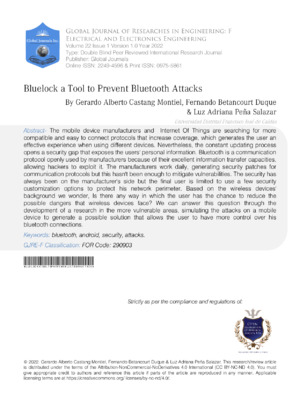
The mobile device manufacturers and Internet Of Things are searching for more compatible and easy to connect protocols that increase coverage, which generates the user an effective experience when using different devices. Nevertheless, the constant updating process opens a security gap that exposes the users’ personal information. Bluetooth is a communication protocol openly used by manufacturers because of their excellent information transfer capacities, allowing hackers to exploit it. The manufacturers work daily, generating security patches for communication protocols but this hasn’t been enough to mitigate vulnerabilities. The security has always been on the manufacturer’s side but the final user is limited to use a few security customization options to protect his network perimeter. Based on the wireless devices’ background we wonder, Is there any way in which the user has the chance to reduce the possible dangers that wireless devices face? We can answer this question through the development of a research in the more vulnerable areas, simulating the attacks on a mobile device to generate a possible solution that allows the user to have more control over his bluetooth connections.
Gerardo Alberto Castang Montiel.. 2026. \u201cBluelock a Tool to Prevent Bluetooth Attacks\u201d. Global Journal of Research in Engineering - F: Electrical & Electronic GJRE-F Volume 22 (GJRE Volume 22 Issue F1): .
Crossref Journal DOI 10.17406/gjre
Print ISSN 0975-5861
e-ISSN 2249-4596
Explore published articles in an immersive Augmented Reality environment. Our platform converts research papers into interactive 3D books, allowing readers to view and interact with content using AR and VR compatible devices.
Your published article is automatically converted into a realistic 3D book. Flip through pages and read research papers in a more engaging and interactive format.
Total Score: 103
Country: Colombia
Subject: Global Journal of Research in Engineering - F: Electrical & Electronic
Authors: Gerardo Alberto Castang Montiel., Fernando Betancourt Duque, Luz Adriana Peña Salazar (PhD/Dr. count: 0)
View Count (all-time): 222
Total Views (Real + Logic): 1707

Total Downloads (simulated): 38
Publish Date: 2026 01, Fri
Monthly Totals (Real + Logic):
This paper attempted to assess the attitudes of students in
Advances in technology have created the potential for a new
Inclusion has become a priority on the global educational agenda,
The mobile device manufacturers and Internet Of Things are searching for more compatible and easy to connect protocols that increase coverage, which generates the user an effective experience when using different devices. Nevertheless, the constant updating process opens a security gap that exposes the users’ personal information. Bluetooth is a communication protocol openly used by manufacturers because of their excellent information transfer capacities, allowing hackers to exploit it. The manufacturers work daily, generating security patches for communication protocols but this hasn’t been enough to mitigate vulnerabilities. The security has always been on the manufacturer’s side but the final user is limited to use a few security customization options to protect his network perimeter. Based on the wireless devices’ background we wonder, Is there any way in which the user has the chance to reduce the possible dangers that wireless devices face? We can answer this question through the development of a research in the more vulnerable areas, simulating the attacks on a mobile device to generate a possible solution that allows the user to have more control over his bluetooth connections.


Lorem ipsum dolor sit amet, consectetur adipiscing elit. Ut elit tellus, luctus nec ullamcorper mattis, pulvinar dapibus leo.