The degree to which students understand the subjects taught in schools largely depends on the educational environment. In resource-poor regions, particularly in resource-poor developing countries, this environment is often inadequate; severely hindering learning outcomes. Here, the mixed-methods approach was used to assess the degree to which students understand chemical formulas and equations taught in Senior Secondary Schools (SSS) in Sierra Leone. A total of 158 SSS II and SSS III students across 6 schools in Bo City were randomly selected. Bo City is the regional headquarter of the Southern Region of Sierra Leone. Diagnostic pre-test results showed an alarming deficiency among students regarding the level of knowledge of foundational chemistry. Only 3.6% of the students correctly formulated Lithium Trioxosulphate (IV) and only another 7.3% accurately balanced the sodium-chlorine reaction equation. Qualitative analysis further showed a widespread misconception of the IUPAC nomenclature (63.29%) and polyatomic ion valencies (88.3%). Additionally, 77% of the students failed to correctly identify NaCl compound and some 53.7% properly balanced the related chemical equations.
## I. INTRODUCTION
As the engine of technological innovation, science education is a critical tool for national development (Orukotan, 2007). Chemistry is a key discipline of central science (Adams & Sewry, 2010), bridging physics, biology, medicine, and engineering. A fundamental aspect of secondary school chemistry education is the study of chemical formulas and equations, which encode the compositions and interactions of substances. Mastery of these concepts underpins critical chemical principles, including stoichiometry, reaction mechanisms, and material properties (Johnstone, 1991), but also the prediction of the behavior of chemicals (Ben-Zvi et al., 1987).
Despite being so important, chemical formulas and equations pose significant learning obstacles, particularly in resource-constrained settings (Calik & Ayas, 2005; Taber, 2020). Students struggle most with symbolic and submicroscopic notations, which demand abstract reasoning (Johnstone, 1991). These difficulties are exacerbated by inadequate teaching resources, overcrowded classroom spaces, and reliance on rote learning. WAEC (2018) documented systemic failure in balancing basic reaction equations such as $\mathrm{Cl}_2 + \mathrm{H}_2\mathrm{O}$, reflecting a widespread inability to connect abstract notation to tangible phenomena. Calik & Ayas (2005) attributed this disconnect to curricula that neglect real-world applications, a recurring issue in underfunded education systems.
Khurshid et al. (20171) noted that persistent struggles with chemical notations result in mass failures in high-stake examinations, discouraging students to pursue STEM pathways. The declining proficiency in chemistry is increasing the scarcity of qualified chemistry instructors, resulting in a cycle of poor science education (OECD, 2023). Treating equation balancing as a mechanical exercise rather than a reflection of mass conservation (Nakhleh, 1992) only increases the tendency to confuse molecular (e.g., $\mathsf{H}_2\mathsf{O}_2$ ) with empirical (e.g., HO) (Taber, 2002) formulas. This also results in misapplication of valency rules, especially for polyatomic ions (Barke et al., 2021).
Johnstone (1991) noted that the three levels of chemical notation (macroscopic, submicroscopic, and symbolic) are seldom taught cohesively in under-resourced institutions. Limited access to models or digital simulations (Gilbert & Treagust, 2022) forces students to rely on abstract learning, deepening the misunderstanding. In Sierra Leone, these challenges are compounded by dilapidated laboratories, undertrained instructors, and post-conflict recovery constraints (MoE-SL, 2022). Similar trends in Nigeria (Orukotan, 2007) and Pakistan (Khurshid et al., 2017) highlight a global equity gap in chemistry education.
Studies show that scalable solutions can be used to bridge the gaps in science education. One such solution is scaffolded learning, where step-by-step templates are used in balancing equations (Johnson & Lee, 2022). Another is peer collaboration, where students work in groups to solve science problems and by doing build confidence (Zoller, 2021). Multimodal tools such as PhET simulations for visualizing reactions (Smith et al., 2023) and molecular kits for tactile learning (Adu-Gyamfi, 2019) have also been proven useful. One other approach is the use of remedial drills with focus on valency can improve the ability of students to balance chemical equations (Nakleh, 2023). Curriculum redesign in Rwanda reduced errors in balancing stoichiometry equations by $30\%$ (MoE-R, 2021). The use of hands-on modeling kits in Ghana demonstrated the impact of systemic investment in teacher training on science education (OECD, 2023).
While misconceptions in chemical formulas and equations are well-documented in resource-sufficient regions, little is so done for resource-constrained environment. The aim of this study was to investigate misconceptions in interpretations of chemical formula and test intervention strategies among secondary school students in Sierra Leone. This was investigated by adapting global insights to local realities. By diagnosing recurring errors and piloting context-appropriate interventions, the basis for equitable chemistry education in resource-constrained settings were developed, using Sierra Leone as a case study.
## II. MATERIALS AND METHODS
### a) Study Area
Sierra Leone is on the west coast of Africa, between latitudes $6.91 - 10.08^{\circ}$ N and longitudes $10.21 - 13.32^{\circ}$ W and has a total area of $71,740\mathrm{km}^2$. The country is divided into sections, amalgamated into chiefdoms, in turn amalgamated into districts, and eventually amalgamated into regions, and then the Western Area.
Bo District, which lies in the Southern Region, has an area of $1,400\mathrm{km}^2$ and population of 463,668 persons (SSL, 2014; UNDP, 2018). The district comprises 15 chiefdoms, with Bo Township located in Kakua Chiefdom. Bo township is also the district headquarters and the second largest city in Sierra Leone (Mokuwa & Maat, 2020).
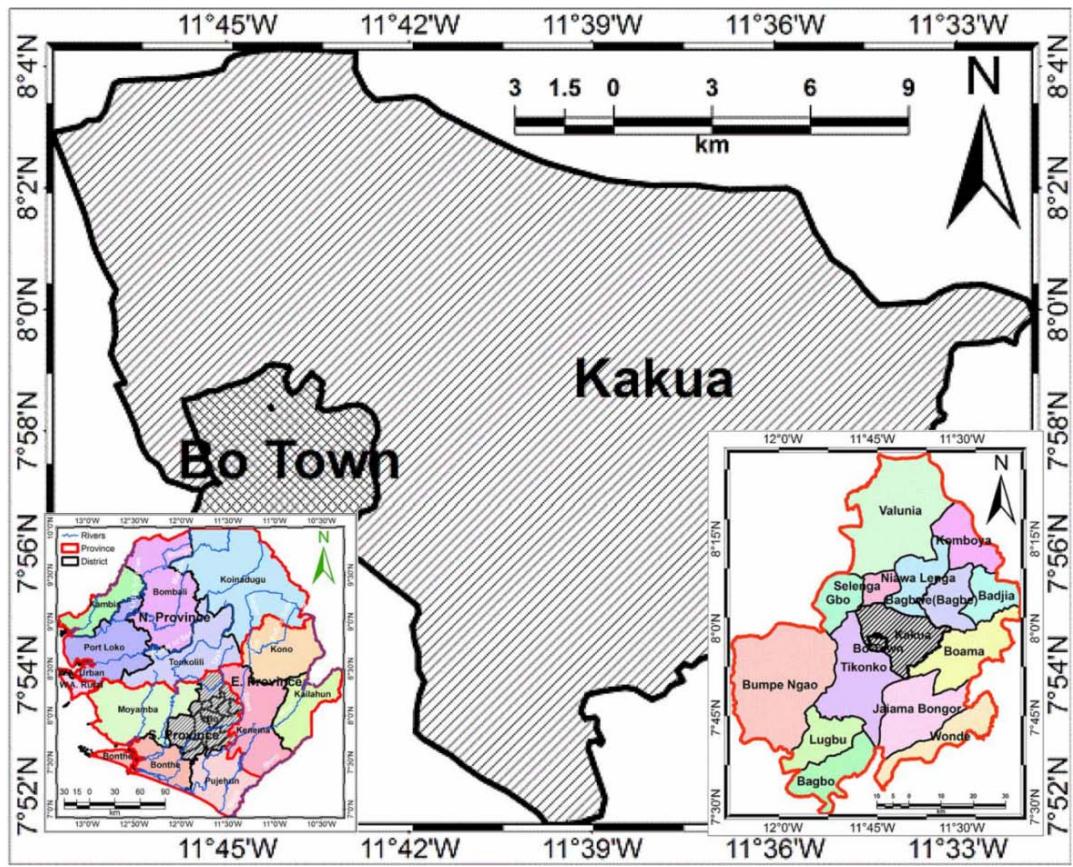 Fig. 1: A map of Sierra Leone (inset on left) depicting Bo District (in stripes), a map of the district (inset on right) depicting Kakua Chiefdom (in strips), and then the main map depicting Kakua Chiefdom and Bo township (the study area).
### b) Study Population and Sample
There are some 1025 schools in Bo District, of which 747 (72.88%) are in Bo City. Only 47 (4.59%) of the 1025 schools in the district are SSS; of which 18 (38.30%) are in Bo township (Table 1). Of the 18 SSS in the township, 6 (33.33%) were randomly selected for this study. Also, as chemical formulas and equations are generally taught in Grades 11 (SSS II) and 12 (SSS III), only science students in these grades were targeted. Based on 2023-2024 data (MoE-SL, 2022; WAEC, 2023), there are some 5000 SSS students in Bo township, with 3200 in SSS II & III. Of this number, 158 $(4.94\%)$ students participated in the study. A total of 22 students $(13.92\%)$ were in SSS II and 136 $(86.08\%)$ in SSS III. The number of students and then the male-female ratio of participants per school varied.
Table 1: A list of the categories and number of schools in Bo District, Bo town and the percent ratio
<table><tr><td>Category of Schools</td><td>Bo District (BD)</td><td>Bo City (BC)</td><td>BC/BD (%)</td></tr><tr><td>Pre-primary School</td><td>158</td><td>69</td><td>43.67</td></tr><tr><td>Primary School</td><td>688</td><td>620</td><td>90.12</td></tr><tr><td>Junior Secondary School</td><td>132</td><td>40</td><td>30.30</td></tr><tr><td>Senior Secondary School</td><td>47</td><td>18</td><td>38.30</td></tr><tr><td>Total</td><td>1025</td><td>747</td><td>72.88</td></tr></table>
### c) Data Collection
The mixed-methods approach that was a combination of purposive random sampling, diagnostic pre-test, and questionnaire was used to collect both quantitative and qualitative data. According to Johnstone (1993), this data collection approach is effective for both qualitative and quantitative data collection (Taber, 2020).
For the diagnostic pre-test, a total of 12 carefully selected variables were used to evaluate fundamental competency of chemistry students. Of this, 7 were used to assess basic chemical notation proficiency, 3 for testing equation formulation, and 2 for balancing equation. Supplementary questions were used to examine the core principles of chemical formulas and equations. Also, questionnaires were used to evaluate the levels of comprehension of students and confidence in writing chemical symbols and equations.
The pre-test was conducted on different days under timed classroom setting and the responses scored for analysis. The questionnaire was administered several days after the pre-test to the same set of students in the 6 schools. The responses were then used to evaluate the learning outcomes.
For validity and reliability, the data collection instruments (pre-test and questionnaire) were piloted on 20 students in the Bo Government Secondary School. The feedback was used to identify and fix the gaps in the data collection instruments and to also ensure consistency.
### d) Data Analysis
Descriptive statistics was used to measure frequencies and percentages of the pre-test performance (Tables 2-5). The focus here was on correct and incorrect response rates for formulas, equations, and basic concepts. The questionnaire data were analyzed for recurring patterns. The analysis was done in Microsoft Excel environment.
## III. RESULTS AND DISCUSSIONS
### a) Pre-test Result Discussion
In Sierra Leone and much of Africa, the 6-3-3-4 education system is such that secondary school chemistry for SSS II (Grade 11) and SSS III (Grade 12) students focuses more intensively on formulas and equations (Taylor, 2021; MBSSE, 2022). The pre-test assessment revealed a generally low level of competency among SSS students in basic chemical notations, including chemical formulas and equations. As shown in Table 2, students performed best in writing chemical formula for Sodium Chloride (73.18% correct responses), with the lowest scores recorded for Lithium Trioxosulphate (IV) and Beryllium Nitride (3.64% each). Apart from Sodium Chloride, the next highest score was for Zinc Oxide (38.64%), indicating a widespread deficiency in correctly writing basic chemical formulas among SSS students (Brown et al., 2019; MBSSE, 2022). This knowledge gap may be attributed to constrained education environment, including the availability of teachers who are sufficiently competent and committed.
Table 2: Performance of SSS students in writing chemical formulas under timed classroom setting
<table><tr><td rowspan="2">Compound</td><td colspan="2">Correct</td><td colspan="2">Incorrect</td><td colspan="2">No Response</td><td rowspan="2">Total</td></tr><tr><td>Count</td><td>%</td><td>Count</td><td>%</td><td>Count</td><td>%</td></tr><tr><td>Sodium Chloride</td><td>116</td><td>73.18</td><td>41</td><td>25.91</td><td>1</td><td>0.91</td><td>158</td></tr><tr><td>Lithium trioxosulphate (IV)</td><td>6</td><td>3.64</td><td>148</td><td>93.64</td><td>4</td><td>2.73</td><td>158</td></tr><tr><td>Calcium Tetraoxophosphate (V)</td><td>10</td><td>6.36</td><td>142</td><td>90.00</td><td>6</td><td>3.64</td><td>158</td></tr><tr><td>Calcium Tetraoxosulphate (VI)</td><td>34</td><td>21.82</td><td>119</td><td>75.45</td><td>4</td><td>2.73</td><td>158</td></tr><tr><td>Sodium Oxide</td><td>20</td><td>12.73</td><td>135</td><td>85.45</td><td>3</td><td>1.82</td><td>158</td></tr><tr><td>Beryllium Nitride</td><td>6</td><td>3.64</td><td>139</td><td>88.18</td><td>13</td><td>8.18</td><td>158</td></tr><tr><td>Zinc Oxide</td><td>61</td><td>38.64</td><td>80</td><td>50.45</td><td>17</td><td>10.91</td><td>158</td></tr></table>
The study also revealed widespread misconceptions among students regarding the fundamental principles of writing and balancing chemical equations. This was particularly evident for nomenclatures of complex chemicals and valencies of oxoanions and polyatomic ions (Smith & Johnson, 2020). As illustrated in Table 3, students struggled significantly; with the highest accuracy rate of $7.27\%$ for formulating basic equations and the lowest of $1.82\%$ (for more complex reactions). The findings aligned with prior studies, suggesting that secondary school students across Sub-Saharan Africa often face difficulties in balancing chemical equations due to knowledge gaps on stoichiometry and valency rules (Adesoji & Babatunde, 2018; Ezeudu, 2019).
The analysis further suggested that the challenges stemmed from inadequate understanding of the concept of oxidation states and ion charges, particularly for transition metals and oxoanions such as sulfates and nitrates (Taber, 2020). Limited application of the crisscross method in formula derivation was another challenge (WAEC, 2021). Over-reliance on rote learning rather than grasping periodic trends and bonding principles was another challenge (Niaz & Robinson, 2021). These deficits highlighted the need for targeted pedagogical interventions (such as inquiry-based learning and digital simulations) to reinforce stoichiometric reasoning (Gabel & Bunce, 2023).
Table 3: Performance of Students in Writing and Balancing Equations of Chemical Reaction under timed Classroom Setting
<table><tr><td rowspan="2">Reaction</td><td colspan="2">Correct</td><td colspan="2">Incorrect</td><td colspan="2">No Response</td><td rowspan="2">Total</td></tr><tr><td>Count</td><td>%</td><td>Count</td><td>%</td><td>Count</td><td>%</td></tr><tr><td>Na + Cl2</td><td>11</td><td>7.27</td><td>141</td><td>89.09</td><td>6</td><td>3.64</td><td>158</td></tr><tr><td>Ca + H2PO4</td><td>3</td><td>1.82</td><td>147</td><td>92.73</td><td>9</td><td>5.45</td><td>158</td></tr><tr><td>Zn(OH)2 + H2SO4</td><td>11</td><td>7.27</td><td>135</td><td>85.45</td><td>11</td><td>7.27</td><td>158</td></tr></table>
Table 4 further shows chemical equations, of which only $28.2\%$ of the students balanced one and $34.5\%$ balanced the other correctly, a concern for those straightforward chemical equations. Johnson & Lee (2022) noted that students more easily grasp chemical reactions involving straightforward stoichiometry. Smith et al. (2023) also concluded that secondary school students are generally challenged with correctly balancing simple chemical reactions. Gilbert & Treagust (2022) observed that the difficulty students face with reaction dynamics point to gaps in linking theoretical concepts to practical applications. Consistent with those studies, Brown et al. (2021) found that students generally struggle with acid-base reactions.
Table 4: Performance of Students in Balancing Chemical Equations under timed Classroom Setting
<table><tr><td rowspan="2">Reaction</td><td colspan="2">Correct</td><td colspan="2">Incorrect</td><td colspan="2">No Response</td><td rowspan="2">Total</td></tr><tr><td>Count</td><td>%</td><td>Count</td><td>%</td><td>Count</td><td>%</td></tr><tr><td>CH4 + O2 → CO2 + H2O</td><td>45</td><td>28.18</td><td>101</td><td>63.64</td><td>13</td><td>8.18</td><td>158</td></tr><tr><td>HCl + CaCO3→CaCl2+ H2O + CO2</td><td>55</td><td>34.55</td><td>88</td><td>55.45</td><td>16</td><td>10.00</td><td>158</td></tr></table>
For the variables in Table 5, the highest score — indicating student knowledge on basic principles and concepts of chemical formulas and equations — was $75.45\%$ and the lowest $1.82\%$. The average score among participating students was $28.08\%$, which was critically low for a public examination-level class. The findings suggested a widespread deficiency in foundational knowledge on chemical principles. Similarly, Smith et al. (2021) reported a low average performance (\<30%) in balancing chemical equations
among secondary school students. In terms of conceptual gap, Johnson & Lee (2022) noted that weak foundational knowledge hinders mastery of complex topics. Scores below $40\%$ in formative assessments affect examination readiness, resulting in poor performance in standardized chemistry examinations (Ogunleye & Adeyemo, 2023).
These challenges were linked to systemic issues within the educational environment. In Sierra Leone, schools are severely resource-constrained, lacking even basic teaching aids and adequate infrastructure (MBSSE, 2022). Many schools lack sufficient furniture, leaving students without proper seating for effective learning (UNICEF, 2021). Additionally, there is a shortage of adequately trained teachers, particularly in specialized subjects like chemistry (World Bank, 2020). Even the available teachers often receive inadequate salaries, reducing their motivation and commitment to the profession (Education International, 2019). These systemic deficiencies contribute to the poor performance of students in basic sciences, including chemistry (African Development Bank, 2022).
Table 5: Knowledge of students on basic principles and concepts of chemical formulas and equations
<table><tr><td rowspan="2">Question</td><td colspan="2">Correct</td><td colspan="2">Incorrect</td><td colspan="2">No Response</td><td rowspan="2">Total</td></tr><tr><td>Count</td><td>%</td><td>Count</td><td>%</td><td>Count</td><td>%</td></tr><tr><td>Name the elements in NaCl</td><td>37</td><td>23.18</td><td>105</td><td>66.36</td><td>17</td><td>10.45</td><td>158</td></tr><tr><td>How many oxygen atoms are in C6H12O6</td><td>119</td><td>75.45</td><td>31</td><td>19.55</td><td>8</td><td>5.00</td><td>158</td></tr><tr><td>Why are chemical equations balanced</td><td>70</td><td>44.55</td><td>75</td><td>47.27</td><td>13</td><td>8.18</td><td>158</td></tr><tr><td>The number in front of a balanced chemical equation denotes......</td><td>62</td><td>39.09</td><td>82</td><td>51.82</td><td>14</td><td>9.09</td><td>158</td></tr><tr><td>What are the valencies of X2and Y3</td><td>29</td><td>18.64</td><td>57</td><td>36.36</td><td>71</td><td>45.00</td><td>158</td></tr><tr><td>In balancing chemical equations, the total number of...... on the reactant side must equal that on the product side</td><td>75</td><td>47.27</td><td>55</td><td>35.00</td><td>28</td><td>17.73</td><td>158</td></tr><tr><td>+ on the right-hand side</td><td>3</td><td>1.82</td><td>112</td><td>70.91</td><td>43</td><td>27.27</td><td>158</td></tr><tr><td>+ on the left of the equation</td><td>3</td><td>1.82</td><td>115</td><td>72.73</td><td>40</td><td>25.45</td><td>158</td></tr><tr><td>In the chemical formula for Aluminium Tetraoxosulhpate (VI), represented as Al2(SO4)</td><td>32</td><td>20.00</td><td>81</td><td>51.36</td><td>45</td><td>28.64</td><td>158</td></tr><tr><td>Chemical formula</td><td>24</td><td>15.45</td><td>80</td><td>50.45</td><td>54</td><td>34.09</td><td>158</td></tr><tr><td>Chemical symbol</td><td>57</td><td>35.91</td><td>46</td><td>29.09</td><td>55</td><td>35.00</td><td>158</td></tr><tr><td>Chemical equation</td><td>3</td><td>1.82</td><td>80</td><td>50.91</td><td>75</td><td>47.27</td><td>158</td></tr><tr><td>Total</td><td>43</td><td>27.08</td><td>77</td><td>48.48</td><td>39</td><td>24.43</td><td>158</td></tr></table>
### b) Questionnaire Result Discussion
Table 6 shows the key areas of the questionnaire and the recorded response in count and percent. In line with the SSS Grades, most of the students (>60%) were above 16 yr old. The age range (16-19 yr) matched well with this system of education. Even in the self-assessment, a very low fraction of the students (6.33%) had an excellent knowledge of chemistry. Only 15.82% rated themselves as confident in balancing chemical equations. A good number of the students (63.29%) had challenges with the IUPAC naming system. This underscored the complexity of the IUPAC nomenclature in chemistry education (Barke et al., 2021).
Table 6 further shows that because the tutors had multiple challenges in teaching chemistry, the teaching method was virtually ineffective. This resulted in the high misconception of chemistry taught in schools, including chemical symbols, valencies, formulas, and equations. Zoller (2021) noted that closing this gap required targeted teaching with needy students given special tutorials.
The questionnaire-based self-rating further suggested that students generally had a fair knowledge of basic chemistry concepts but struggled with applications. This was consistent with the difficulty of transitioning from memorizing to understanding chemistry concepts (Taber, 2020).
Systemic barriers such time constraints confirmed global reports on the challenges of STEM education (OECD, 2023). This suggested a significant gap in conceptual knowledge, confirming literature indicating that learners are often challenged with grasping chemical notations (Johnstone, 1993). The high proportion of struggling students underscored the spread of these misconceptions, including difficulties in balancing chemical equations and interpreting notation (Taber, 2002).
Students showed significant difficulties in correctly writing chemical formulas, particularly for compounds involving valency exchange (e.g., Beryllium Nitride). Many could not recall the correct symbol for nitride, indicating foundational knowledge gap (Smith et al., 2021; MBSSE, 2023). The recurring mistakes suggested that students struggled with remembering valencies of complex ions and elements.
Misconceptions regarding atomic valencies generally hinder the correct balancing of chemical equations (Nakleh, 2023).
Table 6: The attributes of the variables covered in the questionnaire used for self-assessment of students
<table><tr><td>No.</td><td>Variable</td><td>Detail</td><td>Count</td><td>Percent (%)</td></tr><tr><td rowspan="2">1.</td><td rowspan="2">SSS grade</td><td>SSS II</td><td>22</td><td>13.92</td></tr><tr><td>SSS III</td><td>136</td><td>86.08</td></tr><tr><td rowspan="3">2.</td><td rowspan="3">Age of student</td><td>14-16</td><td>48</td><td>30.38</td></tr><tr><td>17-19</td><td>99</td><td>62.66</td></tr><tr><td>>19</td><td>11</td><td>6.96</td></tr><tr><td rowspan="4">3.</td><td rowspan="4">Understanding chemistry</td><td>Excellent</td><td>10</td><td>6.33</td></tr><tr><td>Good</td><td>73</td><td>46.20</td></tr><tr><td>Fair</td><td>59</td><td>37.34</td></tr><tr><td>Poor</td><td>16</td><td>10.13</td></tr><tr><td rowspan="5">4.</td><td rowspan="5">Confidence in balancing chemical equations</td><td>Very low</td><td>30</td><td>18.99</td></tr><tr><td>Low</td><td>17</td><td>10.76</td></tr><tr><td>Average</td><td>56</td><td>35.44</td></tr><tr><td>High</td><td>30</td><td>18.99</td></tr><tr><td>Very high</td><td>25</td><td>15.82</td></tr><tr><td rowspan="3">5.</td><td rowspan="3">Challenge in knowing chemical formulas</td><td>Cramming valency</td><td>52</td><td>32.91</td></tr><tr><td>IUPAC naming system</td><td>100</td><td>63.29</td></tr><tr><td>Both</td><td>6</td><td>3.80</td></tr><tr><td rowspan="4">6.</td><td rowspan="4">Writing chemical equations</td><td>Balancing equation</td><td>45</td><td>28.48</td></tr><tr><td>Knowing reactants & products</td><td>14</td><td>8.86</td></tr><tr><td>Knowing coefficients & subscripts</td><td>22</td><td>13.92</td></tr><tr><td>Knowing reaction change</td><td>78</td><td>49.37</td></tr><tr><td rowspan="2">7.</td><td rowspan="2">Misconception of formulas & equations</td><td>Yes</td><td>138</td><td>87.34</td></tr><tr><td>No</td><td>20</td><td>12.66</td></tr><tr><td rowspan="3">8.</td><td rowspan="3">Nature of misconception</td><td>Polyatomic ion valency</td><td>76</td><td>48.10</td></tr><tr><td>Element symbol & valency</td><td>46</td><td>29.11</td></tr><tr><td>Balancing equation</td><td>36</td><td>22.78</td></tr><tr><td rowspan="5">9.</td><td rowspan="5">Challenges teachers face</td><td>Resource availability</td><td>39</td><td>24.58</td></tr><tr><td>Crowded class</td><td>29</td><td>18.44</td></tr><tr><td>Finishing syllabus</td><td>55</td><td>34.64</td></tr><tr><td>Student knowledge gap</td><td>34</td><td>21.23</td></tr><tr><td>Teaching method</td><td>2</td><td>1.12</td></tr><tr><td rowspan="5">10.</td><td rowspan="5">Effective teaching method</td><td>Very high</td><td>33</td><td>20.89</td></tr><tr><td>High</td><td>60</td><td>37.97</td></tr><tr><td>Average</td><td>40</td><td>25.32</td></tr><tr><td>Low</td><td>18</td><td>11.39</td></tr><tr><td>Very low</td><td>7</td><td>4.43</td></tr></table>
## IV. CONCLUSIONS AND RECOMMENDATIONS
### a) Conclusions
In this study, two core objectives were investigated. Firstly, the knowledge base of SSS students in the fundamentals of chemistry was assessed, including formulas, equations and the governing concepts. Secondly, the prevalence of misconceptions of basic chemistry principles and the related learning obstacles study was measured. The results showed significant gaps in knowledge base of students in chemistry science. There were also resource gaps at the institutional level, contributing to challenges students and teachers/tutors faced in schools. These gaps were situated in both global pedagogical discourse and current educational constraints in Sierra Leone.
Students demonstrated significant challenges in writing chemical formulas, particularly for compounds involving polyatomic ions such as lithium trioxosulfate (IV). Balancing chemical equations was also a key difficulty among SSS science students, even for simple sodium and chlorine reaction. Foundational knowledge gaps were evident, including misinterpretations of chemical notations and valencies. The abstract nature of chemical symbols and reaction dynamics further hindered students' understanding of stoichiometry and how chemical formulas change during reactions.
These challenges were linked to systemic issues within the educational environment. In Sierra Leone, schools are highly resource-constrained, lacking even basic teaching aids and adequate infrastructure. Many schools lack sufficient furniture, leaving students without proper seating for effective learning. Additionally, there is a shortage of adequately trained teachers, particularly in specialized subjects like chemistry. Even the available teachers receive inadequate salaries, reducing motivation and commitment to the profession. These systemic deficiencies contribute to the poor performance of students in basic sciences, including chemistry.
While similar challenges exist throughout Sub-Saharan Africa, Sierra Leone's unique combination of infrastructural deficiencies and pedagogical limitations creates a formidable barrier to chemistry education. These findings corroborate with international research on the inherent challenges of chemical symbolism, while importantly deepening the understanding of resource-limited educational environments.
This research not only filled the gap in the literature on chemistry education in Sierra Leone but also offered a blueprint for similar contexts. Future studies could explore longitudinal impacts of the proposed interventions or expand into excluded areas such as redox reactions. Ultimately, there is the need for targeted remediation to address immediate knowledge gaps and systemic investment in infrastructure and teacher capacity to sustain long-term improvement. By equipping students with symbolic literacy and critical thinking skills, this work will contribute to global efforts to democratize STEM education, ensuring that learners in resource-constrained settings are empowered to engage meaningfully with science in the 21st century.
### b) Recommendations
Based on the findings in this study (highlighting such challenges as inadequate infrastructure, lack of teaching aids, teacher shortages, and poor student performance in chemistry), relevant recommendations were put forward to improve learning outcomes in resource-constrained schools in Sierra Leone and beyond.
## i. Providing Infrastructure and Learning Materials
a. The Sierra Leone's MBSSE in partnership with NGOs and international donors, should prioritize funding for school infrastructure, including classrooms, laboratories, and basic furniture. b. Schools should be equipped with essential chemistry teaching aids, such as molecular models, periodic tables, and chemical reaction kits, to enhance practical understanding (Smith & Johnson, 2020).
## ii. Teacher Training and Retention
a. The government should invest in continuous professional development programs for science teachers, focusing on effective pedagogy for abstract science concepts. b. Competitive salaries and timely payments should be ensured to retain qualified teachers and reduce recruitment turnover.
## iii. Curriculum and Pedagogical Reforms
a. Chemistry curriculum and much so all other science curricula should be adapted to include more real-life applications and step-by-step knowledge building for complex topics including chemical formulas and stoichiometry. b. Schools should establish peer tutoring programs and after-school remedial sessions to address foundational gaps.
## iv. Community and Stakeholder Engagement
a. Awareness campaigns are needed to encourage community support for education, including local fundraising for school supplies. b. Collaborations are needed with private sector stakeholders to provide funding for science labs and digital learning tools.
## v. Monitoring and Policy Implementation
a. The Sierra Leone MBSSE should enforce strict monitoring to ensure compliance with infrastructure and teaching standards.
b. Policymakers should use empirical studies like this to guide evidence-based reforms in science education.
- The above recommendations suggest that addressing these challenges in education system in Sierra Leone requires a multi-path approach that combines infrastructure development, teacher support, curriculum improvement, and community engagement. Implementing these recommendations could enhance science education and overall learning outcomes in Bo other parts of Sierra Leone and beyond.
### ACKNOWLEDGEMENTS
We would like to express our deepest gratitude to all those who contributed to the successful completion of this publication particularly to Prof. Moiwo Juana for his invaluable insights and constructive feedback as one of the reviewers, and to our colleagues of Njala University for their unwavering support and stimulating discussions.
Generating HTML Viewer...
Funding
No external funding was declared for this work.
Conflict of Interest
The authors declare no conflict of interest.
Ethical Approval
No ethics committee approval was required for this article type.
Data Availability
Not applicable for this article.
Dr. Dauda Morie Fortune. 2026. \u201cBridging Gaps in Science Education- A Case Study of Chemistry Education in Bo City, Sierra Leone\u201d. Global Journal of Human-Social Science - G: Linguistics & Education GJHSS-G Volume 25 (GJHSS Volume 25 Issue G4): .
The degree to which students understand the subjects taught in schools largely depends on the educational environment. In resource-poor regions, particularly in resource-poor developing countries, this environment is often inadequate; severely hindering learning outcomes. Here, the mixed-methods approach was used to assess the degree to which students understand chemical formulas and equations taught in Senior Secondary Schools (SSS) in Sierra Leone. A total of 158 SSS II and SSS III students across 6 schools in Bo City were randomly selected. Bo City is the regional headquarter of the Southern Region of Sierra Leone. Diagnostic pre-test results showed an alarming deficiency among students regarding the level of knowledge of foundational chemistry. Only 3.6% of the students correctly formulated Lithium Trioxosulphate (IV) and only another 7.3% accurately balanced the sodium-chlorine reaction equation. Qualitative analysis further showed a widespread misconception of the IUPAC nomenclature (63.29%) and polyatomic ion valencies (88.3%). Additionally, 77% of the students failed to correctly identify NaCl compound and some 53.7% properly balanced the related chemical equations.
Our website is actively being updated, and changes may occur frequently. Please clear your browser cache if needed. For feedback or error reporting, please email [email protected]
×
This Page is Under Development
We are currently updating this article page for a better experience.
Thank you for connecting with us. We will respond to you shortly.