
General Context and Background
The thought of ‘Peoplization of SOEs’ was first mooted by the Krishna Menon Committee in 19591. This was further amplified in 1966 by the GoI appointed Administrative Reforms Commission on Government and Public Enterprises2 in its study report on SOEs. The Arjun Sengupta Committee appointed by the GoI in 19843 to review the Public Enterprise Policy, also favoured the idea of mobilizing capital in SOEs through public participation. A comprehensive study by the Institute of Public Enterprise (IPE) in 1986 for the Prime Minister’s Economic Advisory Council identified mobilization of resources through Initial Public Offers (IPOs) as an important source with enormous potential4. This was followed by another study by the IPE in 1989, hinting at the potential of the equity and debt instruments as a source for raising finance by the SOEs5. The economic reforms initiated in 1991 stressed the need for capital mobilization through stock exchanges, which implied restructuring and, consequently, the listing of those enterprises that were identified for disinvestment of shareholdings. It is thus clear that the listing of SOEs in India was necessitated by disinvestment. The salient features of the current disinvestment policy6 are as follows:
Citizens have every right to own part of the shares of the SOEs
SOEs are the wealth of the nation, and this wealth should rest in the hands of the people
While pursuing disinvestment, the Government has to retain a majority shareholding, i.e., at least 51% and management control of the Public Sector Undertakings
The initial approach for Disinvestment is outlined below:
Already listed profitable SOEs (not meeting mandatory shareholding of 10%) are to be made compliant by ‘Offer for Sale’ by the Government or by the SOEs through issue of fresh shares or a combination of both
Unlisted SOEs with no accumulated losses and having earned net profit in three consecutive years are to be listed
Follow-on public offers would be considered, taking into consideration the needs for capital investment of SOEs, on a case-by-case basis, and the Government could simultaneously or independently offer a portion of its equity shareholding
In all cases of disinvestment, the Government would retain at least 51% equity and management control
All cases of disinvestment are to be decided on a case-by-case basis
The Department of Disinvestment (DoD)/ Department of Investment and Public Asset Management (DIPAM) is to identify SOEs in consultation with respective administrative Ministries and submit a proposal to the Government in cases requiring Offer for Sale (OFS) of Government equity
There have been twists and turns in the initial approach of disinvestment. The Department of Investment and Public Asset Management, Ministry of Finance, GoI, was entrusted in 2016 with the responsibility of disinvestment. Prior to this, the Department of Disinvestment, set up in 2004 under the same Minister, was looking after disinvestments. Prior to this, the Department of Public Enterprises, Ministry of Heavy Industries and Public Enterprises, was in charge of Disinvestment. The current approach divides the SOEs into two groups: Strategic SOEs for Disinvestment/Privatization and Minority Stake Sale in SOEs. Strategic Disinvestment implies the entire or substantial sale of the Government shareholding of a CPSE along with the transfer of management control. In case of Privatization, which is a subset of strategic disinvestments, the Government equity in CPSE and its management control is transferred to a private strategic buyer(s), and in other cases of strategic disinvestment, the Govt equity is transferred to another CPSE along with control. Minority Stake Sales in certain CPSEs are carried out without a transfer of management control through various SEBI-approved methods, such as an Initial Public Offer (IPO), Offer for Sale (OFS), or share buybacks. These methods play an important role in strengthening the capital market through increasing the float of well-performing CPSEs, providing an opportunity to retail investors to participate in an extended range of stocks, and increasing liquidity and depth of the capital market
The disinvestment of SOEs in India has passed through the following phases between 1991 and 2025:
| Phase | Period | Key Features | Approach |
|---|---|---|---|
| Phase I | 1991–1999 | Began during economic liberalization. The government sold minority stakes in Public Sector Enterprises (PSEs). | Cautious, revenue-focused; no transfer of management control. |
| Phase II | 1999–2004 | Creation of the Department of Disinvestment (1999). Strategic sales of companies like BALCO, Modern Foods, and VSNL. | More aggressive privatization; management control transferred in select cases. |
| Phase III | 2004–2014 | Slower pace; emphasis on minority stake sales via public offers. | Government retained majority control; limited strategic disinvestment. |
| Phase IV | 2014–2020 | Push for strategic disinvestment and asset monetization. Examples: Air India privatization plan, stake sales in ONGC, Coal India. | Focus on efficiency, reducing fiscal burden, and attracting private capital. |
| Phase V (Current) | 2020 onwards | Under the Atmanirbhar Bharat framework, emphasis on the privatization of non-strategic PSUs and retaining only a few in strategic sectors (defense, energy, banking). This shift is increasingly perceived by the market as a move towards unlocking operational efficiencies and long-term value. | Clear roadmap for privatization; National Monetization Pipeline launched. |
According to data given in Table 2, over 17.6% of the market value of SOEs in India is related to the listed companies. As listed, SOEs also represent a significant share in terms of employment, 30.07%. Table 2 shows that India tops in terms of number of listed SOEs and employment. The distinguishing feature of the disinvestment of SOEs in India relates to the fact that the Government continues to hold the ownership of the enterprise by ensuring that the extent of disinvestment does not exceed 49% of its shareholding.
| Country | Listed SOEs (No.) | Employees (No.) | % of Total SOE Employment | Market Cap (US$ bn) | % of SOE Market Val. |
|---|---|---|---|---|---|
| Austria | 2 | ~27,000 | 34% | 9.1 | 48% |
| Belgium | 1 | ~17,000 | 19% | 14.5 | 24% |
| Chile | 1 | ~200 | – | 0.3 | 1.2% |
| Czech Republic | 1 | ~32,000 | 20% | 27.0 | 55% |
| Finland | 3 | ~25,000 | 26% | 31.2 | 52% |
| France | 2 | ~170,000 | 20% | 120.0 | 50% |
| Greece | 7 | ~39,000 | – | 16.5 | – |
| India | 72 | ~1.9 million | 28–30% | 105–110 | 18% |
| Japan | 1 | ~50,000 | – | 37.0 | – |
| Korea | 8 | ~40,000 | 33% | 40.5 | 22% |
| New Zealand | 1 | ~11,000 | 34% | 0.6 | 3% |
| Norway | 3 | ~75,000 | 32% | 106.0 | 80% |
| Poland | 13 | ~185,000 | – | 61.0 | – |
| Slovenia | 3 | ~3,000 | – | 1.0 | – |
| Switzerland | 1 | ~20,000 | 20% | 20.5 | 60% |
| United Kingdom | 1 | ~160,000 | 42% | 52.0 | 74% |
Source: Government of India, DIPAM updates (2022–2025); World Bank SOE Reform Database (2023).
SOEs in India are entities wherein the Government holds 51% or more shareholding. The position with regard to the listing of SOEs has evolved since the early 1990s. During 1991–92 to 2011–12, 35 listed SOEs accounted for 37.10% of paid-up capital, 81.35% of turnover, 70.65% of profit after tax, 22.74% of dividends, and 83% of capital employed of all SOEs taken together in 2012–13. These listed SOEs raised ₹113,139.19 crore through disinvestment between 1991–92 and 2012–13.
By 2025, the Government continues to hold majority shareholding of 51% or more in around 72 listed SOEs (including subsidiaries), such as ONGC, Coal India, NTPC, GAIL, Power Grid, and LIC. The LIC IPO in 2022 was the largest listing in Indian history, significantly expanding the SOE’s footprint in capital markets. Cumulative disinvestment proceeds from listed SOEs between 1991–92 and 2024–25 now exceed ₹5.5 lakh crore, reflecting both minority stake sales and strategic privatizations. Listed SOEs remain dominant in performance indicators, contributing over 75% of turnover, 65–70% of profit after tax, and nearly 80% of capital employed. A majority of the companies were listed during 1992–93 to 1996–97, marking the first major wave of reforms, while subsequent listings such as LIC, IRCTC, HAL, and RVNL have reinforced the trend. The crude oil and petroleum (refinery and marketing) cognate groups continue to be favored for listing, alongside power generation, insurance, and transport. Even if some SOEs unwillingly agree to listing, often due to fears of losing administrative autonomy or the burden of increased regulatory compliance, they cannot be taken to the capital market as their equity base is very small and does not comply with the requirement of NSE/BSE, which requires at least Rs10 crore paid-up equity capital. At times, their Articles of Association (AoA) do not provide for public shareholding, and unless the AoAs are amended, SOEs cannot be taken to the capital market.
Process and motivations leading to Listing
The Government announces its intentions of listing through the plan documents, budgets presented to Parliament, its announcements with regard to Disinvestment Policy, and yearly targets of disinvestment proceeds to be realized, and the Prime Minister / President of India ’s speech on the occasion of giving away Memorandum of Understanding awards annually to SOEs. A note is prepared for the Cabinet Committee on Economic Affairs (CCEA) for Disinvestment, which has to be done necessarily as per the guidelines of the Securities and Exchange Board of India (SEBI) and the Issue of Capital and Disclosure Requirements Regulations, 2009 (ICDR), which make listing on Stock Exchange (s) mandatory. For the preparation of the note for the Cabinet, an ‘in-principle’ agreement between the Administrative Ministry, the DoD/DIPAM, and the concerned SOE regarding the public offering has to be arrived at. The proposal can either be mooted by SOEs through their Administrative Ministry, if it needs to issue fresh equity or the DoD/DIPAM can propose to the Administrative Ministry that the GoI wishes to offload a part of its shareholdings (minority sale) in a SOE which meets the criteria laid down in the disinvestment policy. In both cases, the agreement of the Administrative Ministry, the DoD/DIPAM, and the concerned SOEs is important for the public offering to move forward successfully. The CCEA note includes among other things a brief introduction of the SOE, its financial performance for the last 5 years, extent of proposed disinvestment along with its justification, the percentage of disinvestment proposed, aspects relating to issue of bonus shares and splitting of shares, price incentives to retail investors, discount offered to employees, reservation of upto 5% of the post issue capital of the SOE for allotment to employees of the issuer, the heads under which the costs are to be allocated between GoI and SOE in case it is a piggy-back transaction, appointment of Book Running Lead Managers (BRLMs) and information about the compliance about the minimum number of independent directors.
There have been many motivations for the listing of SOEs. The Economic Reforms of 1991 necessitated listing to reduce the dependence of the SOEs on budgetary resources, on the one hand, and to act as a source of tapping financial resources, on the other. The Disinvestment programme of the GoI was kicked off in 1991, with this as the central purpose. The listing enabled the SOEs to tap the domestic and international capital markets. As a part of the ‘Financial and Insurance Related Economic Reforms’ (FIRE), the widening and deepening of financial markets was initiated to create greater liquidity and credibility. It was envisaged that the participation of the SOEs would help achieve these objectives.
It may be noted that during 1991, there were 17 stock exchanges in India, which number stood at 22 by March 2013. As of 28 March 2013, there were 5,775 listed companies on the various stock exchanges in India with a market capitalization of ₹65,18,227 crore. Of these, 35 listed SOEs had a market capitalization of ₹11,53,824 crore, accounting for 17.70% of the total market capitalization of listed companies in India (Annexure 4). One of the reasons for enforcing the listing of SOEs was the Government’s decision to strengthen corporate governance in these enterprises. It was asserted that listing would result in better disclosure practices, sound financial management, benchmarking, and a level playing field with their private sector counterparts. Listing was also expected to make SOEs board-run enterprises, thereby reducing their dependence on the Government and bringing in greater autonomy and accountability to stakeholders. By 2025, the position further evolved. India now has two major stock exchanges (NSE and BSE), with regional exchanges consolidated or phased out. The number of listed companies is around 5,200, with a combined market capitalization exceeding ₹370 lakh crore. Within this, 72 listed CPSEs contribute significantly, with a combined market capitalization of approximately ₹25-30 lakh crore, led by LIC, ONGC, Coal India, NTPC, and Power Grid. The Government’s emphasis on listing SOEs has continued, not only to mobilize resources through disinvestment but also to enforce global standards of governance, transparency, and accountability. The listing enhances shareholder value in the listed SOEs in the following ways:
The listed companies are mandated by the Company Law/ SEBI/ Stock Exchanges to comply with a higher level of disclosures. This will bring greater transparency and credibility.
With the induction of independent directors, management accountability, competencies, and performance are enhanced.
Investor-centric research regularly provides a third-party professional assessment of risks as well as prospects to management to help it benchmark its business model with the industry.
Daily trading volume and prices work as a barometer for the management and operate as a concurrent source of feedback about the impact of managerial decisions as well as shop floor developments. The higher levels of public scrutiny promote ethical conduct of business and improve corporate culture.
Expectations of investors (shareholders) bring productive pressure upon the management to motivate it to perform efficiently to unlock the true value of the enterprise, and also to strive to stand tall amongst the sector.
Listing of profitable SOEs on the stock exchanges with a mandatory public ownership of at least 10% shareholding has been observed to increase significantly the value of the Enterprise and Government’s residual shareholding as well as that held by the public post-listing. Listing provides the development of people’s ownership of SOEs, thus encouraging participation and sharing the prosperity of SOEs.
Actual Process of Listing
The process of listing of an SOE starts with the appointment of BRLMs and other intermediaries. Different committees are constituted by the DoD/DIPAM or the SOE for their appointments. The DoD/DIPAM constitutes an Inter-Ministerial Group (IMG) with the approval of the Ministry of Finance for guiding the process of disinvestment through a public offer. The IMG approves the advertisement for Expression of Interest from the merchant banker for selection as BRLMs to the Issue. IMG also approves the Request for Proposal (RFP) for the selection of the BRLMs, Legal Advisers, Advertising Agency, Registrar, Auditors, and collection/refund bankers for the Issue. BRLMs are overall responsible for all activities relating to the IPO/FPO, OFS, IPP, buyback, etc. However, the Draft Red Herring Prospectus (DRDP) is drafted and prepared by the SOEs with the assistance of legal counsels appointed for the issue.
Once the Minister of Finance has approved the proposal for disinvestment through public offer, the process for selecting and appointing the BRLMs begins. The first step in this direction is the constitution of an IMG with the approval of the Minister of Finance. The RFP is to be approved by the IMG. The duties and responsibilities of the BRLMs have to be clearly brought out in the RFP. SEBI Regulations in this regard are also to be kept in view. The detailed RFP has to be uploaded on the website of the DoD/DIPAM, the administrative ministry, and the concerned SOE. The technical bids received by the appointed date and time are examined before the prospective bidders make their presentations to the IMG. Merchant bankers are evaluated on the performance in the disinvestment issues handled by the DoD/DIPAM since 2009.
The DoD/DIPAM followed the Combined Quality cum Cost Based System for the bid evaluation. The selected bidders are required to work as a team as the BRLMs. The mandate letter issued to the BRLMs not only defines the scope of work but also reiterates their commitment to deal teams, confidentiality clause, assistance in post-issue, etc. The procedure for appointment in cases of piggy-back, i.e., fresh issue of equity, would remain the same and would be discharged by the concerned SOE instead of the DoD/DIPAM. The same process is followed in regard to the appointment of Legal Advisers, Advertising Agency, Registrar, Auditors, and collection/refund bankers to the Issue. This follows the pre-issue Kick off to Issue closure part of the disinvestment process of SOEs.
The Kick-off meeting is held by an SOE, which is usually attended by the Secretary of the Administrative Ministry and the Secretary of the DoD/DIPAM. The concerned SOE makes a presentation before the BRLMs and Legal Advisors on the issue, the administrative ministry’s officials, and officials of the DoD/DIPAM. The BRLMs discuss the way forward and the tentative timelines in addition to other matters relating to the public issue, such as compliance with the provisions of clause 49 of the Listing Agreement, certification of the reserves by an independent agency in case the issuer SOE is involved in mining/hydrocarbon activities, etc. The domestic and international legal counsels inform the SOE on the dos and don’ts and publicity restrictions during the period of the public issue.
The key regulatory requirement for a public issue relates to Board composition, dematerialization of shares held by the Government, and the lock-in period. Clause 49 of the Listing Agreement requires that the Board of the SOE should have an optimum combination of executive and non-executive directors, with not less than 50 per cent of the Board of Directors comprising non-executive directors. Where the Chairman of the Board is a non-executive director, at least 1/3 of the Board should comprise independent directors, and in case the Chairman is an executive director, at least half of the Board should comprise independent directors. The timing of the public issue is decided in consonance with the provisions contained in Regulation 68 of the ICDR Regulation. An IPO/FPO committee is constituted to assist the legal counsel and the BRLMs in the preparation of the offer document by providing all relevant information concerning the SOE.
The SOE in reference has to disclose in the DRHP that it has complied with the requirements of corporate governance in the Equity Listing Agreement, particularly relating to the constitution of committees like the audit committee, investment committee, investor grievance committee, remuneration committee, and the appointment of the compliance officer. Approvals have to be obtained from the RBI for the transfer of shares in favour of the investors residing outside India, and the Foreign Investment Promotion Board (FIPB) in case the investment is not through the automatic route.
Once the activities in reference are completed, the process of preparing the DRHP begins, entailing the appointment of a monitoring agency, IPO grading, filing the DRHP with SEBI, and in-principle approval for the listing of shares on the stock exchanges. Following this, the SOE, in case, announces filling DRHP through advertisement, filling of the DRHP with SEBI, organizing road shows for marketing, pre-issue advertisement, holding publicity campaign, and fixation and announcement of price band/floor price. Activities concerning the selection of bidding centers, revision of bids, withdrawal of bids, stipulations concerning minimum subscription, price discovery, signing of underwriter’s agreement, and filling of prospectus are completed thereafter. The issue closure to the listing of shares on the stock exchanges process takes off from here.
As per the ICDR in an IPO, reservations could be made in the specified categories as follows:
| Parameter | Retail Individual Inv. (inc. emp.) | Non-Inst. Investors | QIBs |
|---|---|---|---|
| Existing company fulfilling conditions in ICDR | 35% | 15% | 50% |
| Existing company not fulfilling conditions in ICDR | Not more than 10% | Not more than 15% | Not less than 75% |
| Allocation in net offer to public category | Minimum 50% | 50% | |
Source: Response received from NLC Ltd.
An advertisement giving details relating to oversubscription, basis of allotment, number, value, and percentage of all applications is released within 11 working days from the date of completion of the various activities. The application money in the public offerings is received in the respective ESCROW accounts opened by the SOEs with the banks to the issue, which are subsequently transferred to the public issue account opened by each collection bank, and the excess amount is transferred into the refund account. For the funds to be received by the GoI, the DoD/DIPAM writes to the Pay and Accounts Office confirming the details of the accounts in which the funds are to be credited.
Having completed the allotment exercise, an SOE is required to file an application for listing and trading permission with stock exchanges when it gets listed for the first time through an IPO, or it issues fresh equity in an FPO. A listing agreement is an agreement that an SOE has to have with a Stock Exchange for listing and trading its shares. The listing agreement is entered immediately after the allotment of shares has been completed and the refunds have been dispatched by the Registrar to the Issue. Under the listing agreement, the SOE undertakes to meet certain obligations of periodic disclosures of information relating to its performance, shareholding pattern, happenings which are likely to materially affect its financial performance, and its stock prices. In case the SOE violates the provisions of the listing agreement, it can face disciplinary action, including suspension/delisting. A listing agreement is signed by the SOE when it comes out with an IPO, and at the time of issue, fresh equity in an FPO. For instance, an SOE that comes out with an FPO consisting of an offer for sale by the GoI does not have to sign the listing agreement with the stock exchanges.
The listed SOEs have been targeting “core investors” or investor groups as per the stipulations of the SEBI. At least 90% of the issue has to be subscribed for the issue to sail successfully. The “core investors” comprise promoters, QIBs including insurance companies and mutual funds, investor institutions, retail investors, and employees. Normally, institutional investors registered with SEBI, who are eligible to participate in Government disinvestments, are targeted before the launch of a particular Issue. One-to-one meetings are organized depending upon the size of the funds managed by an Institution, its focus on investment in a particular sector, and exposure to India, particularly to the SOEs. This could be seen from the shareholding pattern of the listed.
Investors’ relations form a very important component of listing. Investor relations are not a one-time activity and have to be overseen on a continuing basis. The complaints relating to public issues are attended to by BRLMs, SEBI, and the stock exchanges, which have to be addressed by the compliance officer appointed by the Registrar of Issues. Besides the immediate post-listing grievances, a listed company has to handle grievances from time to time. These are attended to by the Investor Services Cell (ISC). The SOE is required to appoint a Shareholders’ Investor Grievance Sub-Committee of the Board under the chairmanship of an Independent Director for the redressal of shareholder and investor grievances. The Board sub-committee for the issue of share/bond certificates also attends to some of such grievances. In the proactive mode, such a cell gets engaged in developing investor relations. The DoD/DIPAM has prepared Investor Relations Guidelines for the listed companies containing the best practices from the public and private sectors.
The SOEs going in for disinvestment have to list themselves with at least one stock exchange. However, all the 72 SOEs are listed on more than one stock exchange. The concept of “golden shares” is not prevalent in SOEs. NHPC had a successful experience with the market when its IPO was oversubscribed by 24 times. The various facets of the experience of listing of OIL are explained in Box 2.
Oil India Limited (OIL) is a Government of India Enterprise, under the administrative control of the Ministry of Petroleum and Natural Gas, the second largest national oil and gas Company in India in terms of total proved plus probable oil and natural gas reserves and production and is engaged in the business of exploration, production, and transportation of crude oil and natural gas. The Company also produces Liquefied Petroleum Gas (LPG) in its plant at Duliajan, Assam. OIL possesses 50 years of experience in Oil & Gas production. OIL IPO has been a landmark and memorable event in OIL’s illustrious history. OIL came up with a public offer of 2,64,49,982 equity shares, for cash at the rate of Rs. 1050 per share (Face value of Rs. 10 per share at a premium of Rs. 1040 per share) through 100% Book Building Method. Issue opened on September 7, 2009, and closed on September 10, 2009. In order to unlock the potential of OIL, the GoI suggested a listing of OIL shares. It all began with the Government of India’s approval in the year 2007 and reached its grand finale with the listing Ceremony on September 30, 2009, spanning a period of more than 2 years. Listing of OIL Shares on the National Stock Exchange and Bombay Stock Exchange was a defining moment for all Oil India ns. All the activities were meticulously planned and executed with clinical precision. The whole IPO process was completed in record time by diligently executing Project Management skills. It was a collaborative effort of all the members of the IPO Team, which resulted in the accomplishment of various tasks undertaken.
The overwhelming response and interest shown by the investors for OIL’s share made it a landmark IPO. The confidence reposed by strategic investors, the general public, and analysts in OIL’s share has changed the prevailing Indian equity market and opened up opportunities for other SOEs to undertake such endeavors. The whole IPO process was completed in record time, and OIL Shares were successfully listed on the National Stock Exchange and Bombay Stock Exchange on 30th September, 2009. Figure 1 depicts the listing process.
Fig 1: Listing Process of OIL
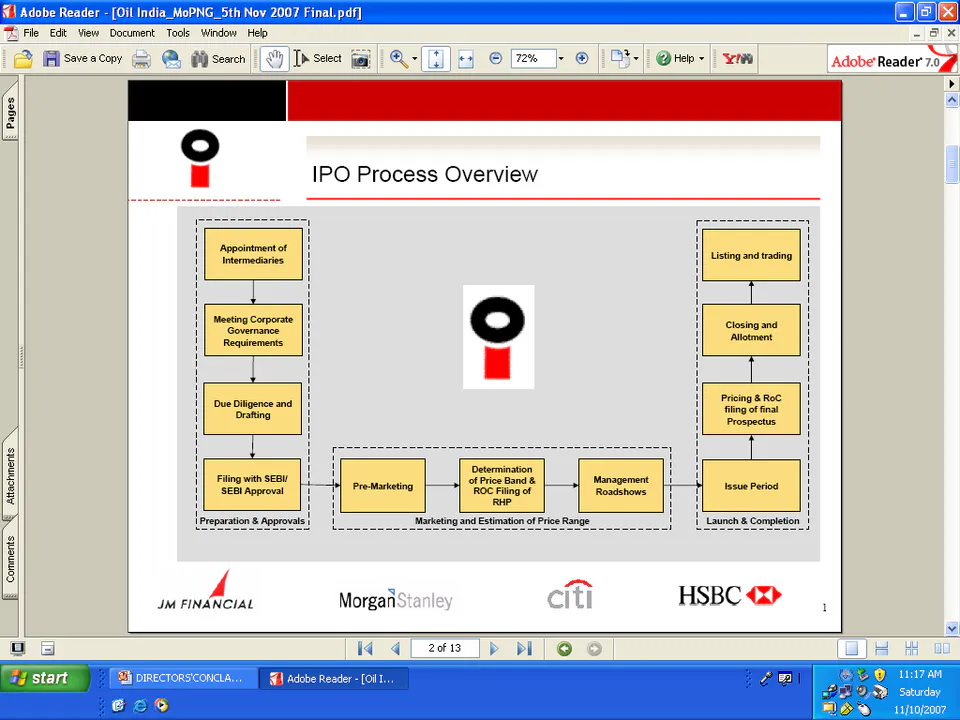
(Source: Mishra, R.K and Kiranmai, J, Corporate Governance in Asia, Allied Publisher, New Delhi, 2012)
The detailed activity chart of OIL IPO listing process is given as under:
Timelines of OIL Listing
| Particulars of Activity | Date Executed |
|---|---|
| Approval of the MOP&NG for IPO / Disinvestment | 11-Sep-07 |
| Approval of the OIL Board | 12-Sep-07 |
| Filing of the DRHP | 14-Dec-07 |
| Compliance with Corporate Governance Norms | 12-Aug-08 |
| Date of SEBI Observations | 11-Sep-08 |
| Setting up an updated due diligence room | 6-Jul-09 |
| Lawyers to circulate updated research/ publicity guidelines | 8-Jul-09 |
| Completion of due diligence by Domestic and Int. Legal Counsel | 8-Jul-09 |
| Final DRHP to be circulated | 16-Jul-09 |
| Board Meeting for DRHP / Restated Financials | 18-Jul-09 |
| IPO Grading by CRISIL | 14-Aug-09 |
| Management pre-road show to end | 14-Aug-09 |
| BRLM to recommend a price band to the Company | 14-Aug-09 |
| Appoint Escrow Bankers and obtain SEBI details | 16-Aug-09 |
| Completion of RHP due diligence | 17-Aug-09 |
| Finalize Distribution Schedule for IPO Stationery | 18-Aug-09 |
| Finalize RHP including June 2009 Accounts | 19-Aug-09 |
| Board Meeting for RHP / Price Band | 21-Aug-09 |
| Inter-Ministerial Pricing Committee Meeting for Price Band | 21-Aug-09 |
| Finalize Bidding Centres at various Locations | 21-Aug-09 |
| Offer Document filed with RoC | 25-Aug-09 |
| Issue Opening | 7-Sep-09 |
| Issue Closing | 10-Sep-09 |
| Filing of Prospectus with ROC | 15-Sep-09 |
| ROC Clearance | 15-Sep-09 |
| Approval of basis of allotment | 22-Sep-09 |
| Board Meeting to approve basis of allotment | 23-Sep-09 |
| Completion of dispatch of refunds and demat uploads | 25-Sep-09 |
| Receipt of Listing and Trading Approval | 30-Sep-09 |
The detailed shareholding pattern of the OIL IPO7 is given below:
Breakup of the IPO Shareholding Pattern
| Category | Breakup |
|---|---|
| Initial Public Offer | 26.4 million shares (11% of post-offer equity capital) |
| Public | 24.04 million shares (10% of post-offer equity capital) |
| Employees | 2.40 million shares (1% of post-offer equity capital) |
| QIBs | 14.28 million shares (60%) |
| Retail Investors | 7.21 million shares (30%) |
| HNIs | 2.40 million shares (10%) |
Source: Mishra, R.K and Kiranmai, J, Corporate Governance in Asia, 2012.
The cut-off price was finalized as ₹1,050 in view of the 99.59% of the bids were received at that price. This catapulted OIL to the group of the first 30 companies based on market capitalization and unlocked the real value of the company. The share of OIL was priced 10% below the prevailing quoted price of ONGC Ltd. However, through effective investor relations and aggressive marketing, the same has outperformed its counterpart and despite being a debutant, acquired the numero-uno status amongst the Petroleum Sector. The post listing Performance of the Company has been commendable in terms of the surge in its share prices and interaction/communications with the Investor Community. The wealth creation has been achieved through regular interaction with the stakeholders by providing them monthly and quarterly updates at various conferences and one-to-one meetings, both internally and externally, overseas and in India.
Post listing Scenario: Changes resulting from listing and measures initiated to achieve the purpose of listing
Before listing, most of the SOEs did not have their vision and mission statements as they were not preparing corporate plans, and their annual reports did not contain a detailed section on management discussions and analysis. The SOEs had to incorporate a number of changes in their Memorandum of Association (MoA) and the Articles of Association (AoA).
The changes in MoA and AoA have been by and large carried out by the SOEs going for Listing. Neyveli Lignite Corporation Ltd (NLC), a Navratna SOE, completed its second round of disinvestment in August 2013 and in the process of doing so had to alter several provisions of its AoA and MoA. The Capital Clause of MOA was amended prior to listing of shares whereby the face value of the equity shares was changed from Rs.1000/- per equity share to Rs.10/- per equity share; allotment of shares (Article 8); issue of New share certificate in place of one defaced, lost or destroyed (Article 11); payment in anticipation of calls may carry interest (Article 18); company’s Lien on shares (Article 20); transfer and transmission of shares (Article 23); notice of refusal to register transfer (Article 24); form of transfer (Article 26); fee on transfer (Article 29); power to increase capital (Article 32); on what conditions new shares may be issued (Article 33); new shares to be offered to Members (Article 35); reduction of capital etc. (Article 36); sub-division and consolidation of shares (Article 37); power to borrow (Article 39); conditions on which money may be borrowed (Article 40); issue of discount etc. or with special privileges (Article 42); business of ordinary meeting (Article 49); evidence of the passing of a resolution where poll not demanded (Article 55); instrument appointing proxy to be in writing (Article 67); instrument appointing proxy to be deposited at office (Article 68); form of Proxy (Article 70); appointment of Chairman and Directors (Article 75(1)); retirement/tenure of part-time Govt. Directors (Article 75(2)); to create posts and to appoint officers etc. including General Managers of Constituent Units (Article 77(5)); to give percentage (Article 77(14)); to create Provident Fund (Article 77(17)); alternate Director (Article 82); powers of Board to appoint additional Directors / fill casual vacancies (Article 82).
The NLC Ltd has occasioned the following changes in consequence of Listing:
| Parameters | Pre - listing | Post - listing |
|---|---|---|
| Financial information | The financial information to the GoI was furnished only annually. | The financial information is being furnished to all shareholders every quarter |
| 2-3 | The Companies Act, 1956, does not mandate the consolidation of subsidiary accounts with the holding company. | As per the listing agreement, it is mandatory to provide annual consolidated financials to the Stock Exchanges. |
| Internal Governance | Nil | The Listing Agreement prescribes several Internal Governance requirements, such as: a) having an adequate number of Independent Directors b) Disclosures about Related Party Transactions c) applicability of Code of Conduct for Board level and Senior Management of the Company d) applicability of Code of Internal Procedures and Conduct for Prohibition of Insider Trading in compliance with Securities and Exchange Board of India (Insider Trading) Regulations, 1992 e) adherence to the Corporate Governance Conditions prescribed in the Listing Agreement f) requirement to have a Remuneration Committee of the Board of Directors, etc |
| Employee Context | NIL | The listing of equity shares of the Company provided an opportunity for the employees to own the equity shares and become its partners in the growth of the Company |
| Public service obligations | Public service obligations were carried out by the company | The company has been carrying out public service obligations, and there was no change on this point on account of the listing |
| Subsidies received from the Government. | Some direct and indirect subsidies were being provided, but these were not reported in the Annual Report. | Explicit subsidies find a mention in the annual report. |
| Autonomy and accountability | As prescribed by the guidelines issued by the DPE from time to time | No change except for the fact that the company has become accountable to shareholders besides the GoI |
| SEBI Conditions | NIL | SEBI had not laid down any conditions. Consequent on the disinvestment of shares, the shares were listed at Madras, Delhi, and Ahmedabad Stock Exchanges. These Stock Exchanges had requested the Company to carry out necessary amendments as suggested by them to the Memorandum and Articles of Association of the Company. However, the Bombay Stock Exchange insisted on the amendment of certain clauses of the Memorandum and Articles of Association of the Company as a precondition for listing. |
| Parameters | Pre - listing | Post - listing |
|---|---|---|
| SEBI requirements for the SOE to continue to remain listed | NIL | a. Furnishing of periodical returns to the Exchange about shareholding pattern, compliance of corporate governance requirements, submission of reconciliation of share capital audit reports, Utilization Statement (as projected in the Prospectus and actual) b. Furnishing of quarterly/ annual financial results as per the prescribed format. c. Furnishing of book closure dates/ record date, price sensitive information, change in directors, dividend payment date etc., d. Furnishing of annual report of the Company in the form as directed by the Exchanges. e. Adherence to the timelines and other conditions prescribed in the Listing Agreement, regarding the transfer of shares/ splitting/ consolidation of share certificates. f. Disclosure of certain information in the annual report. |
| Process of Listing | Nil | As per the direction of GoI, the Company was earlier listed with the Madras, Delhi, Ahmedabad, and Bombay Stock Exchanges. Subsequently, in the year 2000, the equity shares were also listed on the National Stock Exchange. Since the Company was already a listed entity, NSE listed the equity shares in its exchange on submission of the relevant application form with supporting documents, including the approval from the Board of Directors of the Company for listing the equity shares with NSE. A formal agreement (Listing Agreement) was entered into with NSE in this regard. |
| Proper balance between minority and majority shareholders | NIL | Decisions are taken by the Board of Directors, taking into account the interests of the Company. So far, there is no controversy with regard to majority/ minority shareholders. |
| Commercial Orientation | NIL | On account of listing of equity shares, the Company is required to provide various market share price-sensitive information to the Exchange, which does not apply to a non-listed company |
| Access to Capital Markets | NIL | Listing of equity shares has provided a window for a corporation to access capital |
| Role on Corporate Boards | The Board acted as a buffer between the enterprise and the Government. | The Boards play a major role in the development of the Company. In the Corporate Boards, the Independent Directors play a major role. Clause 49 of the Listing Agreement prescribes that a certain minimum number of Independent Directors be on the Board of a listed entity. Thus, the listing of equity shares has paved the way for having Independent Directors on the Board of the Company |
| No. of Independent Directors (IDs) | No IDs | There were no Independent Directors on the Board of Directors before listing, and also till Clause 49 of the SEBI Listing Agreement was introduced. Consequently, 8 IDs have been appointed on the Board |
| Handling Financing and Public Service Obligation | No impact on handling the financing and carrying out of public service. | |
| 1-3 Consumers outcomes improved | The Company has no specific consumer base to ascertain the consumer outcomes, as it supplies power to only the Electricity Boards of Southern States. | |
| 1-3 Commercial returns are lowered by consumer satisfaction | The Company is operating pithead power stations, and the generated power is supplied to TANGEDCO and Southern Grid. The tariff for the power supplied by the Company is fixed by CERC as per the prevailing tariff policy. In view of the above, the question of focusing on commercial returns and lowering of consumer satisfaction does not arise | |
| 1-3 | ||
| Parameters | Pre - listing | Post - listing |
|---|---|---|
| Transparency and disclosure | As far as the transparency and disclosure requirements are concerned, the requirements are prescribed in the Accounting Standards and Companies Act, 1956, and the same apply to all Companies, whether listed or non-listed. | In case of listed SOEs / private enterprises, in addition to Standalone financials, it is mandatory to furnish Annual Consolidated financial statements. There is no difference between listed SOEs and other privately listed enterprises in terms of the transparency and disclosure requirements |
| Government access to privileged information and the status of Reporting | Reporting of accounts annually. The matters related to Corporate Social Responsibility (CSR) and Sustainable Development (SD) did not constitute a part of the Annual Report. | The Company is required to report quarterly on the financial performance in addition to other compliance-related requirements, including price-sensitive information to the Exchanges. The matters relating to CSR and SD Annual report constitute a part of the Annual report |
| The government is exerting influence on the enterprise | Being a 100 % Publicly owned SOE, the AGM was fully controlled by the Government | Being a Navratna enterprise, certain functional Autonomy is granted to the Company. As per the Articles of Association, the President of India has the power to issue a directive on any issue. |
The listed SOEs have a large number of minority shareholders, some more than 100,000 each8. While fixing the price, an attempt is made to ensure that the price is attractive to the investors and fair to the Government. After considering the valuation of various parameters and taking into consideration the listed price if the share is listed, a particular valuation is arrived at. A small discount is then offered so that it becomes attractive for the investor. Thus, a proper balance is maintained for both investors/shareholders majority as well as the minority. However, the special status of listed SOEs limits the sway of minority shareholders. Sadly, no precautions have been taken to ensure a proper balance between minority shareholders’ protection and the continued use of listed SOEs for public policy.
Positive and negative aspects of listing SOEs
The impact of listing on operational performance, gauged from the point of view of commercial orientation, board independence, separation of commercial from non-commercial objectives, transparency disclosure, CSR, and state influence, has been found very positive. The listing has had a positive impact on the operational performance of the SOEs. Annexure 5 shows the operational performance as related to turnover, net fixed assets, net worth, profit before depreciation and income tax, profits after tax (PAT), dividends paid, earnings per share, and forex earnings.
Figure 2 and Figure 3 show the percentage increase in net worth, profit before depreciation, interest, and tax (PBDIT), profits after tax (PAT), earnings per share, and dividend per share in the pre and post-listing periods. The pre-listing period is limited to 1988–89 to 1992–93. The post-listing period is from 1993–94 to 2011–12. It is seen that the percentage increase is much higher during the post-listing period.
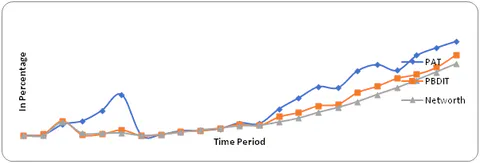
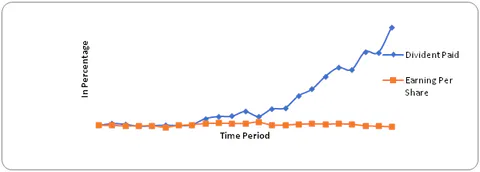
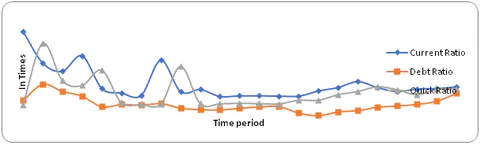
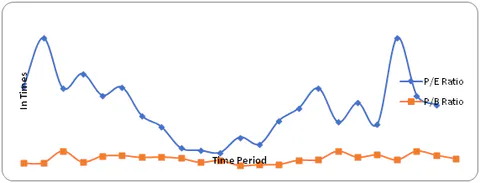
Figure 4 and Figure 5 show the current, quick, debt-equity, price-earnings, and price-to-book ratios during the pre- and post-listing periods of the listed SOEs. It is seen that all the ratios exhibited healthy trends. The ratios showed a positive behavior during the post-listing period. The PE ratio was also in line with the general trend, barring 2009–10 due to market expectations of a wholesale disinvestment under the regime of the United Progressive Alliance-2 Government, which was not to happen.
The Government introduced the Maharatna Scheme in February 2010 to identify SOE champions with the objective to delegate enhanced powers to the Boards of identified large-sized SOEs to facilitate expansion of their operations, both in domestic and global markets. The Maharatna SOEs can invest ₹5,000 crore in one project and create below Board level positions. They are empowered to set up technology joint ventures and strategic alliances, undertake organizational restructuring, mobilize resources from domestic and international markets, and set up subsidiaries.
One of the eligibility criteria for the grant of Maharatna status is that they should be listed on the Indian Stock Exchange with a minimum prescribed public shareholding under SEBI regulations. In addition, an SOE has to have:
A Navratna status
An average annual turnover during the last 3 years of more than Rs 25,000 crore
An average annual net worth during the last 3 years of more than Rs 15,000 crore
An average annual net profit after tax during the last 3 years of more than Rs 5,000 crore
Significant global presence or international operations.
The following SOEs have been accorded the status of Maharatna:
Bharat Heavy Electricals Limited (BHEL)
Bharat Petroleum Corporation Limited (BPCL)
Coal India Limited (CIL)
GAIL (India) Limited
Hindustan Aeronautics Limited (HAL)
Hindustan Petroleum Corporation Limited (HPCL)
Indian Oil Corporation Limited (IOCL)
NTPC Limited
Oil & Natural Gas Corporation (ONGC)
Power Grid Corporation of India Limited (PGCIL)
Steel Authority of India Limited (SAIL)
Rural Electrification Corporation Limited (REC)
Power Finance Corporation Limited (PFC)
National Mineral Development Corporation (NMDC)
As seen from Annexure 1, the Maharatna SOEs dominate the profile of the listed SOEs and also the overall profile of the SOEs in India. The listing has helped SOEs in tapping the national and international capital markets and reducing their dependence on the exchequer.
Board practices
The corporate boards of the listed SOEs have undergone a tremendous change in their role, responsibilities, and composition. These have been explained in the DPE Guidelines on Corporate Governance for SOEs9 and Clause 49 of the Listing Agreement of the SEBI. The IDs provide managerial expertise to the Company and also provide checks and balances on the decision-making process. The IDs have taken on themselves the responsibility of insulating the listed SOEs from political interference and have moderated the influence of government officials on the functioning of the SOEs. As per the SEBI stipulations, the IDs should form 50 % of the total board strength. However, IDs constituted only 40 % of the total strength as on 31st March 2012. A greater role for IDs would certainly strengthen the commercial orientation and would act as a roadblock against political interference. An empirical study establishes that even a minority sale of shareholdings of SOEs results in improving the finances of such SOEs. The study further points out that SOEs with minority sales of shareholdings perform better financially than fully government-owned SOEs. As per the study, SOEs that eventually sell the majority equity have higher sales, lower assets, higher return on sales, fewer employees, and lower levels of employee compensation compared to SOEs that remain fully government-owned10. This was earlier confirmed by a study on controlling for the listing effect and changes in the competitive environment, comparing partially privatized firms to fully state-owned firms. The study noted that the coefficient of the share of private equity was positive and statistically significant for the profitability, productivity, and investment measures. 11
Capital and Investment Renewal
While as unlisted companies normally depend on finances from the government or loans from banks and other institutions, listing provides another platform for raising funds. The unlocked value on listing provides a benchmark for raising capital based on the market capitalization. It is important to note that the listed enterprises do not obtain any capital and investment support from the GoI. The investments and capital renewal are done through extra-budgetary resources and internal funds, entirely.
Commercial and non-commercial objectives
The listing has compelled both the Government and the SOEs to separate commercial objectives from the non-commercial objectives. This has helped in enhancing the accountability of the SOEs to consumers and made them more responsive to their demands. In the listed companies, the enterprise governance is expected to improve as a larger number of shareholders exerts pressure on the management to perform better, transparently, and efficiently. The procurement, recruitment, budgeting, pricing, auditing, quality, and performance management policies have undergone fundamental changes in terms of delegation, decentralization, and rewarding performance.
Transparency and disclosure requirements
The transparency and disclosure requirements have undergone a sea-change. The periodicity of disclosure has become quarterly, as against being annual in the pre-listing period. Not only standalone financial results and non-financial information have to be made available, but consolidated group results have to be furnished. The quality of disclosure of the listed SOEs is much superior to that of non-listed SOEs and the private sector enterprises. Listing demands higher levels of disclosure and public scrutiny. The CEO / CFO certification is required as a backup for the financial statements. As per the policy of the Government and the Companies Act, 2013, the listed companies must spend 2 % of their average net profits during the last three years on CSR. This should be monitored by the board of an SOE through a sub-committee headed by an Independent Director. The sub-committee should be assisted by a committee below the board level of the executives. The CSR spend has to be disclosed in the annual report of the company and also on its website. In case the spend turns out to be lower than 2% of the average net profits during the last three years, the SOE has to explain the reasons for not having done so.
Internal Governance
The listed SOEs have to comply with the code of internal procedures and conduct for the prohibition of insider trading in dealing with securities. A code of business conduct and ethics for board members and designated personnel has been adopted by the listed SOEs. Some listed SOEs have formulated a fraud prevention policy and code of conduct for insider trading. A whistleblower policy, which is a non-mandatory requirement under the listing agreement, has also been adopted. It may be noted that some SOEs have committed themselves to conducting business with an objective of preserving the environment and working towards sustainable development. HR policies have also been reformulated to ensure greater employee engagement, capability building, leadership development, and promotion of industrial harmony.
State influence
The state influence continues to be tremendous. As noted earlier, the Government continues to hold 51% or more shareholding in the listed SOEs. The Government exerts influence on the Company through its nominee Directors. Further, in SOEs, there is always a provision that the Government can issue directives that are required to be mandatorily complied with by the SOEs. This places the Government in a privileged position to have access to all such information which otherwise is not available in the public domain. A complex ownership framework allows political interference and commercial decision-making, affecting the SOEs performance negatively in the long run12.
Concluding observations and roadmap for future
The listing has led to ‘Peoplisation of SOEs’. It has made them board-run enterprises, resulting in a significant increase in their day-to-day operational autonomy. The listing has built up a connection between the listed SOEs with domestic and international capital markets, and thereby resulted in their marketization. Although in the listed SOEs, the Government continues to hold more than 51 % of the shareholding, a novel ownership structure is emerging, leading to a greater empowerment of such entities. However, the SOEs in India have to go a long way to list all such entities. This will be possible only when such entities fulfill the SEBI stipulated requirements for listing, on the one hand, and the process of listing is simplified, on the other. Gradualism could be an approach to achieving this objective at hand.
The Oil & Natural Gas Corp. Ltd, Coal India Ltd, NTPC Ltd, Indian Oil Corp. Ltd and Power Grid Corp. of India Ltd. have emerged as the most successful examples of listing in terms of market capitalization, forays in domestic capital market, accessing international capital markets, adhering timelines for completing the disinvestment programme, subscription to the issues, instituting suitable grievance redressal machinery and minimizing the cost of flotation. The IRCON Ltd, Fertilizers and Chemicals Travancore Ltd. (FACT), Hindustan Photo Films Manufacturing Ltd., and HMT Ltd. have undergone de-listing from the stock exchanges and could therefore be called as unsuccessful cases of listing.
The GoI has an ambitious programme for the listing of SOEs. The DoD/DIPAM, as per the Result-Framework Document (RFD) for the year 2013–14, proposed to list all unlisted profitable SOEs on stock exchanges. The overall conclusions to be derived from the listing of the SOEs are as follows:
Listing has unlocked the value of the SOEs and sensitized them about their intrinsic value at the time of listing. It has substantially enhanced the quality of disclosure and reporting practices. It has resulted in greater empowerment of the SOEs’ Boards
Listing has provided access to domestic and international capital markets to the SOEs and thereby exposes them to a rigorous market discipline. Listing has resulted in widening and deepening the Indian capital market
The timing of listing of the issues is very critical to the success of the disinvestment programme of SOEs
The minimum stake of 51% in the shareholding of the listed SOEs has deprived the minority shareholders of their rights and precluded the SOEs from deriving full advantage of listing.
The GoI should opt for the listing only of such SOEs which have shareholdings above a threshold level.
Annexure – 1
(in Crore Rupees)
| S No | Company Name | Paid up equity capital | Total income | Capital Employed | Profit after tax | Dividends |
|---|---|---|---|---|---|---|
| 1 | BEML Ltd. | 520.50 | 37,890.40 | 40,251.00 | 748.00 | 272.00 |
| 2 | Balmer Lawrie & Co. Ltd. | 210.00 | 32,255.00 | 8,100.00 | 1,804.00 | 590.00 |
| 3 | Bharat Electronics Ltd. | 1,050.00 | 84,250.00 | 73,500.00 | 10,800.00 | 2,150.00 |
| 4 | Bharat Heavy Electricals Ltd. | 6,300.00 | 685,000.00 | 332,000.00 | 90,500.00 | 20,000.00 |
| 5 | Bharat Petroleum Corp. Ltd. | 4,700.00 | 2,85,000.00 | 48,500.00 | 17,000.00 | 5,100.00 |
| 6 | Chennai Petroleum Corp. Ltd. | 1,900.00 | 58,500.00 | 9,500.00 | 800.00 | 380.00 |
| 7 | Coal India Ltd. | 81,000.00 | 12,500.00 | 26,800.00 | 1,03,000.00 | 81,000.00 |
| 8 | Container Corp. of India Ltd. | 1,650.00 | 5,600.00 | 7,200.00 | 11,200.00 | 2,750.00 |
| 9 | Dredging Corp. of India Ltd. | 360.00 | 650.00 | 2,100.00 | 170.00 | — |
| 10 | Engineers India Ltd. | 2,150.00 | 5,300.00 | 2,350.00 | 8,100.00 | 2,600.00 |
| 11 | GAIL (India) Ltd. | 16,200.00 | 53,000.00 | 34,500.00 | 47,000.00 | 14,000.00 |
| 12 | HMT Ltd. | 9,600.00 | 270.00 | 1,600.00 | -1,050.00 | — |
| 13 | Hindustan Copper Ltd. | 5,900.00 | 2,250.00 | 1,800.00 | 4,200.00 | 1,200.00 |
| 14 | Hindustan Petroleum Corp. Ltd. | 4,350.00 | 2,43,000.00 | 54,500.00 | 11,800.00 | 3,700.00 |
| 15 | Indian Oil Corp. Ltd. | 31,000.00 | 5,50,000.00 | 1,70,000.00 | 50,500.00 | 15,500.00 |
| 16 | MMTC Ltd. | 1,300.00 | 85,000.00 | 6,200.00 | 900.00 | 320.00 |
| 17 | MOIL Ltd. | 2,150.00 | 1,420.00 | 3,150.00 | 5,300.00 | 1,100.00 |
| 18 | MTNL Ltd. | 8,000.00 | 4,650.00 | 15,500.00 | -5,200.00 | — |
| 19 | Mangalore Refinery & Petrochemicals Ltd. | 22,000.00 | 73,500.00 | 17,000.00 | 11,600.00 | 2,250.00 |
| 20 | NHPC Ltd. | 1,55,000.00 | 8,800.00 | 55,500.00 | 35,000.00 | 10,800.00 |
| 21 | NMDC Ltd. | 5,000.00 | 17,000.00 | 31,000.00 | 9,200.00 | 2,250.00 |
| 22 | NTPC Ltd. | 10,350.00 | 84,000.00 | 1,55,000.00 | 11,600.00 | 4,150.00 |
| 23 | National Aluminium Co. Ltd. | 1,620.00 | 9,800.00 | 14,800.00 | 1,080.00 | — |
| 24 | National Fertilizers Ltd. | 620.00 | 9,400.00 | 6,000.00 | 160.00 | 48.00 |
| 25 | Neyveli Lignite Corp. Ltd. | 2,100.00 | 7,500.00 | 20,000.00 | 1,780.00 | 590.00 |
| 26 | Oil & Natural Gas Corp. Ltd. | 5,350.00 | 1,12,000.00 | 1,47,000.00 | 31,500.00 | 10,500.00 |
| 27 | Oil India Ltd. | 305.00 | 14,500.00 | 22,500.00 | 4,350.00 | 1,430.00 |
| 28 | Power Finance Corp. Ltd. | 1,650.00 | 16,500.00 | 1,65,000.00 | 3,800.00 | 990.00 |
| 29 | Power Grid Corp. of India Ltd. | 5,800.00 | 13,800.00 | 97,000.00 | 4,050.00 | 1,230.00 |
| 30 | Rashtriya Chemicals & Fertilizers Ltd. | 690.00 | 8,600.00 | 4,300.00 | 315.00 | 97.00 |
| 31 | Rural Electrification Corp. Ltd. | 1,240.00 | 13,300.00 | 1,31,000.00 | 3,550.00 | 930.00 |
| 32 | SJVN Ltd. | 5,180.00 | 2,700.00 | 12,000.00 | 1,340.00 | 490.00 |
| 33 | Shipping Corp. of India Ltd. | 590.00 | 5,800.00 | 16,500.00 | -540.00 | — |
| 34 | State Trading Corp. of India Ltd. | 75.00 | 39,500.00 | 3,400.00 | 21.00 | 15.00 |
| 35 | Steel Authority of India Ltd. | 5,200.00 | 67,000.00 | 71,500.00 | 4,450.00 | 1,040.00 |
| 36 | Bharat Dynamics Ltd. | 183.00 | 3,200.00 | 2,800.00 | 520.00 | 105.00 |
| 37 | IRCON International Ltd. | 94.00 | 5,100.00 | 3,600.00 | 650.00 | 130.00 |
| 38 | RITES Ltd. | 200.00 | 2,900.00 | 2,200.00 | 580.00 | 115.00 |
| 39 | Mazagon Dock Shipbuilders Ltd. | 150.00 | 4,400.00 | 3,200.00 | 720.00 | 145.00 |
| 40 | Garden Reach Shipbuilders & Engineers Ltd. | 115.00 | 2,600.00 | 1,900.00 | 410.00 | 82.00 |
| 41 | Hindustan Aeronautics Ltd. | 334.00 | 27,500.00 | 24,200.00 | 5,200.00 | 1,040.00 |
| 42 | Bharat Sanchar Nigam Ltd. | 12,500.00 | 19,800.00 | 65,000.00 | -7,200.00 | — |
| 43 | Indian Railway Finance Corp. Ltd. | 10,000.00 | 21,500.00 | 180,000.00 | 6,800.00 | 1,360.00 |
| 44 | Indian Renewable Energy Development Agency Ltd. | 2,100.00 | 3,800.00 | 28,500.00 | 1,050.00 | 210.00 |
| 45 | Bharat Electronics Ltd. (Subsidiary Units) | 250.00 | 4,200.00 | 3,600.00 | 720.00 | 145.00 |
| 46 | Mishra Dhatu Nigam Ltd. | 187.00 | 1,200.00 | 1,050.00 | 210.00 | 42.00 |
| 47 | Goa Shipyard Ltd. | 115.00 | 1,800.00 | 1,400.00 | 310.00 | 62.00 |
| 48 | Hindustan Shipyard Ltd. | 300.00 | 1,100.00 | 1,800.00 | -150.00 | — |
| 49 | Scooters India Ltd. | 42.00 | 250.00 | 180.00 | -25.00 | — |
| 50 | Andrew Yule & Co. Ltd. | 90.00 | 1,050.00 | 850.00 | 95.00 | 19.00 |
| 51 | Bridge & Roof Co. (India) Ltd. | 54.00 | 1,400.00 | 1,200.00 | 120.00 | 24.00 |
| 52 | Hindustan Prefab Ltd. | 50.00 | 300.00 | 250.00 | -20.00 | — |
| 53 | Hindustan Paper Corp. Ltd. | 100.00 | 450.00 | 400.00 | -35.00 | — |
| 54 | Hindustan Newsprint Ltd. | 80.00 | 350.00 | 300.00 | -30.00 | — |
| 55 | Bharat Pumps & Compressors Ltd. | 75.00 | 500.00 | 420.00 | -40.00 | — |
| 56 | Instrumentation Ltd. | 60.00 | 280.00 | 240.00 | -18.00 | — |
| 57 | Richardson & Cruddas Ltd. | 45.00 | 200.00 | 180.00 | -15.00 | — |
| 58 | Tyre Corporation of India Ltd. | 70.00 | 320.00 | 280.00 | -25.00 | — |
| 59 | Bharat Wagon & Engineering Ltd. | 55.00 | 150.00 | 130.00 | -12.00 | — |
| 60 | National Textile Corp. Ltd. | 1,000.00 | 3,200.00 | 2,800.00 | -250.00 | — |
| 61 | Bharat Petro Resources Ltd. | 3,000.00 | 6,200.00 | 12,500.00 | 1,050.00 | 210.00 |
| 62 | ONGC Videsh Ltd. | 10,000.00 | 18,500.00 | 45,000.00 | 3,200.00 | 640.00 |
| 63 | NTPC Green Energy Ltd. | 2,500.00 | 4,800.00 | 9,600.00 | 850.00 | 170.00 |
| 64 | NHDC Ltd. (Narmada Hydroelectric Development Corp.) | 1,600.00 | 3,200.00 | 6,500.00 | 720.00 | 145.00 |
| 65 | North Eastern Electric Power Corp. Ltd. | 3,000.00 | 5,400.00 | 10,200.00 | 950.00 | 190.00 |
| 66 | THDC India Ltd. | 3,500.00 | 6,000.00 | 12,000.00 | 1,100.00 | 220.00 |
| 67 | Damodar Valley Corp. | 4,500.00 | 9,200.00 | 18,500.00 | 1,600.00 | 320.00 |
| 68 | KIOCL Ltd. | 650.00 | 2,800.00 | 5,200.00 | 420.00 | 85.00 |
| 69 | Fertilizers & Chemicals Travancore Ltd. | 500.00 | 3,600.00 | 4,800.00 | 150.00 | 30.00 |
| 70 | Madras Fertilizers Ltd. | 160.00 | 1,200.00 | 1,000.00 | -45.00 | — |
| 71 | Brahmaputra Valley Fertilizer Corp. Ltd. | 200.00 | 950.00 | 850.00 | -30.00 | — |
| 72 | Rashtriya Ispat Nigam Ltd. (Vizag Steel) | 4,000.00 | 20,500.00 | 25,000.00 | 1,200.00 | 240.00 |
\
Source: Public Enterprises Survey (2024–25), Department of Public Enterprises, Ministry of Finance, Government of India, Vol. I, pp. 150–170.
Annexure – 2
| S No | Name of SOE | Date of Listing | Exchange | Disinvestment % | Fresh Capital | Issue Amount | GoI Holding % | Post Issue GoI % | Value of GoI Holding | Type | Date of Disinvestment | |
|---|---|---|---|---|---|---|---|---|---|---|---|---|
| 1 | BEML Ltd. | 26/07/1990 | BSE/NSE | – | – | – | – | – | – | – | – | |
| 2 | Balmer Lawrie & Co. Ltd. | – | – | – | – | – | – | – | – | – | – | – |
| 3 | Bharat Electronics Ltd. | – | – | – | – | – | – | – | – | – | – | – |
| 4 | Bharat Heavy Electricals Ltd. | 20/09/1993 | BSE/NSE | – | – | – | – | – | – | – | – | – |
| 5 | Bharat Petroleum Corp. Ltd. | 16/09/1992 | BSE/NSE | OFS 2019–21 | – | – | 53.29 | 51.00 | – | – | OFS | 2019–21 |
| 6 | Chennai Petroleum Corp. Ltd. | – | – | – | – | – | – | – | – | – | – | – |
| 7 | Coal India Ltd. | 04/11/2010 | BSE/NSE | 10.00 | – | 15,199.44 | 99.99 | 66.13 | 1,39,275.82 | IPO/OFS | 2010, 2015, 2017 | |
| 8 | Container Corp. of India Ltd. | 02/02/1996 | BSE/NSE | OFS 2015 | – | – | 61.80 | 54.80 | – | OFS | 2015 | |
| 9 | Dredging Corp. of India Ltd. | 05/05/1997 | BSE/NSE | 20.00 | – | 221.20 | 98.56 | 78.56 | 879.91 | FPO | 26/02/2004 | |
| 10 | Engineers India Ltd. | 20/10/1997 | BSE/NSE | 10.00 | – | 959.65 | 90.40 | 51.32 | 7,856.12 | FPO/OFS | 2010, 2017 | |
| 11 | GAIL (India) Ltd. | 08/10/1992 | BSE/NSE | OFS 2013, 2017 | – | – | – | 51.00 | – | – | OFS | 2013, 2017 |
| 12 | HMT Ltd. | – | – | 10.00 | – | 1,627.36 | 67.34 | 57.34 | 9,456.27 | FPO | 27/02/2004 | |
| 13 | Hindustan Copper Ltd. | – | – | OFS 2017 | – | – | – | 77.20 | – | – | OFS | 2017 |
| 14 | Hindustan Petroleum Corp. Ltd. | – | – | OFS 2017 | – | – | – | 51.11 | – | – | OFS | 2017 |
| 15 | Indian Oil Corp. Ltd. | 09/08/1995 | BSE/NSE | OFS 2017, 2019 | – | – | – | 51.50 | – | – | OFS | 2017, 2019 |
| 16 | MMTC Ltd. | – | – | – | – | – | – | – | – | – | – | – |
| 17 | MOIL Ltd. | – | – | IPO 2010 | – | – | – | 81.00 | – | – | IPO/OFS | 2010, 2017 |
| 18 | MTNL Ltd. | 23/12/1999 | BSE/NSE | 9.33 | – | 572.34 | 99.33 | 90.00 | 5,520.28 | OFS | 13/06/2013 | |
| 19 | Mangalore Refinery & Petrochemicals Ltd. | – | – | – | – | – | – | – | – | – | – | – |
| 20 | NHPC Ltd. | 01/09/2009 | BSE/NSE | IPO 2009 | 4,025.70 | 6,038.55 | 100.00 | 74.51 | 38,244.13 | IPO/OFS | 2009, 2013 | |
| 21 | NMDC Ltd. | 2007 | BSE/NSE | IPO 2007 | 1,200.00 | 1,200.00 | 98.00 | 60.79 | 45,000.00 | IPO/OFS | 2007, 2010, 2017 | |
| 22 | NTPC Ltd. | 09/10/1992 | BSE/NSE | 6.09 | – | 628.53 | 87.15 | 51.10 | 83,66.58 | IPO/OFS | 2004, 2013, 2017, 2020 | |
| 23 | National Aluminium Co. Ltd. | 08/10/1996 | BSE/NSE | 7.64 | – | 101.08 | 97.64 | 51.00 | 1,190.80 | IPO/OFS | 1996, 2013, 2017 | |
| 24 | National Fertilizers Ltd. | 28/11/1995 | BSE/NSE | 3.56 | 358.21 | 358.21 | 93.56 | 74.71 | 9,059.63 | IPO/OFS | 1995, 2013 | |
| 25 | Neyveli Lignite Corp. Ltd. | 01/09/2009 | BSE/NSE | 4.55 | 4,025.70 | 6,038.55 | 100.00 | 66.36 | 38,244.13 | IPO/OFS | 2009, 2013, 2017 | |
| 26 | Oil & Natural Gas Corp. Ltd. | 28/08/1997 | BSE/NSE | 8.38 | – | 9,930.45 | 98.38 | 58.89 | 1,07,052.55 | FPO/OFS | 2004, 2010, 2014, 2017 | |
| 27 | Oil India Ltd. | 05/11/2004 | BSE/NSE | 5.00 | – | 8,480.10 | 89.50 | 56.66 | 1,40,740.70 | IPO/FPO/OFS | 2004, 2010, 2017 | |
| 28 | Power Finance Corp. Ltd. | 2007 | BSE/NSE | 9.96 | – | 10,542.40 | 84.11 | 55.99 | 79,303.03 | IPO/OFS | 2007, 2014, 2017 | |
| 29 | Power Grid Corp. of India Ltd. | 30/09/2009 | BSE/NSE | 11.00 | 2,777.25 | 2,777.25 | 88.13 | 51.34 | 19,802.95 | IPO/FPO/OFS | 2009, 2013, 2017, 2019 | |
| 30 | Rashtriya Chemicals & Fertilizers Ltd. | 23/02/2007 | BSE/NSE | 10.22 | 997.19 | 997.19 | 100.00 | 75.00 | 8,758.83 | IPO/OFS | 2007, 2013 | |
| 31 | Rural Electrification Corp. Ltd. | 05/10/2007 | BSE/NSE | 9.09 | 1,989.63 | 2,984.45 | 100.00 | 52.63 | 18,901.52 | IPO/OFS | 2007, 2014, 2017 | |
| 32 | SJVN Ltd. | 2010 | BSE/NSE | 12.50 | – | 310.49 | 92.50 | 61.00 | 1,987.16 | IPO/OFS | 2010, 2013 | |
| 33 | Shipping Corp. of India Ltd. | 1995 | BSE/NSE | IPO 1995 | – | – | 100.00 | 63.75 | – | IPO/OFS | 1995, 2010, 2021 | |
| 34 | State Trading Corp. of India Ltd. | 30/11/1992 | BSE/NSE | 9.09 | 582.45 | 1,164.90 | 80.12 | 63.75 | 4,157.16 | FPO/OFS | 1992, 2010 | |
| 35 | Steel Authority of India Ltd. | 20/05/2010 | BSE/NSE | 10.03 | – | 1,062.74 | 100.00 | 65.00 | 9,676.23 | IPO/OFS | 2010, 2014, 2019 | |
| 36 | Bharat Dynamics Ltd. | 23/03/2018 | BSE/NSE | 12.75 | 960.00 | 960.00 | 100.00 | 74.25 | 8,400.00 | IPO/OFS | 2018 | |
| 37 | IRCON International Ltd. | 28/09/2018 | BSE/NSE | 10.00 | 470.00 | 470.00 | 100.00 | 90.00 | 4,200.00 | IPO | 2018 | |
| 38 | RITES Ltd. | 22/06/2018 | BSE/NSE | 12.00 | 460.00 | 460.00 | 100.00 | 88.00 | 4,000.00 | IPO | 2018 | |
| 39 | Mazagon Dock Shipbuilders Ltd. | 12/10/2020 | BSE/NSE | 15.00 | 444.00 | 444.00 | 100.00 | 85.00 | 3,800.00 | IPO | 2020 | |
| 40 | Garden Reach Shipbuilders & Engineers Ltd. | 01/10/2018 | BSE/NSE | 12.00 | 350.00 | 350.00 | 100.00 | 88.00 | 3,200.00 | IPO | 2018 | |
| 41 | Hindustan Aeronautics Ltd. | 28/03/2018 | BSE/NSE | 10.20 | 4,229.00 | 4,229.00 | 100.00 | 89.80 | 37,000.00 | IPO/OFS | 2018, 2020 | |
| 42 | Bharat Sanchar Nigam Ltd. | – | – | – | – | – | – | – | – | – | – | |
| 43 | Indian Railway Finance Corp. Ltd. | 29/01/2021 | BSE/NSE | 13.64 | 4,633.00 | 4,633.00 | 100.00 | 86.36 | 40,000.00 | IPO | 2021 | |
| 44 | Indian Renewable Energy Dev. Agency Ltd. | 29/11/2023 | BSE/NSE | 25.00 | 2,150.00 | 2,150.00 | 100.00 | 75.00 | 8,600.00 | IPO | 2023 | |
| 45 | Bharat Electronics Ltd. (subsidiary units) | – | – | – | – | – | – | – | – | – | – | |
| 46 | Mishra Dhatu Nigam Ltd. | 04/04/2018 | BSE/NSE | 26.00 | 438.00 | 438.00 | 100.00 | 74.00 | 3,500.00 | IPO | 2018 | |
| 47 | Goa Shipyard Ltd. | – | – | – | – | – | – | – | – | – | – | – |
| 48 | Hindustan Shipyard Ltd. | – | – | – | – | – | – | – | – | – | – | – |
| 49 | Scooters India Ltd. | – | – | – | – | – | – | – | – | – | – | – |
| 50 | Andrew Yule & Co. Ltd. | – | – | – | – | – | – | – | – | – | – | – |
| 51 | Bridge & Roof Co. (India) Ltd. | – | – | – | – | – | – | – | – | – | – | – |
| 52 | Hindustan Prefab Ltd. | – | – | – | – | – | – | – | – | – | – | – |
| 53 | Hindustan Paper Corp. Ltd. | – | – | – | – | – | – | – | – | – | – | – |
| 54 | Hindustan Newsprint Ltd. | – | – | – | – | – | – | – | – | – | – | – |
| 55 | Bharat Pumps & Compressors Ltd. | – | – | – | – | – | – | – | – | – | – | – |
| 56 | Instrumentation Ltd. | – | – | – | – | – | – | – | – | – | – | – |
| 57 | Richardson & Cruddas Ltd. | – | – | – | – | – | – | – | – | – | – | – |
| 58 | Tyre Corporation of India Ltd. | – | – | – | – | – | – | – | – | – | – | – |
| 59 | Bharat Wagon & Engineering Ltd. | – | – | – | – | – | – | – | – | – | – | – |
| 60 | National Textile Corp. Ltd. | – | – | – | – | – | – | – | – | – | – | – |
| 61 | Bharat Petro Resources Ltd. | – | – | – | – | – | – | – | – | – | – | |
| 62 | ONGC Videsh Ltd. | – | – | – | – | – | – | – | – | – | – | – |
| 63 | NTPC Green Energy Ltd. | – | – | – | – | – | – | – | – | – | – | – |
| 64 | NHDC Ltd. (Narmada Hydroelectric Development Corp.) | – | – | – | – | – | – | – | – | – | – | – |
| 65 | North Eastern Electric Power Corp. Ltd. | – | – | – | – | – | – | – | – | – | – | – |
| 66 | THDC India Ltd. | – | – | – | – | – | – | – | – | – | – | – |
| 67 | Damodar Valley Corp. | – | – | – | – | – | – | – | – | – | – | – |
| 68 | KIOCL Ltd. | 2017 | BSE/NSE | IPO 2017 | 1,000.00 | 1,000.00 | 100.00 | 80.00 | 8,000.00 | IPO/OFS | 2017 | |
| 69 | Fertilizers & Chemicals Travancore Ltd. | – | – | – | – | – | – | – | – | – | – | – |
| 70 | Madras Fertilizers Ltd. | – | – | – | – | – | – | – | – | – | – | – |
| 71 | Brahmaputra Valley Fertilizer Corp. Ltd. | – | – | – | – | – | – | – | – | – | – | – |
| 72 | Rashtriya Ispat Nigam Ltd. (Vizag Steel) | – | – | – | – | – | – | – | – | – | – | – |
(Source: http://www.bsepsu.com)
Annexure – 3
(Values in ₹ Crores; consolidated from DIPAM/DPE records)
| [b] S. No. | SOE Name | Paid-up Capital (2013) | PAT (2013) | Paid-up Capital (2025) | PAT (2024–25) |
|---|---|---|---|---|---|
| 1 | ONGC | 4,277.76 | 20,925.70 | 6,200 | ~38,000 |
| 2 | Coal India Ltd. | 6,316.36 | 9,794.32 | 6,200 | ~85,000 |
| 3 | NTPC | 8,245.46 | 12,633.40 | 9,700 | ~18,000 |
| 4 | LIC of India | – | – | 6,300 | ~35,000 |
| 5 | IOC | 2,427.95 | 5,005.17 | 14,000 | ~55,000 |
| 6 | Power Grid | 4,629.73 | 4,234.50 | 7,000 | ~15,000 |
| 7 | GAIL | 1,268.48 | 4,022.20 | 6,600 | ~12,000 |
| 8 | HPCL | 338.63 | 902.94 | 1,450 | ~10,500 |
| 9 | BPCL | 723.08 | 2,642.90 | 2,200 | ~15,500 |
| 10 | BHEL | 489.52 | 6,614.73 | 1,750 | ~1,800 |
| 11 | NMDC | 396.47 | 6,342.37 | 295 | ~6,500 |
| 12 | HAL | – | – | 670 | ~6,200 |
| 13 | BEL | 80.00 | 895.26 | 730 | ~4,500 |
| 14 | SBI (listed SOE category) | 684.00 | 14,104.98 | 900 | ~65,000 |
| 15 | Bank of Baroda | 415.00 | 4,480.72 | 1,050 | ~18,000 |
| 16 | Canara Bank | 443.00 | 2,871.10 | 1,800 | ~15,000 |
| 17 | Punjab National Bank | 353.00 | 4,747.67 | 1,100 | ~9,000 |
| 18 | Power Finance Corp | 1,320.02 | 4,415.19 | 2,650 | ~22,000 |
| 19 | REC Ltd. | 987.46 | 3,817.62 | 2,650 | ~14,000 |
| 20 | IRFC | – | – | 13,000 | ~6,500 |
Note: 2024–25 figures are provisional/estimated based on Interim Results and DIPAM targets. Capital changes reflect bonus issues, stock splits, and fresh equity infusions. LIC and HAL were unlisted in 2013. The 2013 banking figures are shown for reference as part of the wider SOE listing context though they are separate from DPE reporting for non-financial SOEs. Cross-holdings have been adjusted in the valuation of shares among ONGC, GAIL, and IOC.
(Values in ₹ Crores; consolidated from DIPAM/DPE records)
Annexure – 4
| [b] S No | Company Name | No. of Shares (Lakh) | Close Price (₹) | Market Cap (₹ Crore) 2013 | Market Cap (₹ Crore) 2024–25 |
|---|---|---|---|---|---|
| 1 | Balmer Lawrie & Co. Ltd. | 162.86 | 377.55 | 614.88 | ~1,800 |
| 2 | BEML Ltd. | 416.44 | 175.50 | 730.86 | ~6,500 |
| 3 | BEL | 800.00 | 1,310.15 | 10,481.20 | ~1,60,000 |
| 4 | BHEL | 24,476.00 | 200.55 | 49,086.62 | ~65,000 |
| 5 | BPCL | 7,230.84 | 376.85 | 27,249.43 | ~85,000 |
| 6 | CPCL | 1,489.11 | 99.25 | 1,477.95 | ~6,200 |
| 7 | Coal India Ltd. | 63,163.64 | 324.70 | 2,05,092.35 | ~1,45,000 |
| 8 | CONCOR | 1,299.83 | 1,144.35 | 14,874.58 | ~45,000 |
| 9 | DCI | 280.00 | 215.75 | 604.10 | ~1,200 |
| 10 | Engineers India Ltd. | 3,369.37 | 161.10 | 5,428.05 | ~12,000 |
| 11 | GAIL (India) Ltd. | 12,684.77 | 306.05 | 38,821.75 | ~65,000 |
| 12 | Hindustan Copper Ltd. | 9,252.18 | 95.95 | 8,877.47 | ~18,000 |
| 13 | HPCL | 3,386.27 | 281.70 | 9,539.13 | ~45,000 |
| 14 | HMT Ltd. | 7,603.50 | 29.00 | 2,205.02 | ~1,000 |
| 15 | ITDC | 857.69 | – | – | ~2,500 |
| 16 | IOC | 24,279.52 | 285.85 | 69,403.02 | ~1,10,000 |
| 17 | MTNL | 6,300.00 | 18.20 | 1,146.60 | ~900 |
| 18 | MRPL | 17,525.99 | 43.25 | 7,579.99 | ~14,000 |
| 19 | MMTC | 10,000.00 | 217.25 | 21,725.00 | ~3,500 |
| 20 | NALCO | 25,772.39 | 33.80 | 8,711.07 | ~22,000 |
| 21 | NFL | 4,905.78 | 42.80 | 2,099.68 | ~4,200 |
| 22 | NLC India | 16,777.10 | 82.80 | 13,891.44 | ~25,000 |
| 23 | NHPC | 1,23,007.43 | 19.25 | 23,678.93 | ~55,000 |
| 24 | NMDC | 39,647.16 | 117.60 | 46,625.06 | ~45,000 |
| 25 | NTPC | 82,454.64 | 154.20 | 1,27,145.06 | ~2,40,000 |
| 26 | ONGC | 85,554.90 | 327.90 | 2,80,534.52 | ~2,00,000 |
| 27 | Oil India Ltd. | 6,011.36 | 594.60 | 35,743.54 | ~35,000 |
| 28 | PFC | 13,200.15 | 183.05 | 24,162.87 | ~85,000 |
| 29 | Power Grid Corp. | 46,297.25 | 113.30 | 52,454.79 | ~1,80,000 |
| 30 | RCF | 5,516.88 | 38.70 | 2,135.03 | ~8,000 |
| 31 | REC | 9,874.59 | 221.10 | 21,832.72 | ~90,000 |
| 32 | SCI | 4,657.99 | 36.70 | 1,709.48 | ~6,500 |
| 33 | SJVN Ltd. | 41,366.26 | 20.45 | 8,459.40 | ~25,000 |
| 34 | STC | 600.00 | 165.05 | 990.30 | ~1,200 |
| 35 | SAIL | 41,305.25 | 56.20 | 23,213.55 | ~55,000 |
| THDC India Ltd. | ,000.00 | – | – | ~12,000 | |
| IRCTC | ,600.00 | – | – | ~65,000 | |
| Mazagon Dock Shipbuilders Ltd. | ,000.00 | – | – | ~30,000 | |
| Garden Reach Shipbuilders & Engineers | ,150.00 | – | – | ~12,000 | |
| Cochin Shipyard Ltd. | ,350.00 | – | – | ~10,500 | |
| Hindustan Aeronautics Ltd. (HAL) | ,340.00 | – | – | ~1,80,000 | |
| Mishra Dhatu Nigam Ltd. (MIDHANI) | ,870.00 | – | – | ~8,500 | |
| Bharat Dynamics Ltd. (BDL) | ,830.00 | – | – | ~18,000 | |
| Rail Vikas Nigam Ltd. (RVNL) | ,100.00 | – | – | ~65,000 | |
| IRCON International Ltd. | – | – | ~12,000 | ||
| HUDCO | ,000.00 | – | – | ~15,000 | |
| NBCC (India) Ltd. | ,800.00 | – | – | ~20,000 | |
| Bharat Electronics Ltd. (BEL) Subsidiaries | – | – | – | Included in the BEL consolidated | |
| IFCI Ltd. | ,000.00 | – | – | ~2,500 | |
| IREDA | ,200.00 | – | – | ~15,000 | |
| FCI Aravali Gypsum & Minerals | – | – | – | ~500 | |
| Goa Shipyard Ltd. | ,200.00 | – | – | ~6,000 | |
| Hindustan Fluorocarbons Ltd. | – | – | – | ~300 | |
| Bharat Petro Resources Ltd. | – | – | – | ~2,000 | |
| ONGC Videsh Ltd. | – | – | – | ~12,000 | |
| Hindustan Zinc Ltd. (HZL) | ,000.00 | – | – | ~1,80,000 | |
| Bharat Sanchar Nigam Ltd. (BSNL) | – | – | – | ~25,000 (unlisted, estimated) | |
| Indian Railway Finance Corporation (IRFC) | ,300.00 | – | – | ~95,000 | |
| RailTel Corporation of India Ltd. | – | – | ~8,000 | ||
| National Fertilizers Ltd. (subsidiary updates) | – | – | – | Included in the NFL consolidated | |
| Hindustan Organic Chemicals Ltd. | ,200.00 | – | – | ~1,000 | |
| Fertilizers & Chemicals Travancore (FACT) | ,200.00 | – | – | ~6,500 | |
| Rashtriya Ispat Nigam Ltd. (RINL) | – | – | – | ~12,000 (unlisted, estimated) | |
| Antrix Corporation (ISRO’s commercial arm) | – | – | – | ~3,500 (estimated contracts) | |
| Bharat Broadband Network Ltd. (BBNL) | – | – | – | ~2,000 | |
| Hindustan Shipyard Ltd. | ,000.00 | – | – | ~4,500 | |
| Scooters India Ltd. | – | – | ~400 | ||
| Andrew Yule & Co. Ltd. | – | – | ~300 | ||
| Fertilizer Corporation of India Ltd. | – | – | – | ~1,200 | |
| HLL Lifecare Ltd. | – | – | – | ~5,000 | |
| Bridge & Roof Co. (India) Ltd. | – | – | – | ~1,000 | |
| Bharat Pumps & Compressors Ltd. | – | – | – | ||
(Source: http://www.bsepsu.com)
Annexure – 5
(in Crore Rupees)
| [b] Year | PAT | PBDIT | Net Worth | Net Fixed Assets | Turnover | Forex Earnings | Dividend Paid | Earning Per Share |
|---|---|---|---|---|---|---|---|---|
| 1989–90 | ,000 | ,000 | ,65,000 | ,96,000 | ,19,000 | ,000 | ,420 | ,760 |
| –91 | ,000 | ,000 | ,62,000 | ,51,000 | ,32,000 | ,000 | ,500 | ,900 |
| –92 | ,000 | ,70,000 | ,18,000 | ,87,000 | ,52,000 | ,000 | ,100 | ,250 |
| –93 | ,000 | ,81,000 | ,99,000 | ,17,000 | ,70,000 | ,000 | ,600 | |
| –94 | ,000 | ,01,000 | ,90,000 | ,73,000 | ,03,000 | ,000 | ,240 | ,900 |
| –95 | ,00,000 | ,85,000 | ,12,000 | ,85,000 | ,60,000 | ,000 | ,560 | ,490 |
| –96 | ,11,000 | ,14,000 | ,34,000 | ,03,000 | ,95,000 | ,000 | ,980 | |
| –97 | ,16,000 | ,37,000 | ,05,000 | ,82,000 | ,56,000 | ,000 | ,100 | |
| –98 | ,47,000 | ,09,000 | ,54,000 | ,25,000 | ,16,000 | ,000 | ,500 | |
| –99 | ,50,000 | ,26,000 | ,10,000 | ,45,000 | ,67,000 | ,000 | ,700 | |
| –00 | ,65,000 | ,85,000 | ,33,000 | ,41,000 | ,77,000 | ,000 | ,850 | |
| –01 | ,12,000 | ,75,000 | ,94,000 | ,47,000 | ,77,000 | ,000 | ,600 | |
| –02 | ,06,000 | ,45,000 | ,34,000 | ,69,000 | ,58,000 | ,000 | ,500 | |
| –03 | ,28,000 | ,47,000 | ,55,000 | ,87,000 | ,90,000 | ,13,000 | ,300 | |
| –04 | ,19,000 | ,50,000 | ,20,000 | ,32,000 | ,11,000 | ,59,000 | ,300 | |
| –05 | ,11,000 | ,04,000 | ,18,000 | ,62,000 | ,25,000 | ,16,000 | ,700 | |
| –06 | ,03,000 | ,38,000 | ,52,000 | ,03,000 | ,81,000 | ,43,000 | ,100 | |
| –07 | ,44,000 | ,15,000 | ,57,000 | ,86,000 | ,50,000 | ,40,000 | ,200 | |
| –08 | ,94,000 | ,56,000 | ,44,000 | ,95,000 | ,71,000 | ,28,000 | ,000 | |
| –09 | ,45,000 | ,38,000 | ,02,000 | ,23,000 | ,08,42,000 | ,47,000 | ,000 | |
| –10 | ,70,000 | ,30,000 | ,40,000 | ,30,000 | ,01,82,000 | ,49,000 | ,000 | |
| –11 | ,33,000 | ,92,000 | ,84,000 | ,07,000 | ,22,86,000 | ,31,000 | ,000 | |
| –12 | ,86,000 | ,82,000 | ,39,000 | ,68,000 | ,48,77,000 | ,52,000 | ,000 | |
| –13 | ~1,00,000 | ~2,40,000 | ~6,40,000 | ~4,10,000 | ~15,50,000 | ~9,00,000 | ~1,00,000 | ~15 |
| –14 | ~1,05,000 | ~2,55,000 | ~6,90,000 | ~4,40,000 | ~16,50,000 | ~9,50,000 | ~1,05,000 | ~16 |
| –15 | ~1,10,000 | ~2,70,000 | ~7,40,000 | ~4,70,000 | ~17,80,000 | ~10,00,000 | ~1,10,000 | ~17 |
| –16 | ~1,15,000 | ~2,85,000 | ~7,90,000 | ~5,00,000 | ~18,50,000 | ~10,50,000 | ~1,15,000 | ~18 |
| –17 | ~1,20,000 | ~3,00,000 | ~8,40,000 | ~5,30,000 | ~19,80,000 | ~11,00,000 | ~1,20,000 | ~19 |
| –18 | ~1,30,000 | ~3,20,000 | ~9,00,000 | ~5,70,000 | ~21,50,000 | ~11,50,000 | ~1,25,000 | ~20 |
| –19 | ~1,40,000 | ~3,40,000 | ~9,60,000 | ~6,10,000 | ~23,00,000 | ~12,00,000 | ~1,30,000 | ~21 |
| –20 | ~1,35,000 | ~3,25,000 | ~9,80,000 | ~6,30,000 | ~22,00,000 | ~11,50,000 | ~1,25,000 | ~20 |
| –21 | ~1,20,000 | ~3,00,000 | ~10,00,000 | ~6,50,000 | ~21,00,000 | ~11,00,000 | ~1,20,000 | ~18 |
| –22 | ~1,50,000 | ~3,50,000 | ~10,80,000 | ~7,00,000 | ~25,00,000 | ~12,50,000 | ~1,40,000 | ~19 |
| –23 | ~1,70,000 | ~3,80,000 | ~11,40,000 | ~7,50,000 | ~28,00,000 | ~13,00,000 | ~1,50,000 | ~20 |
| –24 | ~1,90,000 | ~4,10,000 | ~11,80,000 | ~7,80,000 | ~32,00,000 | ~13,20,000 | ~1,55,000 | ~21 |
| –25 | ~2,05,000 | ~4,30,000 | ,00,000+ | ,00,000+ | ,50,000+ | ,50,000+ | ~1,60,000 | ~22 |
(Source: Database on CPSEs by DIPAM, GoI)
AoA - Articles of Association
BRLMs - Book Running Lead Managers
BSE - Bombay Stock Exchange
CCEA - Cabinet Committee on Economic Affairs
CEO – Chief Executive Officer
CFO – Chief Finance Officer
CIL - Coal India Limited
CSR - Corporate Social Responsibility
DIPAM - Department of Investment and Public Asset Management
DoD - Department of Disinvestment
DPE - Department of Public Enterprise
DRHP - Draft Red Herring Prospectus
EGOM - Empowered Group of Ministers
FIPB - Foreign Investment Promotion Board
FIRE - Financial and Insurance Related Economic Reform’s
FPO - Follow-on Public Offer
GoI - Government of India
ICDR - Capital and Disclosure Requirements Regulations
IMG - Inter Ministerial Group
IPOs - Initial Public Offers
ISC - Investor Services Cell
LPG - Liquefied Petroleum Gas
MoA - Memorandum of Association
MoPNG - Ministry of Petroleum and Natural Gas
NLC - Neyveli Lignite Corporation Ltd
NSE - National stock Exchange
OIL - Oil India Limited
PAT - Profit After Tax
QIBs - Qualified Institutional Bidders
RFD - Result Framework Document
RFP - Request for Proposal
SD - Sustainable Development
SEBI - Securities and Exchange Board of India
SOEs - State Owned Enterprises
TCIF - The Children’s Investment Fund
(as on 18 March 2026)
1 Euro = INR 107
1 USD = INR 93
Footnotes
Report on State Undertaking (Krishna Menon Committee Report), Sub-committee of the Congress Party in Parliament, New Delhi, 1958 ↩
Report of the Economic Administration Reforms Commission on Government and Public Enterprises (L K Jha Committee Report), Bureau of Public Enterprises, Ministry of Finance, GoI, New Delhi, 1984 ↩
Committee to review Public Enterprise Policy (Arjun Sengupta Committee Report), GoI, New Delhi, 1984 ↩
Report on Public Sector Enterprises, Institute of Public Enterprise, Hyderabad, 1985 ↩
Gouri, Geeta, Privatization and Public Enterprise: The Asia-Pacific Experience, Asia and Pacific Development Centre and IPE, Oxford and IBH, New Delhi, 1991 ↩
Department of Public Enterprises, Public Enterprise Survey, Vol 1: 2011–12, Government of India, New Delhi, 2013 ↩
Mishra, R.K and Kiranmai, J, Corporate Governance in Asia, Allied Publisher, New Delhi, 2012 ↩
Som, Lalita, Corporate Governance of Public Sector Enterprises in India, Money and Finance, ICRA Bulletin, Kolkata, India, June 2013 ↩
Department of Public Enterprises, Guidelines on Corporate Governance for CPSEs, GoI, New Delhi, 2010 ↩
Gupta, Nandini, Selling the family silver to pay the grocer’s bill? The case of privatization in India, Working Paper, School of International and Public Affairs, Columbia University, 2010 ↩
Gupta, Nandini, Partial Privatization and Firm Performance, The Journal of Finance, Vol. LX, No. 2, April 2005 ↩
Som, Lalita, Corporate Governance of Public Sector Enterprises in India, Money and Finance, ICRA Bulletin, Kolkata, India, June 2013 ↩