Article Fingerprint
ReserarchID
EU02H

Choose where you want to hide AI Takeaway. Your site-wide choice will be remembered in this browser.
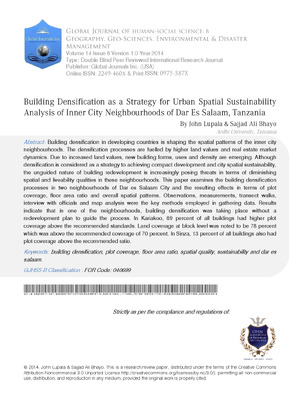
Building densification in developing countries is shaping the spatial patterns of the inner city neighbourhoods. The densification processes are fuelled by higher land values and real estate market dynamics. Due to increased land values, new building forms, uses and density are emerging. Although densification is considered as a strategy to achieving compact development and city spatial sustainability, the unguided nature of building redevelopment is increasingly posing threats in terms of diminishing spatial and liveability qualities in these neighbourhoods. This paper examines the building densification processes in two neighbourhoods of Dar es Salaam City and the resulting effects in terms of plot coverage, floor area ratio and overall spatial patterns. Observations, measurements, transect walks, interview with officials and map analysis were the key methods employed in gathering data. Results indicate that in one of the neighbourhoods, building densification was taking place without a redevelopment plan to guide the process. In Kariakoo, 89 percent of all buildings had higher plot coverage above the recommended standards. Land coverage at block level was noted to be 78 percent which was above the recommended coverage of 70 percent. In Sinza, 13 percent of all buildings also had plot coverage above the recommended ratio.
John Lupala, Sajjad Bhayo, Sajjad Bhayo. 2015. "Building Densification as a Strategy for Urban Spatial Sustainability: Analysis of Inner City Neighbourhoods of Dar Es Salaam, Tanzania". Global Journal of Human-Social Science, Global Journal of Human-Social Science - B: Geography, Environmental Science & Disaster Management GJHSS-B Volume 14 (GJHSS Volume 14 Issue B8).

Crossref Journal DOI 10.17406/GJHSS
Print ISSN 0975-587X
e-ISSN 2249-460X
v1.2
Explore published articles in an immersive Augmented Reality environment. Our platform converts research papers into interactive 3D books, allowing readers to view and interact with content using AR and VR compatible devices.
Your published article is automatically converted into a realistic 3D book. Flip through pages and read research papers in a more engaging and interactive format.
Total Score: 102
Country: Tanzania
Subject: Global Journal of Human-Social Science
Authors: John Lupala, Sajjad Ali Bhayo (PhD/Dr. count: 0)
View Count (all-time): 401
Total Views (Real + Logic): 2084
Total Downloads (simulated): 88
Publish Date: 2014 01, Wed
Monthly Totals (Real + Logic):
We use cookies and similar technologies to improve site performance, understand traffic, and enhance your publishing experience. Cookie Policy
Choose which optional cookies Global Journals can use. Your preference applies across this platform and can be updated any time.
These cookies are required for core website functionality and security.

Lorem ipsum dolor sit amet, consectetur adipiscing elit. Ut elit tellus, luctus nec ullamcorper mattis, pulvinar dapibus leo.