Building Sustainable and Stable Global Value Chains

1
Amachraa Abdelmonim
Amachraa Abdelmonim
2
Bertrand Quelin
Bertrand Quelin

Send Message

To: Author

GJMBR Volume 23 Issue B1

Article Fingerprint

ReserarchID

6936G

Building Sustainable and Stable Global Value Chains Banner
  • English
  • Afrikaans
  • Albanian
  • Amharic
  • Arabic
  • Armenian
  • Azerbaijani
  • Basque
  • Belarusian
  • Bengali
  • Bosnian
  • Bulgarian
  • Catalan
  • Cebuano
  • Chichewa
  • Chinese (Simplified)
  • Chinese (Traditional)
  • Corsican
  • Croatian
  • Czech
  • Danish
  • Dutch
  • Esperanto
  • Estonian
  • Filipino
  • Finnish
  • French
  • Frisian
  • Galician
  • Georgian
  • German
  • Greek
  • Gujarati
  • Haitian Creole
  • Hausa
  • Hawaiian
  • Hebrew
  • Hindi
  • Hmong
  • Hungarian
  • Icelandic
  • Igbo
  • Indonesian
  • Irish
  • Italian
  • Japanese
  • Javanese
  • Kannada
  • Kazakh
  • Khmer
  • Korean
  • Kurdish (Kurmanji)
  • Kyrgyz
  • Lao
  • Latin
  • Latvian
  • Lithuanian
  • Luxembourgish
  • Macedonian
  • Malagasy
  • Malay
  • Malayalam
  • Maltese
  • Maori
  • Marathi
  • Mongolian
  • Myanmar (Burmese)
  • Nepali
  • Norwegian
  • Pashto
  • Persian
  • Polish
  • Portuguese
  • Punjabi
  • Romanian
  • Russian
  • Samoan
  • Scots Gaelic
  • Serbian
  • Sesotho
  • Shona
  • Sindhi
  • Sinhala
  • Slovak
  • Slovenian
  • Somali
  • Spanish
  • Sundanese
  • Swahili
  • Swedish
  • Tajik
  • Tamil
  • Telugu
  • Thai
  • Turkish
  • Ukrainian
  • Urdu
  • Uzbek
  • Vietnamese
  • Welsh
  • Xhosa
  • Yiddish
  • Yoruba
  • Zulu

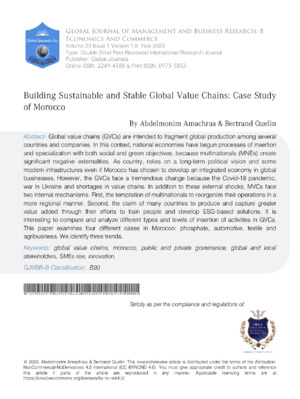
Global value chains (GVCs) are intended to fragment global production among several countries and companies. In this context, national economies have begun processes of insertion and specialization with both social and green objectives, because multinationals (MNEs) create significant negative externalities. As country, relies on a long-term political vision and some modern infrastructures even if Morocco has chosen to develop an integrated economy in global businesses. However, the GVCs face a tremendous change because the Covid-19 pandemic, war in Ukraine and shortages in value chains. In addition to these external shocks, MVCs face two internal mechanisms. First, the temptation of multinationals to reorganize their operations in a more regional manner. Second, the claim of many countries to produce and capture greater value added through their efforts to train people and develop ESG-based solutions. It is interesting to compare and analyze different types and levels of insertion of activities in GVCs. This paper examines four different cases in Morocco: phosphate, automotive, textile and agribusiness. We identify three trends.

Funding

No external funding was declared for this work.

Conflict of Interest

The authors declare no conflict of interest.

Ethical Approval

No ethics committee approval was required for this article type.

Data Availability

Not applicable for this article.

Amachraa Abdelmonim. 2026. \u201cBuilding Sustainable and Stable Global Value Chains\u201d. Global Journal of Management and Business Research - B: Economic & Commerce GJMBR-B Volume 23 (GJMBR Volume 23 Issue B1): .

Download Citation

Smart, stable global value chains for sustainable growth.
Issue Cover
GJMBR Volume 23 Issue B1
Pg. 17- 28
Journal Specifications

Crossref Journal DOI 10.17406/GJMBR

Print ISSN 0975-5853

e-ISSN 2249-4588

Keywords
Classification
GJMBR-B Classification: B20
Version of record

v1.2

Issue date

February 6, 2023

Language

English

Experiance in AR

The methods for personal identification and authentication are no exception.

Read in 3D

The methods for personal identification and authentication are no exception.

Article Matrices
Total Views: 1340
Total Downloads: 17
2026 Trends
Research Identity (RIN)
Related Research

Published Article

Global value chains (GVCs) are intended to fragment global production among several countries and companies. In this context, national economies have begun processes of insertion and specialization with both social and green objectives, because multinationals (MNEs) create significant negative externalities. As country, relies on a long-term political vision and some modern infrastructures even if Morocco has chosen to develop an integrated economy in global businesses. However, the GVCs face a tremendous change because the Covid-19 pandemic, war in Ukraine and shortages in value chains. In addition to these external shocks, MVCs face two internal mechanisms. First, the temptation of multinationals to reorganize their operations in a more regional manner. Second, the claim of many countries to produce and capture greater value added through their efforts to train people and develop ESG-based solutions. It is interesting to compare and analyze different types and levels of insertion of activities in GVCs. This paper examines four different cases in Morocco: phosphate, automotive, textile and agribusiness. We identify three trends.

Our website is actively being updated, and changes may occur frequently. Please clear your browser cache if needed. For feedback or error reporting, please email [email protected]
×

This Page is Under Development

We are currently updating this article page for a better experience.

Request Access

Please fill out the form below to request access to this research paper. Your request will be reviewed by the editorial or author team.
X

Quote and Order Details

Contact Person

Invoice Address

Notes or Comments

This is the heading

Lorem ipsum dolor sit amet, consectetur adipiscing elit. Ut elit tellus, luctus nec ullamcorper mattis, pulvinar dapibus leo.


High-quality academic research articles on global topics and journals.

Building Sustainable and Stable Global Value Chains

Amachraa Abdelmonim
Amachraa Abdelmonim
Bertrand Quelin
Bertrand Quelin

Research Journals