I. INTRODUCTION
The Kingdom of Morocco, a major player in the international phosphate market, has succeeded in becoming a competitive hub in the automotive value chain linking Europe and Africa. A look at the performance of the Moroccan economy's integration in GVCs, including participation and position indices, shows how committed the country is to GVC development.
Author : Professor of Strategic Management at HEC Paris and holds the Bouygues HEC Paris Chair in 'Smart City and the Common Good.
However, Morocco's participation in some GVCs is still characterized today by low value added, poor upgrading, lack of innovation by SMEs (little risk-taking), few jobs for young people (market uncertainties, lack of growth prospects), and a strong dependence of the Moroccan economy on environmental conditions and the European market. As a result, Moroccan industry is trapped in certain low-value-added GVCs that hardly allow it to develop innovation and think about the 4th industrial revolution. We show that for a couple of industries, it is still difficult to take in hand the industrial, digital, social and environmental changes.
The objectives of this research are to:
- Rethink and develop an approach to integrate Morocco into GVCs and serve the socio-economic development of sites where GVCs are in line with the UN Sustainable Development Goals,
- Reflect on relevant and innovative investment programs in the four GVCs analyzed,
- Define the operational model for SMEs, multinationals and public authorities, and identify the new positioning of Morocco itself.
II. GLOBAL VALUE CHAINS - EMERGENCE
BACKGROUND
GVC is the fragmentation of global production between several countries and companies advocating to invest in an ecosystem of suppliers. At the same time, it also promotes the transfer of technologies and good practices. Therefore, it is possible to produce in one place, consume in another, and control production and other segments of the value chain remotely and from another country. In this process, both countries and companies specialize in value-added tasks and functions without worrying about manufacturing an entire finished good. All countries participate in but in different ways depending on their comparative advantages1. All actors must cope with new external and internal factors that can transform the existing GVC organization.
In this globalizing form, fragmentation (Jones and Kierzkowski,2001), offshore supply (Arndt, 1997), external orientation (Campa and Goldberg, 1997), production disintegration (Feenstra, 1998), sharing of world production (Yeats, 2001), vertical specialization
(Hummels et al., 2001), outsourcing (Grossman and Helpman, 2002), global production networks (Hanson and al., 2004, Ceo, et al., 2008), GVC governance (Gereffi et Fernandez-Stark, 2016), CSR and GVC (Bair, 2005), social, political and environmental integration (Levy 2008; Coe, Dicken, and Hess 2008), task exchanges (Grossman and Rossi-Hansberg, 2008), internalization theory and GVC (Strange & Humphrey, Benito et al., 2019), innovation and cooperation (Mudambi, 2008), GVC resilience (Bair, 2005 and 2015; Gereffi and Baldwin, 2020 and 2021), reflect the importance of GVCs in the relationship among countries, multinational firms, and civil society.
However, multinational firms that coordinate the activities and tasks of GVCs, are now under the scrutiny and mainly targeted for their social, governance, and environmental impact. Economists, analysts and civil society note that these business networks create significant negative externalities in both social and environmental (CNUCD, 2013; Bair et Palpacuer, 2015; ILOT, 2016; Kano et al 2020/2021; Ashwin & Kabeer, 2020; Gereffi et al. 2021/2022; Philips et al., 2022).
Firms have therefore started a social turn and a green turn. However, these actions are still often considered social washing and green washing. It leads to an intense criticism of multinational firms (MNEs). Massive contradictions do exist between the ESG practices and policies of firms and their behaviors and strategies that led to the rise of mistrust and injustice feelings among various stakeholders of GVC. Among these factors, we observe negative perception of GVC, high demand for jobs and integration of local SMEs, difficulty of dialogue and communication with stakeholders, low added value captured by developing countries, non-compliance with standards of rehousing of local populations, and environmental nuisances are the biggest challenges.
The concept of GVC sustainability is not limited to improving the social conditions of workers or broadening the participation of stakeholders in the value-sharing process. However, it aims to use resources reasonably, guarantee partners goods and services with good value for money, and ultimately maximize the well-being of all GVC participants. Therefore, we can anticipate that the GVCs of tomorrow will be value chains providing answers to local, social, and environmental problems and transform threats into opportunities.
As a result, ESG has become the main field of the struggle of actors to improve the private governance of GVC (Bair, 2015). For governance, several specialists suggested that actors, including social actors, find ways to take advantage of ESG and force change to adapt the business models of value chains towards models that allow the sustainability of activities and the active participation of all the driving forces of value chains. However, Gereffi and Meyer respectively demonstrate how leading companies have managed to shape the field where this struggle is taking place, mobilizing ESG to control risk and maintain control along the value chain. It appears that ESG strives to absorb and disseminate social protest and political conflicts in this perspective.
Finally, the logic of sustainability, long-term governance, and collaborative innovation induce the systemic transformation of GVCs. A recent study by Kano et al. (2020) identifies new themes to challenge the conceptual frameworks for the analysis of GVC. It introduces an institutional and systemic perspective. It crosses the global performance of global value chains with different factors: value sharing, mapping of the GVC ecosystem, learning, impact of leading companies, social and environmental nuisances, digitalization, and trade agreements. Thus, the multidimensional review offers a broader and sustained perspective of GVC to further integrate them into collective dynamics with other stakeholders.
Another good example is a report entitled "Building Resilient Supply Chain, Revitalizing American Manufacturing, and Fostering Broad Growth," released in June 2021 by President Joe Biden's administration. It identifies five GVCs as vulnerable: semiconductors, batteries, metals, active ingredients, and large-scale public services. In this context, the authors of the McKinsey Global Institute (GSI) report on "Risk, Resilience and Rebalancing in GVCs" also suggest a dozen of measures like relocation of production, diversification of suppliers, strategic stockpiling, risk management capabilities, redundancy of transportation networks, and reduction of product complexity.
Moreover, several scholars have highlighted the importance of platforms and advanced technologies in better integrating suppliers and monitoring their inventories and capacities. Nowadays, automation is used to detect changes instantly in retail trends, allowing for quick adjustments in needed projections. Similarly, artificial intelligence (AI) and automation can help improve efficiency and productivity. The increase in e-commerce delivery solutions and the importance of short, decentralized, and customer-focused supply chains (Panwar et al., 2022) is considerable. Furthermore, other authors have pointed out that we are moving into a phase of "techno-nationalism." Postpandemic governments are likely to play a much more significant role in orchestrating GVCs, especially for more sophisticated products, where they will actively support local knowledge development and production (Gereffi, 2021).
This paper considers this new context of internationalization shaping of the GVCs are organized in networks of countries (Asia, Morocco, Egypt, Turkey, Mexico, Eastern Central Europe) and SMEs, and forging new forms of relationships and innovations. ESG best practices, mergers, and strategic alliances between companies to form more integrated groups, new localized and innovative production sites and the integration of local communities are at the heart of this transformation of GVCs.
In conclusion, about sustainability, the concept of GVC becomes even more useful, as it involves internal and external stakeholders in the process of creating added value and transforming current business models towards sustainable and inclusive models.
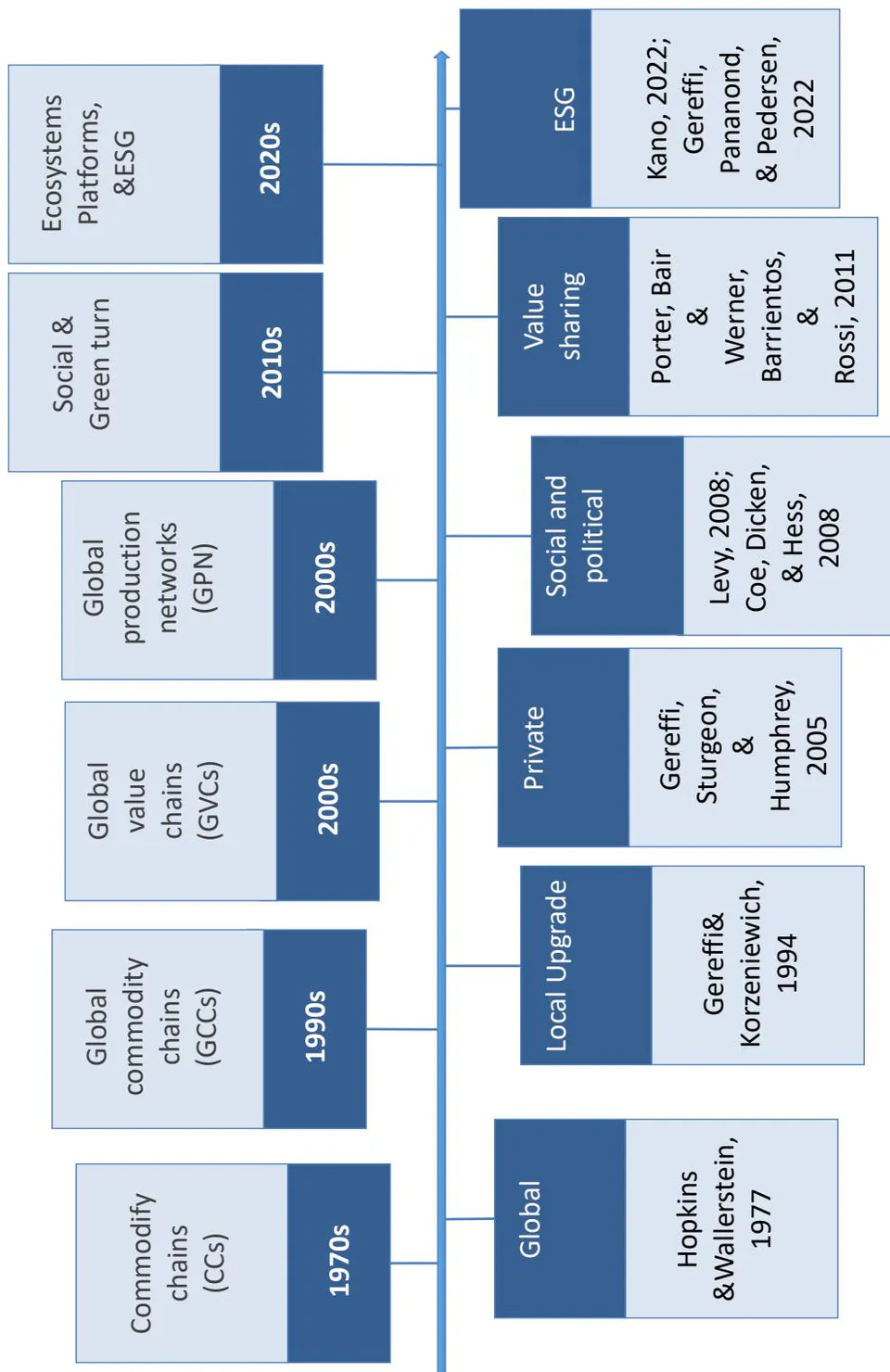
a) Contributions and Limitations of the Literature on GVCs: Tensions between Profitable Integration and Costly Domination
Starting from a presentation of the complex relationship between multinational firms and national economy that highlights the crucial role of the multinational firms in the governance of GVC through the participation of countries and companies in the manufacture and trade of intermediate parts and components essential to final production (Jones and Kierskowski, 2001; Gereffi and Fernandez-Stark, 2016), we review the value-added trade as well as the different models of governance and integration of GVC. Thus, the GVC concepts are associated with the promotion of industrial upgrading and governance of multinational firms advocating the transfer of technology and know-how to emerging countries and investment in Research and Development in industrial countries (Gereffi et al, 2005; Bair, 2008 and 2015; Ryan P. et al. 2022, Kano et al 2021).
The notion of the GVC corporate network makes it possible to go beyond sectors of activity and national economies to establish new forms of participation and relationship (Hudson, 2004; Coe & Hess., 2008; Anner, 2015; Hammer & Plugor, 2019; Coe & Yeung, 2019), social and environmental criticism of GVC leading MNEs to support more entrenched collective dynamics and more strategic rapprochements (acquisitions, mergers or even a more regional organization) and define a more participatory and sustained political framework around shared interests and values. The multinational firm shares in value, but above all in its raison d'etre, commercial conception, and technological standards. The goal is to secure its upstream integration and to face shortages along supply chains (mUNCTAD, 2013; Bair and Palpacuer, 2015; ILOT, 2016; Kano et al 2020/2021; Ashwin & Kabeer, 2020; Gereffi et al. 2021/2022; Philips et al., 2022, Amachraa & Quelin, 2022).
The GVC offers an appropriate policy framework to build a sustainable global system to guarantee its partner's products and services at the best value for money to ensure the maximum well-being of stakeholders with the fairest use of resources. The GVC is indeed a global perspective to activate all the contributions and initiatives of national economies by promoting investment, learning, and synergies. Thus, countries and companies seek a role to play in the global economy instead of destructive competition. This context also encourages MNEs to outsource innovation to SME networks to limit country and investment risks but also to upscale and improve business skills (Mudambi et al 2008; Strange & Magnan, 2018, Amachraa & Quelin, 2022).
In addition, the economic performance of the Global Value Chain will depend on its various activities and functions. These contribute to this performance, which shifts the issue of the competitiveness of companies to the efficiency of value chains. These develop a global capacity to fragment production and coordinate it in a country's offer. As a result, the performance of GVC and the dynamics of development depend on the ability of foreign and local actors (suppliers and subcontractors) to offer innovative services to multinational firms and to set up productions that differentiate them from competitors, either through the specificity of the intermediate good itself, or through the specificity of quality and/or through innovative design processes, production, marketing, and development.
In global economics, the popularity of the GVC concept is marked by the fragmentation of global production among several countries and companies. Thus, more and more countries are getting involved in GVC integration policies. In these policies, the trend towards developing more integrated global groups and deep local integration is confirmed through a dynamic of mergers of companies and positioning of SMEs as service providers and sources of innovation proposals to GVC. This trend has fostered the global networking of multinationals, suppliers, and SMEs. In this perspective, clusters or technological innovation centers have become privileged tools of MNEs to promote adaptation, R&D, and innovation. The theoretical debate allows us to begin the analysis of the integration of the Moroccan economy into the Global Value Chains, where we are strongly interested in the competitiveness of GVC in Morocco, their adaptation, and the implementation of innovation to create integrative clusters.
In this complex and multidimensional integration process, there is no ready-made recipe for success. Still, good practices observed and reflections that should generate debate, it should not be imagined that Morocco's participation in Global Value Chains will be what has been achieved in other Asian countries. Cultures are not the same, nor are ecosystems, resources, technologies, price structures, price structures, markets, etc. On the other hand, Morocco must have its own place by its environment and its African ambition.
In a country like Morocco, favoring employment and projects with a human dimension appears to be the best way, which does not exclude the use of new technologies and participation in sophisticated value chains. The gap between international and local actors should also be reduced. Local actors are poorly mobilized and have little capacity and impact along the value chain. GVC subcontractors have little ambition and fail to offer services or innovations to different industries. Sophisticated value chains are therefore not integrated, and markets are very short-term.
b) Our Methodological Approach
Doing this work is based on a triple approach: i) a study of the environment that has favored the emergence of new Global Value Chains in Morocco, ii) an analysis of the opportunities and threats that weigh on Morocco's model of participation in GVCs, and iii) prospects for the recovery of GVCs through innovation and entrepreneurship.
A triangular approach, allowing us to make a reading of several distinct but congruent facets, using macro-economic sources (OECD, WTO, Ministries, Trade, ExChange Office, Central bank...), industry analysis (ecosystems, sectoral federations...), and interviews with actors (MNEs, SMEs, and public actors...).
Instead of proceeding according to a purely sectoral value chain approach, the analysis of Morocco's participation in GVCs is systemic. It takes place at several levels that must be distinguished: at the national level, at the level of the multinational firm, at the level of the GVC, and the level of the SMEs (survey). Thus, in the first part, we will briefly describe how GVCs and their specificities have contributed to trade, economic growth, and development.
In a second step, we analyze some significant trends in Global Value Chains such as the fragmentation of global production, interdependencies, and the governance of multinational firms. The second part concludes with a subsection exploring the OECD's Trade-in Value Added (TiVA) database and discusses the integration policies of national economies. A third part examines the strengths of the Moroccan integration model by characterizing its participation in the GVCs and by evoking the signs of a transition of the automotive and phosphate sectors to increasingly specialized and complex activities and tasks. In this part, we have chosen to study four GVC, not only because of their importance but also because of their very different respective positions. The analytical framework for each GVC places the four industries along the value chain, characterizing them in terms of positioning, degree of specialization and level of autonomy. In this context, an analysis is carried out for each GVC assessing strengths, weaknesses, opportunities, and risks and threats.
c) What can we Learn from Morocco?
In this paper, we have chosen to study four GVCs, not only because of their importance but also because of their very different respective positions:
- For Agri-Food, the GVC is essentially market-driven. Morocco maintains a production capacity and cost advantage, but it must be careful about climate change and better manage its water resources in distress situations. The Agri-food value chain is backed by strong local agriculture: Morocco has.
succeeded in creating national champions such as Cosumar, Lesieur, Copag Jaouda, etc. Their fast adaptation to proximity to customers and better management of scarce resources are required.
The automotive GVC is very well structured and is orchestrated by foreign MNEs. Thestellantis group has formed a powerful and more integrated ecosystem. However, the local SMEs often acts only in tier 3 and 4 levels as subcontractors. Innovation and value sharing become high expectations of Morocco partners.
The Morocco-born OCP group controls the GVC of phosphates. Morocco is positioning itself on R&D and fertilizers to expand its strategic positioning. As many international mining groups, OCP now faces two main challenges: A stronger regulatory environment that forces producers to review their business models and significant legal risks related to the effects of certain chemicals on human health.
The GVC of textile is dominated by Inditex, the large Fast Fashion Spanish group. Morocco must train a creative workforce and manufacture locally the fabric requiring a lot of energy and R&D but specialized in labor-intensive activities. Therefore, it is required for the case of Morocco to better capitalize on national success stories such as Diamantine and Marwa by proposing an authentic and traditional offer.
In sum, innovation and cooperation are the main requirements to develop and maintain a competitive advantage for local producers (Mudambi, 2008). Participation in GVC can help countries and companies in their process of improving product quality and developing value-added tasks (Giovanni, 2021). However, GVCs are multiple, and their operating models are diverse. It is therefore important that the country or the local company properly assess their up-scaling capabilities and choose a GVC with the same-shared values, and interests. In this vein, the solution lies in the principle of shared value, which involves creating economic value in a way that also spreads value for society by addressing its needs and challenges. Businesses must reconnect company success with social progress by creating new ways to achieve economic success (Porter and Kramer, 2011). Not to mention other factors come into play such as GVC governance (Gereffi, 2005) or industrial and trade policy (Pietrobelli and Staritz, 2018).
To our knowledge, on the one hand, the global performance of GVC become more and more linked to the positive and sustainable impact that must be generated by production and assembly operations in the territories of the countries where the firms and their subsidiaries operate. On the other hand, they must imperatively act on social acceptability and integrate
ESG as levers for GVC performance. These are essential components of the firms' strategy.
Moreover, our study shows how it is necessary to distinguish between global and traditional GVCs. The value chains of global businesses are today driven by international locomotives with which local producers are Tier #1 and #2 equipment manufacturers. However, leading companies are often multinationals and rarely set up Joint Ventures (JV) with Moroccan companies. In most case, the local SMEs often act only in Tier #3 as subcontractors, or even Tier #4 deeply dependent on the MNEs decision. This is not new but raises many concerns about the ability to capture the value and operate sustainable steps of value chains. The important challenge for Morocco today is to go backward gradually. The scheme would be subcontracting, then signing JV, and after becoming national locomotives, at least regional. This observation applies to Morocco's so-called "global professions" sectors such as automotive, aeronautics, and electronics.
For the GVC of the Agri-food industry, the value chain is surely backed by solid local agriculture. Morocco has national leaders such as Cosumar, Lesieur, and Copag Jaouda, etc. The same configuration applies to phosphate and fertilizer industries, and the fishing industry. However, actors take advantage of access to specific assets, but very few take the leadership in their own global GVC. The OCP group in the phosphate industry appears an exception. In addition, our diagnosis of the GVC of textiles and clothing highlights two trends that must be considered. First, the positioning of Turkey is based on a very competitive pricing policy fighting with local producers. Second, the upstream integration (fabric) is very expensive, thus requiring more capital, energy, and R&D. It is, therefore, appropriate for the case of Morocco to capitalize on national success stories such as Diamantine and Marwa by proposing an authentic and traditional offer, but it is far to obtain a solid control of a large part of textile GVC.
Considering the four case studies we analyze in this paper, it appears that GVCs governed by private national (OCP governance) or MNEs (case ofstellantis and Renault groups) adopt two complementary initiatives to implement their shared value strategies:
- An industrial initiative (purchasing processes dedicated to local companies),
- A societal initiative (sustainability and entrepreneurship programs).
Thanks to the strict control of an essential mining resource, the OCP Group has successfully completed an industrial transformation enabling it to make a transition toward high value-added products (fertilizers and derivatives). Thus, R&D has become an essential area of activity and competence for OCP. In automotive, the merger of PSA and Fiat Chrysler to createstellantis has led to a more integrated and competitive industrial group. The key infrastructures like Tangier Med Port and the HST are the backbone of this automotive GVC. MNEs take advantage of these huge national investment efforts, and the industrial ecosystems expect to take advantage for enlarging their scope of activities and control of value added.
Moreover, despite the support of the government, the less sophisticated GVCs (Agri-Food and Textile) remain dominated by buyers or global brands. Moroccan companies appear mostly like local producers, and they must find the industrial critical mass and improve the quality of products, in hyper-competitive contexts.
| GVC | Governance | Place within the GVC | Challenges |
| Phosphates and Derivatives | Public governanceNational mining resourceGVC orchestrated by OCP GroupPresent throughout the entire value chainIt is a Moroccan locomotive, with a corporate strategist around Business Unit network | MiningFertilizersResearch and development (UM6P University)Declared African ambition | >Energy and Green transitions>A firmer regulatory environment requiring producers to renew their business models>Significant legal risks arising from the effects of certain chemicals on human health |
| Automotive | European decision centerGVC structured by MNEsGVC particularly accelerated by 2 manufacturers:Stellantis and RenaultForeign locomotivesMoroccan SMEs are very little integrated | Morocco has developed a modern infrastructure:The HST and the Tangier Med port are the backbone of this GVCElectric and hydrogen car as further step | >Constraining environmental standards requiring heavy investments (CO2 standard).>Upstream integration difficulties>Value sharing |
| Agri-Food | Market-driven governanceGVC governed by European market (Spanish in particular)Multiple GVCs (sardines, tomatoes, citrus, red fruits, etc.) supported by the State and at the crossroads of two national sectoral plans (PAI and PMV) | Agricultural production capacityCost leadershipProduct qualityGreen (2nd phase of the Green Morocco Plan) | >Food and water security>Health risks>R&D led by the private sector>Global trade tensions |
| Textile and Clothing | Buyer-driven value chainsSpanish and Turkish brands dominate Moroccan textile industryThe Spanish Inditex Group controls Moroccan subcontractors | Production costIndustrial flexibility | >Ecological and recycling textile>Market massification>High elasticity of demand>Sensitivity to prices |
In the context of Morocco, three actions can be implemented to accelerate the integration of Moroccan companies into Global Value Chains, including:
- The restructuring of Moroccan SMEs through the creation of a national program or Joint-Venture fund to set up a learning curve allowing a gradual integration of Moroccan players into the international dynamics of GVCs.
- The trend to mass-markets to obtain the necessary volume and critical mass that justify the canvassing and location of large locomotives.
- Supporting industrial dynamics through specific training and R&D led by the private sector. In this case, the Moroccan Automotive Center ofstellantis and the Industrial Competence Centers of OCP (ICC) open the way to the emergence of new innovative and localized production sites.
d) Main Learnings from the Morocco's Economic Consolidation in the GVCs
i. Private-private Initiatives and Territories
First, it is necessary to target both the sector level and at the level of suppliers (foreigners and Moroccan) before developing the roadmap dedicated to quality upgrading. Thus, the integration of Morocco into the GVCs cannot address the needs of all the leading companies. At the same time, the goal is not to replace existing GVCs. It is, therefore, necessary to clarify the targets of the integration policy on two main axes:
- A sector axis: The choice of target sectors must obey both the potential of the sectors, the specificity of the territories concerned, and the needs of GVC suppliers.
- A supplier axis: Beyond the traditional population of suppliers with a high level of capital and education (the easiest to access population), it is a question of
prioritizing the support of projects from the most structured parties (Professional Confederations, Business Networks, Chambers of Commerce, and Industry, etc.).
ii. Clustering the SMEs
One of the major determinants of GVC performance remains access to markets, particularly local markets. The regions where a growing number of GVCs are in Morocco (Tangier and Kenitra, in particular) are territories where the activities of these GVCs represent an important weight in the local economy and national GDP. Although efforts are currently being made in this direction, local perception remains the predominance of foreign or sometimes domestic suppliers. A committed perspective in this direction should be undertaken with the following objectives:
- The acceleration of "local content", either directly through an entrepreneurial and support process, or through a subcontracting strategy.
- Support for the emergence of local champions in certain priority sectors.
- Supporting local suppliers in their upgrade and consolidation process.
One direction might be to encourage the development of shared workshops, based on SMEs participation and mutualizing tools and equipment dedicated to innovation and new technologies. The objectives would be to create a favorable environment to innovation, like Makerspaces, with a cluster effect along the value chain that could crystallize the integration of local companies, anchoring and interacting with the other GVC structuring projects, through a global service offer:
- Entrepreneurial, digital, and financing support.
- Access to high-tech machines (numerically controlled, 3D printing, etc.) and low-tech also to support the professions like the industrial maintenance, parts and components, service to industry, renewable energies, circular economy, recycling, metal creation, and wood, etc.
- Manufacture of prototypes and innovations in the industrial exchanges within GVCs (parts and components, transfer of technologies).
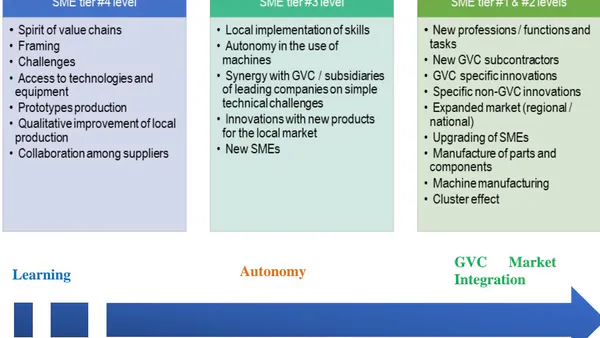
The role of such ecosystems, cluster, or makerspaces in each GVC would help for a backward and upgrading move of SMEs in an emerging country. The vision to be designed for a global deployment should above all consider the specificity explicit to each of the GVCs. It must also be part of the system of governance structures and structuring projects undertaken by multinational firms or their subsidiaries. A strategy for duplicating GVC "Integrator Makerspace" is based on different factors: Identification of strategic partners, skills transfer, specialized equipment, solution testing, feedback from the field and local learning, etc.
| SME tier#4 level | SME tier#3 level | SME tier#1 & #2 levels |
| · Spirit of value chains · Framing · Challenges · Access to technologies and equipment · Prototypes production · Qualitative improvement of local production · Collaboration among suppliers | · Local implementation of skills · Autonomy in the use of machines · Synergy with GVC/subsidiaries of leading companies on simple technical challenges · Innovations with new products for the local market · New SMEs | · New professions/functions and tasks · New GVC subcontractors · GVC specific innovations · Specific non-GVC innovations · Expanded market (regional/national) · Upgrading of SMEs · Manufacture of parts and components · Machine manufacturing · Cluster effect |
| Learning | Autonomy | GVC Market Integration |
iii. Favoring the MNEs Involvement in Sustainability Policies
In addition, to strengthen the sensitivity of the makerspace to sustainable development, it is possible to create sustainability challenges among leading companies and suppliers, either to submit technical problems encountered at the GVC manufacturing or assembly site, or problems related to sustainability such as product recycling, fighting against pollution, and lowering energy consumption. Examples of such challenges from the simplest to the more complex are related to recycling of obsolete production equipment, the second life of objects for sustainability, repairing parts and components by 3D printing, objects with very low energy consumption, or technical improvement to a machine currently in use.
Overall, the strategy for integration into GVCs must consider the ecosystem approach. Several stakeholders are currently operating at the level of GVC installed in Morocco. They have overall sectoral and functional orientations, and primarily address activities such as services, manufacturing, assembly, export, and even research and development. It is not a question for Morocco to replace these subsidiaries and suppliers.
In a context of uncertainty, multinational firms express more needs in terms of subsidiarity and coordination to have a close follow-up at territorial and local levels. Thus, Morocco and firms should consider this need for interrelationships:
- At the level of the choice of sector offers/tasks to be developed within the GVC.
- In terms of providing the necessary expertise, technology, and know-how.
- At the level of information to be offered to the target of local and foreign suppliers.
As suggested, it is time to implement innovation to create a national economy capable of overcoming GVC challenges and transitioning toward quality upgrading and sustainable development.
iv. Public-Private Collaborations
Moroccan State was at the origin of the major strategic choices of integration into the global economy. It is through superior comparative advantages and strong SMEs that the Moroccan economy should face the industrial, social, and environmental challenges of tomorrow. In this paper, we can bring some new elements likely to add to the reflection of the articulation between the GVCs and the national economy.
We observe how Morocco's participation has progressively evolved in advancing GVCs. The automotive ecosystem in Morocco is a good example. We also identified how the OCP Group has successfully innovated in implementing an agile ecosystem around phosphates and fertilizers. In cooperation with public entities, OCP also created the Mohamed VI Polytechnic University to become the new growth engine of the phosphate and derivatives industry. By extension, this modern university welcomes laboratories that can train future employees of some other GVCs.
Based on the analysis of previous experiences and practices of four different industries, we present and discuss what occurred by revealing the "why" and "how". We map all global level actors involved in the four GVCs that appeared at the key moments in the process of GVCs' development, but we also elaborate typologies of integration to show the diversity of positive interactions between the government, companies, and society around these processes.
Our approach allows us to analyze the integration of Morocco in the GVCs out of the four experiences (Agri-food, phosphates, automotive, and textiles) and to identify the favorable and unfavorable factors of local and global dynamics (and their social, economic, and environmental consequences) (Amachraa and Quelin, 2022). Thanks to our analysis, we show how mobilizing international and national actors around a long-term vision was favorable in Morocco's case. Strategic-leading government, responsiveness of companies, diversity of clients and suppliers, national solidarity, and collaboration of Moroccan industrialists made Morocco a resilient and innovative country during the pandemic lockdown period.
v. An Ambitious National Program
The four industries study helps to identify that creative human capital, participatory governance, technology, water, and energy are the key components of a more sustainable and inclusive GVC integration strategy. The success of this strategy depends on the mobilization of all driving forces of the territories where the GVCs are located and the creation of an agile ecosystem of suppliers able to offer innovative proposals and services.
The challenge for Moroccan integration policy is therefore to be as close as possible to local actors, their needs, and their expectations in getting the most from the GVCs, to act and work mutually on the challenges of governance, ESG, value sharing and innovation.
More recently, the impact of the Covid-19 pandemic and the interdependencies within the GVCs have made it more than necessary to change the rules of the game involving government, business associations, communities, businesses, and citizen initiatives. The Sustainable Development Goals (SDG) and the New Development Model (NDM) of Morocco set up in 2021 have put local actors at the heart of their recommendations.
The systemic GVC approach can also be materialized through the building of a new industrial collaboration model among the different stakeholders whose purpose is to improve the value chain, develop new integration models, offer sustainable growth, and finally change the rules of the game. The objectives vary from encouraging the emergence of local players to attracting international investment with new value-added tasks and functions, to stimulate the development of local clusters around industrial ecosystems and finally to encourage the development of other activities attracted by the industrial critical mass of large national firms or MNEs.
Overall, the Kingdom must have a concern for the sustainability of the GVC and strategic independence and it has the means to do so. It would also be necessary to avoid overly dominant positions on GVC that would hinder national private initiatives. GVC must consist mainly of a network of small and medium-sized enterprises capable of offering innovative services and supplying the domestic and African markets. In a few years, explore export market niches towards the USA and Asia.
III. CONCLUSION
Morocco will have to be very vigilant about the quality of the GVC projects that will be presented to it and be wary of GVC that are only attracted by the tax system or who can leave before the change of the tax system. At the same time, in a context of increased competition, when investment commitments are made, they will have to be enforced, which is not always the case.
As for investors and multinationals, Morocco will need trusted foreign partners to transfer technology and markets to the country, but some priority should be given to domestic entrepreneurial investors to limit the risks of large international firms that do not hesitate to cut ties if they run into trouble.
The emergence of Morocco in the GVCs must create sustainable value while respecting the environment. The skills and resources of multinational firms and large groups must be put at the service of local industry. The new framework for Morocco's participation in GVCs should guarantee customers and suppliers the best value for money for products and services, ensure maximum collective welfare (stakeholders and local communities), and guarantee the most efficient use of resources.
The challenge of participating in sophisticated GVCs offers Morocco the opportunity to trigger all the potential initiatives and to co-build innovative ecosystems over time. Morocco needs to expand its current participation framework to include all stakeholders. The OCP experience offers the first elements of broad and sustained governance. It also seems relevant to us to question the projection of these experiences to Africa by OCP Group on the dimensions of governance and societal contribution (well-being of stakeholders and local communities).
Ultimately, there is no shortage of solutions to such global challenges. But a country's economic emergence in the GVC, i.e., the process that leads it to tasks and functions at both ends of the value chain, is not just a matter of a favorable environment or infrastructure alone. Other prerequisites are essential, precisely the quality of human capital, R&D, innovation, support for SMEs, acceleration of energy and ecological transitions, the integration of strategic industries at national and regional level and investment in rare metals and batteries.
Our study opens up doors for future research in two themes. The first one is to look at how to strengthen the positive and sustainable impact of global value chains on local territories and actors, essential elements of the stability of GVCs. The second one is how synergies and strategic linkages among different GVCs can help all stakeholders evolve their business model towards more sustainability and shared value. The strategic rapprochement between the automotive industry and the mining industry to integrate rare metals and batteries or the growing role of fertilizer players in the structuring of the cereal value chain reinforces our orientation.
Footnotes
https://openknowledge.worldbank.org/handle/10986/3437 (p.1) ↩